Aug 04, 2026
Hummingbirds in Texas: The Complete Guide to All 19 Species
Texas sits at the crossroads of the Central and Mississippi Flyways, which is why it's the single most diverse state in the country for hummingbirds — nineteen species accepted on the official Texas Bird Records Committee state list, the most of any U.S. state, with Arizona a close second at eighteen. But nineteen species doesn't sort itself into a simple "common vs. rare" split. Texas has one true year-round resident, six species with a real breeding season here, five that pass through or winter without nesting, and seven genuine rarities — including one migratory breeder, Ruby-throated Hummingbird, whose real weekly presence in Texas is far steadier across the calendar than its "just a migrant" reputation suggests.
This guide sorts out which is which: the one species you can find in any month, the six that have a real nesting season here, the five migrants and winter visitors worth knowing by name, and the seven genuine rarities. For feeder setup, native plants, and pest-safe care, see our how-to-attract guide. For exact arrival and departure windows by region, see the Texas hummingbird calendar.
Free download
All 19 Texas Hummingbirds, One Page
Every species on this page, pictured and grouped by tier — Year-Round Resident, Breeding, Migrants & Winter Visitors, and the seven rarities — on one printable page.
Download all 19 Texas hummingbirds (PDF)One page · PDF · free to print and share

Species grouped by confirmed breeding evidence and committee record history — statewide eBird data (2016–2025) checked week by week against real seasonal clusters and cross-checked against Texas breeding-bird literature and TBRC committee records, not raw sighting counts alone.
Year-Round Resident: Texas's One True Homebody
Only one Texas hummingbird holds a genuine year-round population, with real signal in every month of the year, including December and January — not just a long spring-through-fall season, but a true, self-sustaining resident presence.
Buff-bellied Hummingbird Resident
Texas's best-known year-round hummingbird, and the reason South Texas never really has an off-season. In the Rio Grande Valley, Buff-bellied are the one hummingbird you can count on in January, and by September they're at nearly every feeder — down there, this isn't a specialty bird, it's the default hummingbird.
Quick ID: Sexes look similar. Audubon's field guide describes it as "a stocky hummer, mostly green, with chestnut tail, red bill with black tip, pale buff belly" — a genuinely distinctive combination among U.S. hummingbirds, since no other regularly occurring species pairs a red-and-black bill with a rusty tail.
They thin out quickly north of Corpus Christi and essentially disappear inland. Coastal numbers can also drop in fall and winter as some post-breeding birds wander northeast toward Louisiana, per Cornell Lab — the Rio Grande Valley population is the truly resident one.

Breeding: Six Species With a Real Nesting Season Here
Six more species have a confirmed nesting season in Texas — genuine breeders, not just passing migrants — but without Buff-bellied's true year-round population. Three are common, widespread breeders across Central, South, and West Texas, genuine backyard hummingbirds. The other three are true Big Bend specialties, concentrated almost entirely in the Chisos, Davis, and Guadalupe Mountains, where Brewster County alone hosts more regularly-occurring hummingbird species than the entire year-round list of most states.
Ruby-throated Hummingbird Breeds Here
The single largest raw signal in the entire Texas dataset, with real, substantial presence recorded in nearly every week of the year statewide — genuinely steadier than the "just a spring and fall migrant" reputation this species often gets. But the actual Texas breeding population is a true migrant: the Texas Breeding Bird Atlas and the TOS Handbook of Texas Birds both document birds arriving mid-March to mid-May, breeding into early September, then departing for wintering grounds from late July through mid-November. The strong December–January signal in the data almost certainly reflects Texas's outsized share of U.S. eBird activity — heavy migration and staging volume — rather than a stable, self-sustaining winter population the way Buff-bellied Hummingbird has. Both things are genuinely true at once: a real seasonal breeder, and Texas's most consistently detected hummingbird across the calendar.
Quick ID: Adult males are unmistakable in good light: an emerald-green back and a brilliant, iridescent ruby-red throat (or gorget) that can flash black when the angle is wrong — a trait shared with several other species, so light matters as much as color when you're trying to identify one. Females and immatures lack the red throat entirely, showing a plain whitish throat, golden-green upperparts, and a rounded tail with white outer tips, per Cornell Lab's identification guide.
Real numbers do shift through the year — enormous numbers pour through in fall, and around Corpus Christi and the Rio Grande Valley, September sightings run close to double what they are in spring. Even outside that migration surge, real signal shows up in every region we track, all twelve months — some of that is late migrants and winter stragglers, but it adds up to a hummingbird you can realistically expect to see in Texas at any time of year, even though the true breeding population itself moves on for winter.
How to tell it apart: Ruby-throated is the only hummingbird confirmed breeding across most of the eastern half of the country, so east of Texas, it's usually a safe default ID. In Texas itself that shortcut breaks down — Black-chinned overlaps heavily across Central and West Texas, and females of the two species are essentially impossible to separate in the field, which is exactly why so many summer sightings simply get logged as "a hummingbird."

Black-chinned Hummingbird Breeds Here
The hummingbird that raises families across Central, South, and West Texas — and, like Ruby-throated, shows real presence well beyond the breeding season when the full state's data is considered. Cornell Lab describes it as "the same size as Ruby-throated" — a small, slender bird with a straight bill — which is exactly why the two are so often confused.
Quick ID: Adult males show a black face and throat with only a thin band of iridescent purple at the lower edge of the gorget, visible mainly at the right angle, plus a small white spot behind the eye that's a useful field mark even at a distance. Females are dull metallic green above with whitish underparts and are not reliably separable from female Ruby-throated outside of careful photography.
Black-chinned arrive in mid-March across Central and West Texas and hold steady right through summer — around Austin, they're the hummingbird you'll actually see in July, when Ruby-throated numbers have bottomed out. Most southbound migrants depart mid-July through mid-October, per the Texas Breeding Bird Atlas, though a few linger into December. In the Rio Grande Valley, Black-chinned are reported nearly every week of the year — real, substantial presence, even though Buff-bellied remains the state's only true year-round resident. If you have hummingbirds nesting in your yard in Central or West Texas, these are almost certainly them.

Broad-tailed Hummingbird Breeds Here
A genuine Big Bend breeder, nesting mainly in the Guadalupe and Davis Mountains. Spring migrants arrive from late March, breeding runs into mid-June, and southbound migrants pass through from late July into November — but the Texas Breeding Bird Atlas is clear that winter presence is limited to occasional individual feeder birds, not a stable resident population.
Quick ID: Adult males produce a distinctive high-pitched, insect-like trill with their wings in flight — often the first sign one's nearby, before it's even visible — and show an iridescent rose-magenta throat. Females lack the trill and the throat color, showing a plain whitish throat with fine dark spotting and warm cinnamon-buff flanks.

Lucifer Hummingbird Breeds Here
The signature Big Bend specialty and a bird most American birders travel specifically to see. Real data shows two genuine seasonal clusters — a spring build and a summer peak, both real breeding-season patterns — with no meaningful winter presence. Lucifer is a true seasonal breeder here, present and findable from spring through fall, gone in winter.
Quick ID: Adult males show a dramatic, flared magenta-purple gorget and a distinctly curved bill, with a deeply forked tail characteristic of the "sheartail" hummingbird group. Females lack the gorget but share the same curved bill.

Rivoli's Hummingbird Breeds Here
A real March-through-October breeding season in the Big Bend region, without the winter presence that would make it a true year-round resident. One of the largest hummingbirds in the country, genuinely common within its limited range despite its size.
Quick ID: Adult males are dark overall with a glittering green throat and a violet crown visible in good light; females are green above and grayish below, notably larger than most other Texas species.

Blue-throated Mountain-gem Breeds Here
A sustained March-through-September breeding cluster in the Big Bend region, with real weekly signal throughout that season. One of the largest hummingbirds found in the United States.
Quick ID: Adult males show a striking, solid blue throat patch bordered by white facial stripes; females lack the blue throat but share the same bold white eye-stripe and large size.


A Little Throne for the Hummingbirds That Call Texas Home
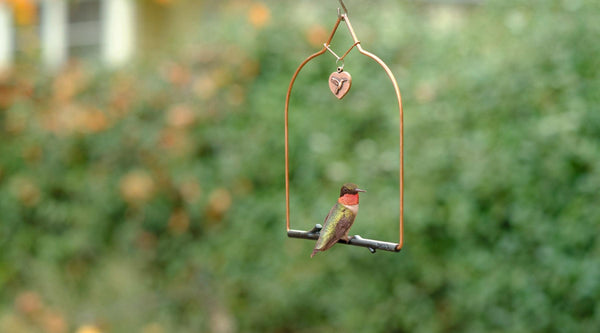
Between Buff-bellied's year-round hold on the Rio Grande Valley and six more species raising broods from the Hill Country to the Chisos Mountains, your resident and breeding hummingbirds need a place to perch and defend — especially once fall migrants start crowding the same feeder. The Charm Redwood Swing gives them exactly that.
Shop Charm Redwood Swing →Migrants and Winter Visitors
Five species pass through or winter in Texas without ever nesting here in any meaningful numbers — genuine, repeatable seasonal patterns, just not a breeding presence.
Rufous Hummingbird Migrant/Winter
A fall spectacle in West Texas and a genuine winter presence almost everywhere else — one of the strongest signals in the whole Texas dataset, despite never nesting here. Cornell Lab calls it "one of the feistiest hummingbirds in North America" — both sexes are aggressive toward other hummingbirds year-round, not just during breeding season, and they'll challenge species double their own weight.
Quick ID: Adult males are unmistakably coppery-orange; females and immatures are green-backed with rufous-washed flanks and rufous patches in the tail, which is the field mark to check since a green-backed Rufous male can otherwise be mistaken for Allen's.
Rufous are all but absent from Texas in June, then surge through Big Bend in August — going from essentially none to one of the commonest birds at a feeder in a matter of weeks, as much of the western breeding population funnels south along the mountains. Elsewhere in the state they settle in for the winter in smaller numbers and are among the most likely hummingbirds at a Texas feeder in January, outside the Rio Grande Valley.

Costa's Hummingbird Migrant/Winter
A real winter visitor to West Texas, with a genuine November-through-December cluster plus scattered fall records — a meaningfully different pattern than in Arizona, where Costa's is a year-round resident. Texas sits at the eastern edge of Costa's range, and here it shows up as a winter specialty rather than a breeder.
Quick ID: Adult males have a dramatic, flared iridescent purple crown and throat; females are green above with a clean whitish throat.

Calliope Hummingbird Migrant/Winter
A genuine migrant with a real, concentrated fall-and-winter pattern in West Texas — the smallest breeding bird in the United States, though it doesn't breed here, only passes through and winters.
Quick ID: Adult males have a truly unique field mark: a gorget of magenta streaks radiating out from the throat like a starburst, a pattern no other North American hummingbird shows. Females and immatures are far plainer — green above, peachy-washed underparts, with fine dark stippling on the throat rather than solid color.

Allen's Hummingbird Migrant/Winter
Allen's shows a genuine pattern in Texas concentrated in January/February and again August through December — a real winter and late-fall visitor, not nesting here.
Quick ID: Adult male Allen's can be told from Rufous by a solid green back with no rufous feathering at all; if a bird shows any solid-rufous back feathers, it's a Rufous, not an Allen's. Beyond that one field mark, females and immatures of the two species are, per Audubon's own field guide, "almost impossible to separate... without close examination" — reliable separation typically requires a bird in hand and a licensed bander.

Anna's Hummingbird Migrant/Winter
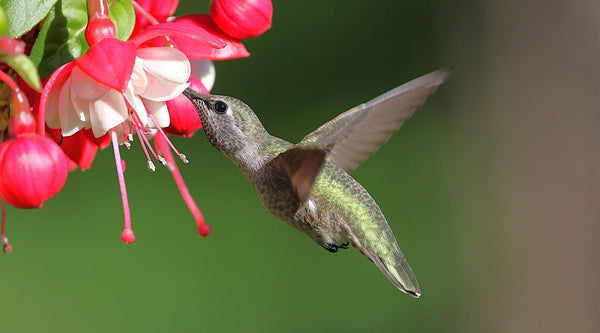
A genuine fall migrant and winter resident concentrated in the Trans-Pecos — arriving around mid-September and mostly gone by the end of January, with birds occasionally reaching east to the upper Texas coast, where they're rare. Interestingly, Anna's has nested in Texas too, just barely: three confirmed nest records exist, all in the Trans-Pecos (the first in Jeff Davis County in 1976, two more since near El Paso), including a documented first Big Bend nesting. That's a handful of local exceptions, though, not a breeding population — the real pattern here is a genuine, concentrated fall-and-winter visitor to West Texas, not a year-round or statewide presence.
Quick ID: Adult males show an iridescent rose-red crown and throat that can look nearly black without direct light — the only U.S. hummingbird with color on the crown itself. Females and immatures are green above with a paler throat, sometimes showing a few red flecks.


An Extra Feeder for Your Winter Visitors
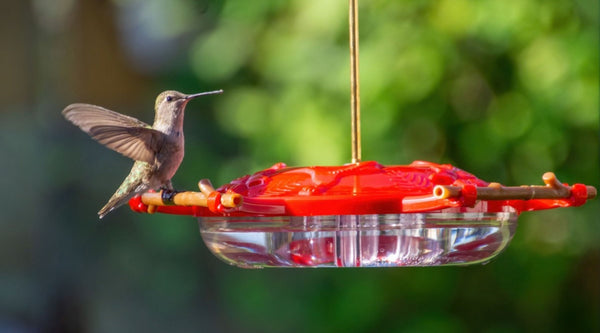
Rufous, Costa's, Calliope, Allen's, and Anna's Hummingbirds all spend real time in Texas without ever nesting here — mostly West Texas and the coast, often at the same feeder as your resident and breeding birds. A second AspenPerch Feeder gives a returning winter visitor its own station instead of a fight over the one already claimed.
Shop AspenPerch® Feeder →Ruby-throated vs. Black-chinned: Where Identification Actually Breaks Down
Adult male Ruby-throated and Black-chinned Hummingbirds are usually easy to tell apart in good light — one shows a red gorget, the other a black one edged in violet-purple. But Cornell Lab's own species comparison is blunt about the rest: females and immatures of the two species are close to identical in the field. The one reliable field mark on a perched bird is wing-to-tail proportions — Ruby-throated has a longer tail that extends visibly past the wingtips at rest, while Black-chinned has longer wings that reach the tip of the tail or extend just slightly beyond it. Some birders also watch for tail-pumping: Black-chinned habitually pumps its tail while hovering, Ruby-throated tends to hold its tail still.

The Rarities
Seven more species round out Texas's official list of nineteen — all real, TBRC-accepted records, ranging from a genuine if sparse recurring pattern down to a single once-ever sighting.
Mexican Violetear Rare / Casual Visitor
One of Texas's most frequently recorded rarities — 104 accepted TBRC records, among the highest of any Texas review species — but a real, recurring non-breeding visitor, not a nester. There's no Texas Breeding Bird Atlas account for this species at all; it breeds in the highlands of southern Mexico south to Nicaragua and turns up in Texas, primarily the southern and central part of the state, as birds disperse after their own breeding season ends elsewhere. Texas's first record dates to 1961, at Santa Ana National Wildlife Refuge.
Quick ID: Sexes look alike — shining green overall with a glittering violet-blue patch on the sides of the neck and chest, and a blue-green tail crossed by a bold black band. Noticeably larger than most other Texas species, with a mostly straight black bill.

White-eared Hummingbird Rare / Casual Visitor
A real, recurring Trans-Pecos specialty — 49 accepted TBRC records, clustering in the Davis and Guadalupe Mountains — but not a confirmed Texas breeder. There's no Texas Breeding Bird Atlas account for this species, and even in Arizona, where it's better known, Audubon notes there have been "few proven records of its actually having nested there." The real pattern here is a genuine, repeatable July-through-September presence in its Trans-Pecos mountain haunts, not a nesting population. Named for its most reliable field mark: a bold white stripe behind the eye, visible on both sexes.
Quick ID: Adult males add a striking violet-blue crown and throat, with a red bill tipped in black; females are duller but keep the diagnostic white ear stripe and red-based bill.

Broad-billed Hummingbird Rare / Casual Visitor
A real, near-annual visitor to Big Bend and beyond — not the year-round resident it's sometimes described as, and not a confirmed Texas breeder at all. TBRC's own 2003 committee minutes describe it as "an annual visitor to the state with approximately 55 documented records" (the count at which it was removed from the formal Review List), and specifically note that its occurrence pattern in the eastern two-thirds of the state looks meaningfully different from the Trans-Pecos. A genuine, recurring rarity — just not the dependable year-round presence this species is sometimes given credit for.
Quick ID: Adult males are unmistakable, with an orangish-red bill tipped in black and an iridescent blue-green throat and body. Females are duller, grayish below with a more subdued bill color.

Berylline Hummingbird Rare / Casual Visitor
Genuinely rare and genuinely recurring — just 6 accepted Texas records ever, spanning roughly 35 years since the species was first added to the state list in 2001. Every one of those records falls in summer, mid-July to early September, concentrated in the Chisos and Davis Mountains. (A strong-looking January–March signal turns up in the raw statewide eBird data, but it doesn't match any accepted record for this species in any season — almost certainly a single long-staying or misidentified bird generating repeat winter checklists rather than a real pattern, so we're not building this page around it.)
Quick ID: An overall coppery-green species best identified by its wings and tail: rich rufous patches on the wings and a rufous-edged tail, visible even when the bird is perched. Both sexes look broadly similar.

Violet-crowned Hummingbird Rare / Casual Visitor
A real, well-established rarity in the Trans-Pecos and Big Bend — roughly 27–28 accepted TBRC records since the first in 1987, concentrated around the Davis Mountains and Christmas Mountains Oasis. The raw eBird data shows a couple of apparent seasonal spikes, but those most likely reflect a handful of long-staying, heavily-visited feeder birds rather than a genuine population-wide migration pattern — worth knowing the difference before reading too much into any one season's numbers.
Quick ID: Genuinely distinctive and easy to identify even at a distance: a clean white throat and belly, unusual for a hummingbird, paired with a shining violet-blue crown and a red bill with a black tip. Sexes look alike — both show the same white underparts and violet crown, an uncommon trait among North American hummingbirds.

Amethyst-throated Mountain-gem Historic / Accidental
Texas's newest and rarest confirmed hummingbird, with a single accepted record — a male photographed at a Davis Mountains feeder in October 2016, the first confirmed U.S. record of the species anywhere. The eBird data matches the official record exactly: one single week of real signal, nothing before or since. A true one-time event, not an under-detected pattern — worth knowing about, but not worth expecting.
Quick ID: Adult males show a dark facial mask set off by a whitish eye-stripe, dusky gray underparts, and the namesake amethyst gorget — a rosy-pink throat patch that can look almost black in shade but glows vivid purple in direct light. Females are similar in size and shape but lack the fully developed throat color. Both sexes show a blackish tail with pale gray corners and a medium-length straight black bill.

Green-breasted Mango Rare / Casual Visitor
A genuine Rio Grande Valley tropical stray with 25 accepted Texas Bird Records Committee records — a real, recurring pattern going back to the 1990s, not a one-off. What makes it unusual is that it's essentially invisible in modern statewide eBird data despite that real record count: the sightings are too scattered geographically to register as a detectable cluster in a statewide pull, not because the species itself has gone quiet. Unlike the Big Bend specialties above, Mango records cluster in South Texas, reflecting its normal range in Mexico and Central America rather than the desert Southwest.

Quick ID: A large, distinctive hummingbird with a curved bill and a reddish-purple tail. Adult males look dark at a distance but show deep green plumage with a black stripe running down the throat and belly, bordered by glittering lime and teal. Females and immatures look strikingly different: white underparts with a dark central stripe, and outer tail feathers banded in magenta and dark blue with narrow white tips.
Give Every Visitor a Reason to Stay
Whether it's a Mexican Violetear passing through or the kind of once-in-a-lifetime sighting Amethyst-throated Mountain-gem gave a Davis Mountains feeder back in 2016, a rare bird only sticks around if your yard is worth the stop. Nectarlyte's electrolytes and calcium give any visitor, common or rare, a reason to linger at the feeder — and a real wildflower planting gives it a reason to come back.


Texas Hummingbirds at a Glance

Statewide eBird data, 2016–2025 (Cornell Lab of Ornithology). Also documented but too rare to chart reliably: Allen's, Amethyst-throated Mountain-gem, Berylline, Blue-throated Mountain-gem, Broad-billed, Costa's, Mexican Violetear, Violet-crowned, and White-eared Hummingbird.
| Species | Status in Texas | Best Chance |
|---|---|---|
| Buff-bellied | Year-Round Resident | Any month — genuinely present all year, Rio Grande Valley |
| Ruby-throated, Black-chinned, Broad-tailed, Lucifer, Rivoli's, Blue-throated Mountain-gem |
Breeding | Spring through fall — statewide for the first three, Big Bend only for the rest |
| Rufous, Costa's, Calliope, Allen's, Anna's |
Migrant / Winter Visitor | Fall through winter, mostly West Texas and the coast |
| Mexican Violetear, White-eared, Broad-billed, Berylline, Violet-crowned |
Rare — real recurring pattern | A real if infrequent possibility, mostly West and South Texas |
| Amethyst-throated Mountain-gem | Rare — one accepted record | Not expected — a single sighting, Oct 2016 |
| Green-breasted Mango | Rare — real pattern, no modern eBird signal | Not expected today — 25 accepted records, none detectable in recent data |
Frequently Asked Questions
How many species of hummingbirds are in Texas?
Nineteen species are accepted on the official Texas Bird Records Committee state checklist — the most of any U.S. state, with Arizona a close second at eighteen. Just one of those, Buff-bellied Hummingbird, is a true year-round resident. But Ruby-throated, Black-chinned, and Buff-bellied together account for the vast majority of sightings statewide, even though the first two are genuine seasonal breeders rather than year-round residents.
Are there hummingbirds in Texas year-round?
Yes, in a couple of different senses. Buff-bellied Hummingbird is Texas's only true year-round resident, with a self-sustaining population in the Rio Grande Valley present every month. Ruby-throated and Black-chinned Hummingbirds are genuine seasonal breeders, not residents — but both show real, substantial presence in Texas nearly every week of the year, including December and January, largely thanks to Texas's outsized share of U.S. migration and staging activity. So while only one species is a true resident, you can realistically encounter a hummingbird in Texas in any month.
What hummingbirds are in Texas in winter?
Buff-bellied Hummingbird is present all winter as Texas's only true resident. Genuine winter visitors that don't nest here include Rufous, Costa's, Allen's, and Anna's Hummingbirds — plus continuing presence from the breeding population of Ruby-throated and Black-chinned, especially in the Rio Grande Valley.
What is the rarest hummingbird in Texas?
Amethyst-throated Mountain-gem, with a single accepted record — a male at a Davis Mountains feeder in October 2016, the first confirmed U.S. record of the species anywhere. Green-breasted Mango is rare in a different way: 25 accepted TBRC records show a real, recurring pattern going back to the 1990s, but the sightings are too scattered geographically to register in modern statewide eBird data — so despite the stronger overall record, it's genuinely harder to actually encounter today.
How do I tell Ruby-throated and Black-chinned Hummingbirds apart?
Adult males are the easy case: Ruby-throated shows a red gorget, Black-chinned shows a black throat with a thin purple band at the base. Females of the two species are not reliably distinguishable in the field — anywhere either species overlaps, either is a reasonable guess without a very close look.
For feeder setup, nectar ratios, and native plants that support these species, head back to our how-to-attract-hummingbirds-in-Texas guide. For region-by-region arrival and departure windows, see the Texas hummingbird calendar.
Why We Created This
Pop's Birding has been helping hummingbird lovers for three generations. One of the questions our customers ask most often is "What hummingbirds are actually in Texas?" — we built this species guide to give a direct, sourced answer, not a generic one. Texas has the longest official hummingbird list of any U.S. state, but the number alone doesn't answer the real question people have: is this bird actually going to be here in December, or does it just pass through? Those are genuinely different questions, and Texas's own data shows real, different answers for different species — Ruby-throated and Black-chinned, for instance, are both far more consistently detected across the calendar than a simple "spring and fall migrant" label suggests, even though neither one holds a true year-round population the way Buff-bellied does.
How We Created This
We started with the Texas Breeding Bird Atlas, the TOS Handbook of Texas Birds, and the Texas Bird Records Committee's official checklist and annual reports as our primary sources for classifying each species, then cross-checked every tier against statewide eBird data from the Cornell Lab of Ornithology, covering 2016 through 2025. Since Texas sees more eBird activity than almost any other state, that volume can make a species look like a year-round fixture even when it isn't — Ruby-throated, Black-chinned, Broad-tailed, and Broad-billed Hummingbirds all show real December and January detections, but the published breeding literature is clear that each species' true breeding population leaves for winter, so we followed the literature for status and used the eBird signal to describe how detectable each species really is. One distinction worth noting: a species can have a real, recurring accepted-record pattern and still show zero eBird signal simply because its sightings are too scattered to register as a cluster — Green-breasted Mango, with 25 accepted records since the 1990s, is a good example, and we treat that differently than a true one-time record like Amethyst-throated Mountain-gem's single sighting.
Sources
- Texas Bird Records Committee, official state checklist (updated June 7, 2026). Source for the state's official all-time species count and review-species record totals.
- Texas Breeding Bird Atlas (txtbba.tamu.edu). Source for confirmed and probable breeding evidence behind the Year-Round Resident and Breeding tier assignments.
- eBird bar chart data, Cornell Lab of Ornithology — Texas statewide, 2016–2025. Source for the weekly presence patterns cross-checked against every tier classification on this page.
Know before they arrive
You don't have to keep this calendar taped to the fridge. Insider Birding Access members get seasonal notes timed to your region — when to have feeders out, what the birds are doing right now, and what's worth doing in your yard this season. We take the guesswork out of the calendar. Joining takes about thirty seconds, and there's 10% off your first order in it.
Join Insider Birding Access →Free to join. 10% off your first order.
Shop Texas's Hummingbird Favorites


Bethany Sloan has served as General Manager of Pop's Birding since 2010, continuing the legacy of her grandfather, William "Pops" Sloan, inventor of the Original Hummingbird Swing. A lifelong hummingbird enthusiast, educator, and independent researcher, she leads the company's educational content, including its 50-State Hummingbird Guide series, Regional Guide, Species Guide and Hummingbird Learning Center. Bethany combines scientific research, regional migration data, and more than 16 years of hands-on experience to create trusted educational resources for bird enthusiasts across North America.