Sep 02, 2026
Hummingbirds in Oklahoma: The Complete Guide to All 11 Species
Between 2005 and 2009, banders working feeders in Grady and Comanche counties in southwestern Oklahoma caught 118 adult male hummingbirds and looked closely at each one. Eleven of them — just over nine percent — were neither Ruby-throated nor Black-chinned, but both: hybrids, with a gorget somewhere between ruby and violet and measurements that split the difference. That study, published in the Bulletin of the Oklahoma Ornithological Society, is the clearest proof anywhere that Oklahoma sits on the line where the East's hummingbird meets the West's. Drive from Tulsa to Lawton and you cross it. Everything else on the state's list — a fall migrant from the Pacific Northwest, a Panhandle handful of Rocky Mountain species, and a few tropical strays — is a footnote to those two.
Eleven hummingbird species are on the Oklahoma Ornithological Society's official state checklist, maintained by its Bird Records Committee. Two breed here. One passes through every fall on its way south. The other eight are rarities the committee has documented on the strength of a specimen, a photograph, or in one case only a written description — and the committee's own documentation tiers, printed right on the checklist, are the most honest measure of how solid each one is.
Free download
All 11 species, one page
Every Oklahoma hummingbird with its status — from Ruby-throated, on nearly a third of summer checklists, down to a species the committee has accepted on a written description alone — sized 8.5" x 11" for easy reference and printing.
Download the Oklahoma species guideOne page · PDF · free to print and share

All 11 documented Oklahoma hummingbird species, grouped by tier — statewide eBird data, 2016–2025, cross-checked against the Oklahoma Bird Records Committee's official state checklist and peer-reviewed Oklahoma breeding research.
The Hummingbirds You're Most Likely to See
Ruby-throated Hummingbird Breeds Here
Oklahoma's hummingbird across the eastern three-quarters of the state, and the only one you'll see in the eastern half. It's reported on 31% of all Oklahoma checklists at its mid-August peak — 43% around Tulsa, 41% around Norman, 51% in McCurtain County in the far southeast — and the Oklahoma City Audubon Society's own account of the state's hummingbirds calls it the most common and widespread species here, back in the state each spring between about April 10 and 20 and gone by early October. The Oklahoma Department of Wildlife Conservation confirms it as a nester from April through September. Where it fades is the west: under 2% at its best around Lawton, and barely 1% in the Panhandle.

Quick ID: Adult males show an all-red iridescent throat that can look solid black without direct light, a green crown, a dark cheek, and a forked black tail. Females and immatures are green above and plain white below, with white tips on the outer tail feathers. The Oklahoma problem is the next species: on Ruby-throated, the tail extends clearly past the folded wingtips at rest, while Black-chinned's wings reach nearly to the tail tip. Ruby-throated also tends to hold its tail still while hovering; Black-chinned pumps it.
Black-chinned Hummingbird Breeds Here
The West's hummingbird, and in southwestern Oklahoma the default one. Around Lawton in Comanche County, Black-chinned is on 33% of July checklists, more than ten times its statewide figure; in the Panhandle it hits 21% in May. Its breeding here is documented in the peer-reviewed literature — nesting confirmed in Grady County, published in the Bulletin of the Oklahoma Ornithological Society in 2007 — and the Oklahoma City Audubon Society describes it as most common around Lawton and Altus, having pushed its range eastward over three decades until it's now common as far east as Chickasha. That eastward push is what created the hybrid zone described at the top of this page. East of Oklahoma City it's scarce; around Tulsa it doesn't register at all.

Quick ID: Adult males have a velvety black throat edged by a thin violet band that only shows at the right angle — in most light the whole throat reads black, which is the first thing that separates them from the red-throated males of the previous species. Females and immatures are slender, green above and white below, with a longer, slightly drooping bill and a habit of pumping the tail constantly while hovering. Against a female Ruby-throated, check the wingtips: on Black-chinned they reach almost to the end of the tail. In the Chickasha-to-Lawton corridor, be aware that a male with a throat that looks purplish-red rather than clearly red or clearly black may be a hybrid — banders have found them at nearly one in ten.

A Little Throne for Your Backyard Breeder
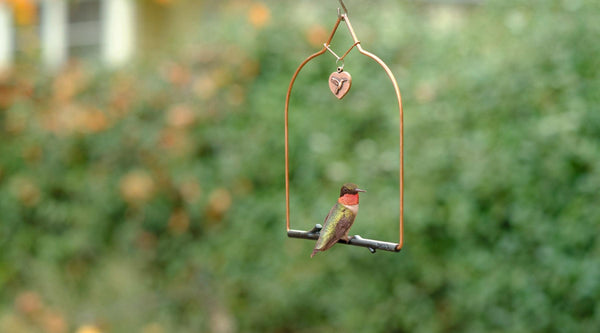
Whether it's a Ruby-throated holding a corner of the yard in eastern Oklahoma or a Black-chinned working a Lawton-area feeder, a breeding hummingbird claims a favorite perch near its food — the Charm Redwood Swing gives it a real one to defend, right where you can watch.
Shop the Redwood Swing →Passing Through: Oklahoma's One Regular Migrant
Rufous Hummingbird Migrant/Winter
Oklahoma's third regular hummingbird, and a fall bird only. The Oklahoma Ornithological Society's Date Guide to the Occurrences of Birds in Oklahoma gives its window as a rare fall migrant from July 22 to November 20 in every part of the state except the southeast, and Sutton's 1967 Oklahoma Birds recorded it as a late-summer visitor and fall transient with no spring record at all. The eBird data matches: nothing in spring, a modest statewide peak of 0.4% in mid-August, and a much stronger 8.6% in the Panhandle's Cimarron County, where the Rocky Mountain flyway spills over the state line. It isn't a review species — the committee expects it every year — but "expected" and "common" are different things, and outside the Panhandle a Rufous is a good bird.

Quick ID: Adult males are almost entirely orange-rufous with a glowing orange-red throat — unmistakable. Most Oklahoma birds aren't adult males, though; females and immatures are green above with cinnamon-washed flanks, a coppery rump, and rufous at the base of the tail, which separates them from the clean gray-and-white flanks of a female Ruby-throated or Black-chinned. Allen's Hummingbird, the near-identical look-alike, has never been recorded in Oklahoma, so a green-backed rufous-flanked bird here is a Rufous.

An Extra Feeder for Your Rufous
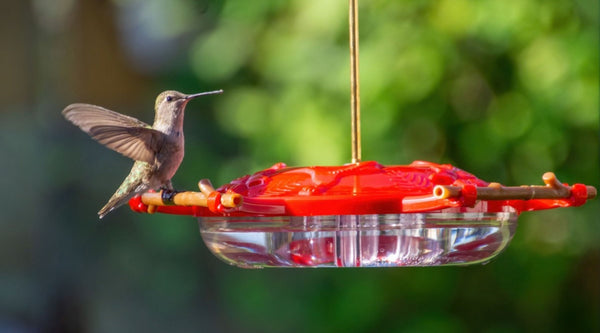
Cimarron County's fall Rufous signal is real but thin — an extra AspenPerch Feeder set apart from your regular feeders gives a passing bird its own spot to defend, rather than losing it to whichever Ruby-throated or Black-chinned already claimed the yard.
Shop the AspenPerch Feeder →Oklahoma's Recurring Rarities
Two more species are on the state checklist with a real, if thin, recurring pattern in the Panhandle — genuine visitors rather than one-off events.
Calliope Hummingbird Rare / Casual Visitor
The most regular of Oklahoma's rarities, and almost entirely a Panhandle bird. Statewide, Calliope barely registers — 0.18% in early September — but Cimarron County alone carries about seven-tenths of that signal, peaking at 6.9% of August checklists as southbound birds from the northern Rockies drift east of the mountains. The committee lists it at the photograph tier. We call it rare rather than a regular migrant only because the composite eBird data can't confirm the pattern year by year and the committee hasn't published a frequency statement we could obtain; the Panhandle signal itself is real and repeatable.

Quick ID: The smallest hummingbird in the United States, with a short tail that sits about level with the wingtips at rest. Adult males show magenta streaks radiating down a white throat rather than a solid gorget, unlike anything else on Oklahoma's list. Females are told from female Rufous by size, that short tail, very little rufous in the tail, and a pale buff wash spread evenly across the breast rather than concentrated on the flanks.
Broad-tailed Hummingbird Rare / Casual Visitor
A species Oklahoma lost and then got back. The committee dropped Broad-tailed from the state list in 1992 because the old records couldn't rule out similar species, then formally restored it in 2001 on new documentation from Kenton, in the far western Panhandle, published in the Bulletin of the Oklahoma Ornithological Society. The Oklahoma Department of Wildlife Conservation now describes Broad-taileds as rare visitors to western Oklahoma — plural, which fits a thin recurring pattern rather than a single event. Cimarron County shows it at 3.7% in late August; statewide it sits at eBird's rounding floor.

Quick ID: Adult males show a rose-magenta throat close enough to Ruby-throated's red to cause confusion, but with a thin white eye-ring instead of the dark cheek, and a high metallic wing-trill in flight that no other Oklahoma hummingbird makes. Females show cinnamon-colored outer tail feathers where a female Ruby-throated's are green and black, plus a longer tail that extends well past the wings. Against female Rufous, look for that longer tail and less copper in it.

Make Your Sanctuary Worth a Detour
Calliope and Broad-tailed both drift east out of the Rockies into the Panhandle in real, repeatable numbers each August — real electrolytes and calcium beyond plain sugar water give a wandering visitor a genuine reason to linger long enough to be seen and confirmed.
Shop Nectarlyte® Powder →If You're Lucky: Oklahoma's Historic Rarities
Six more species are on the state checklist, and the committee prints its confidence right next to each name: no mark for a species backed by a voucher specimen, an asterisk for one backed by a recognizable photograph, and brackets for one supported only by written documentation. All six are one-offs or close to it.
Anna's Hummingbird Historic / Accidental
The one Oklahoma rarity backed by a specimen — the committee's strongest evidence tier — and still an accidental. Anna's carries no mark on the state checklist, which under the committee's legend puts it among the species documented by a voucher specimen, but no per-species count or dates are published, and the eBird record for the past decade amounts to a single December bird around Tulsa. For the Pacific coast's most abundant hummingbird, that's about as clear a signal of accidental status as Oklahoma can give.

Quick ID: The only North American hummingbird with an iridescent crown as well as throat — males glow rose-pink from the top of the head down. Females are plump and short-billed with grayish-green flanks and usually a small red throat spot; against female Black-chinned, Anna's is stockier, dingier below, and holds its tail still where Black-chinned pumps it. A hummingbird at an Oklahoma feeder in December is worth photographs whatever it turns out to be.
Broad-billed Hummingbird Historic / Accidental
One documented record: an adult male at a Lawton-area feeder in the 2002 season, which the Oklahoma Department of Wildlife Conservation's hummingbird-survey results for that year called the highlight of the season, and which was written up in the Bulletin of the Oklahoma Ornithological Society. The committee lists the species at the photograph tier. eBird checklists also show a November bird in the Oklahoma City area within the last decade — a short burst of reports that looks like a single well-visited individual — but we couldn't trace it to a published committee record, so this page counts one.

Quick ID: The bright red, black-tipped bill is diagnostic in every plumage — no regular Oklahoma species shows red on the bill. Adult males add a shimmering blue throat on a mostly emerald body; females are gray below with a white line curving behind the eye and a bill that's red at the base with a dark tip.
Costa's Hummingbird Historic / Accidental
One of the newest names on the list. The committee's 2022 checklist names Costa's Hummingbird among eight species added since the 2017 edition on the basis of photographs taken in Oklahoma — and that sentence is the whole of what the committee has published about it. No date, county, or count appears in the checklist, and we found no record-level account in any source we'd cite. A real, committee-accepted bird; a single one, as far as the public record shows.

Quick ID: Adult males are unmistakable — a violet-purple crown and a gorget that flares out past the sides of the neck like a mustache. Females are small, short-tailed, and whiter-bellied than any regular Oklahoma species, with a faint pale eyebrow and a slightly droopy bill; against female Black-chinned, the bird they'd most likely be mistaken for, Costa's is smaller, shorter-billed, and paler below.
Rivoli's Hummingbird Historic / Accidental
Added in the same 2022 checklist revision as Costa's, on the same basis — a photograph of the bird in Oklahoma — and with the same silence about the details. A very large hummingbird of the Arizona and New Mexico sky islands, this far east it's a genuine stray, and the committee's single line is the extent of the documented history.

Quick ID: Roughly double the mass of a Black-chinned, with a bill up to half again as long. Adult males can look all-black until the light catches an emerald throat and violet crown. Females are gray below with a small white mark behind the eye; size and bill length alone rule out every regular Oklahoma species.
Mexican Violetear Historic / Accidental
Two confirmed records, twenty-four years apart. The first, from 1998, was published in the Bulletin of the Oklahoma Ornithological Society as the state's first Green Violetear, the species' name at the time. The second turned up in Stillwater in the summer of 2022, found by Scott Loss and logged in the Oklahoma City Audubon Society's seasonal recorder's report — and it's the reason this species shows a small July blip in the statewide eBird data. Two birds in a quarter-century is a stray pattern, not a recurring one.

Quick ID: Unmistakable if you get a look — an all-glittering-green bird, larger than any of Oklahoma's regular species, with a violet-blue ear patch and a violet-blue band across the chest, a straight black bill, and a blue-green tail crossed by a dark band. Both sexes look alike.
Blue-throated Mountain-gem Historic / Accidental
Oklahoma's least-supported hummingbird, by the committee's own accounting. Blue-throated Mountain-gem appears on the checklist in brackets — the committee's mark for a species supported only by written documentation, with no specimen and no photograph — and the 2017 edition's note explains that it was added in hypothetical status on the written description of a single sighting. It has stayed at that tier through the 2022 revision. That's a real entry on the official list, and an honest one about its own limits.

Quick ID: The largest hummingbird that nests in the United States, with two white face stripes — one above the eye and a short one below it — a gray belly, and big white corners on a blackish tail that flash in flight. Adult males add a sapphire throat. Against Rivoli's, look for those two face stripes and the large white tail corners; Rivoli's has a single small white dot behind the eye.

Give Every Visitor a Reason to Stay
Breeding Ruby-throated or Black-chinned, a passing Rufous, or a once-in-a-lifetime Costa's, Rivoli's, or Violetear — what keeps any hummingbird coming back is real habitat. Perfect Little Sanctuary® Wildflower Seed packs 12 nectar-rich varieties into one packet for lasting native forage, planted before the next rarity ever shows up.
Shop Wildflower Seed →Oklahoma Hummingbirds at a Glance
One species accounts for nearly all of Oklahoma's hummingbird activity when the whole state is averaged: Ruby-throated peaks at 31% of statewide checklists, Black-chinned at 2.5%, and nothing else clears half a percent. That gap is too wide for a shared bar chart to show anything useful — and it hides the fact that Black-chinned is the majority hummingbird around Lawton and that the Panhandle hosts four species the rest of the state rarely sees. Here's the same information as a table instead; the Oklahoma hummingbird calendar charts each region at its true scale.
| Species | Status | Oklahoma Records |
|---|---|---|
| Ruby-throated Hummingbird | Breeding | Statewide peak 31% in August; 51% in McCurtain County, 43% around Tulsa |
| Black-chinned Hummingbird | Breeding | Statewide peak 2.5%; 33% around Lawton in July; nesting confirmed in Grady County |
| Rufous Hummingbird | Migrant / Winter Visitor | Fall migrant, July 22–November 20 per the OOS Date Guide; 8.6% in the Panhandle in August; not a review species |
| Calliope Hummingbird | Rare / Casual | Photograph tier; 6.9% in Cimarron County in August, near zero elsewhere |
| Broad-tailed Hummingbird | Rare / Casual | Photograph tier; restored to the state list in 2001; 3.7% in Cimarron County in August |
| Anna's Hummingbird | Historic / Accidental | Specimen tier; one December bird near Tulsa in a decade of eBird data |
| Broad-billed Hummingbird | Historic / Accidental | Photograph tier; 1 documented record — Lawton area, 2002 |
| Costa's Hummingbird | Historic / Accidental | Photograph tier; added to the list between 2017 and 2022; no details published |
| Rivoli's Hummingbird | Historic / Accidental | Photograph tier; added to the list between 2017 and 2022; no details published |
| Mexican Violetear | Historic / Accidental | Photograph tier; 2 records — 1998, and Stillwater 2022 |
| Blue-throated Mountain-gem | Historic / Accidental | Written-documentation tier only; 1 sighting, listed as hypothetical |
Frequently Asked Questions
How many kinds of hummingbirds have been documented in Oklahoma?
Eleven, all on the Oklahoma Ornithological Society's official state checklist. Two breed in the state, Ruby-throated and Black-chinned; one, Rufous, passes through every fall; and the other eight are rarities, from two Rocky Mountain species that show up in the Panhandle most years down to one the committee has accepted only on a written description.
Do Ruby-throated and Black-chinned Hummingbirds interbreed in Oklahoma?
Yes — Oklahoma has one of the best-documented hybrid zones for the two anywhere. A banding study in Grady and Comanche counties, published in the Bulletin of the Oklahoma Ornithological Society in 2011, found that 11 of 118 adult males captured — about 9% — were hybrids. In the corridor from Chickasha southwest to Lawton, a male whose throat looks purplish-red rather than clearly ruby or clearly black may be one.
How do I tell a female Black-chinned from a female Ruby-throated?
Not easily. Both are green above and white below with white-tipped outer tail feathers. The most useful mark is wing length: on Black-chinned, the folded wingtips reach nearly to the tip of the tail, while on Ruby-throated the tail extends clearly past the wings. Black-chinned also pumps its tail almost constantly while hovering; Ruby-throated tends to hold still. Where you are helps too — east of Oklahoma City it's almost certainly Ruby-throated, around Lawton almost certainly Black-chinned, and in between it may take a bander to settle.
Which western hummingbirds reach the Oklahoma Panhandle?
Cimarron County, at the far western tip, is where the Rocky Mountain flyway spills into Oklahoma each fall. Rufous reaches 8.6% of August checklists there, Calliope 6.9%, and Broad-tailed 3.7% — while Black-chinned is the Panhandle's spring and summer bird at 21% in May. None of the three migrants nests in Oklahoma; they're passing through on their way south.
What is the rarest hummingbird in Oklahoma?
By the committee's own evidence tiers, Blue-throated Mountain-gem — on the list in brackets, accepted on a single written description with no specimen or photograph, and carried as hypothetical. Costa's and Rivoli's are close behind: each was added on a photograph sometime between the 2017 and 2022 checklists, and the committee has published nothing more about either.
Why We Created This Guide
Pop's Birding has been helping hummingbird lovers for three generations. One of the questions our customers ask most often is "what hummingbirds are actually in my state?" — we built this guide to give a direct, sourced answer for Oklahoma specifically, not a generic one. Most identification content treats Oklahoma as a Ruby-throated state with a western fringe, and that misses what's distinctive here: a second breeder that's the majority hummingbird in the southwest, a documented hybrid zone between the two, a Panhandle corner that hosts Rocky Mountain migrants the rest of the state never sees, and a state checklist that tells you, species by species, how good the evidence is.
How We Created This Guide
We started with statewide eBird bar chart data from the Cornell Lab of Ornithology, covering 2016 through 2025, plus six counties chosen to capture Oklahoma's different landscapes — the Tulsa and Oklahoma City metros, Norman, Lawton and the southwest, the Panhandle, and the wet southeastern corner. Since a few weeks of heavy reporting on one bird can look like a real recurring pattern in raw checklist data — a single 2022 Mexican Violetear in Stillwater produced a statewide spike larger than several genuine visitors — we checked every species's week-by-week signal for real recurrence against the Oklahoma Bird Records Committee's official state checklist and review list, along with the peer-reviewed breeding and hybridization studies in the Bulletin of the Oklahoma Ornithological Society. That's why Broad-billed Hummingbird is counted as a single record here even though eBird shows a second November sighting we couldn't trace to any published account, and why Ruby-throated's overwhelming statewide dominance is stated plainly rather than flattened into a shared-scale chart that would erase the Panhandle's real four-species signal.
Sources
- eBird bar chart data, Cornell Lab of Ornithology — Oklahoma statewide plus Tulsa, Oklahoma, Cleveland, Comanche, Cimarron, and McCurtain counties, 2016–2025.
- Oklahoma Bird Records Committee, The Oklahoma Ornithological Society Checklist of Oklahoma Birds, 6th edition (May 2022) — source for all 11 species and their documentation tiers.
- Oklahoma Bird Records Committee, Review List and About the OBRC — source for review status and the 1992 removal of Broad-tailed from the state list.
- Judd, E. R., C. J. Butler, and N. Batchelder. 2011. Hybridization between Black-chinned (Archilochus alexandri) and Ruby-throated (A. colubris) hummingbirds in Oklahoma. Bulletin of the Oklahoma Ornithological Society 44:1–7. Source for the hybrid-zone figures.
- Butler, C. J., D. Ledbetter, N. Batchelder, and G. Batchelder. 2007. Black-chinned hummingbirds breed in Grady County. Bulletin of the Oklahoma Ornithological Society 40(3–4):13–16.
- Reinking, D. L., J. E. Puschock, and B. L. Gall. 2001. Recent documentation restores the Broad-tailed Hummingbird to Oklahoma's state bird list. Bulletin of the Oklahoma Ornithological Society 34:21–25.
- Tarbutton, B., and D. Clapp. 1998. First record of the green violet-ear for Oklahoma. Bulletin of the Oklahoma Ornithological Society 31(3):21–24.
- Oklahoma Department of Wildlife Conservation, 2002 Hummingbird Survey Results, and ODWC species accounts. Source for the 2002 Broad-billed record and Broad-tailed's "rare visitors" status.
- Oklahoma City Audubon Society, "Oklahoma Hummingbirds" and its Summer 2022 Recorder's Report — regular-species range statements and the 2022 Mexican Violetear.
- Oklahoma Ornithological Society, Date Guide to the Occurrences of Birds in Oklahoma, and Sutton, G. M. 1967. Oklahoma Birds. Source for Rufous Hummingbird's seasonal window.
Know before they arrive
You don't have to keep this calendar taped to the fridge. Insider Birding Access members get seasonal notes timed to your region — when to have feeders out, what the birds are doing right now, and what's worth doing in your yard this season. We take the guesswork out of the calendar. Joining takes about thirty seconds, and there's 10% off your first order in it.
Join Insider Birding Access →Free to join. 10% off your first order.
Shop Oklahoma's Hummingbird Favorites


Bethany Sloan has served as General Manager of Pop's Birding since 2010, continuing the legacy of her grandfather, William "Pops" Sloan, inventor of the Original Hummingbird Swing. A lifelong hummingbird enthusiast, educator, and independent researcher, she leads the company's educational content, including its 50-State Hummingbird Guide series, Regional Guide, Species Guide and Hummingbird Learning Center. Bethany combines scientific research, regional migration data, and more than 16 years of hands-on experience to create trusted educational resources for bird enthusiasts across North America.