Sep 03, 2026
Hummingbirds in New Mexico: The Complete Guide to All 17 Species
New Mexico's documented hummingbird list runs to seventeen species — trailing only Texas's nineteen and Arizona's eighteen among its immediate neighbors, and well ahead of Colorado's twelve, Oklahoma's eleven, and Utah's ten to eleven. Six species breed here, four are migrants passing through or a genuine winter visitor, and seven are documented rarities, ranging from a handful of decades-old records to species with dozens of accepted sightings.
Free download
All 17 species, one page
A one-page reference to every hummingbird documented in New Mexico — six breeders, four migrants and winter visitors, and seven rarities, with each species' status and record history at a glance.
Download the New Mexico species guideOne page · PDF · free to print and share

All 17 documented New Mexico hummingbird species, grouped by tier — statewide eBird data, 2016–2025, cross-checked against the New Mexico Bird Records Committee's own accepted-record history.
The Hummingbirds You're Most Likely to See
Black-chinned Hummingbird Breeds Here
New Mexico's most common hummingbird by a real margin — its statewide eBird frequency peaks near 40% in late July, the highest of any species tracked here. It's a genuine, widespread breeder present April through September, common across nearly every habitat type the state has to offer: rivers, towns, deserts, and foothills alike. It isn't on the New Mexico Bird Records Committee's Review List at all — a fully regular, non-reviewable species.

Quick ID: Males show a velvety black throat, only revealing a thin purple band in direct light — otherwise it just looks solid black. Females are plain and pale-throated, best told apart by white-tipped outer tail feathers and a small white spot behind the eye.
Broad-tailed Hummingbird Breeds Here
New Mexico's second most common species, statewide frequency peaking near 31% in late August. It's a genuine high-elevation breeder in mountain ranges nearly statewide above roughly 6,000 feet, present early April through September — New Mexico holds an estimated 17% of the species' entire global breeding population.

Quick ID: Males have a rose-magenta throat and produce a loud, distinctive metallic wing trill in flight — often heard before seen. Females show green throat spotting rather than solid color, with a pale eyering that helps separate her from similar species.
Broad-billed Hummingbird Breeds Here
A narrowly localized breeder, confirmed regular only in Guadalupe Canyon, Hidalgo County, in the state's far southwest bootheel — the New Mexico Bird Records Committee reviews reports from everywhere else in the state, since it's genuinely rare outside that one canyon system.

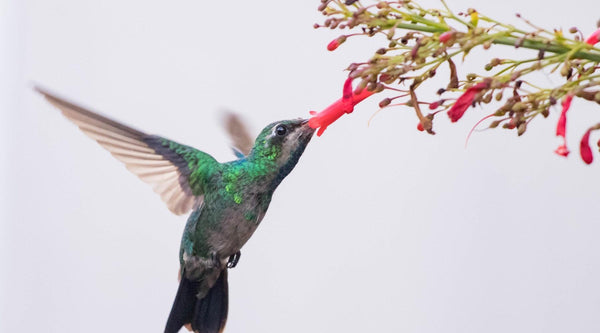
Quick ID: Named for the field mark that settles it at a glance — a bright red bill tipped in black. Males show a shimmering sapphire-blue throat over an emerald-green body; females are duller, golden-green above and gray below, but carry that same diagnostic red-and-black bill.
Lucifer Hummingbird Breeds Here
Another bootheel specialty — a small breeding population confined to the Peloncillo Mountains' Clanton, Skeleton, and Post Office canyons. Like Broad-billed, it's reviewable everywhere else in the state, since its real range here is that one mountain range.

Quick ID: A small hummingbird with a long, curved bill unlike any other New Mexico species. Males show a green back, a long forked tail, and an iridescent purple gorget that flares outward at the sides. Females are buffy below with a dusky ear patch and pale eyebrow stripe.
Rivoli's Hummingbird Breeds Here
A localized sky-island summer breeder — New Mexico sits at the documented northern limit of this species' entire breeding range, with nesting confined to a handful of the state's southwestern mountain ranges.

Quick ID: One of the largest hummingbirds in New Mexico. Males are dark overall with a glittering green throat and a violet crown visible in good light; females are green above and grayish below, with limited pale tips in the tail corners rather than the bold white outer-tail markings smaller species show.
Violet-crowned Hummingbird Breeds Here
New Mexico's rarest true breeder — a state-listed threatened species, with a documented population of roughly a dozen individuals at Guadalupe Canyon, nesting from mid-June into September, timed to match the bloom of Schott's agave.

Quick ID: Unmistakable once you know it — a bright violet-blue crown on an otherwise plain gray-and-white bird, with a distinctive red-based bill. No other New Mexico hummingbird combines a colored crown with such plain, pale underparts.

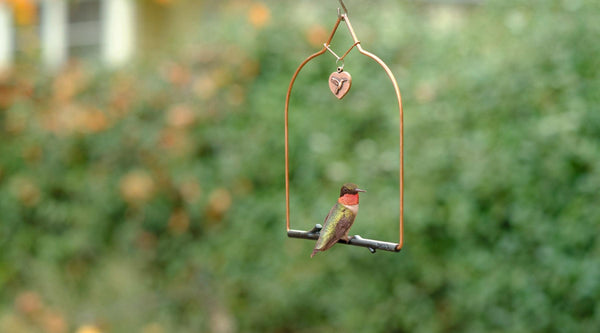
A Little Throne for Your Breeding Season Regulars
New Mexico's six breeders hold territory across very different corners of the state, from statewide desert and river habitat down to isolated bootheel canyons. A stable perch gives them somewhere to hold that territory besides the feeder port itself, all season long.
Shop Charm Redwood Swing →New Mexico's Migrants and Winter Visitors
This tier is really two different stories in New Mexico. Rufous, Calliope, and Ruby-throated Hummingbird pass through as migrants, most visible in late summer and fall — none of them breed or winter here. Anna's Hummingbird is the genuine exception, showing a real winter-only presence rather than a migration pattern.
Rufous Hummingbird Migrant/Winter
A conspicuous late-summer and fall migrant, statewide frequency peaking near 30% in late August — nearly as common at that time of year as the state's two resident breeders. New Mexico lies well south and east of Rufous's actual breeding range, so every bird here is passing through on one of the longest migrations of any hummingbird in North America, not settling in to nest.

Quick ID: Males glow with a fiery orange-red throat and a coppery-orange body — one of the most recognizable hummingbirds in North America. Females and immatures are green above with rusty flanks and rufous patches at the base of the tail.
Calliope Hummingbird Migrant/Winter
A real but much thinner migrant presence than Rufous — statewide frequency peaks near 7% in late July. Its actual breeding range sits farther north and west, so New Mexico sightings are mid-to-late-summer and fall birds moving through rather than any local population.

Quick ID: North America's smallest breeding hummingbird, with a hunched posture and short tail. Males have a unique streaked, ray-like magenta throat unlike any other species' solid gorget. Females are tiny even by hummingbird standards, with very little rufous in the tail.
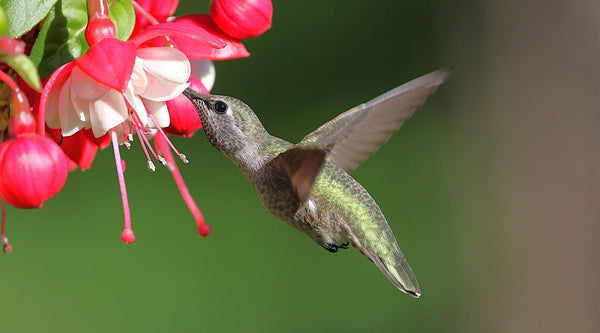
Anna's Hummingbird Migrant/Winter
The one real winter bird in this tier — a genuine winter-only range expansion into New Mexico, peaking in January, not a breeder here. It's still an NMBRC Review species, meaning every report is documented individually even though the winter pattern itself is well established.

Quick ID: The only North American hummingbird with a fully colored crown as well as throat — males glow rose-pink from head to throat. Females show a central patch of rose-red spotting on an otherwise plain throat, with a stocky, broad-tailed build.
Ruby-throated Hummingbird Migrant/Winter
The thinnest of New Mexico's four migrant/winter-tier species — a scarce, possibly regular fall transient across the state's eastern plains. The New Mexico Bird Records Committee's own Seventh Report describes it plainly: 58 accepted records, every one dated September or October, and no accepted winter records at all despite occasional winter sighting reports.

Quick ID: Males flash a brilliant ruby-red throat in good light, but it reads as solid black most of the time — the forked black tail is the more reliable everyday mark. Females have a plain whitish throat and a more rounded, white-tipped tail.

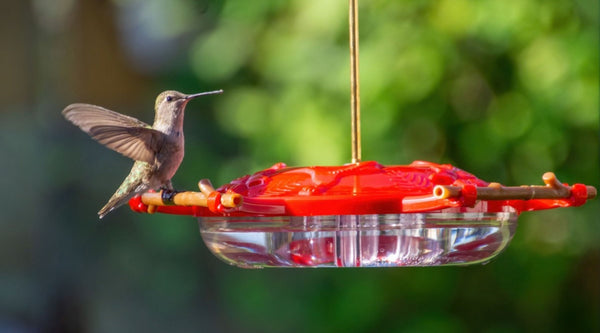
An Extra Feeder for Your Winter Visitors
Rufous, Calliope, and Ruby-throated pass through New Mexico as migrants each fall, while Anna's holds on through the winter itself. A second station spread across the yard gives these later-season visitors room of their own instead of competing at a single feeder port.
Shop AspenPerch Feeder →New Mexico's Recurring Rarities
Three more species have accepted New Mexico records with dozens of accepted sightings apiece and a real recurring seasonal pattern — genuine, if infrequent, visitors rather than one-off flukes.
Allen's Hummingbird Rare / Casual Visitor
26 accepted NMBRC records through 2022 — the committee's own report notes that almost all of them have resulted from banding work since 1990, not casual sightings. The most recent: a juvenile male in the Peloncillo Mountains, Hidalgo County, in the summer of 2020.

Quick ID: Males glow with a reddish-orange throat and typically a solid green back, giving a mixed orange-and-green look. Females and immatures are green above with rufous-washed flanks and rufous in the tail — plumage so close to female Rufous Hummingbird that Cornell rates the two "very difficult to separate" without an in-hand tail measurement.
Blue-throated Mountain-gem Rare / Casual Visitor
Roughly 78 accepted NMBRC records, concentrated in the sky-island and bootheel canyons near confirmed breeding populations just across the Arizona and Texas borders. The committee's own language — "a rare summer-fall visitor... with no confirmed breeding records to date" — is specific and worth noting: some popular sites loosely describe this species as a New Mexico breeder, but NMBRC does not.

Quick ID: One of the largest hummingbirds likely to show up in New Mexico. Males show a brilliant blue throat patch and bold white facial stripes on an otherwise dark head; both sexes have a distinctive squared, white-tipped tail that's a reliable mark even at a distance.
Costa's Hummingbird Rare / Casual Visitor
80 accepted NMBRC records through 2022 — the most of any reviewed New Mexico hummingbird, including 4 new records added between 2019 and 2022 alone, spread across Doña Ana, Grant, and Hidalgo counties.

Quick ID: Males show an extravagant violet-purple throat that flares out into long points at the sides, almost like a mustache. Females are compact and plain-faced, best told from other small desert hummingbirds by their short tail and a subtle grayish wash rather than the peachy or rufous tones seen on similar species.

Make Your Sanctuary Worth a Detour
Allen's, Blue-throated Mountain-gem, and Costa's are all genuinely recurring here, not one-time flukes — real electrolytes beyond plain sugar water give a documented rarity a reason to linger instead of just passing through.
Shop Nectarlyte® Powder →If You're Lucky: New Mexico's Historic Rarities
Four more species have accepted New Mexico records, but each has only a handful of records apiece, and two of them (noted honestly below) have thinner sourcing than the rest of this page.
Berylline Hummingbird Historic / Accidental
4 total accepted NMBRC records — the most recent an adult male banded near Mimbres, Grant County, in July 2006, described in the committee's report as "the first away from Hidalgo Co." Nothing new has been documented since, across a 12-year committee-report window running through 2022.

Quick ID: A medium-sized hummingbird with an overall coppery-green look — green head and chest, rufous-tinged wings and tail, and a mostly red bill with a black tip.
Cinnamon Hummingbird Historic / Accidental
A single confirmed U.S. occurrence in New Mexico, per Cornell's Birds of the World, which states plainly that only two individuals have ever strayed into the southernmost United States — one in Arizona, one in New Mexico. No recurrence has been documented.

Quick ID: Told apart from New Mexico's other rarities by its overall warm cinnamon-orange color, both above and below, rather than a green back — from behind it can suggest Buff-bellied or Rufous-tailed Hummingbird, but a front or side view showing no green chest patch at all confirms Cinnamon.
Mexican Violetear Historic / Accidental
New Mexico has one confirmed occurrence, pointing to a single accepted decision around 2016 rather than an established recurring pattern — and the state sits well outside this species' main U.S. vagrancy corridor along the Texas coast. Treated here as Historic/Accidental on that basis; see "How We Created This Guide" below for the sourcing detail behind that call.

Quick ID: A larger hummingbird than most on this list, glittering metallic green overall with a violet-blue patch across the breast and a violet ear patch that gives the species its name. Sexes look nearly identical.
White-eared Hummingbird Historic / Accidental
A confirmed New Mexico Bird Records Committee Review species — a documentation-required rarity in the state's extreme southwestern montane canyons. New Mexico's own committee treats this as a rarer status than neighboring Arizona, where White-eared is a confirmed regular scarce breeder — a real difference in status by state, not an inconsistency between the two pages. (No dedicated species guide exists yet, so this name isn't linked.)

Quick ID: Told at a glance by a bold white stripe behind the eye set against an otherwise dark face — visible in every plumage. Males add an emerald throat and a violet flash on the forehead in good light; the bright red, black-tipped bill shows on both sexes.

Give Every Visitor a Reason to Stay
Whether it's your breeding Black-chinned or a genuine one-off like White-eared, real nectar sources give any visitor, common or rare, more reason to stick around your yard.
Shop Wildflower Seed →New Mexico Hummingbirds at a Glance

Statewide peak eBird frequency, 2016–2025. Costa's Hummingbird, Lucifer Hummingbird, Violet-crowned Hummingbird, Allen's Hummingbird, and Blue-throated Mountain-gem all sit at or below the ~0.15% eBird rounding floor and aren't plotted here — their real record histories are documented in the table and species write-ups above, just not visible at this statewide statistical scale.
| Species | Status | New Mexico Records |
|---|---|---|
| Black-chinned Hummingbird | Breeding | Common, widespread breeder statewide, April–September; not on NMBRC's Review List. ~18% of the species' global population breeds here. |
| Broad-billed Hummingbird | Breeding | Breeds regularly only in Guadalupe Canyon, Hidalgo Co.; reviewable everywhere else in the state. |
| Broad-tailed Hummingbird | Breeding | Common high-elevation breeder nearly statewide above ~6,000 ft, early April–September. ~17% of the species' global population breeds here. |
| Lucifer Hummingbird | Breeding | Small breeding population confined to the Peloncillo Mountains (Clanton, Skeleton, Post Office canyons); reviewable elsewhere. |
| Rivoli's Hummingbird | Breeding | Localized sky-island summer breeder at the species' documented northern range limit. |
| Violet-crowned Hummingbird | Breeding | State-listed threatened species; ~12 breeding individuals at Guadalupe Canyon, nesting mid-June–September. |
| Anna's Hummingbird | Migrant / Winter Visitor | Genuine winter-only range expansion into New Mexico, peaking in January; not a breeder here. NMBRC Review species. |
| Calliope Hummingbird | Migrant / Winter Visitor | A mid-to-late-summer and fall migrant passing through; breeding range lies farther north and west. |
| Ruby-throated Hummingbird | Migrant / Winter Visitor | Scarce, possibly regular fall transient across the eastern plains — 58 accepted NMBRC records, all dated Sep–Oct; no accepted winter records. |
| Rufous Hummingbird | Migrant / Winter Visitor | Conspicuous late-summer/fall migrant passing through on its long southbound journey; New Mexico lies outside its breeding range. |
| Allen's Hummingbird | Rare / Casual Visitor | 26 accepted NMBRC records, most from banding work since 1990; most recent 2020, Peloncillo Mountains. |
| Blue-throated Mountain-gem | Rare / Casual Visitor | ~78 accepted NMBRC records; committee's own characterization is "a rare summer-fall visitor... with no confirmed breeding records to date." |
| Costa's Hummingbird | Rare / Casual Visitor | 80 accepted NMBRC records — the most of any reviewed New Mexico hummingbird — including 4 new records 2019–2022. |
| Berylline Hummingbird | Historic / Accidental | 4 total accepted NMBRC records; most recent 2006, nothing since across a 12+ year committee-report window. |
| Cinnamon Hummingbird | Historic / Accidental | A single confirmed U.S. occurrence in New Mexico per Cornell Birds of the World; no recurrence documented. |
| Mexican Violetear | Historic / Accidental | NMBRC Review species; only reference located points to one accepted decision around 2016 — exact count/date not independently confirmed. |
| White-eared Hummingbird | Historic / Accidental | NMBRC Review species in extreme SW montane canyons; exact accepted-record count/dates not independently confirmed despite dedicated research. |
Frequently Asked Questions
How many hummingbird species have been recorded in New Mexico?
Seventeen — more than all of its neighbors except Texas and Arizona. Six species breed in the state, four are genuine migrants or a winter visitor, and seven are documented rarities.
Which hummingbirds actually breed in New Mexico?
Six: Black-chinned and Broad-tailed Hummingbird breed widely across the state, while Broad-billed, Lucifer, Rivoli's, and Violet-crowned Hummingbird are all narrowly localized to the bootheel region in the state's far southwest corner.
Is New Mexico's most common hummingbird a summer or winter bird?
Summer. Black-chinned Hummingbird — the state's top species by eBird frequency, peaking near 40% statewide in late July — is a breeder present April through September, not a winter visitor.
Do any of New Mexico's migrant hummingbirds actually stay for winter?
Only Anna's Hummingbird shows a genuine winter pattern here, appearing as a range expansion in January. Calliope, Ruby-throated, and Rufous Hummingbird are all passage migrants, moving through New Mexico in late summer and fall rather than settling in for the cold months.
How many of New Mexico's hummingbirds are genuine rarities?
Seven. Allen's, Blue-throated Mountain-gem, and Costa's Hummingbird each have dozens of accepted records and a real recurring pattern. Berylline, Cinnamon, Mexican Violetear, and White-eared Hummingbird are far thinner — one to four total accepted records apiece.
Why We Created This Guide
Pop's Birding has been helping hummingbird lovers for three generations. One of the questions our customers ask most often is "what hummingbirds actually show up in my state" — we built this guide to give a direct, sourced answer, not a generic one. New Mexico is one of the most hummingbird-diverse states in the country, but that diversity gets flattened in most general references into one long, undifferentiated list. This page separates New Mexico's six real breeders from its four migrants and one winter visitor, and its three well-documented rarities from its four genuinely thin ones — each tier verified against the New Mexico Bird Records Committee's own record-by-record history, not just a species name on a checklist.
How We Created This Guide
We started with eBird checklist data for New Mexico from the Cornell Lab of Ornithology, covering 2016 through 2025, pulled statewide plus four counties that capture the state's real geography — Albuquerque's Bernalillo County, rural Catron, Silver City's Grant County, and the bootheel's Hidalgo County, home to most of the state's true rarities. Since a decade of checklists can't tell the whole story on their own, especially for older or one-off sightings, we checked every species against the New Mexico Bird Records Committee's current Checklist, Review List, and Seventh Report, which lists exact accepted-record totals and, for many species, individual dates and locations. That's how we confirmed Allen's, Blue-throated Mountain-gem, and Costa's Hummingbird all have real, recurring multi-decade patterns rather than a handful of records. Two species were harder to source than the rest: Mexican Violetear and White-eared Hummingbird are both confirmed Review species with real New Mexico occurrences, but after three research passes each, we couldn't retrieve the committee's specific accepted-record count or dates, so both are labeled Historic/Accidental as a conservative default — if you have access to NMBRC's earlier reports and can confirm either species' record history, we'd welcome the correction.
Sources
- eBird bar chart data, Cornell Lab of Ornithology — New Mexico statewide, 2016–2025.
- New Mexico Bird Records Committee, New Mexico Ornithological Society — source for every rare-species record count and status on this page.
Know before they arrive
You don't have to keep this calendar taped to the fridge. Insider Birding Access members get seasonal notes timed to your region — when to have feeders out, what the birds are doing right now, and what's worth doing in your yard this season. We take the guesswork out of the calendar. Joining takes about thirty seconds, and there's 10% off your first order in it.
Join Insider Birding Access →Free to join. 10% off your first order.
Shop New Mexico's Hummingbird Favorites


Bethany Sloan has served as General Manager of Pop's Birding since 2010, continuing the legacy of her grandfather, William "Pops" Sloan, inventor of the Original Hummingbird Swing. A lifelong hummingbird enthusiast, educator, and independent researcher, she leads the company's educational content, including its 50-State Hummingbird Guide series, Regional Guide, Species Guide and Hummingbird Learning Center. Bethany combines scientific research, regional migration data, and more than 16 years of hands-on experience to create trusted educational resources for bird enthusiasts across North America.