Oct 08, 2023
When to Put Up (and Take Down) Your Hummingbird Feeder
Quick answer: Take your hummingbird feeder down about two weeks after your last hummingbird sighting of the season — and not a day before that on account of the calendar. Leaving a feeder up in fall does not delay or prevent migration; hummingbirds leave on day length, not food supply. Put feeders back up shortly before hummingbirds typically return to your area in spring, since returning birds check familiar locations. In parts of the Pacific Coast, Desert Southwest, South Texas and the Gulf Coast, feeders can stay up all year.
Timing questions come up constantly around hummingbird feeding, and one myth in particular causes a lot of unnecessary worry every fall. Whether you call it taking the feeder down, bringing it in, putting it away, or just stopping feeding for the year, it's the same decision — and the answer is less about the date than most people expect. Here's what actually matters, and what doesn't.
When to Put Your Feeder Up
Hummingbird arrival timing varies significantly by region. In the Gulf Coast and Deep South, migratory hummingbirds can begin arriving in early spring; further north, arrival shifts later into spring. That regional spread is the whole reason there's no single national date — our state-by-state hummingbird guides give the actual arrival and departure windows for your state, built from eBird observation data rather than a rule of thumb.
When Should You Put Out Hummingbird Feeders?
Shortly before hummingbirds typically return to your area — not on a fixed national date. We suggest roughly a week or two ahead of your local arrival window, which gives you margin for an early bird without leaving nectar sitting out for a month with nothing to drink it.
To be straight with you about where that number comes from: the "one to two weeks early" interval is our own practical recommendation, not an agency guideline. We haven't found a wildlife agency or a research paper that establishes that specific window, and we'd rather tell you that than dress up a convention as science. Some agencies do publish regional conventions worth knowing — the Texas Parks & Wildlife Department, for instance, tells Texans to have feeders up by the Ides of March.
What is well established is why erring early is sensible at all. Hummingbirds show strong site fidelity — they come back to the same places. Banding work by Operation RubyThroat found that of 3,614 Ruby-throated Hummingbirds banded at a single South Carolina site, more than one in eight returned in a later year, and two came back five years running. A decade-long study of Broad-tailed Hummingbirds published in Oecologia recorded female return rates between consecutive breeding seasons as high as 70%.
So a returning hummingbird arriving in your yard is quite likely to be a bird that was there last year, checking a place it remembers. That's a good reason to have the feeder out and filled when the first ones show up — though we'd stop short of the popular claim that birds hover at the precise spot where a feeder used to hang. That story is everywhere online and we couldn't find it documented by any wildlife agency or banding study, so we're not going to repeat it as fact.
Shop the feeder
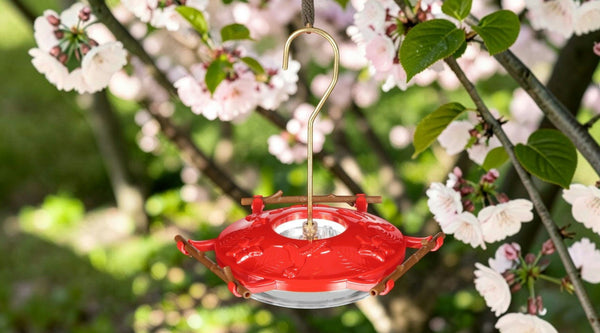
AspenPerch® Hummingbird Feeder, 8 oz

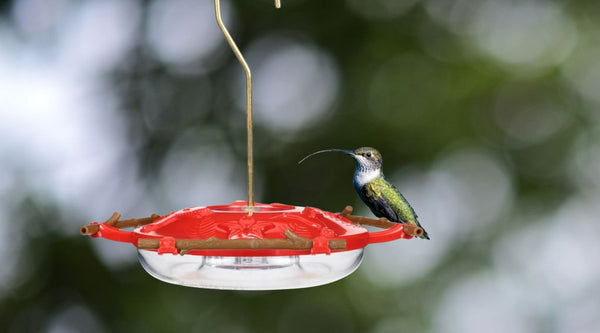
If the birds are coming back to the same spot anyway, it's worth that spot being a good one. The AspenPerch® gives them somewhere to actually sit and drink rather than hover, and it's leak-proof and dishwasher-safe — which matters more than it sounds, because the feeder that's easy to clean is the feeder that stays clean across a long season. The 8 oz size suits most backyards: enough for a busy feeder, little enough that you're not pouring half of it out at every change.
Shop AspenPerch® →Hung a feeder and nothing came? That's normal early in the season and usually fixable. Start with where to hang a hummingbird feeder, and if the feeder is brand new, why hummingbirds sometimes take weeks to find one.
The Fall Migration Myth (And Why It's Wrong)
Here's the misconception worth putting to rest directly: leaving your hummingbird feeder up in the fall will not cause hummingbirds to delay migration or stay somewhere they shouldn't. State wildlife agencies say so plainly. The Georgia Department of Natural Resources puts it about as directly as it can be put: you cannot keep hummingbirds from migrating by leaving feeders up in fall and winter, because they migrate in response to declining day length, not food availability. Texas Parks & Wildlife reaches the same conclusion from the other direction — feeders won't stall migration, but they may help along stragglers slowed by illness or a late nesting attempt.
The mechanism behind that is photoperiod: the seasonal change in day length that migratory birds use as their cue to prepare and depart. Experimental work published in Royal Society Open Science isolated day length as the trigger directly — birds held on naturally increasing daylight developed a full migratory state, including fat deposition and migratory restlessness, while birds held on short days did not. One honest caveat: that experiment was run on pine siskins, not hummingbirds. Photoperiod is established as the migratory cue across migratory birds generally, and agencies apply it to hummingbirds, but we're not aware of the equivalent experiment having been run on a hummingbird. Treat it as a well-founded general principle rather than a hummingbird-specific finding.
Either way, the practical upshot is the same: a feeder doesn't override that instinct any more than a well-stocked flower garden would. The National Park Service frames a feeder as a quick burst of energy rather than something that pulls a bird away from its natural foods — a supplement, not a trap.
Why a Late-Season Feeder Actually Helps
The stronger argument isn't that leaving a feeder up is harmless. It's that it's genuinely useful, because of what hummingbirds are doing in the weeks before they go.
Migratory birds enter a period of dramatically increased appetite called hyperphagia in the run-up to departure. The Smithsonian National Zoo and Conservation Biology Institute describes it starting two to three weeks out, with some migrants able to add as much as 10% of their body weight per day in fat. That fuel has to come from somewhere, and in late summer and early fall it's coming from whatever nectar is available.
Research on migrating Rufous Hummingbirds published in PNAS showed just how concentrated that refueling is: birds stopping over at mountain meadows put on a large share of their total gain in only a few days before pushing on. A feeder isn't holding those birds anywhere. It's a filling station on a route they're already committed to.
That's also why the two weeks after your last sighting matter so much — more on that below.
There isn't one hummingbird season — there are dozens. Different species run on completely different calendars, and some move north in fall rather than south. Our guide to why there's no single hummingbird season covers how those calendars actually differ.

A feeder is one fuel source; blooming flowers are the other, and late-season bloom is exactly what departing migrants are refueling on. Pop's Hummingbird & Butterfly Wildflower Seed is a 12-variety pollinator mix — Palmer penstemon, purple coneflower, perennial lupine and more — chosen for a range of bloom shapes, heights and colors. One packet covers about 10 square feet.
Shop Wildflower Seed →When to Take It Down
There's no strict deadline, and that's the honest answer — but there is a rule of thumb with agency backing behind it, and there are several regions where the correct answer is simply "don't."
When Should You Take Down Hummingbird Feeders?
About two weeks after your last hummingbird sighting of the season. That's the interval Texas Parks & Wildlife recommends, describing it as a good rule of thumb rather than a research finding — which is a fair way to put it. The Southern Wisconsin Bird Alliance lands in the same place from a different part of the country, advising at least two weeks after the last bird visits.
The reason for the two-week buffer is late migrants. Your resident birds leaving doesn't mean traffic has stopped — birds from further north are still moving through, and a bird that turns up in week two has usually travelled a long way to get there.
Note what the trigger is: your last sighting, not a date on the calendar. A feeder that goes away on September 1 because it's September is a feeder that vanished on the birds still using it.
When to Bring In or Put Away Your Feeder for the Season
Same timing, whatever you call it — bringing it in, putting it away, taking it in, or packing it up all describe the same two-week-after-last-sighting window above.
What matters more is how you put it away. Discard any remaining nectar rather than storing it. Give the feeder a full clean, not a rinse — the same method you'd use mid-season, with attention to the ports and any rubber gaskets where mold gets a foothold. Then let it dry completely before it goes in a box, because a feeder stored damp is a feeder you'll be scrubbing again in March.
When to Stop Feeding Hummingbirds
You don't need to taper off, reduce the amount, or "wean" birds off a feeder before migration — that's another version of the same myth. Keep the feeder filled and clean right up until you take it down, then take it down.
The one thing worth adjusting late in the season is batch size. As traffic thins out, you'll have fewer birds drinking the same volume of nectar, and nectar spoils on its own schedule regardless of how many visitors it gets. Mix smaller amounts, or fill a feeder only partway, so the last few weeks don't turn into repeatedly pouring out full reservoirs.
How Long Should You Leave a Hummingbird Feeder Out?
Through the entire time hummingbirds are present in your area, plus that two-week buffer at the end. For most of the country that means roughly spring through mid-autumn; in the South and along both coasts it runs considerably longer, and in some places it never stops.
There's no upper limit at which a feeder starts doing harm, provided you're maintaining it. A feeder left up but neglected is a genuine problem — spoiled nectar and mold cause real illness in hummingbirds. A feeder left up and kept clean is not.
Is Frost or Cold Weather a Signal to Take It Down?
Not really, and this trips people up. Because departure is cued by day length rather than temperature, the first frost doesn't tell you the season is over. Late migrants can pass through after your first cold snap, and in much of the South the most interesting hummingbirds of the entire year show up after it.
Cold weather changes feeder maintenance rather than feeder timing. Nectar at the standard 1:4 ratio freezes a little below the freezing point of plain water, so on hard-freeze nights you're managing ice, not deciding whether to quit. Bringing the feeder in overnight and putting it back out before first light, or rotating two feeders so one is always thawed, handles it without any special equipment. Don't be tempted to add extra sugar to lower the freeze point — see our nectar ratio guide for why the ratio isn't the place to improvise. Our winter hummingbird feeder care guide covers heaters and freezing in detail.
Regions Where Feeders Can Stay Up Year-Round
In several parts of the country the answer to "when do I take it down" is that you don't.
- Pacific Coast — Anna's Hummingbird is resident year-round and has expanded dramatically northward. The American Bird Conservancy attributes that expansion in large part to the spread of feeders and ornamental flowering plants — which makes year-round feeding in this region not just acceptable but part of the story.
- Desert Southwest — Anna's again, alongside Costa's Hummingbird, which the Western Hummingbird Partnership describes as a resident of Sonoran and Mojave desert habitat. Worth knowing: Costa's is noted as having limited adaptability to feeders compared with Anna's, so in Costa's country native desert nectar plants carry more of the load than a feeder does.
- South Texas — the Buff-bellied Hummingbird is present year-round, with winter presence along the Texas coast and through the Rio Grande Valley, according to Texas Parks & Wildlife Magazine.
- Gulf Coast and Southeast — a genuine winter hummingbird season, covered below.
Georgia's wildlife agency goes further than "you may" and recommends keeping at least one feeder up throughout the year. If you're in one of these regions, the seasonal question stops being when do I take it down and becomes how do I keep it going.
Leaving Feeders Up Through Winter in the Southeast
This is the part most people don't know, and it's the best argument on this page for leaving a feeder up.
Over the last several decades, western hummingbird species have increasingly wintered in the Gulf Coast and southeastern states. The shift was formally documented in The Auk in 1998, describing a real change in the winter distribution of Rufous Hummingbirds across Georgia, Florida, Mississippi, Tennessee and Alabama.
A decade of winter banding in southern Alabama and northern Florida, published in the Journal of Field Ornithology, put numbers on it: 1,598 hummingbirds of ten species banded between November and March, with Rufous the most common by a wide margin, followed by Ruby-throated and Black-chinned, plus Calliope, Allen's, Broad-tailed and others. The same study found 144 birds returning to the same wintering location in a later year — including one male Rufous recaptured at the same Florida address for six consecutive winters.
Those birds were found because people left feeders up. Georgia's DNR has written about how its own winter hummingbird list lengthened after the agency encouraged residents to keep a winter feeder going, and ongoing efforts like Project HUMMER continue to band winter hummingbirds across the Southeast to track how these patterns are shifting.
There's a conservation angle too. Rufous Hummingbird is listed as Near Threatened on the IUCN Red List with a decreasing population, and analysis in Scientific Reports documents the long-running decline among North American hummingbirds that Rufous sits at the sharp end of. A maintained winter feeder in Alabama is a small thing, but it is not a pointless one. Our guide to the Rufous Hummingbird's clockwise migration loop explains how a bird that breeds in Alaska ends up at a Gulf Coast feeder in January.
One reassurance if you're worried about the birds themselves in cold weather: hummingbirds enter torpor overnight, dropping their metabolic rate dramatically to survive cold nights — research on Costa's Hummingbird rewrote a good deal of what's known about it. They are better equipped for a cold snap than they look. A reliable feeder just makes the mornings easier.

Late-season and winter feeding means small, frequent batches rather than big ones. Nectarlyte® Powder Concentrate mixes to the correct 1:4 strength in warm water, so you can make exactly what the feeder holds on a cold morning — no boiling, no measuring, and nothing left over to store.
Shop Nectarlyte® Powder →
Putting the feeder away for the season? Our complete guide to cleaning a hummingbird feeder covers the deep clean worth doing before storage — and if you're wondering what to do with the nectar that's left, how long hummingbird nectar lasts has the storage answer.
Quick Reference by Situation
| Situation | Recommendation |
|---|---|
| Spring arrival | Hang the feeder shortly before your local arrival window |
| Peak season | Leave it up continuously; keep to your normal cleaning schedule |
| Fall migration | Leave the feeder up — it does not delay migration |
| After your last sighting | Keep it up about 2 more weeks for late migrants |
| First frost arrives | Not a signal to stop — manage freezing, not the calendar |
| Traffic thinning out | Mix smaller batches; don't taper or stop early |
| Pacific Coast / Desert Southwest / South Texas | Resident species — leave feeders up year-round |
| Gulf Coast & Southeast, winter | Keep at least one feeder going — winter hummingbirds are real |
| Storing for the season | Discard nectar, deep clean, dry fully before boxing |
Key Takeaways
- Take the feeder down about two weeks after your last sighting — the trigger is the birds, not the date.
- Leaving a feeder up in fall does not delay or prevent migration. Departure is cued by day length, not food supply.
- Hang feeders shortly before hummingbirds typically return to your area; banding studies show strong site fidelity, so returning birds check familiar places.
- Late-season feeders support hyperphagia — the pre-migration fat gain that fuels the journey.
- First frost is not a signal to stop. It changes how you manage freezing nectar, not whether you feed.
- Along the Pacific Coast, in the Desert Southwest and in South Texas, resident species mean feeders can stay up all year.
- In the Gulf Coast and Southeast, winter feeders support documented wintering Rufous and other western species.
- Whenever you do take it down, discard the nectar, deep clean, and dry completely before storage.
Frequently Asked Questions
When should you take down hummingbird feeders?
About two weeks after your last hummingbird sighting of the season. Texas Parks & Wildlife recommends that interval as a rule of thumb, and it gives late migrants moving through from further north a chance to refuel. The trigger is your last sighting, not a calendar date.
When should I take my hummingbird feeder down?
Two weeks after you last see a hummingbird at it. If you're in the Pacific Coast, Desert Southwest, South Texas or the Gulf Coast and Southeast, you may not need to take it down at all — those regions have resident or wintering hummingbirds.
When do you take hummingbird feeders down for the winter?
In most of the country, roughly two weeks after the last sighting in autumn. In the Southeast and along the Gulf Coast, many people deliberately keep at least one feeder up all winter, because western species including Rufous Hummingbirds now regularly winter there.
When to bring in hummingbird feeders?
Same answer as taking one down — about two weeks after the last bird you see. Bringing a feeder in temporarily on freezing nights and putting it back out before dawn is a different thing entirely, and is a good practice anywhere you're feeding through cold weather.
When should you put out hummingbird feeders?
Shortly before hummingbirds typically return to your area — we suggest roughly a week or two ahead of your local arrival window. Arrival varies enormously by region, so check the timing for your own state rather than a national date.
When to put up a hummingbird feeder in spring?
Ahead of your local arrival window rather than on a fixed date. Some agencies publish regional conventions — Texas Parks & Wildlife suggests Texans have feeders up by mid-March — but the right date in Maine is nothing like the right date in Louisiana.
Will leaving my feeder up too long stop hummingbirds from migrating?
No. This is the most persistent myth in hummingbird feeding. Georgia's Department of Natural Resources states plainly that you cannot keep hummingbirds from migrating by leaving feeders up, because migration is triggered by declining day length rather than food availability.
How long should you leave a hummingbird feeder out?
For as long as hummingbirds are present in your area, plus about two weeks after the last one you see. There's no point at which a well-maintained feeder starts doing harm — but a neglected one does, so the limit is your cleaning schedule, not the calendar.
When should I stop feeding hummingbirds?
Don't taper off or reduce the amount before migration — keep the feeder filled and clean right up until you take it down. The only late-season adjustment worth making is mixing smaller batches as traffic thins, since nectar spoils on its own schedule regardless of how many birds are drinking it.
Should I take my hummingbird feeder down after the first frost?
No. Because departure is cued by day length rather than temperature, frost doesn't mean the season is over — late migrants can pass through afterward, and in much of the South the winter hummingbirds arrive after the first cold snap. Frost changes how you manage freezing nectar, not whether you feed.
Should I keep feeding hummingbirds during fall migration?
Yes. Migratory birds enter a period of sharply increased feeding called hyperphagia in the weeks before departure, and research on migrating Rufous Hummingbirds shows how concentrated that refueling is at stopover sites. A fall feeder is a filling station on a route the birds are already committed to.
Do hummingbirds remember feeder locations from previous years?
Yes. Banding studies show strong site fidelity — Operation RubyThroat recorded more than one in eight banded Ruby-throated Hummingbirds returning to the same South Carolina site in a later year, and a ten-year Broad-tailed study found female return rates as high as 70% between consecutive breeding seasons.
Can I leave my hummingbird feeder up all year?
In several regions, yes — and it's encouraged. Anna's Hummingbird is a year-round Pacific Coast resident, Costa's is resident in the Desert Southwest, and the Buff-bellied Hummingbird is present all year in South Texas. Georgia's wildlife agency recommends keeping at least one feeder up throughout the year.
Are there really hummingbirds in the Southeast in winter?
Yes, and it's well documented. A decade of winter banding in Alabama and Florida recorded 1,598 hummingbirds across ten species between November and March, with Rufous the most common — including one male recaptured at the same Florida address for six winters running.
How do I store a hummingbird feeder for the winter?
Discard any remaining nectar rather than storing it, give the feeder a full clean rather than a rinse — paying attention to ports and rubber gaskets where mold takes hold — and let it dry completely before boxing it up. A feeder stored damp is one you'll be scrubbing again in spring.
Summary
Feeder timing is simpler than it's often made out to be, and the fall half of it comes down to one rule: take the feeder down about two weeks after your last sighting, not on a date you picked in advance. Leaving it up does not delay migration — hummingbirds go on day length, not on whether dinner is still being served — and a late-season feeder actively helps birds building the fat reserves that get them where they're going. In spring, hang it shortly before hummingbirds typically return to your area, since the birds arriving are often the same individuals that were there last year. And in a good part of the country — the Pacific Coast, the Desert Southwest, South Texas, and the Gulf Coast in winter — the right answer is to leave it up and keep it clean.
Shop What Keeps Feeders Ready Year-Round
Feeder timing is only half the job — the other half is having a setup you'll actually keep going from the first spring arrival through the last late migrant. Here's what this guide recommends.


Bethany Sloan has served as General Manager of Pop's Birding since 2010, continuing the legacy of her grandfather, William "Pops" Sloan, inventor of the Original Hummingbird Swing. A lifelong hummingbird enthusiast, educator, and independent researcher, she leads the company's educational content, including its 50-State Hummingbird Guide series, Regional Guide, Species Guide and Hummingbird Learning Center. Bethany combines scientific research, regional migration data, and more than 16 years of hands-on experience to create trusted educational resources for bird enthusiasts across North America.