Aug 02, 2026
Lucifer Hummingbird: A Courtship Unlike Any Other
Every other hummingbird species studied by ornithologists performs its courtship display somewhere public — a favorite perch, an open feeding area, sometimes even a small group display site shared with rival males. The Lucifer Hummingbird does something genuinely different: the male flies directly to the female's own nest, while she's in the middle of building it or laying eggs, and performs his entire display right there. Cornell Lab of Ornithology and Birds of the World both describe this as a courtship behavior apparently unique among every hummingbird species studied to date — a fittingly dramatic habit for a bird whose very name means "light-bearing."
Quick Facts
- Scientific name: Calothorax lucifer (also known as the Lucifer Sheartail)
- Length: approximately 3–4 inches (8–10 cm)
- Weight: about 3–4 grams
- Conservation status: Least Concern (IUCN), population trend stable; Audubon describes the limited US population specifically as uncommon but possibly increasing
- Population: approximately 200,000 globally, with essentially the entire population in Mexico and roughly 10 percent spending part of the year in the US, per Partners in Flight
- Lifespan: oldest banded record at least 7 years, 5 months — a male recaptured in Texas
- US range: genuinely narrow — primarily the Big Bend region of Texas, with smaller numbers in select areas of southern Arizona and a small population in southwestern New Mexico
- Claim to fame: a courtship display performed directly at the female's nest — a behavior apparently unique among every hummingbird species studied so far
The Origin Story: A Name Meaning "Light-Bearing"
The Lucifer Hummingbird was formally described in 1827 by English zoologist William Swainson, based on a specimen collected at Temascaltepec in central Mexico. Swainson originally placed the species in the genus Cynanthus, coining the binomial name Cynanthus lucifer. The species name comes from the Latin meaning of "Lucifer" — "light-bearing" — almost certainly a reference to the male's brilliant, iridescent purple gorget rather than any darker association the name might otherwise suggest.
In 1840, English zoologist George Robert Gray established the genus Calothorax specifically for this species and one close relative, the Beautiful Hummingbird, confined entirely to Mexico. The genus name comes from the Ancient Greek kalos ("beautiful") and thorax ("breastplate"), according to Cornell's Birds of the World key to scientific names. The Lucifer Hummingbird is also sometimes called the "Lucifer Sheartail," a name it shares with a small group of related tropical hummingbirds known for their long, deeply forked tails.
Where the Lucifer Hummingbird Lives: A True Desert Specialist With One Real US Stronghold
According to Cornell's All About Birds, this species is mainly a bird of northern and central Mexico, reaching the United States in only a few select places — Partners in Flight estimates that 100 percent of the global population lives in Mexico, with roughly 10 percent spending part of the year in the US. The Big Bend region of western Texas has become the most reliable US location, with the species rated a locally common summer resident specifically in the Chisos Mountains, according to the Texas Breeding Bird Atlas, and a rarer, more local breeder in the nearby Davis Mountains. According to Kenn Kaufman, writing for BirdWatching, this species was first detected in the United States in 1901, in the arid country of what's now Big Bend National Park — genuinely one of the earliest documented US records for any of the region's specialty hummingbirds.
Smaller numbers also occur in select canyons of southern Arizona, including Ash Canyon in the Huachuca Mountains and near Portal — a presence that was historically rare but has become regular since the 1970s, per Kaufman. A small breeding population also exists in New Mexico's Peloncillo Mountains, particularly Clanton, Skeleton, and Post Office canyons, where the species is officially listed as threatened at the state level; New Mexico's population is thought to number only in the hundreds.
How to Identify the Lucifer Hummingbird
Males
According to Cornell's All About Birds, males have a green back, a long, deeply forked dark tail, and a long, iridescent purple gorget with a distinctive outward flare, set against dingy whitish underparts. According to Kaufman/BirdWatching, the species has genuinely odd proportions compared to most other North American hummingbirds — a long, curved bill paired with relatively short wings, which makes the length of the tail especially noticeable when the bird is perched. That signature forked tail is actually harder to see than illustrations often suggest: per Audubon, the fork is rarely visible except when the male spreads it wide during his display flight.

Females
Females look considerably different from males and are commonly overlooked as a result: according to Cornell, they're warm buffy below with green backs, with the cinnamon wash particularly intense on the breast and throat, plus a dusky mask and a buffy eyebrow stripe. Like the males, they show the same curved bill, though their tails are noticeably shorter and less forked.

Similar Species
Kaufman/BirdWatching specifically flags the male Black-chinned Hummingbird as a common source of confusion, since it also occurs in the same southwestern lowlands and shows a somewhat forked, black tail along with purple coloring on the lower throat — different enough on close inspection, but similar enough at a glance to cause real identification mix-ups in the field.
Behavior: Territorial, With a Specific Rival in Mind
According to Cornell's All About Birds, males defend patches of flowers from other males, from females, and specifically from intruding Black-chinned Hummingbirds — the same species most likely to be confused with them visually — by chattering at and chasing off intruders. Females, in turn, defend their nest sites against Black-chinned Hummingbirds as well as larger threats like Scott's Orioles and Loggerhead Shrikes. A 1983 study by Kuban, Lawley, and Neill, published in The Southwestern Naturalist, documented exactly how Lucifer and Black-chinned Hummingbirds divide up flowering century plants (agaves) where their ranges overlap in Big Bend — a genuine study in resource partitioning between two competing desert hummingbird species relying on the same limited nectar source.
Feeding and Diet
Like other hummingbirds, the Lucifer Hummingbird feeds primarily on nectar, with insects making up a real portion of the diet as well, according to Cornell's All About Birds. Favored nectar sources include agave, penstemon, and a desert shrub called anisacanth, along with paintbrush, willow, trumpet flower, and cholla; the species gets comparatively little from ocotillo, since carpenter bees tend to pierce and rob those flowers before hummingbirds can feed from them. Lucifer Hummingbirds also sometimes "steal" nectar from bat-pollinated agave flowers — too small themselves to pollinate those blooms in the process. Insects and spiders round out the diet, caught in midair or occasionally lifted right out of a spider's web, and parents preferentially feed these protein-rich foods to their nestlings.
Courtship and Mating: A Genuinely Unique Display
This is the single most remarkable fact about the Lucifer Hummingbird, and it's worth stating plainly: unlike other hummingbirds, which perform courtship displays near feeding areas, favorite perches, or dedicated group display sites, the male Lucifer Hummingbird performs his display directly at the nest of a specific female, during her nest-building or egg-laying stage. Cornell describes the mechanics in some detail: the male shuttles back and forth in arcs roughly 6 feet wide close to the nest, producing a distinct wing-flicking sound on the approach, then climbs as high as 100 feet before diving steeply past the nest, finishing with a sharp "wack-wack-wack" tail sound on the way out. A full display lasts roughly 30 to 45 seconds and may be repeated as often as five times in a single hour.
Birds of the World is direct about just how unusual this is, describing it as "a courtship behavior apparently unique among hummingbirds studied to date" — genuinely rare language in a field where most display behaviors, however dramatic, at least have some rough parallel in a related species.
Nesting and Family Life
According to the Audubon Field Guide, the nest site is typically in an open cholla cactus, on the stem of an ocotillo, or on an agave stalk, generally 2 to 10 feet above the ground — all classic desert plants suited to this species' arid habitat; Cornell adds that dead, dried lechuguilla stalks on steep, dry, rocky slopes are another documented choice. The nest itself, built by the female alone over roughly 10 days to two weeks, is a compact cup about 1.8 inches across and 2.2 inches tall, made from oak catkins, flower down, dried grass, and twigs bound with spider silk, and camouflaged on the outside with bits of leaves or lichen; females sometimes build a new nest directly on top of the previous year's.
Clutch size is two plain white eggs, each about half an inch long. The female incubates alone for about 15 days, and the young typically fledge around 19 to 24 days after hatching. Lucifer Hummingbirds may raise one to two broods in a season.
Migration
According to the Audubon Field Guide, birds from the southwestern US and northern Mexico apparently move to south-central Mexico for the winter, with the species present in the US roughly from March to September. Much of what's known about this species' basic biology actually comes from studying migratory populations around Mexico City rather than the breeding population in Texas, according to Birds of the World — a reminder that even a well-photographed US specialty bird can still have real gaps in its documented natural history.
Habitat
According to Cornell's All About Birds, the Lucifer Hummingbird favors Chihuahuan desert foothills at elevations of roughly 3,500 to 5,500 feet, in canyons, dry washes, and scrub dominated by agave, ocotillo, cholla, sotol, and other desert shrubs and cacti. The Audubon Field Guide notes the species also moves into some less arid settings, including grassland with scattered oaks, particularly farther south in its range; in winter, Cornell notes birds shift into pine-oak woodland or tropical deciduous forest canyons.
Lucifer Hummingbird by Region: Where and When to Find Them
| Region | Status | Best Time to See Them |
|---|---|---|
| Big Bend region, Texas (Chisos Mountains) | The most reliable US location; locally common summer resident; first documented here in 1901 | March through September |
| Davis Mountains, Texas | Rare, local breeder | Spring through fall |
| Southern Arizona (Ash Canyon, near Portal) | Historically rare, now regular | Spring through fall |
| Southwestern New Mexico (Peloncillo Mountains) | Small breeding population; state-listed as threatened | Spring through fall |
| Northern & central Mexico | Core range and primary wintering grounds | Year-round |
If You're Hoping to Spot (or Attract) a Lucifer Hummingbird
Because this species' US range is so narrow and desert-specific, a visit to a known hotspot will almost always beat trying to attract one cold to a home feeder outside its range.
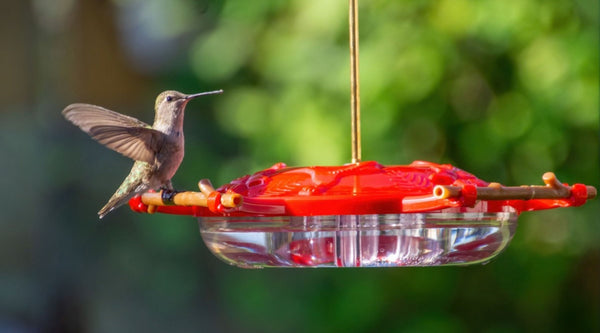
- If you're in the desert scrub of the Big Bend region of Texas or a documented canyon in southern Arizona, a leak-proof feeder like the AspenPerch® Hummingbird Feeder filled with fresh Pop's Nectar gives you a genuine chance.
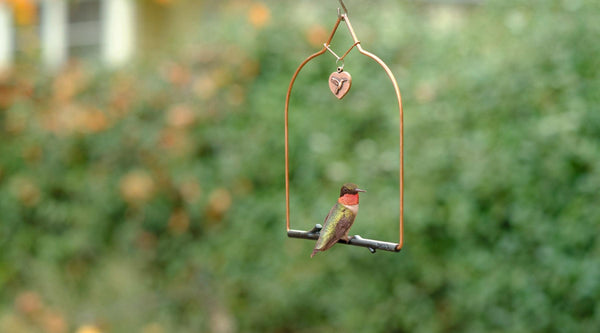
- Add a swing near your feeder — a Pop's Original Hummingbird Swing gives any visiting hummingbird a place to rest and be observed up close.
- Plant true desert natives like agave, penstemon, and cholla — not just as nectar sources, but as the exact plants this species relies on for both feeding and nesting.
- Skip the insecticide, since insects are a real part of this species' diet, especially for feeding nestlings. Use HummGuard™ nectar tips instead to manage bees and wasps without removing food this bird depends on.
- Consider a visit to Big Bend National Park. For most people hoping to see this species, a trip to the Big Bend region is simply a far more realistic path than attracting one to a home feeder outside its narrow natural range.
For general feeder timing, native plant lists, and wildflower planting guidance for the region, see our companion guides for Texas and Arizona, or find your own state in our full hummingbird guide by state series.
Frequently Asked Questions
What does the Lucifer Hummingbird's name actually mean?
It comes from the Latin meaning of Lucifer, "light-bearing," almost certainly referring to the male's brilliant iridescent purple gorget rather than any darker association with the name.
What makes the Lucifer Hummingbird's courtship display genuinely unique?
Unlike every other hummingbird species studied, which display near feeding areas, favorite perches, or group display sites, the male Lucifer Hummingbird performs his entire courtship display directly at the female's own nest while she's building it or laying eggs — a behavior described by Cornell and Birds of the World as apparently unique among hummingbirds studied to date.
Where is the best place to see a Lucifer Hummingbird in the US?
The Chisos Mountains of the Big Bend region in western Texas, where it was first documented in the United States in 1901, remain the most reliable location and the species' true US stronghold. Small numbers are also found in a few select canyons of southern Arizona and a small breeding population in New Mexico's Peloncillo Mountains.
How can you identify a male Lucifer Hummingbird?
Look for a long, distinctly curved bill, a deeply forked dark tail (though the fork is mostly visible only during flight maneuvers), a long purple gorget with a distinctive outward flare, a green back, and dingy whitish underparts.
How can you identify a female Lucifer Hummingbird?
Females look quite different from males and are easy to overlook: green above with warm buffy underparts, an especially intense cinnamon wash on the breast and throat, a dusky facial mask, and a buffy eyebrow stripe. They share the male's curved bill but have a noticeably shorter, less-forked tail.
How long do Lucifer Hummingbirds live?
The oldest recorded individual was a male at least 7 years, 5 months old when recaptured during banding operations in Texas.
How many eggs does a Lucifer Hummingbird lay?
Typically two plain white eggs, incubated by the female alone for about 15 days, with the young fledging around 19 to 24 days after hatching. Pairs may raise one to two broods per season.
Is the Lucifer Hummingbird endangered?
No, it's rated Least Concern by the IUCN with a stable global population, and the Audubon Field Guide describes its limited US population as uncommon but possibly increasing. It is, however, listed as a threatened species within New Mexico specifically, where the breeding population is small and localized.
How can I attract a Lucifer Hummingbird to my yard?
Realistically, only if you're in the desert scrub of the Big Bend region of Texas or a handful of specific canyons in southern Arizona. A feeder can help within that narrow range, alongside native desert plants like agave, penstemon, and cholla, but this species' presence is governed far more by location than by garden setup.
At Pop's Birding, we believe every backyard — big or small — has room for a little more wonder. Explore our feeders, nectars, swings, and wildflower seed blends to start building your own hummingbird sanctuary today.

Bethany Sloan has served as General Manager of Pop's Birding since 2010, continuing the legacy of her grandfather, William "Pops" Sloan, inventor of the Original Hummingbird Swing. A lifelong hummingbird enthusiast, educator, and independent researcher, she leads the company's educational content, including its 50-State Hummingbird Guide series, Regional Guide, Species Guide and Hummingbird Learning Center. Bethany combines scientific research, regional migration data, and more than 16 years of hands-on experience to create trusted educational resources for bird enthusiasts across North America.