Jul 01, 2026
How to Attract Hummingbirds in Texas: A Backyard Sanctuary Guide
Texas sits at the eastern end of the richest hummingbird corridor in the country — a band of diversity running from western Texas to southern Arizona. Birders have documented nineteen species here, more than any other state, and where you stand changes almost everything about which ones you'll meet: a backyard in Dallas regularly sees four of them, while Big Bend's mountains have logged far more.
Whether you've got a sprawling backyard shaded by live oaks or a small apartment balcony with room for one feeder, this guide will walk you through everything you need to turn your space into a Texas hummingbird hotspot: who's flying through, when to expect them, what to plant, and how to keep your feeder clean, safe, and full of happy visitors.
The short version, if you're in a hurry:
To attract hummingbirds in Texas, put up a leak-proof feeder filled with fresh, dye-free nectar about two weeks before migrants reach your region (mid-February in West Texas, mid-March in North Texas — and year-round along the Gulf Coast, where they never fully leave), keep it clean and refilled every 1–6 days depending on heat, skip the insecticide so hummingbirds can still hunt insects for protein, and plant native, nectar-rich flowers like Indian Blanket, Turk's cap, and autumn sage so your yard offers real food alongside the feeder.
- Species you'll see: nineteen documented — four common statewide, far more regular in Big Bend alone
- Best feeder type: leak-proof design with a comfort perch, like the AspenPerch® Hummingbird Feeder
- Best nectar: plain 4:1 water-to-sugar ratio, no red dye — or Pop's Nectar with added electrolytes and calcium
- Feeder timing: year-round in South Texas and the Gulf Coast; mid-February in West Texas and Big Bend; late February in Central Texas; mid-March in North Texas
- Busiest month: September, not spring — across nearly all of Texas, hummingbird numbers peak in early fall
- Nectar change frequency: every 1–2 days above 90°F, every 5–6 days below 70°F
- Pest control: no insecticide — use vinegar-water spray and HummGuard® nectar tips instead
- Top native plants: Turk's cap, autumn sage, Indian Blanket, coral honeysuckle, flame acanthus (varies by region — see below)
- Best wildflower planting window: October, for spring bloom timed to spring migration
Free download
Take Texas with you
Everything on this page on one page you can print and keep by the back door — the four species you'll actually see, feeder timing for all five regions, nectar change schedules for Texas heat, and the native plants worth putting in the ground where you are.
Download the Texas cheat sheetOne page · PDF · free to print and share
What Types of Hummingbirds Are in Texas?

Nineteen species are documented in Texas, more than any other state. Four make up most of what you'll actually see: Ruby-throated (the most numerous, a summer breeder with a genuine winter population in the Rio Grande Valley), Black-chinned (common breeder west of roughly the 97th meridian), Buff-bellied (Texas's only true year-round resident, breeding nowhere else in the U.S.), and Rufous (a common fall migrant surging through the Trans-Pecos). Far West Texas adds real breeders found nowhere else in the state: Blue-throated Mountain-gem and Lucifer (both confirmed nesting in the Chisos, Davis, and Guadalupe Mountains), Rivoli's (the same three ranges), and Broad-tailed (a mountain breeder with only occasional winter stragglers). Anna's and Costa's are real fall-and-winter Trans-Pecos visitors; Allen's is a documented regular winter resident on the upper coast; and the Calliope is an uncommon but regular statewide migrant. Big Bend's rarities are genuinely recurring, not one-offs: Mexican Violetear (104 accepted records, among the highest of any Texas review species), White-eared (49), Broad-billed (about 55, common enough to be removed from formal review in 2003), Violet-crowned (27–28 since 1987), Berylline (just 6, all in summer), and Green-breasted Mango (25, nearly annual in the Rio Grande Valley). And Texas holds one genuine first: the only U.S. record ever of an Amethyst-throated Mountain-gem, photographed near Fort Davis in October 2016.
For full identification help — photos, field marks, how to tell look-alikes apart, and all 19 documented species including the Big Bend rarities — see our complete Hummingbirds in Texas species guide.
When Do Hummingbirds Arrive and Leave Texas?
Texas is too big for one answer. Big Bend gets its first arrivals in early March, Central Texas in mid-March, and North Texas not until late March — while South Texas has hummingbirds every week of the year and never really has an off-season at all. Across nearly the whole state, numbers peak in September, not spring.

Arrival and departure windows by region, based on eBird checklist data (Cornell Lab of Ornithology), 2016–2025. See our Texas hummingbird calendar for the full month-by-month breakdown.
🗓️ Feeder Timing at a Glance
Put your feeder up: About two weeks before the first arrivals where you live — mid-February in West Texas, late February in Central Texas, mid-March in North Texas.
Take it down: About two weeks after the last hummingbird you see. Across most of Texas that means late October or November — later than most people expect.
South of San Antonio, don't take it down at all. Buff-bellied Hummingbirds are year-round residents in the Rio Grande Valley, and along the Coastal Bend, Rufous Hummingbirds keep moving through in real — if week-to-week fluctuating — numbers all winter. A feeder in Brownsville or Corpus Christi has customers in January.
For the full month-by-month breakdown — every region, both charts, and exactly when each species moves through — see our complete Texas hummingbird calendar.
How to Attract Hummingbirds in a Small Yard, Balcony, or Big Property
You don't need acres of land to invite wonder into your yard. Hummingbirds are famously adaptable — all they're really looking for is a dependable food source, a safe place to perch, and a little place to become territorial over.

Small Patio or Balcony
One feeder hung from a bracket or shepherd's hook, paired with a potted Turk's cap or autumn sage — both do well in containers and are the same top performers recommended throughout this guide — is plenty to get noticed. Hummingbirds are solitary feeders by nature, so a single feeder works great in tight spaces. In Texas heat, hang the feeder somewhere it gets afternoon shade rather than sun all day; it slows nectar spoilage as much as it keeps the birds comfortable. We put together a guide to which hummingbird products work best on a small patio or balcony if space is tight.
Average Backyard
Add a mix of feeders and native blooms — Turk's cap and autumn sage both work well in beds or containers — along a fence line or garden bed, and give your visitors a swing or two nearby to rest and survey their territory between sips.
Large Yard with Trees
Take advantage of the shade — genuinely more important in Texas than in most of the country, since full sun accelerates nectar fermentation on top of already brutal summer heat. Tuck feeders and plantings out of harsh, direct afternoon sun, with a nearby branch or swing to perch on and watch for rivals. Spread multiple feeders far apart, since hummingbirds are territorial and will happily chase each other off a single feeder.
Hummingbird Feeding Tips in Texas
Choose a Leak-Proof Feeder
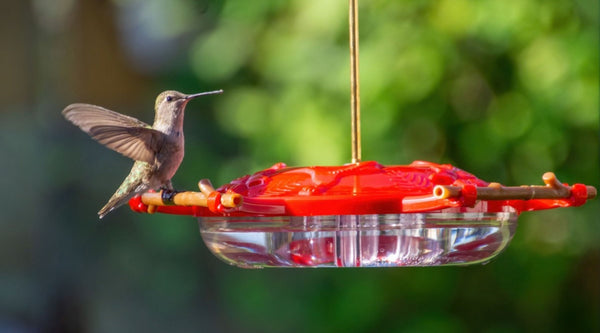
A feeder is only as good as what's in it — and how well it's kept. Pop's AspenPerch® Hummingbird Feeder was built with Texas heat in mind: a leak-proof design paired with our patented Polyperch® comfort perch, so your hummingbirds can rest and feed at the same time instead of hovering the whole meal — important here, since hovering is metabolically expensive and generates its own body heat on top of already brutal summer temperatures.
Shop the feeder
AspenPerch® Hummingbird Feeder, 8 oz

Leak-proof by design, with a patented Polyperch® comfort perch built in — so your hummingbirds can rest and feed at the same time instead of hovering through the whole meal. You get to see their tongue in action versus their back!
Shop the AspenPerch® Feeder →Only Fill What They'll Drink in a Few Days
An 8 oz feeder rarely needs to be topped all the way off — overfilling just means more nectar sitting around long enough to spoil, especially in Texas summer heat.
Skip the Red Dye
Your feeder's color does the attracting; dyed nectar offers no benefit and can be harmful to a hummingbird's health.
Use a Real Nectar Recipe
Use a 4:1 plain sugar-water ratio to make your hummingbird nectar and read our full recipe guide to get your batch right. You can also use our nectar mixing calculator for any unit of choice to get the full breakdown on sugar to water ratio. Or skip the math with the ready-to-use option below.

Just getting your first feeder going? Nectarade® Ready to Use Liquid comes pre-mixed and ready to pour — no measuring, no mixing, nothing to commit to before Texas's real September peak tells you whether you need more.
Shop the Ready to Use Nectar →How Often to Change Nectar (Texas Heat Edition)
Sugar water ferments faster the hotter it gets, and Texas doesn't do "mild." Use this as your rule of thumb:
| Outdoor Temp | Change Nectar Every |
|---|---|
| Below 70°F | 5–6 days |
| 70–80°F | 3–4 days |
| 80–90°F | 2–3 days |
| Above 90°F | 1–2 days |
If the nectar ever looks cloudy before that window is up, change it early — cloudiness means it's already started to ferment.
Wondering how long nectar actually lasts? Our full guide to how long hummingbird nectar lasts covers storage, fermentation, and warning signs in more depth.
Keep Feeders Pest-Free Without Insecticide
Hummingbirds don't live on nectar alone — small insects make up a big part of their protein diet, especially for feeding chicks. That means insect spray is off the table around your feeding station; it removes a food source hummingbirds depend on and can be harmful to them directly. Clean your feeder every time you change the nectar, using warm water and a bottle brush — no soap residue, no bleach. A little vinegar and water solution works great for breaking down sticky buildup or the beginnings of mold. Our practical guide to cleaning hummingbird feeders walks through the whole routine.
Ants
Fire ants specifically are a serious Texas problem most northern feeder advice never mentions — they'll swarm a dripping feeder fast, and an ant moat filled with water is worth using as standard equipment here, not just an occasional fix. A vinegar-water spray around (not on) the feeder ports, or a wipe-down of the hanging hook where ants tend to march down, both help too.
Dealing with a real ant problem? Our full guide to keeping ants out of a hummingbird feeder covers every fix that actually works.
Bees and Wasps
Bees and wasps are drawn to the same sugar water, and they'll crowd a feeder's ports faster than most people expect in Texas heat.
Bees and wasps still crashing the party? Our full guide to keeping bees away from a hummingbird feeder has the fixes.

Still crashing the party? HummGuard® Nectar Tips slide onto the AspenPerch's feeding ports — a flexible membrane lets hummingbird beaks through and closes tight against anything bigger.
Shop HummGuard® Tips →Plant a Texas Native Hummingbird Garden
Feeders are a wonderful supplement, but nothing beats real, native nectar. Native plants evolved right alongside Texas hummingbirds, so they bloom on the right schedule and produce exactly the nectar these birds are looking for.
Best Native Nectar Plants by Texas Region
- Central & Hill Country: Autumn sage, Turk's cap, red columbine, coral honeysuckle, cedar sage
- South Texas & Gulf Coast: Turk's cap, Esperanza (Yellow Bells), tropical sage, firebush, flame acanthus
- West Texas & Big Bend: Desert willow, red yucca, flame acanthus, chocolate daisy
- North Texas & Blackland Prairie: Crossvine, coral honeysuckle, standing cypress, Texas lantana, autumn sage
Pop's tip: Aim for something blooming in spring, summer, and fall — that way your garden is feeding hummingbirds whether they're arriving in March or fueling up for the trip south in October.
If You're Near the State Border
Hummingbirds don't check a map before deciding where to feed, so if you're near a state line, your best guide might be a blend of both.
Near New Mexico: West Texas and eastern New Mexico share very similar desert timing and native plants, and Palmer Penstemon performs noticeably better here than farther east in Texas. See our New Mexico hummingbird guide for more.
Near Oklahoma: Black-chinned Hummingbirds have been steadily expanding eastward through Oklahoma — if you're just south of the Red River, you may be seeing the leading edge of that same shift. See our Oklahoma hummingbird guide for more.
Near Arkansas: East Texas shares Arkansas's humidity and soil more than Central Texas does, and Perennial Lupine — a poor performer in most of Texas — is confirmed native just across this border. See our Arkansas hummingbird guide for more.
Near Louisiana: Southeast Texas shares Louisiana's Gulf Coast timing and winter-visitor lineup, including Buff-bellied and Rufous Hummingbirds. See our Louisiana hummingbird guide for more.
To make this easy, our Perfect Little Sanctuary® Hummingbird Wildflower Seed Blend is designed to bring nectar-rich color into your yard with minimal fuss.
When to Plant the Perfect Little Sanctuary® Blend in Texas

Fall is prime planting season across most of Texas — aim for late September through early November, with October as the sweet spot. Fall-sown seed gets natural cold stratification over winter and is ready to germinate as soon as temperatures warm in spring, giving you blooms timed almost perfectly with the spring hummingbird migration. A light spring planting works too, but you'll see fewer blooms your first season.

Ready to plant? Perfect Little Sanctuary® Wildflower Seed Blend packs all 12 varieties into one packet — no separate shopping trips before Texas's October planting window.
Shop the Seed →Top Performers in Texas
The Perfect Little Sanctuary® blend contains 12 varieties, and a handful are especially well-suited to Texas heat and drought — several are even Texas natives:
- Indian Blanket (Gaillardia pulchella) — a Texas native and one of the toughest, most drought-proof bloomers around. Texas is its original home; the populations now found across the Southeast likely spread from here.
- Lance-Leaved Coreopsis (Coreopsis lanceolata) — native across much of the central and eastern US, including Texas, and thrives in the heat.
- Black-Eyed Susan (Rudbeckia hirta) — Texas native, reliable through heat and drought.
- Purple Coneflower (Echinacea purpurea) — only truly native to a small pocket of Northeast Texas (the prairie coneflower most of the state shares is a different species, Echinacea angustifolia), but still a proven heat- and drought-tolerant performer once established.
- Painted Daisy (Chrysanthemum carinatum) — not a North American native, but a dependable heat- and drought-tolerant bloomer from summer through fall.
- Palmer Penstemon (Penstemon palmeri) — a hummingbird favorite that loves heat and drought; performs especially well in Central and West Texas.
Pop's tip: You don't need to do anything special to favor these — just sow the blend as directed. The rest of the mix still adds seasonal color, but these varieties are the ones that will do the heaviest lifting in a Texas yard.
Give Them a Place to Rest
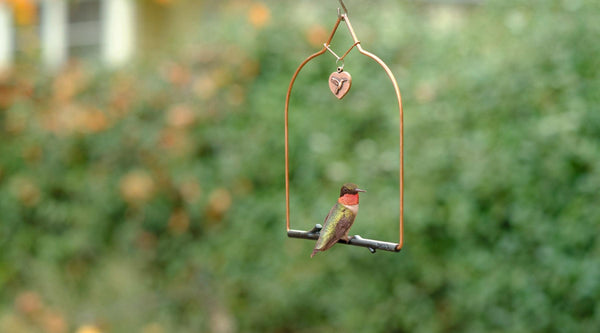
Hummingbirds spend about three-quarters of the day perched when food is plentiful, and as little as about a fifth when it's scarce. Research shows hummingbirds rest near good food and guard it from nearby perches. Giving them a comfortable perch beside your feeder is Pop's reasoning, built on that behavior. See our research on why hummingbirds prefer to perch for the full picture. It matters more than usual in Texas come August, when Rufous Hummingbirds surge through Big Bend and beyond — one of the feistiest species in North America, known for challenging birds twice their size over a feeder. More perches spread further apart genuinely means fewer standoffs during that stretch. A Pop's Original Hummingbird Swing hung near your feeder gives them exactly that spot, and it turns your feeding station into a front-row seat for watching them up close. Hang it about 1 foot from your feeder, at the same height (Pop's rule of thumb), and don't be surprised if a hummingbird claims it as their own personal lookout post. Our guide to where to hang your hummingbird swing covers placement in more detail — height, distance, and the sightlines that make one get used.
Shop the Perfect Perch
Original Series Hummingbird Swing, Onyx

A second swing gives a chased-off bird its own perch to fall back to — especially useful once Rufous Hummingbirds surge through Big Bend in August, known for challenging birds twice their size over a single feeder.
Shop the Original Swing →Keep Your Sanctuary Safe from Predators
A feeding station draws more than hummingbirds, and knowing what's actually worth worrying about — and what isn't — makes for a safer yard. Cats and window strikes are the two best-documented threats to hummingbirds around any home. See our full Hummingbird Predators guide for the complete picture.
Texas has a real, documented predator of its own worth knowing about: the National Audubon Society reports a common green darner dragonfly caught and ate a Ruby-throated Hummingbird on a picnic table in Port Arthur, photographed by a birder in the act — Audubon notes the two animals are close in size, "so it must have been quite a fight." A 2017 peer-reviewed study in the Wilson Journal of Ornithology also names Texas among the top five U.S. states for a stranger threat: praying mantises, especially the invasive Chinese mantis, ambushing hummingbirds at feeders. Neither is common enough to change how you set up your yard — hang feeders away from dense perching cover a large mantis could ambush from, and that's about it.
Summary: Key Takeaways for Attracting Hummingbirds in Texas
Building a hummingbird-friendly yard doesn't take a green thumb or a big budget — just a little consistency and the right setup. Here's everything from this guide in one place:
- Nineteen hummingbird species have been documented in Texas — the state sits at the eastern end of the country's richest hummingbird corridor, which runs from western Texas to southern Arizona, and at the crossroads of the Central and Mississippi Flyways.
- The four most common species are Ruby-throated, Black-chinned, Buff-bellied (year-round in South Texas), and Rufous (fall migration and winter).
- Feeder timing depends on region: leave feeders up year-round in South Texas and along the Gulf Coast, mid-February in West Texas, late February in Central Texas, and mid-March in North Texas.
- Fall is the busiest season across nearly all of Texas — hummingbird numbers peak in September, not spring.
- Big Bend and the Davis Mountains host far more species than the rest of the state combined — real breeders like Lucifer, Blue-throated Mountain-gem, and Rivoli's, plus regular winter visitors and Texas's rarest hummingbird records — making far West Texas the most species-rich hummingbird area in the country outside southeast Arizona.
- Any size space works — one feeder is plenty for a balcony; larger yards can support multiple feeders spaced apart, since hummingbirds are territorial.
- Use a leak-proof feeder with a comfort perch, like the AspenPerch®, and fill it only as full as it'll be drunk in a few days.
- Skip red dye in nectar; a plain 4:1 sugar-water ratio or Pop's Nectar (with electrolytes and calcium) both work.
- Change nectar every 1–2 days above 90°F, up to every 5–6 days below 70°F.
- Clean the feeder at every nectar change with warm water and vinegar — no soap or bleach.
- Never use insecticide near feeders; hummingbirds rely on insects for protein. Use vinegar-water spray and HummGuard® nectar tips for pest control instead.
- Add a hummingbird swing near the feeder to give them a place to rest and be observed up close.
- Cats and window strikes are the two best-documented threats to hummingbirds; Texas also sees real, if uncommon, predation from dragonflies and praying mantises.
- Native, nectar-rich plants (Turk's cap, autumn sage, Indian Blanket, coral honeysuckle, flame acanthus, depending on region) do more for hummingbirds long-term than feeders alone.
- Sow wildflower seed in October for blooms timed to spring migration; Indian Blanket, Lance-Leaved Coreopsis, Black-Eyed Susan, Purple Coneflower, Painted Daisy, and Palmer Penstemon are the strongest Texas performers in Pop's Perfect Little Sanctuary® blend.
Get these basics in place, and the wonder takes care of itself.
This guide covers what's specific to Texas — the species, the timing, the plants that belong here. For the fundamentals that apply anywhere, including water sources, shelter, and how the pieces work together, read our guide to building the ultimate hummingbird sanctuary.
Frequently Asked Questions
A few of the questions we hear most from fellow hummingbird lovers across Texas:
What are common mistakes when feeding hummingbirds?
The big three: overfilling the feeder so nectar sits around long enough to spoil, adding red dye (unnecessary — your feeder's own color does the attracting), and not cleaning often enough in Texas heat. A close fourth is placing the feeder in direct afternoon sun, which speeds up fermentation no matter how often you change it. Fix all four and most feeding problems solve themselves.
Do hummingbirds like feeders without perches?
They don't need one — hovering while feeding is their default — but they'll use a perch readily when it's there, resting between sips instead of burning energy the whole meal. That matters even more in Texas heat: hovering is metabolically expensive and generates its own body heat, so a bird that can perch and feed instead of hover the entire visit is working less hard in conditions that are already demanding. That's the reasoning behind the AspenPerch's built-in Polyperch® comfort perch: it doesn't change whether hummingbirds visit, but it changes how long they stay once they do.
What happens if you don't boil sugar water for hummingbirds?
Nothing dangerous — boiling isn't strictly required. Its real purpose is helping sugar dissolve fully in cooler water and giving nectar a slightly longer shelf life before fermenting, not eliminating some hidden risk. Warm tap water dissolves sugar just as well. In Texas specifically, boiling matters far less than sticking to the change schedule — nectar left out through a 95°F afternoon will ferment on its own timeline regardless of whether it was boiled going in, so the temperature table below does more real work than the boiling step ever will.
When should I put my hummingbird feeder out in Texas?
In South Texas and along the Gulf Coast, don't take it down at all — Buff-bellied Hummingbirds are year-round residents in the Rio Grande Valley, and Rufous Hummingbirds keep the Coastal Bend active through winter. In West Texas and Big Bend, aim for mid-February: Lucifer Hummingbirds are typically the first species to arrive, in early March, with Black-chinned and Broad-tailed both arriving through the rest of the month. Central Texas, late February. North Texas, mid-March.
What is the number one plant to attract hummingbirds in Texas?
If you can only plant one thing, make it Turk's cap. It's the rare plant that performs well in nearly every region covered on this page — Central Texas, the Hill Country, South Texas, and the Gulf Coast all list it as a top performer — and it keeps blooming through the Texas heat that shuts down less drought-tolerant flowers by midsummer. Autumn sage is the strong second choice, especially in Central Texas and the Hill Country.
Is it bad to leave my feeder up in fall?
Not at all — it's a myth that a feeder left up will delay migration. Hummingbirds migrate based on daylight and instinct, not food availability, and a full feeder just helps them refuel for the journey ahead. In Texas specifically, this matters more than in most states: the fall decline is gradual, not sudden — Ruby-throated are still showing up on roughly one checklist in twenty by the end of October, with real stragglers into November — so a feeder left up isn't just harmless, it's genuinely still catching late migrants passing through. South of San Antonio, don't take it down at all.
What are the best plants to attract hummingbirds in Texas?
Turk's cap, autumn sage, and coral honeysuckle perform well across most of the state, with Esperanza and flame acanthus especially strong in South Texas and the Gulf Coast, and desert willow and red yucca better suited to West Texas. Native, tubular, red or orange flowers are the general rule of thumb.
Texas Hummingbird Resources
Audubon Chapters, Centers & Sanctuaries
Texas has one of the largest Audubon networks in the country, with dozens of local chapters and several Audubon-run Centers & Sanctuaries open to the public statewide. Find the one closest to you with Audubon's Find Your Local Audubon tool.
If You Find an Injured or Grounded Hummingbird
Hummingbirds are protected under federal and Texas state law, so only a licensed wildlife rehabilitator can legally care for one.
- Texas Parks & Wildlife Department — Wildlife Rehabilitators by County — the official, regularly updated statewide directory, searchable by county
- Wildlife Center of Texas (Houston) — a dedicated trauma and rehabilitation center for injured, sick, or orphaned native Texas wildlife
Hummingbird Research & Banding in Texas
- Gulf Coast Bird Observatory (Lake Jackson) — hosts monthly public bird banding sessions and ongoing hummingbird research; also hosts the annual Xtreme Hummingbird Xtravaganza, listed under Events below
- Hummer House (West Texas, South Concho River corridor) — a ranch-based hummingbird banding research site running for more than 20 years, known especially for its Black-chinned Hummingbird population
Hummingbird Events & Festivals in Texas
- Rockport-Fulton HummerBird Celebration (Rockport and Fulton) — one of the most established hummingbird festivals in the country, celebrating the fall Ruby-throated Hummingbird migration along the Gulf Coast. Features speaker programs, guided birding trips, hummingbird home tours, and public bird banding demonstrations. Held every year, each September.
- Davis Mountains Hummingbird Festival (Fort Davis, West Texas) — a multi-day event centered on the exceptional hummingbird diversity of the Davis Mountains, with field trips, seminars, and a banquet. Held every other year, in late August. Registration typically required in advance.
- Xtreme Hummingbird Xtravaganza at Gulf Coast Bird Observatory (Lake Jackson) — a public hummingbird banding celebration held during peak fall migration, including symbolic hummingbird adoptions and live banding demonstrations. Held every year, each September.
- Hummingbird Festival at Kleb Woods Nature Center (Tomball, Harris County) — a free, long-running community event hosted by Harris County Precinct 4, featuring live hummingbird banding, guided nature walks, and a historic homestead tour. Held every year, each September during peak fall migration.
Sources
- eBird bar chart data, Cornell Lab of Ornithology — Texas statewide plus Hidalgo, Nueces, Travis, Dallas, and Brewster counties, 2016–2025. All arrival, departure, and species frequency figures on this page come from this dataset.
- Texas Breeding Bird Atlas (Robert C. Tweit and Felipe Chavez-Ramirez, 1987–1992 fieldwork) and the Texas Bird Records Committee state and review lists — breeding status, record counts, and rarity classifications for every species named on this page.
- Nyffeler, M., Maxwell, M.R., and Remsen, J.V. Jr. (2017). "Bird Predation By Praying Mantises: A Global Perspective." The Wilson Journal of Ornithology 129(2):331–344.
- National Audubon Society, "Which Animals Prey on Hummingbirds?" — the Port Arthur dragonfly predation record.
Why We Built This Guide
Pop's Birding has been helping hummingbird lovers for three generations. One of the questions our customers ask most often is "How do I actually attract more hummingbirds to my yard?" — we built this guide to give a direct, practical answer, not a generic one. Most feeder advice online is the same handful of tips repeated regardless of where you live, but a nectar-change schedule written for a mild climate is genuinely wrong for a Texas summer, and a plant list that ignores the difference between the Hill Country and the Gulf Coast will have you planting things that never bloom on time — or never bloom at all. We wanted a guide that actually accounts for Texas heat, Texas regions, and Texas timing, not one that happens to mention Texas in the title.
How We Built This Guide
The feeder-timing figures on this page are pulled from the same eBird checklist data (Cornell Lab of Ornithology, 2016–2025, statewide plus five representative counties) behind our Texas hummingbird calendar — see that page for the full methodology. The nectar-change schedule is calibrated in bands by actual outdoor temperature rather than a generic "keep it fresh" rule, since a schedule written for a mild-summer state would leave Texas nectar spoiling far more often than it should. The native plant lists are organized by Texas's own distinct growing regions rather than one statewide list — Hill Country clay, Gulf Coast humidity, and Big Bend desert don't support the same plants — and the border-state notes (Palmer Penstemon performing better near New Mexico, Perennial Lupine confirmed native just across the Arkansas line) come from checking each neighboring state's own native plant records directly. This regional plant breakdown and the border-specific notes are original to this guide, not a repeat of generic national hummingbird-gardening advice.
Haven't grabbed it yet? Download the free Texas Quick Reference Guide — one page, print and keep.
Know before they arrive
You don't have to keep this calendar taped to the fridge. Insider Birding Access members get seasonal notes timed to your region — when to have feeders out, what the birds are doing right now, and what's worth doing in your yard this season. We take the guesswork out of the calendar. Joining takes about thirty seconds, and there's 10% off your first order in it.
Join Insider Birding Access →Free to join. 10% off your first order.
Your Texas Backyard Sanctuary
Every real hummingbird sanctuary comes down to the same staples: mess- and pest-free food, a place to perch, native flowers, and fresh nectar. Here's everything from this guide to get all the bases covered in your own Texas yard.


Bethany Sloan has served as General Manager of Pop's Birding since 2010, continuing the legacy of her grandfather, William "Pops" Sloan, inventor of the Original Hummingbird Swing. A lifelong hummingbird enthusiast, educator, and independent researcher, she leads the company's educational content, including its 50-State Hummingbird Guide series, Regional Guide, Species Guide and Hummingbird Learning Center. Bethany combines scientific research, regional migration data, and more than 16 years of hands-on experience to create trusted educational resources for bird enthusiasts across North America.