May 20, 2023
How Long Does Hummingbird Nectar Last? Recipe & Storage Guide
Quick answer: Once nectar is in a feeder outdoors, you should change it every 2–3 days in normal weather and every 1–2 days in hot weather (90°F+), since heat speeds fermentation and mold growth. Homemade nectar that hasn't been put in a feeder yet can be refrigerated in a sealed container for up to 1 week. Unopened, sealed Nectarlyte® or Nectarade® is guaranteed for 3 years when stored in a cool, dry place out of direct sunlight; once opened or mixed, follow the same guidance as any other nectar.
Nectar shelf life — whether you call it hummingbird food, sugar water, or hummingbird water — comes down to two very different questions: how long it lasts sitting in a feeder outdoors, and how long it lasts stored before you use it. Mixing these up is where most spoilage problems start. This guide covers both, plus how often to change the nectar in your feeder at any outdoor temperature.
How to Make Hummingbird Nectar: 1 Part Sugar to 4 Parts Water
The Basic Recipe
Quick answer: Mix 1 part white granulated sugar with 4 parts water — for example, 1 cup of sugar to 4 cups of water. Boil the water first, stir in the sugar until it's fully dissolved, then let the mixture cool completely to room temperature before filling your feeder.
- Boil water to help the sugar dissolve fully and remove impurities.
- Stir in white granulated sugar at a 1:4 ratio (sugar to water) until completely dissolved.
- Let the mixture cool to room temperature before filling feeders — hot nectar can damage plastic feeder parts.
- Store any extra in a sealed, airtight container in the refrigerator (see storage guidance below).
Want the full method, or a copy for the fridge door? Our complete Hummingbird Nectar Ratio Guide covers why the ratio stays at 1:4 in cold weather, batch sizing for any feeder, and why 1:4 is the number nearly every wildlife agency lands on. If you'd rather just have the recipe to hand, download the printable nectar recipe card (PDF) — ratio, steps, and the storage note on one clean page.
Never use honey, brown sugar, artificial sweeteners, or red food coloring — these can be harmful to hummingbirds. Stick with plain tap, well, or bottled spring water — skip distilled water, which is stripped of the natural minerals hummingbirds benefit from, and go easy on heavily softened water, which can add unwanted salts.

Skip the boiling and the measuring. Nectarlyte® Powder Concentrate mixes to the same 1:4 strength in warm water, so the ratio is right every time — and because you mix only what your feeder holds, there's no leftover batch sitting in the fridge counting down its week.
Shop Nectarlyte® Powder →Adjusting for Weather
1:4 is your everyday standard — it's the ratio recommended by the Smithsonian and most wildlife agencies, and the one used throughout this guide. Some feeding guides allow a slightly richer mix, up to about 1:3, during cold, rainy spells when fresh water is plentiful. In freezing weather, though, winter hummingbird groups recommend staying at 1:4. Either way, 1:4 is the right default all year. Our free Nectar Change Calculator uses 1:4 as its baseline.
Hummingbird Nectar Ratio Chart by Feeder Size:
| Feeder Size | Sugar | Water |
|---|---|---|
| Small (~8 oz) | ¼ cup | 1 cup |
| Medium (~16 oz) | ½ cup | 2 cups |
| Large (~32 oz) | 1 cup | 4 cups |
Is plain sugar water really all they need? Sugar is the calories, but it isn't the whole story — our breakdown of electrolyte nectar vs. plain sugar water covers what's actually in each and when the difference matters.
How Much to Make
How much should you actually fill your feeder? Only as much as your hummingbirds will finish within your normal change window — 2–3 days in mild weather, 1–2 days in heat. A large feeder visited by just one or two hummingbirds spoils just as fast, in real terms, as a small one: fermentation starts the moment nectar is mixed, so fewer birds simply means less gets consumed before it goes bad. If you don't have many visitors yet, use a small-batch amount (see the "Small" row above) or fill a larger feeder only partway rather than topping it all the way off — that avoids both wasted nectar and unnecessary spoilage risk.
A Balanced Backyard
Think of your feeder as one dish on the buffet, not the whole spread. Native, nectar-rich flowers are the main course — they offer natural nectar plus the small insects hummingbirds need for protein, something a feeder alone can't provide. Your feeder is a wonderful, reliable addition to that spread, not a replacement for it.
There's an angle here that matters for a guide about shelf life, too: flowers are the one part of a hummingbird's food supply with no change schedule attached. Nectar in a bloom renews itself and never needs dumping, so a planted yard keeps feeding birds on the days you're travelling, busy, or simply a day late to the feeder. Pair a feeder with a few hummingbird-friendly plants nearby and you've built a proper buffet line, not just a dessert table.

Ready to put some of that main course in the ground? Pop's Hummingbird & Butterfly Wildflower Seed is a 12-variety pollinator mix — Palmer penstemon, purple coneflower, perennial lupine and more — chosen for a range of bloom shapes, heights and colors. One packet covers about 10 square feet.
Shop Wildflower Seed →Nectar in the Feeder: 2–3 Days, More in Heat
Once nectar is out in a feeder, exposed to sun, heat, and the elements, it starts fermenting far faster than nectar sitting in your fridge. As a general guideline:
- Hot weather (90°F+): replace every 1–2 days, sometimes daily
- Normal/moderate weather: replace every 2–3 days
- Below 70°F: every 5–6 days
How Often Should You Change Hummingbird Feeder Nectar?
Every 2–3 days in normal weather, and every 1–2 days once it's 90°F or hotter. That's the whole answer, and it doesn't change based on what you call the mixture. "Hummingbird food," "sugar water," "hummingbird water," and "nectar" are all the same thing — a sugar-and-water solution — so the schedule for changing hummingbird water is identical to the schedule for changing nectar. It also doesn't change based on how much the birds have drunk: a feeder that's still three-quarters full on day three still needs emptying, because the clock starts when the nectar is mixed, not when the level drops.
One common mix-up worth clearing up: people often search for how often to change a hummingbird feeder. The feeder itself doesn't get replaced — it's the nectar inside that gets changed, and the feeder gets washed at the same time. Every nectar change is also a cleaning, which is what actually keeps mold from establishing in the reservoir and ports.
For a more precise breakdown by actual outdoor temperature — a quick nectar change chart by temperature:
| Outdoor Temperature | Replace Nectar |
|---|---|
| Below 70°F | Every 5-6 days |
| 70–80°F | Every 3–4 days |
| 80-90°F | Every 2–3 days |
| 90°F and up | Every 1-2 days |
Our chart sums up state wildlife agency guidance, which ranges from every other day to about a week depending on heat — Virginia's Department of Wildlife Resources says every 2–5 days, more often the warmer it gets, and the Smithsonian's National Zoo says at least weekly in cooler weather. Feeders in full sun spoil faster than shaded ones (Becker et al. 2013).
Want your exact schedule instead of a general range? Our free Nectar Change Calculator factors in your local temperature and nectar ratio to tell you exactly when your feeder needs a refill.
How Long Can Nectar Stay Out in the Feeder?
The same window, read from the other direction: nectar can safely stay out in a feeder for 2–3 days in ordinary weather, and 1–2 days once temperatures climb past 90°F. Below 70°F you can stretch it to 5–6 days. Past that, you're no longer relying on a schedule — you're relying on luck.
Two things shorten the window faster than the calendar suggests. Direct sun is the first: a feeder hanging in full afternoon sun runs far hotter than the air temperature around it, so the "90°F and up" row can apply on an 80°F day. Shade is the single cheapest fix there is. The second is a feeder that's too big for the traffic it gets — a 32 oz reservoir serving two birds is mostly a fermentation tank with a perch on it.
How Often to Change Hummingbird Nectar in Summer and Hot Weather
In summer, assume the 1–2 day schedule any time the forecast hits 90°F, and change daily during a genuine heat wave. Heat is the accelerant for everything that goes wrong in a feeder: fermentation, bacterial growth, and mold all move faster as the temperature climbs, which is why a batch that looked perfect at breakfast can be cloudy by dinner.
Three habits make hot weather manageable. Hang the feeder where it gets afternoon shade. Fill it only as full as the birds will drink in a day or two. And try wrapping the nectar reservoir in aluminum foil — the reflective surface bounces heat and sunlight away rather than absorbing it, and as a bonus the glare can help deter bees and squirrels. Foil is an extra layer during a heat wave, not a replacement for shade or your regular schedule; keep changing nectar every 1–2 days at 90°F+, foil or no foil.
Insects are the other hot-weather variable, and they're a freshness problem rather than just a nuisance. Bees and wasps crowding the feeding ports leave debris behind, and any that drown in the reservoir have to be fished out — which in practice means dumping the whole batch early, whatever the calendar said. Ants do the same thing on a smaller scale, and they arrive in numbers. Keeping insects out of the nectar is one of the simplest ways to make a change schedule actually hold.

If bees are the real problem, skip the foil workaround. Hummguard® Nectar Tips sit in the feeding ports and let hummingbirds' long tongues through while keeping bees and wasps out — which also means less nectar lost to insects between changes.
Shop Nectar Tips →Losing more nectar to insects than to birds? The two culprits need different fixes, so we've covered them separately: how to keep bees away from a hummingbird feeder deals with what's happening at the ports, and how to keep ants out of a hummingbird feeder deals with the trail up the hanger. Both walk through what actually works and what just makes a mess.
How Often to Change Hummingbird Nectar in Winter
Cold weather buys you time. Below 70°F, every 5–6 days is generally fine. Heated feeders are the exception: warmth speeds up spoilage, so check a heated feeder daily and change it more often. In genuinely cold conditions spoilage stops being the limiting factor at all. What replaces it is freezing. Sugar water freezes at a lower temperature than plain water does, but it will still freeze solid in a hard freeze, and a frozen feeder is no use to a bird that needs calories most on the coldest mornings.
So in winter the job changes shape: you're checking the feeder for ice and slush more than you're checking it for cloudiness. Bringing the feeder in overnight and putting it back out before first light, or rotating two feeders so one is always thawed, solves it without any special equipment. Keep the regular 1:4 even when it freezes, and protect the feeder instead. Our winter hummingbird feeder care guide covers heated feeders, the night swap and two-feeder rotation.
Whatever the temperature, trust the nectar over the schedule. Signs it has gone bad in the feeder: cloudiness, a visibly darker or yellowish tint, or visible mold (often black) inside the reservoir or ports. If you see any of these, dump it immediately regardless of how many days it's been — don't wait for the "scheduled" refill.
Every nectar change is also a cleaning. Rinsing isn't enough once mold has a foothold — our complete guide to cleaning your hummingbird feeder covers the vinegar method, black mold on rubber gaskets, and how the feeder's design changes how long the job takes.
Choose a Leak-Proof Feeder That's Easy to Clean
The feeder itself has more to do with how long nectar lasts than most people expect, and both of the reasons come back to the same place. A feeder that drips is losing nectar to the ground before a bird ever gets it — and the sticky trail it leaves down the hanger is exactly what brings ants and wasps up to the ports, which puts you right back in the contamination problem above.
The second reason is plainer: a feeder that's a fight to take apart is a feeder that gets a quick rinse instead of a real wash, or gets skipped altogether on a busy week. Neither of those looks like a nectar problem on paper, but both shorten how long a batch actually stays good. So when you're choosing one, two things matter more than capacity — does it seal, and does it come apart without a struggle.
Shop the feeder
AspenPerch® Hummingbird Feeder, 8 oz

A nectar-change schedule only works if you'll actually keep it. The AspenPerch® is built around that reality: leak-proof, dishwasher-safe, and it comes apart without tools or a special brush, so a full change and wash takes minutes instead of becoming the chore you put off until Saturday. The 8 oz size is also the right capacity for most backyards — enough nectar for a busy feeder, little enough that you're not pouring half of it down the drain every other day.
Shop AspenPerch® →What Happens If a Hummingbird Drinks Spoiled Nectar?
This is the real reason all the guidance above matters. Spoiled nectar isn't just "less fresh" — it can make hummingbirds sick. Sugar water left out too long, especially in heat, becomes a breeding ground for mold and bacteria. The Missouri Department of Conservation warns that bacteria growing in a dirty feeder can sicken hummingbirds, and that honey mixed with water can grow a dangerous fungus that attacks their tongues. Regularly changing nectar and keeping your feeder clean is the simplest protection you can give them.
What about the "drunk hummingbird" alcohol myth? You may have heard that fermented nectar gives hummingbirds alcohol poisoning or liver failure. The research doesn't support that. A 2023 University of California, Berkeley study found Anna's Hummingbirds tolerate low levels of ethanol without issue, and hummingbirds' extremely fast metabolisms burn through what little alcohol naturally occurs in nectar before it can meaningfully accumulate. The genuine danger of spoiled nectar isn't alcohol — it's the mold and bacteria described above. Keep your feeder on schedule for that reason, not the fermentation scare.
Changed the nectar and the birds still aren't showing up? Stale nectar is one reason a feeder goes quiet, but it's not the only one. Start with seven fixes for a feeder hummingbirds are ignoring, or, if the feeder is brand new, why hummingbirds sometimes take weeks to find a new feeder.
Homemade Nectar in Storage: Refrigerator Guidelines (Up to 1 Week)
If you're batch-making homemade nectar ahead of time, the unused portion can be stored in a clean, sealed, airtight container in the refrigerator for up to 1 week. Before using stored nectar, always check for cloudiness or mold, and let it come to room temperature before filling a feeder — cold nectar straight from the fridge is fine for hummingbirds, but many people prefer to let it warm slightly first.
That one-week figure applies to homemade hummingbird food, sugar water, and mixed concentrate alike — refrigerated, sealed, and not yet poured into a feeder. The moment it goes into a feeder, the much shorter 2–3 day clock takes over, and the days it already spent in the fridge count against it.
Does Hummingbird Nectar Need to Be Refrigerated?
Only the batch you're saving. Nectar you've just mixed and are about to pour into a feeder doesn't need to be chilled first — it only needs to be cooled to room temperature so it doesn't warp plastic feeder parts. Nectar already out in a feeder should never be brought inside and refrigerated for reuse either; once it's been out, exposed to air and visiting birds, it gets replaced rather than saved.
What does need the fridge is the leftover. Extra homemade nectar sitting on the counter will start fermenting within a day in a warm kitchen, so if you're not using it immediately, seal it and refrigerate it. If you'd rather not manage a leftover batch at all, mixing smaller amounts — or using a ready-to-use nectar — sidesteps the question entirely.
How to Store Homemade Hummingbird Nectar
Storage is simple, and the details that matter are the boring ones:
- Use a clean, airtight container. A glass jar with a sealing lid or a food-safe plastic bottle both work. What you're avoiding is an open pitcher or a loosely covered jug, where the nectar picks up fridge odors and airborne yeast.
- Cool it before it goes in. Warm nectar in a sealed container sweats, and the condensation ends up back in the mixture.
- Label it with the date you mixed it. The one-week window is easy to keep if it's written down and impossible to keep if you're guessing.
- Check before every pour. Cloudiness, stringiness, or any visible specks mean the batch is done, whether it's been a week or two days.
A practical note on batch size: mix what you'll use within the week, not the biggest batch your pot will hold. Nectar is cheap and the fridge space isn't the constraint — the constraint is that a half-used jug at day six is a jug you'll be tempted to stretch to day eight.
Can You Freeze Hummingbird Nectar?
We recommend refrigerating rather than freezing, and the reasoning is practical more than scientific. A week in the refrigerator already covers any batch you'd realistically mix at once, so freezing adds a step and a thawing decision without buying you anything you actually needed. If a batch is big enough that freezing seems necessary, the better fix is mixing less at a time.
Pop's Nectarlyte® and Nectarade®: Sealed vs. Mixed


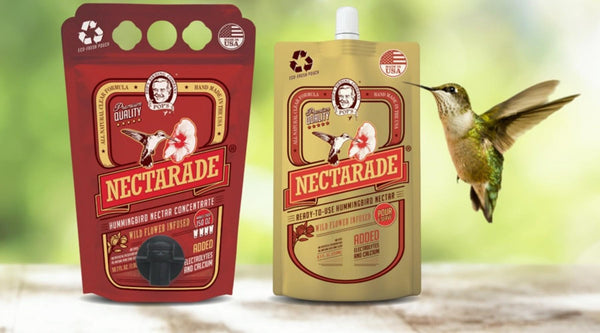
Unopened, sealed packaging: Nectarlyte® powder and Nectarade® (both Ready to Use and Concentrate) are guaranteed for 3 years when stored in a cool, dry location out of direct sunlight. As a general rule, sealed dry powder products like Nectarlyte® tend to have a longer shelf life than liquid formulas, simply due to the nature of powder versus liquid storage.
Once mixed or opened: the same feeder guidance applies as homemade nectar — 2–3 days in the feeder (sooner in heat), and if you've mixed more than you'll use right away, refrigerate the extra in a sealed container and use it within about a week to be safe.
Does Store-Bought Hummingbird Nectar Need to Be Refrigerated?
Not while it's sealed. Commercial hummingbird nectar — ours included — is shelf-stable unopened, which is why it lives on a shelf in the store rather than in a cooler. Store it somewhere cool and dry, out of direct sunlight, and it keeps for as long as the manufacturer states on the package.
After opening is where it varies, and it's worth reading the label rather than assuming. Different brands use different formulations, so the correct "use within" window for an opened bottle is the one that brand prints, not a universal number. What is universal is what happens after it leaves the bottle: once store-bought nectar is poured into a feeder, it's subject to exactly the same 2–3 day schedule as homemade, and exactly the same 1–2 day schedule above 90°F. No commercial nectar is formulated to sit in an outdoor feeder longer than homemade sugar water can.
Does store-bought nectar go bad? Yes — sealed products have a shelf life, opened ones have a shorter one, and anything in a feeder spoils on the ordinary schedule. The cloudiness-and-mold test applies regardless of where the nectar came from.
Not sure which format fits your setup? Our comparison of liquid nectar vs. powder concentrate covers cost per ounce, storage footprint, and mixing effort — and the Nectarade® FAQ answers the specifics on shelf life, dilution, and ingredients.
Quick Reference
| Situation | Guidance |
|---|---|
| Nectar in feeder (normal weather) | Replace every 2–3 days |
| Nectar in feeder (90°F+) | Replace every 1–2 days |
| Nectar in feeder (below 70°F) | Replace every 5–6 days |
| Homemade nectar, refrigerated, unused | Up to 1 week |
| Leftover nectar left on the counter | Refrigerate the same day, or discard |
| Unopened Nectarlyte®/Nectarade® | Guaranteed 3 years, sealed, cool/dry storage |
| Mixed Nectarlyte®/Nectarade®, extra batch | Refrigerate, use within about 1 week |
| Opened store-bought nectar | Follow that brand's label; feeder schedule still applies |
| Any nectar showing cloudiness or mold | Discard immediately, regardless of timeline |
Key Takeaways
- Standard homemade nectar ratio is 1 part sugar to 4 parts water — never honey, brown sugar, or artificial sweeteners.
- Nectar in a feeder should be replaced every 2–3 days normally, and every 1–2 days in hot weather.
- "Hummingbird food," "sugar water," "hummingbird water," and "nectar" are the same thing — the change schedule is identical whichever term you use.
- The feeder itself isn't what gets changed; the nectar is, and the feeder gets washed at every change.
- Unused homemade nectar can be refrigerated for up to 1 week in a sealed, dated container — we recommend the fridge over the freezer.
- Sealed, unopened Pop's products are guaranteed for 3 years in cool, dry, sealed storage.
- Once mixed or opened, any nectar — homemade, Pop's, or another brand — follows the same feeder-replacement schedule.
- Cloudiness or visible mold means it's time to discard the nectar immediately, no matter how many days have passed.
Frequently Asked Questions
How often should you change hummingbird food?
Every 2–3 days in normal weather, and every 1–2 days once it's 90°F or hotter. "Hummingbird food" and "nectar" are the same sugar-and-water mixture, so the schedule is the same either way. Change it on that timetable even if the feeder is still mostly full — the clock starts when the nectar is mixed, not when the level drops.
How often should you change hummingbird water?
The same schedule: every 2–3 days in normal weather, every 1–2 days above 90°F. "Hummingbird water," "sugar water," "hummingbird food," and "nectar" all describe the same mixture, so the timing guidance is identical regardless of which term you use.
How often should I change the nectar in my hummingbird feeder?
Every 2–3 days in normal weather, and every 1–2 days in hot weather (90°F and above), since heat speeds up fermentation and mold growth.
How often should I change my hummingbird feeder?
The feeder itself doesn't need replacing — it's the nectar inside it that needs changing, every 2–3 days in normal weather and every 1–2 days above 90°F. The feeder should be fully cleaned at each nectar change to prevent mold buildup.
How often should I change hummingbird nectar in summer vs. winter?
In summer heat (90°F and above), change nectar every 1–2 days — sometimes daily during heat waves. In cooler winter weather (below 70°F), nectar stays good longer, generally every 5–6 days. The deciding factor is always outdoor temperature, not the calendar season itself, so use the temperature chart above as your actual guide.
How long can hummingbird nectar stay out in the feeder?
2–3 days in ordinary weather, 1–2 days once temperatures pass 90°F, and up to 5–6 days below 70°F. A feeder in direct afternoon sun runs hotter than the surrounding air, so treat it as one bracket warmer than the forecast suggests, and move it into shade if you can.
How long does hummingbird nectar last in the refrigerator?
Homemade nectar stored in a sealed, airtight container in the refrigerator lasts up to 1 week. Always check for cloudiness or mold before using, and let it reach room temperature before filling a feeder.
Does hummingbird nectar need to be refrigerated?
Only if you're storing a batch ahead of time rather than using it right away. Nectar already out in a feeder should never be refrigerated — it should be replaced on the regular 2–3 day (or sooner in heat) schedule instead. Extra homemade nectar not yet in a feeder can and should go in the refrigerator, sealed, for up to 1 week.
How do you store homemade hummingbird nectar?
In a clean, airtight container — a sealing glass jar or a food-safe plastic bottle — in the refrigerator, for up to 1 week. Let it cool to room temperature before sealing it so condensation doesn't end up back in the mixture, label the container with the date you mixed it, and check for cloudiness or specks before every pour.
Can I store extra homemade hummingbird nectar?
Yes, in a sealed, airtight container in the refrigerator for up to 1 week. Check for cloudiness or mold before using, and let it reach room temperature before filling a feeder.
Can I freeze hummingbird nectar to make it last longer?
We recommend the refrigerator instead. A week in the fridge already covers any batch you'd realistically mix at once, so freezing adds a step and a thawing decision without gaining you anything. If a batch seems big enough to need freezing, the better fix is mixing less at a time.
Does store-bought hummingbird nectar need to be refrigerated?
Not while it's sealed — commercial nectar is shelf-stable unopened and should be kept somewhere cool and dry, out of direct sunlight. After opening, follow the "use within" window printed on that brand's label rather than assuming a universal number, since formulations differ. Once it's poured into a feeder, store-bought nectar follows exactly the same 2–3 day schedule as homemade.
How long does unopened Nectarlyte® or Nectarade® last?
Unopened, sealed Nectarlyte® and Nectarade® are guaranteed for 3 years when stored in a cool, dry place out of direct sunlight.
Do I need to boil the water for hummingbird nectar?
No — boiling isn't required for safety. Nectar picks up contamination the moment a hummingbird sips from the feeder, regardless of how the water was prepared, so boiled water doesn't stay sterile in any meaningful way. Boiling does help the sugar dissolve fully and quickly, which is why the recipe above calls for it — but it's a convenience, not a safety step.
How much nectar should I put in my hummingbird feeder?
Only as much as your hummingbirds will drink within your normal change window — 2–3 days in mild weather, 1–2 days in hot weather. If you only have a few visitors, a small-batch feeder or a partially-filled larger one avoids waste and keeps nectar from sitting around long enough to spoil. Overfilling a feeder that only a bird or two visits doesn't save you work — it just means more nectar reaches the fermentation point before it gets consumed.
Does aluminum foil keep hummingbird nectar cool?
Wrapping the nectar reservoir in aluminum foil can help, since the reflective surface bounces heat and sunlight away rather than absorbing it — some backyard birders also find it helps deter bees and squirrels. It's a helpful extra layer during heat waves, but not a substitute for shade or your regular nectar-change schedule; keep changing nectar every 1–2 days once temperatures hit 90°F+, foil or no foil.
How do I know if hummingbird nectar has gone bad?
Look for cloudiness, an off color, or visible mold (often black) in the reservoir or feeding ports. If you see any of these signs, discard the nectar immediately rather than waiting for your usual replacement schedule.
Can spoiled nectar make hummingbirds sick?
Yes. Nectar left out too long grows mold and bacteria, and the Missouri Department of Conservation warns that bacteria in a dirty feeder can sicken hummingbirds. Keeping feeders clean and nectar fresh on schedule is the best prevention.
Does fermented nectar make hummingbirds drunk or damage their liver?
No — this is a persistent myth, not established science. A 2023 UC Berkeley study found hummingbirds tolerate trace ethanol in nectar without issue, metabolizing it too quickly to accumulate. The real risk of spoiled nectar is mold and bacteria, not alcohol.
Summary
Nectar shelf life depends entirely on where it is: mixed fresh at a 1:4 sugar-to-water ratio, it needs replacing every 2–3 days once it's in a feeder outdoors (faster in heat, slower in cold); stored ahead of time in a sealed container in the refrigerator, homemade nectar holds for up to 1 week; and sealed Pop's products are guaranteed for 3 years until opened or mixed, at which point the same feeder-replacement rules apply. When in doubt, look at the nectar itself — cloudiness or mold means it's time for a fresh batch, regardless of the calendar.
Shop the Products That Keep Nectar Fresh
Nectar spoils on a schedule set by heat, insects, and how easy your feeder is to clean. Here's everything this guide recommends for keeping a batch good as long as it should be.


Bethany Sloan has served as General Manager of Pop's Birding since 2010, continuing the legacy of her grandfather, William "Pops" Sloan, inventor of the Original Hummingbird Swing. A lifelong hummingbird enthusiast, educator, and independent researcher, she leads the company's educational content, including its 50-State Hummingbird Guide series, Regional Guide, Species Guide and Hummingbird Learning Center. Bethany combines scientific research, regional migration data, and more than 16 years of hands-on experience to create trusted educational resources for bird enthusiasts across North America.