Jan 01, 2023
What's in Nectarade®? Ingredients, Electrolytes & Why They Matter
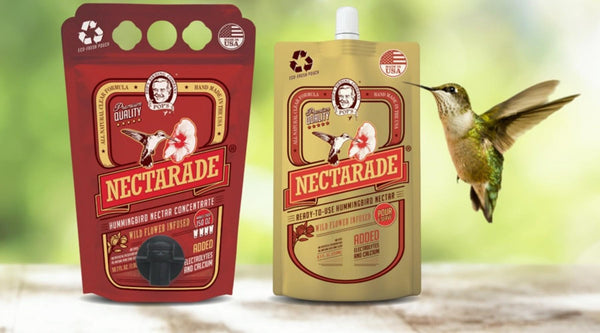
Quick answer: Nectarade® is Pop's liquid nectar, built on pure cane sugar (the same base recommended in most homemade recipes) with three small additions: potassium chloride, a mineral salt; calcium carbonate; and wildflower hydrosols, water steam-distilled from mixed wildflowers. There are no dyes and no preservatives; a little citric acid is added only to adjust pH. Mix Nectarade® Concentrate at 1 part to 2 parts water, a different ratio than Nectarlyte® powder (1:4), since Nectarade® starts more concentrated.
Hummingbirds are surprisingly particular about their food sources. Once a hummingbird finds a reliable spot, it will defend it — which means the nectar you offer should be fresh, clean and simple. When we built Nectarade®, the question we kept coming back to was what real flower nectar actually contains, and what we could honestly say about anything we added.
We Started With What the Research Actually Shows
Plain sugar water — 1 part sugar to 4 parts water, no dye, no honey — is a safe, time-tested way to feed hummingbirds, and it matches the basic sugar content of flower nectar. But flower nectar isn't pure sugar water. It carries trace mineral salts such as sodium and potassium. Because hummingbirds drink so much nectar, they are constantly getting rid of extra water, and they lose some of those salts in their very dilute urine; physiologists Calder and Hiebert found that the trace salts in flower nectar can replace most of that loss (Calder & Hiebert, 1983).
Calcium is the other piece. Field observers have repeatedly watched hummingbirds — almost always females in the nesting season — eating sand, soil, wood ash and limy grit. Researchers who reviewed those reports suggest a nectar diet alone may run short on calcium for egg-laying, partly because hummingbirds have very little of the bone calcium store other birds draw on for eggshells (Adam & des Lauriers, 1998). A 2021 study in West Mexico also found grit mostly in female hummingbirds and suggested it may help meet mineral needs related to breeding (Maya-García et al., 2021).
Those observations are what inspired Nectarade®. To be clear about what they do and don't show: they describe what wild hummingbirds do. No study has tested adding minerals to feeder nectar, so adding them is Pop's reasoning, built on that research — not a proven health benefit.
No Dye, No Preservatives — By Design, Not by Accident
Hummingbirds find flowers mainly by sight, which is why red is such a strong visual cue for them. (They do have a sense of smell: one study found wild and captive hummingbirds avoided feeders carrying the scent of certain ants, Kim et al., 2021.) Red is a good reason to use a red feeder or red accents. It's not a good reason to dye the nectar itself. The Smithsonian's National Zoo notes that red dye isn't necessary to attract hummingbirds and could be harmful to them. We simply don't see a reason to add it.
Skipping preservatives was a harder design problem. Most preservative-free liquids have a short shelf life once sealed. Our solution was the packaging itself: Nectarade® ships in a vacuum-sealed foil pouch that protects the nectar from air and light. Stored sealed in a cool, dry place, it holds for a long time; once opened, it's best used within a few months (refrigeration can extend that further, though it isn't required). The only other ingredient is a small amount of citric acid, which is there to adjust pH.
Pure Cane Sugar, Plus Wildflower Hydrosols
We use pure cane sugar as the base — the same sugar most reputable homemade nectar recipes recommend. Nectarade® also includes wildflower hydrosols: water steam-distilled from mixed wildflowers. It's a small touch of the flowers themselves. We don't claim it attracts hummingbirds or does anything for their health; hummingbirds find food mainly by sight.
Potassium and Calcium: What We Add, and Why
Nectarade® adds potassium chloride, a mineral salt like the trace salts found in flower nectar, and a little calcium carbonate, inspired by those field observations of nesting females seeking out calcium-rich grit. It's a modest addition and an honest one: it brings our nectar a little closer to the real thing, but it isn't a substitute for what hummingbirds get elsewhere. Nectar is fuel; insects supply the protein, fat and other nutrients hummingbirds need, so the best setup pairs a clean feeder with native flowers that bring both.
Getting the Ratio Right
Here's a detail worth clarifying directly, since it's a common point of confusion: Nectarade® Concentrate uses a 1:2 ratio (1 part Nectarade® to 2 parts water) — not the 1:4 ratio used for homemade sugar water or Nectarlyte® powder concentrate. That's because Nectarade® starts out more concentrated than the powder formula. A single 1.5-liter bag makes about 150 oz of prepared nectar — enough to fill a standard 16 oz feeder more than 9 times — and concentrating it this way also cuts down on shipping weight, since we're not shipping water across the country.
Once it's in the feeder, Nectarade® follows the same schedule as any nectar: change it every 2–3 days in normal weather, every 1–2 days when it's 90°F or hotter, and right away if it turns cloudy. Our Nectar Change Calculator gives your exact schedule.
Loved So Much, We Made a Powder Version Too
Hummingbirds took to Nectarade® so well that we wanted to offer the same core recipe in a different format — that's how Nectarlyte® powder concentrate came to be. It's pure cane sugar with potassium chloride and calcium carbonate, with no dye and no preservatives. Two things are Nectarade®-only: the wildflower hydrosols, which only work in liquid form, and the citric acid used to adjust the liquid's pH. Curious which format fits your backyard best? Here's a closer look at how our liquid and powder nectars compare.
Our Honest Take
Plain sugar water isn't wrong, and we'll never claim otherwise — Penn State Extension says commercial nectar mixes are no better than the ones you make yourself. If you'd like a ready-made nectar that's dye-free, convenient, and modeled on the trace minerals in real flower nectar, that's what Nectarade® was built to be.
Key Takeaways
- Nectarade® starts from the same pure cane sugar base recommended in most homemade nectar recipes.
- Flower nectar carries trace mineral salts that help hummingbirds replace salts lost in their dilute urine, and nesting females have been seen eating calcium-rich grit.
- Nectarade® adds potassium chloride, calcium carbonate and wildflower hydrosols. Adding them is Pop's reasoning; no study has tested minerals in feeder nectar.
- No red dye, ever — it isn't needed to attract hummingbirds and could be harmful.
- No preservatives — vacuum-sealed foil packaging protects freshness by blocking air and light. A little citric acid adjusts pH.
- Nectarade® Concentrate mixes at 1 part concentrate to 2 parts water — a different ratio than Nectarlyte® powder (1:4).
- A single 1.5L bag makes about 150 oz of prepared nectar — enough for more than 9 refills of a standard 16 oz feeder.
Frequently Asked Questions
What's the mixing ratio for Nectarade® Concentrate? 1 part Nectarade® Concentrate to 2 parts water. This is different from Nectarlyte® powder concentrate, which uses a 1:4 ratio (powder to water) — the two products start at different concentrations, so they aren't interchangeable at the same ratio.
What does "1 part" mean — is that a cup? "Part" refers to a ratio, not a fixed unit. It just means whatever measurement you choose to use, as long as you use the same one for both the concentrate and the water. So "1 part Nectarade® to 2 parts water" could mean 1 cup Nectarade® to 2 cups water, or 1 oz Nectarade® to 2 oz water — the unit doesn't matter, only that it stays consistent.
Why doesn't Nectarade® use red dye? Hummingbirds find food mainly by sight and are drawn to red — but that's a reason to use a red feeder, not to dye the nectar. The Smithsonian's National Zoo notes that red dye isn't necessary and could be harmful to hummingbirds.
How does Nectarade® stay fresh without preservatives? Through its packaging, not additives. The vacuum-sealed foil pouch blocks out air and light, the two biggest causes of spoilage in a sealed liquid. A little citric acid is added only to adjust pH.
How long does Nectarade® last once opened? Several months when stored in a cool, dark place, though this can vary with storage conditions — always check for cloudiness or an off smell before using. Refrigeration can extend shelf life further but isn't required.
Why does Nectarade® contain potassium and calcium? Flower nectar naturally carries trace mineral salts, which help hummingbirds replace salts lost in their very dilute urine, and nesting females have been seen eating calcium-rich soil and grit. We add potassium chloride and calcium carbonate to bring our nectar a little closer to the real thing. No study has tested minerals in feeder nectar, so this is Pop's reasoning, not a proven health benefit.
How often should I change Nectarade® in the feeder? The same as any nectar: every 2–3 days in normal weather, every 1–2 days when it's 90°F or hotter, and right away if it turns cloudy. Our Nectar Change Calculator gives your exact schedule.
How much nectar does one bag of Nectarade® Concentrate make? A 1.5L bag makes approximately 150 oz of prepared nectar — enough to fill a standard 16 oz feeder more than 9 times.
Summary
Nectarade® starts with the same pure cane sugar base found in any good homemade nectar recipe, then adds a little potassium chloride, calcium carbonate and wildflower hydrosols — modeled on what's in flower nectar and on what researchers have watched wild hummingbirds do, without dyes or preservatives. Mixed at 1 part concentrate to 2 parts water, one bag goes a long way. Pair it with native flowers and a clean feeder changed on schedule, and you've covered the basics hummingbirds actually depend on.
Ready to try it? Shop Nectarade® Liquid Nectar.
References
Adam, M. D., & des Lauriers, J. R. (1998). Observations of hummingbirds ingesting mineral-rich compounds. Journal of Field Ornithology, 69, 257–261.
Calder, W. A., & Hiebert, S. M. (1983). Nectar feeding, diuresis, and electrolyte replacement of hummingbirds. Physiological Zoology, 56, 325–334.
Kim, A. Y., Rankin, D. T., & Wilson Rankin, E. E. (2021). What is that smell? Hummingbirds avoid foraging on resources with defensive insect compounds. Behavioral Ecology and Sociobiology.
Maya-García, O., Ortega-Flores, M., & Schondube, J. E. (2021). True grit: ingestion of small stone particles by hummingbirds in West Mexico. Avian Research, 12, 62.
Penn State Extension. Attracting Hummingbirds.
Smithsonian's National Zoo & Conservation Biology Institute. Hummingbird Nectar Recipe.

Pete Stankovich is the Director of Business Development for Pop's Birding, where he has helped grow the company's mission of connecting people with hummingbirds and the natural world since 2020. A lifelong outdoorsman, outdoor educator, and conservation advocate, Pete brings decades of field experience to his work. For 12 years, he served as a Boy Scout leader and merit badge instructor, teaching Bird Study, Nature, Fish and Wildlife Management, and other outdoor-focused programs. He also spent 5 years on a search and rescue team, developing expertise in outdoor safety, wilderness awareness, and Leave No Trace principles. Pete holds a B.A. in Business Communication from Chapman University and a Strategic Marketing Management certification from the University of Chicago Booth School of Business.