Apr 21, 2023
How to Keep Ants Out of a Hummingbird Feeder: 7 Fixes That Work
Quick answer: Keep ants out of a hummingbird feeder without pesticides by using a built-in ant moat (ants can't swim, so a small water barrier stops them cold), choosing a saucer-style feeder that holds nectar below the feeding ports, hanging the feeder somewhere ants can't easily climb to it, and keeping it clean and leak-free so there's no sugary residue drawing them in. Never use pesticides, petroleum jelly, or cooking oil on or near a feeder — they're common advice, but sticky and oily substances can mat a hummingbird's feathers. Ants already in the nectar? Here's what to do today.
Key Points
- An ant moat and a saucer-style feeder are the two most reliable long-term fixes — both stop ants before they reach the nectar at all.
- On a pole or shepherd's hook, the moat has to sit between the hook and the feeder, and it has to stay full of water.
- Already have ants in it? Dump the nectar, wash the feeder, wipe the hook, refill the moat, and rehang the same day.
- Ants matter more than they look: research shows hummingbirds reject nectar once they touch or taste ants in it.
- Skip the petroleum jelly and cooking oil. They show up in a lot of ant-prevention advice, but they can end up on a hummingbird's feathers.
The Fix to Skip
A lot of ant advice online tells you to coat the feeder's pole or hanger in petroleum jelly, grease, or cooking oil so ants can't get a grip. Our stance is simple: keep all of it away from your feeder. Operation RubyThroat, a long-running hummingbird banding and research project, warns against Vaseline and similar compounds because they can mat down a hummingbird's feathers, which can cause hypothermia or keep the bird from flying. That lines up with what the U.S. Fish & Wildlife Service documents about oil on birds in general: it strips feathers of their water repellency and can cost a bird the ability to fly.
In fairness, some agencies and extension services do suggest grease on the pole itself, below the feeder. We still wouldn't. A hummingbird that brushes a greased hook even once has a problem that a water moat never creates, and a water moat does the same job. Pesticides and insecticide sprays are a firmer no — as Operation RubyThroat puts it, if a chemical kills insects, it can't be good for hummingbirds. Every method below works without anything slippery, sticky, or toxic near the feeder.
1. Add an Ant Moat — or Choose a Feeder With One Built In
An ant moat is a small water-filled barrier that sits between the hanger and the feeder itself. Ants can't swim, so when they reach the moat, they stop. Iowa State University's Yard and Garden extension program lists an ant moat on the feeder's suspension wire as one of the standard barriers for keeping ants off a hummingbird feeder, and Texas Parks & Wildlife calls a moat a very effective way to keep ants from reaching feeders, with about an inch of water in the cup. The catch is that a moat only works while it's full. Water evaporates, and ants will walk straight across a dry one — so check it every time you check the nectar.
Look for a moat built into the feeder itself rather than sold as a separate add-on — it means you're covered from day one without hunting down a compatible part later. Our hummingbird feeder buying guide covers what else is worth looking for while you're shopping.
Shop the feeder
AspenPerch® Hummingbird Feeder, 8 oz

We built the ant moat into the AspenPerch® itself, in the open center of the feeder — fill it with water whenever you fill the nectar and there's no separate part to buy, fit, or lose. It's leak-proof too, and that matters here as much as the moat does: a feeder that doesn't drip doesn't leave a sugar trail down the pole for scouts to follow. Dishwasher-safe on the top rack, so a full clean after an ant visit takes minutes.
Shop AspenPerch® →
2. Choose a Saucer-Style Feeder
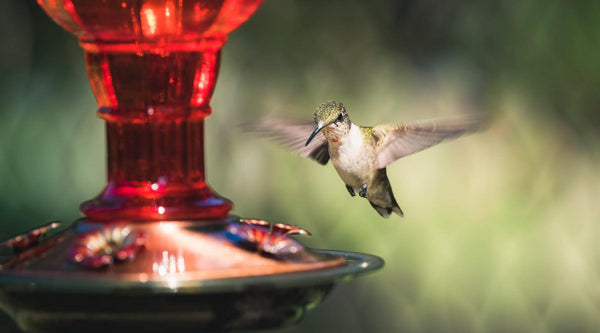
Feeders come in two broad designs: bottle-style, where nectar sits above the feeding ports and drains down, and saucer-style, where nectar sits in a shallow basin below the ports. This matters for ants because a saucer design gives them very little to reach even if they do get onto the feeder — the nectar sits low, in a basin, rather than pooling anywhere near the ports themselves. Whatever design you choose, a feeder that doesn't leak removes the spilled residue that draws ants in the first place. For the full side-by-side, see saucer vs. bottle vs. window hummingbird feeders.

Pop's Tip
A saucer feeder gives you one more edge: since you can see the nectar level, you can fill it to match how fast your hummingbirds are actually draining it. On 90°F+ days, that might mean filling less so it's gone daily instead of sitting out for several — in cooler weather, you have more flexibility. As a bonus, a feeder filled only partway keeps the nectar low enough that flying insects often can't reach it either, even without a full barrier (more on that in the bees and wasps section below). Use our nectar change calculator to find the right fill level and change schedule for your temperatures, and see our guide on how often to change nectar for the full timelines.
3. Hang It Where Ants Can't Climb
Where and how a feeder hangs changes how easily ants reach it in the first place. (For everything else that goes into placement — height, sun, cover, windows — see where to hang a hummingbird feeder.)
- Swap the hook for fishing line. Thin monofilament fishing line is difficult for ants to climb — there's little for their legs to grip — and it's nearly invisible against foliage. If you go this route, make sure the line is the only path to the feeder; a nearby branch or leaf touching the line gives ants a bridge around it.
- Hang from a tree branch instead of a pole. Ants scale a smooth metal or wooden pole easily. They're less likely to leave the ground to climb out onto a tree branch or hang from a gutter, so moving the feeder off a shepherd's hook and onto a tree limb removes one of their easiest routes in.
- Move the feeder every few days. Ants navigate by scent trails laid down by earlier scouts, so relocating the feeder even a few feet breaks that trail. Hummingbirds won't lose it: they remember places by the landmarks around them. In a field study published in Animal Cognition, wild Rufous Hummingbirds learned a feeding spot after a single visit, and when the flower was moved they checked the old spot first, then flew on to the flower itself.

How to Keep Ants Off a Hummingbird Feeder Pole or Shepherd's Hook
If your feeder hangs from a pole or shepherd's hook, that pole is the ant highway: up from the ground, out along the arm, and down the hanger to the nectar. The fix is to put something in that path ants can't cross, not to coat the pole in something.
- Put the moat between the hook and the feeder. A moat only works if it sits on the route ants actually walk. A feeder with a built-in moat handles this automatically; a separate hang-on moat goes on the hook first, with the feeder hanging below it.
- Keep it topped up with water. A moat on a pole in full sun can dry out faster than you'd expect on a hot day, and a dry moat is just a bridge.
- Wipe the pole when you refill. Nectar that drips down a pole leaves a sugar streak from the feeder to the ground. According to the University of Florida's IFAS Extension, ant scouts that find food lay a pheromone trail back to the colony for nestmates to follow — a sticky pole is a ready-made route.
- Check for bridges. Tall plants, a fence, a second hook, or a branch touching the pole below the moat — or touching the feeder itself — let ants walk around the moat entirely.
- Leave the pole bare. No grease, jelly, or oil on the pole, for the reasons in the Fix to Skip box above.
One honest note: even with all of this, Operation RubyThroat observes that ants seem to eventually find a way to almost any feeder. That's why the moat is a habit — check it, refill it, wipe the pole — rather than something you set up once and forget.
Black Ants, Sugar Ants, Carpenter Ants: Does the Kind of Ant Matter?
"Sugar ant" isn't actually a species — it's a nickname. Washington State University Extension notes that odorous house ants and pavement ants often get called sugar ants because of their attraction to sweet foods. UF/IFAS lists carpenter ants and fire ants among the species that go after sugars as well. So the black ants, little brown ants, or big carpenter ants you're finding in your feeder are most likely just whichever sweet-loving species is common in your yard.
The good news is that for keeping them out of a feeder, the species mostly doesn't matter. Every ant gets to the nectar the same way — on foot, following the trail its scouts laid — so a full water moat, a leak-free feeder, and a clean pole work on all of them. If you want to know exactly which ant you have (useful if they're also turning up in your house), your county extension office can help identify it.
4. Keep It Clean and Leak-Free
Sticky, spilled nectar on the outside of a feeder is one of the biggest ant attractants there is. Check for leaks regularly, wipe away any drips immediately, and stick to a consistent cleaning schedule. A dry, residue-free feeder is simply less interesting to ants than one with sugar water crusted around the ports or dripping down the pole. Our guide to cleaning a hummingbird feeder walks through the full routine.

Ants Already in Your Hummingbird Feeder? What to Do Today
Everything above is prevention. If you're standing at a feeder full of ants right now, deal with it today and prevent it tomorrow — and do it the same day, because once a scout has reported back, the rest of the colony has directions.
- Take the feeder down and dump the nectar. Don't strain it and put it back. Iowa State points out that ants climbing in and drowning make a mess that means cleaning the feeder and replacing the solution.
- Wash the feeder completely — ports and all, not just a rinse — so no drowned ants or sugar film are left behind.
- Wipe down the hook, pole, or hanger with warm, soapy water to remove the sugar residue along the route the ants were using, then rinse it well.
- Rinse the outside of the feeder and the ports before rehanging. Texas Parks & Wildlife recommends this to make a feeder harder for bees and wasps to find, and it leaves nothing sweet on the outside for ants either.
- Fill the moat with water, then rehang. If ants had a well-worn trail, hang the feeder a few feet away from its old spot to break it.
- Refill with a fresh, small batch at the standard 1:4 ratio — see our nectar ratio guide for measuring any batch size.

Dumping a batch mid-week stings less when the next one takes a minute. Nectarlyte® Powder Concentrate mixes to the correct 1:4 strength in warm water, so you can make exactly what the feeder holds and get it back up the same afternoon — no boiling, and nothing left over to store.
Shop Nectarlyte® Powder →Do Ants Hurt Hummingbirds or Hummingbird Feeders?
Ants won't damage the feeder itself. The harm they do is to the nectar and to your visitors, and it's more real than it looks.
The first part is simple contamination: ants that climb in drown, and a heavy ant presence can clog the feeding ports. The second part is the one most people don't know. In a 2018 study published in Behavioral Ecology and Sociobiology, researchers in Southern California tested Anna's, Black-chinned, Allen's, and Costa's Hummingbirds, both wild and in aviaries. Given a choice, the birds avoided flowers and feeders that had ants in the sugar solution.
What's striking is how they decided. Seeing ants alone wasn't enough to put them off — it was touching and tasting the ants that did it. In other words, a hummingbird tends to discover the ants by touching or tasting them at the port — and given somewhere else to feed, it goes there. A feeder full of ants isn't just messy; it can quietly lose its regulars.
For some ants, the birds may not even need a taste. A 2021 follow-up from the same research group, also in Behavioral Ecology and Sociobiology, found that both wild and captive hummingbirds avoided feeders scented with formic acid, a defensive chemical wood ants produce. Wild birds visited the unscented feeders about three times as often.
To be clear about the limits: both studies were run in Southern California on western hummingbird species, the taste study used one ant species (the Argentine ant), and the birds had alternatives nearby. It hasn't been repeated with Ruby-throated Hummingbirds or with the ants most eastern yards have. But they're the best direct evidence there is, and it points the same way as everything else here — keep ants out of the nectar.
Birds gone quiet, and it isn't ants? Ants are only one reason a feeder loses its regulars. Our guide to why hummingbirds aren't coming to your feeder walks through the other usual suspects.
5. Plant Mint Nearby
Mint is one of the most repeated ant tips out there, so here's what the research actually covers. Texas A&M AgriLife Extension notes that some herbs, including mint, are unattractive to fire ants. And in a laboratory trial published in the Journal of Entomological Science, Argentine ants and red imported fire ants crossed barriers treated with peppermint oil — along with basil, citronella, lemon, and tea tree oils — less often than untreated ones.
Notice what that trial tested, though: concentrated essential oil applied to a barrier, not a mint plant growing nearby, and we haven't found research testing whether a potted mint actually keeps ants off a feeder. So treat mint as a small, pleasant extra rather than protection in its own right — never a replacement for a moat or a clean feeder. (And keep essential oils themselves off the feeder and hanger for the same reason as the petroleum jelly.) If you do plant it, grow it in a container, since mint spreads aggressively in the ground.

6. Hang It in Partial Shade
Nectar in the sun spoils faster than nectar in the shade — Georgia's Department of Natural Resources notes that feeders in bright sun during hot weather grow mold and bacteria more quickly, and suggests hanging feeders in the shade. For ants, the payoff is indirect but real: fewer spoiled batches means fewer mid-week dump-and-refill cycles, and fewer chances for spills and drips down the pole. It's one more reason a feeder in dappled light needs less frequent attention than one baking in full sun all day.

7. Consider a Water Feature as a Barrier
If a feeder hangs near a small pond, fountain, or birdbath, that water can act as a barrier much like a moat does — ants generally won't attempt to cross open water to reach it. This won't work for every yard, but it's worth factoring in if you're already deciding where to place a feeder or a water feature.

What About Bees and Wasps?
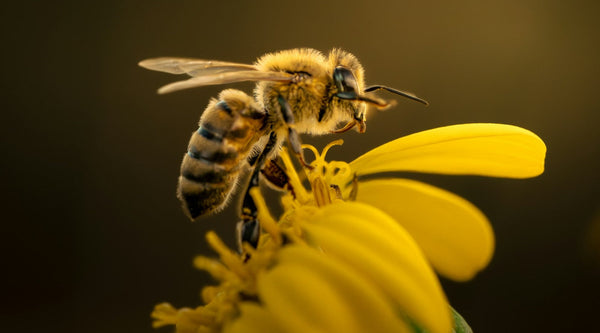
Sugar water doesn't discriminate — bees and wasps are drawn to it just as much as ants and hummingbirds are, and several of the fixes above pull double duty against both. A saucer-style feeder and a bee guard over the feeding ports work the same way against bees as they do against ants: they put the nectar out of reach, while a hummingbird's long bill and tongue still get to it. Texas Parks & Wildlife recommends a bee guard as an inexpensive way to discourage both wasps and bees, and Colorado State University Extension explains why it works: bees and wasps have much shorter tongues than hummingbirds.

If you're using an AspenPerch®, Hummguard® Nectar Tips are its bee guard. They slide onto the feeding ports on the underside of the feeder, and the flexible membrane in each tip opens when a hummingbird inserts its bill, then closes tight when it pulls out — so bees and wasps can't get to the nectar. They're made specifically for AspenPerch® ports, and they're for flying insects; the moat is still your ant defense.
Shop Hummguard® Nectar Tips →A few more bee- and wasp-specific tips: hang the feeder in partial shade, since Operation RubyThroat notes honeybees favor feeders in direct sun; avoid feeders with yellow parts, which University of Georgia Cooperative Extension recommends against; and keep the feeder away from your flower garden if bees are a persistent problem, so the two food sources aren't concentrated in the same spot. If honeybees still take over, Operation RubyThroat suggests drawing them off with a much stronger 1:2 sugar mix in a shallow dish set well away from the hummingbird feeder — keep the hummingbird feeder itself at the standard 1:4.
Bees and wasps the bigger problem? They need a different playbook than ants do. Our full guide on how to keep bees away from a hummingbird feeder covers all six fixes.

Quick Reference
| Method | Why It Works |
|---|---|
| Ant moat | Water barrier ants can't swim across — as long as it stays full |
| Saucer-style feeder | Nectar sits below the ports, out of easy reach |
| Fishing line or tree branch | Removes an easy climbing route |
| Moat between hook and feeder | Blocks the pole, the most common ant route |
| Clean, leak-free feeder | No sugary residue to attract ants |
| Ants already inside | Dump, wash, wipe the hook, refill the moat, rehang |
| Mint nearby | A small extra — oil barriers deter ants in the lab; plants are untested |
| Partial shade | Slows fermentation and reduces scent |
| Move the feeder periodically | Breaks the scent trail ants rely on |
Key Takeaways
- An ant moat and a saucer-style feeder stop ants before they reach the nectar — the two most reliable fixes on this list.
- On a pole or shepherd's hook, the moat belongs between the hook and the feeder, kept full of water, with nothing touching the pole below it.
- If ants are already in the feeder, dump the nectar, wash everything, wipe the hook, and rehang the same day.
- Ants do real harm: hummingbirds in a 2018 study rejected nectar once they touched or tasted ants in it.
- The kind of ant — black, sugar, carpenter — doesn't change the fix. They all arrive on foot.
- Mint is a small extra at best; the research behind it tested essential oils on barriers, not plants.
- Skip petroleum jelly, oil, and pesticides — a water moat does the job without the risk to hummingbirds.
Frequently Asked Questions
Why are ants attracted to hummingbird feeders?
Hummingbird nectar is essentially a concentrated sugar solution, and ants are extremely efficient at finding food sources like that. According to the University of Florida's IFAS Extension, ants forage using scouts — once a scout finds something worth eating, it lays a pheromone trail back to the colony, and nestmates follow that trail straight to the source. That's why one or two ants on a feeder can turn into a real infestation within a day: the moment a scout reports back, the whole colony has directions. Leaks and drips make it worse, since sugary residue around the ports or down the pole gives ants an even stronger scent to follow.
Why is it important to remove ants from a hummingbird feeder?
Ants that get into the nectar drown in it, which contaminates the solution and means more frequent cleaning and refilling — and a heavy ant presence can clog the feeding ports. More importantly, a 2018 study in the journal Behavioral Ecology and Sociobiology found that hummingbirds avoided feeders and flowers with ants in the sugar solution. It wasn't the sight of the ants that turned them away but touching and tasting them, so a bird tends to discover the problem mid-sip and then feed elsewhere if it can.
Do ant moats actually work?
Yes. Ants can't swim, so a water-filled moat positioned between the hanger and the feeder creates a barrier they can't cross. Texas Parks & Wildlife calls a moat a very effective way to keep ants off feeders. It only works while it's full, though — check the water every time you check the nectar.
How do I keep ants off a hummingbird feeder pole?
Put a water-filled moat between the hook and the feeder, since the pole is the route ants climb, and keep it topped up. Wipe nectar drips off the pole when you refill, and make sure no plants, fences, or branches touch the pole below the moat or the feeder itself. You can also switch to thin fishing line or hang the feeder from a tree branch. Don't grease the pole.
What should I do if there are already ants in my hummingbird feeder?
Take it down and dump the nectar rather than straining and reusing it. Wash the feeder completely, wipe the hook or pole with warm soapy water, rinse the outside of the feeder and the ports, fill the moat with water, and rehang it — a few feet from the old spot if the ants had an established trail. Refill with a fresh, small batch at a 1:4 ratio.
Does moving the feeder actually deter ants?
Yes. Ants rely on scent trails laid down by earlier scouts to find their way back to a food source, so relocating the feeder even a short distance breaks that trail. Hummingbirds remember feeding spots by the landmarks around them, and in a field study wild Rufous Hummingbirds found a moved flower after first checking where it used to be — a feeder moved a few feet stays easy for them to find.
Is it safe to use petroleum jelly or oil to keep ants off a feeder?
We don't recommend it. Operation RubyThroat, a long-running hummingbird research project, warns that Vaseline and similar compounds can mat a hummingbird's feathers, which can cause hypothermia or keep the bird from flying. Some agencies do suggest grease on the pole below the feeder, but a water moat does the same job without that risk.
What can I put on my hummingbird feeder to keep ants off?
Water, in an ant moat — and nothing else on the feeder itself. Keep petroleum jelly, grease, cooking oil, essential oils, and insecticides off the feeder, the hanger, and anywhere a hummingbird might perch. Pair the moat with a leak-free feeder and a clean pole.
Does planting mint really keep ants away?
Probably only a little. Texas A&M AgriLife Extension notes that mint is unattractive to fire ants, and a lab trial in the Journal of Entomological Science found ants crossed barriers treated with peppermint oil less often. But that trial tested concentrated oil on a barrier, not a living plant, so treat mint as a small extra alongside a moat, never a replacement for one.
Can I use pesticides near a hummingbird feeder?
No. Operation RubyThroat, a long-running hummingbird research project, says insecticides and other poisons should never be used at hummingbird feeders — if they kill insects, they can't be good for hummingbirds. A water moat, a leak-free feeder, and a clean pole handle ants without them.
Do ants hurt hummingbirds?
The harm is indirect, but it's real. Ants contaminate the nectar and can clog the ports, and a 2018 study of Anna's, Black-chinned, Allen's, and Costa's Hummingbirds found the birds rejected nectar once they touched or tasted ants in it, and a 2021 follow-up found they also avoided feeders scented with a defensive chemical wood ants produce — so an ant-filled feeder can cut hummingbirds off from a food source they were relying on.
Do ants hurt hummingbird feeders?
Not the feeder itself. What they damage is the nectar, which has to be dumped once ants drown in it, and the feeder's usefulness to the birds, since hummingbirds avoid nectar that has ants in it. Ants can also clog the feeding ports until the feeder is cleaned.
What kind of ants get into hummingbird feeders?
Mostly whichever sweet-feeding species is common where you live. "Sugar ant" is a nickname rather than a species — Washington State University Extension notes it's often applied to odorous house ants and pavement ants — and UF/IFAS lists carpenter ants and fire ants among the ants that go after sugars. The species doesn't change the fix, since they all reach the feeder on foot.
What's the best ant deterrent for a hummingbird feeder?
An ant moat is the single most reliable deterrent, since it's a physical barrier rather than a scent or texture ants can eventually work around. For preventing ants in the first place, pair it with a saucer-style feeder and a clean, leak-free hanging spot — the moat stops ants that show up, and the rest reduces how often they show up at all.
Will these methods also keep bees and wasps away?
Partly. Saucer feeders and bee guards work on bees and wasps the same way they work on ants, by putting the nectar out of reach — Colorado State University Extension notes that bees and wasps have much shorter tongues than hummingbirds. Hanging the feeder in partial shade helps too, since honeybees favor feeders in direct sun. For the full picture, see our dedicated guide to keeping bees away from a hummingbird feeder.
Summary
Keeping ants off a hummingbird feeder comes down mostly to design and placement, not an ongoing fight. An ant moat and a saucer-style feeder stop the problem before it starts; on a pole, the moat belongs between the hook and the feeder, kept full, with nothing bridging around it; and a clean, leak-free feeder in partial shade removes the scent that draws ants in. If they've already moved in, dump, wash, wipe, and rehang the same day — it matters, because hummingbirds reject nectar with ants in it. No pesticides, oil, or petroleum jelly required. AspenPerch® was built with exactly this in mind: a leak-proof design with a built-in ant moat, plus feeding ports made to accept Pop's Hummguard® Nectar Tips if bees and wasps ever become the bigger nuisance.
Ready to keep your feeder ant-free? Shop the AspenPerch® Hummingbird Feeder, and add Hummguard® Nectar Tips for bees and wasps.
Shop the Setup That Keeps Ants Out
A water moat and a leak-free feeder keep ants out, bee guards handle the flying insects, and quick-mix nectar gets you back up the same day if ants ever get in. Here's what this guide recommends.


Bethany Sloan has served as General Manager of Pop's Birding since 2010, continuing the legacy of her grandfather, William "Pops" Sloan, inventor of the Original Hummingbird Swing. A lifelong hummingbird enthusiast, educator, and independent researcher, she leads the company's educational content, including its 50-State Hummingbird Guide series, Regional Guide, Species Guide and Hummingbird Learning Center. Bethany combines scientific research, regional migration data, and more than 16 years of hands-on experience to create trusted educational resources for bird enthusiasts across North America.