Jul 12, 2026
Saucer vs. Bottle vs. Window Hummingbird Feeders: Which Type Is Right for You?
Quick answer: There are three main types of hummingbird feeders. Saucer-style feeders (nectar sits in a basin below the feeding ports) are generally the most leak-resistant and the easiest to clean, and they're the type UGA Cooperative Extension suggests for keeping bees off the nectar. Bottle-style feeders offer larger capacity but are more prone to drips and need more careful assembly to avoid leaking. Window feeders attach directly to glass for extremely close viewing, but typically hold less nectar and need more frequent refilling. The right choice depends on what you're optimizing for: low maintenance and insect resistance (saucer), capacity for heavy hummingbird traffic (bottle), or the closest possible view (window).
Not all hummingbird feeders work the same way, and the basic mechanical design — where the nectar sits relative to the feeding ports — affects almost everything else: how easily it leaks, how well it resists insects, how it's cleaned, and how it's typically placed. Here's how the three main types actually compare, what the research and extension guidance say about each, and where the evidence runs out.
Saucer-Style Feeders
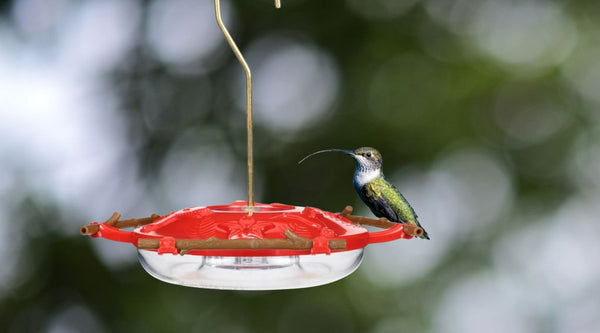
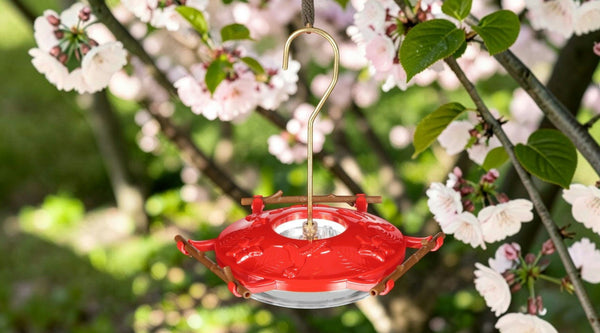
How they work: Nectar sits in a shallow basin, with feeding ports on a lid above it. Hummingbirds reach down into the basin with their long tongues; most insects can't.
Strengths:
- Generally the most leak-resistant design, since there's no vacuum seal to fail
- Naturally more insect-resistant, since the gap between ports and nectar (which only grows as nectar is consumed) keeps short-tongued bees and wasps out
- Typically easier to clean, since the wide, shallow basin has fewer hard-to-reach corners than a narrow bottle neck
- Can be dishwasher-safe in some designs, cutting cleaning friction further
Trade-offs:
- Generally lower capacity than large bottle-style feeders
- Various saucer models can differ with the type of perch ring and comfort for the hummingbird.
This is the category AspenPerch® belongs to. It's also the design extension educators point to when bees are the problem: UGA Cooperative Extension's garden coordinator recommends saucer-type feeders or feeders with bee guards as a first line of defense.
What Is a Saucer-Style Hummingbird Feeder?
A saucer-style feeder (you'll also see it called a dish, basin, or flat feeder) is a low, round feeder where the nectar sits in an open bowl and the feeding ports sit in a cover directly above it. Nothing is stored upside down and nothing relies on air pressure — the nectar just rests in the bowl, and a hummingbird drinks by pushing its bill through a port and reaching down with its tongue.
That one design choice explains most of what people like about saucers. Because the nectar isn't held up by a vacuum, there's nothing to push it out of the ports when the day warms up. Because the bowl is wide and open, there's no narrow neck to scrub. And because the nectar surface sits below the ports, a short-tongued insect standing on the cover has farther to reach than it would on a design where nectar pools right at the opening.
Do Saucer Feeders Really Keep Bees and Wasps Out?
Mostly — with a caveat worth knowing. The principle is sound: Colorado State University Extension explains that bees and wasps have much shorter tongues than hummingbirds, so any barrier that puts distance between the insect and the nectar excludes them while leaving hummingbirds free to feed.
The caveat is the gap itself. A saucer is at its most bee-resistant when the nectar level has dropped a little below the ports, and at its least resistant when it's filled right to the brim. Operation RubyThroat, the long-running hummingbird banding project at Hilton Pond Center, notes that honeybees can be especially pesky on feeders with flat feeding ports because their mouthparts can reach the sugar water — and that leaky, dripping feeders attract many more bees and ants than well-maintained ones. So in practice:
- Don't overfill. Leave a little headroom between the nectar and the underside of the ports.
- Wipe spills. Nectar smeared on the cover or dripped on the ports feeds insects no matter what design you own.
- Add port guards if bees keep coming. Penn State Extension describes bee guards as openings that let a hummingbird's long bill and tongue through while stopping bees and other flying insects.
- Skip yellow. UGA Extension also advises avoiding feeders with yellow parts, since bees are drawn to the color.

If you already use an AspenPerch® saucer and bees still find the nectar in late summer, Hummguard® Nectar Tips are the port guard made for it. Each tip slides onto a feeding port on the underside of the AspenPerch®, with a flexible center that opens for a hummingbird's bill and closes tight behind it. They're built specifically for AspenPerch®, not as a universal fit.
Shop Hummguard® Tips →Already fighting insects at your feeder? Our step-by-step guides cover how to keep bees away from a hummingbird feeder and how to keep ants out of a hummingbird feeder — including what to do when they've already moved in.
What to Look For in a Saucer Feeder
Saucers share the same basic mechanism, but they're not all equally pleasant to own — or equally comfortable for the birds. The details that separate a good one from a frustrating one:
- A perch hummingbirds will actually use. Hummingbirds spend a large share of their day perched rather than flying, which is why the shape and height of the perch matter more than most shoppers expect. We dig into the evidence in what the research shows about hummingbird perching.
- Few parts. Every extra piece is one more thing to scrub and reassemble correctly.
- A built-in ant moat. A moat above the feeder stops crawling ants before they reach the ports, without an extra accessory to remember.
- Dishwasher-safe construction. It turns a chore you'll put off into one you won't.
- A capacity you'll empty. For most backyards, a smaller saucer you refill often beats a large one sitting half-full while the nectar ages (more on that under bottle feeders below).
If you're weighing a basic saucer against one designed around perch comfort, we compare them side by side in AspenPerch® vs. a standard saucer feeder.
Shop the feeder
AspenPerch® Hummingbird Feeder, 8 oz

We built AspenPerch® to check every box on that list. It's a saucer at heart — nectar sits in an open bowl, so there's no vacuum seal to drip — with our patented Polyperch® perching surface and Grandview™ perch placement, which puts the perches above the bowl so you watch each bird lean in and drink instead of watching its back. It has an ant moat built into the frame, comes apart into two pieces plus a brass rod, is top-rack dishwasher safe, and holds 8 oz, a size most backyards will actually finish before it needs changing. It's 100% Made in the USA and backed by Pop's Lifetime Warranty.
Shop AspenPerch® →Bottle-Style Feeders
How they work: A bottle or reservoir holds the nectar above the feeding base, and gravity (aided by a vacuum seal) feeds nectar down to the ports as it's consumed.
Strengths:
- Often available in larger capacities, useful for yards with heavy hummingbird traffic
- Clear glass or plastic makes it easy to monitor nectar levels at a glance
- Classic, familiar design many birders grew up with
Trade-offs:
- More prone to leaking if the vacuum seal isn't perfectly formed, or if the feeder is tilted, overfilled, or exposed to temperature swings
- Nectar sits closer to the feeding ports, giving bees and wasps easier access than a saucer design
- Narrow necks can be harder to reach into for thorough cleaning without a dedicated bottle brush
Why Bottle Feeders Drip
An inverted bottle feeder works a bit like a water cooler. When you flip the filled bottle onto its base, a little nectar runs out until the air pressure pushing up from below balances the weight of the liquid — and that balance is what holds the rest of the nectar up in the bottle. Anything that upsets it lets nectar escape:
- Heat. As the air trapped at the top of the bottle warms in the sun, it expands and pushes nectar down and out through the ports. This is why a bottle feeder that's dry at dawn can be dripping by mid-afternoon.
- A tilt. A feeder hanging off-level, or swinging in the wind, lets air slip in on one side and nectar out on the other.
- A worn or unseated gasket. If the seal between bottle and base isn't airtight, there's no vacuum to hold the nectar up at all.
Drips aren't just messy. Operation RubyThroat points out that leaky feeders draw far more bees and ants than well-kept ones, so a dripping bottle feeder tends to become an insect problem too. Hanging it level, in shade, and checking the gasket each time you clean will prevent most leaks — and shade does double duty, since Oregon State University Extension notes that direct sun makes nectar mold sooner. A saucer sidesteps the heat problem entirely because nothing in it is held up by air pressure.
Glass vs. Plastic Bottle Feeders
Bottle feeders come in both, and neither is automatically better — it's a trade between durability and convenience:
- Glass holds up to hot-water washing without warping and doesn't get cloudy with age, but it's heavier and can break if it's dropped or knocked down.
- Plastic is lighter and won't shatter, but lower-grade plastics can turn brittle or discolored after a few seasons of sun. If you go plastic, look for a durable, UV-resistant material rather than the thinnest option on the shelf.
Whichever you choose, the neck matters more than the material: a wide-mouth bottle you can reach into is far easier to keep clean than a narrow one.
Is a Bigger Feeder Better?
Capacity is the bottle feeder's biggest selling point, but only if your birds actually drain it before it spoils. Nectar has to be changed on a schedule no matter how much is left in the feeder — Smithsonian's National Zoo & Conservation Biology Institute recommends changing and cleaning feeders every other day, and at a minimum twice a week in hot weather and once a week in cooler weather. Penn State Extension's advice is to choose a feeder that holds enough for three to four days, and Oregon State's extension guide notes that most people prefer several small feeders to one large one.
In other words: size the feeder to your traffic, not to the number on the box. A 32-ounce bottle in a yard with two or three regular visitors mostly means pouring out old nectar. If you've got a crowd, a second smaller feeder often works better than one giant one — our hummingbird feeder placement guide covers where to put it so one territorial bird can't guard both.

Right-sizing your feeder means more frequent, smaller refills. Nectarade® Ready to Use comes in an 8.5 oz pouch — enough to fill an 8 oz feeder like AspenPerch® in one pour, with nothing to measure or mix. It's made with pure cane sugar and no dyes or artificial preservatives.
Shop Nectarade® Ready to Use →Prefer to mix your own? Our guide to the correct hummingbird nectar ratio shows how to scale the standard 1:4 recipe to any batch size, so you only make what your feeder will hold.
Window Feeders
How they work: Small feeders that attach directly to glass via suction cups, positioned right up against a window.
Strengths:
- Unmatched close-up viewing — some designs let you watch hummingbirds feed just inches away
- Sits right on the glass, which is the placement wildlife agencies recommend for any feeder near a window (more on the evidence below)
- Great for small spaces like apartment balconies where a hanging feeder isn't practical
Trade-offs:
- Typically smaller capacity, meaning more frequent refills
- Suction cup attachment can be less secure in extreme heat or heavy wind
- You're limited to wherever your window is — you can't move it into shade the way you can a hanging feeder, and a feeder on a sun-baked window will need its nectar changed more often
Are Window Hummingbird Feeders Safe?
For collisions, a window feeder is about as safe as a feeder near a house gets — but the evidence is more nuanced than "window feeders prevent window strikes," so here's what it actually says.
The U.S. Fish & Wildlife Service's best-practices guide on bird collisions advises placing any bird feeder 3 feet or less from your windows, "the closer, the better", and Oregon State's extension guide gives the same advice for hummingbird feeders specifically: very close to the window so birds become familiar with the glass, or at least 20 feet away. A feeder mounted on the pane is the closest you can get.
What the research doesn't show is that a feeder makes a window safer than no feeder at all. A study of residential houses in Alberta found that having a bird feeder raised the collision rate about 1.84 times, and the difference between feeders at 1 meter and 5 meters from the glass wasn't statistically strong. That study, like most collision research, covered backyard birds generally rather than hummingbirds. The honest summary: any feeder draws birds toward your house, and if you're going to feed near glass, right on it or very close to it is the recommended spot.
Worried about the window itself? Glass reflects sky and greenery, so birds often don't register it as a barrier — and hummingbirds are small and fast. Our guide to why hummingbirds are vulnerable to window strikes covers what actually reduces collisions and what to do if a bird hits your glass.
Is a Window Feeder a Saucer or a Bottle?
It can be either. "Window feeder" describes where the feeder mounts, not how it holds nectar. Many window models are small open trays or basins — essentially a mini saucer on suction cups — while others use a small reservoir. That's why a window feeder's leak and insect resistance depends on the specific design: a basin-style window feeder behaves like a saucer, and a reservoir-style one behaves more like a small bottle. Check which you're buying before you judge it on those two points.
Which Is Actually Easiest to Clean and Refill?
This question deserves its own answer, since it's often the deciding factor once leak resistance and insect control are equal. Saucer-style feeders come out ahead here, but the reasons are worth understanding, since they point to specific features worth checking for regardless of which type you choose.
Why saucer feeders win on cleaning: nectar sits in a wide, shallow basin rather than a narrow-necked bottle. That shape means more open surface area you can reach with a sponge, and far fewer tight corners where mold can take hold unnoticed. Bottle feeders, by contrast, are recognizable by the exact feature that makes them harder to clean — a narrow neck that a standard sponge can't reach into, which is why dedicated bottle-brush sets exist specifically for this feeder type. If you go with a bottle-style feeder, treat a bottle brush as a required accessory, not an optional one.
Why saucer feeders win on refilling: most saucer designs let you lift a cover and pour nectar directly in. Bottle feeders typically require unscrewing the reservoir from the base, filling it, and carefully reattaching it without spilling or trapping air bubbles that can cause the vacuum-fed mechanism to leak. Window feeders sit in between — their small reservoirs are quick to refill, but the multiple small parts (suction cups, tiny ports) common on window designs mean more individual pieces to manage each time.
The features that matter most, within any type:
- A wide fill opening you can pour into without a funnel
- Dishwasher-safe parts — this single feature often determines whether a feeder actually gets properly cleaned versus just rinsed
- Fewer total small parts to disassemble, clean, and correctly reassemble
- A lift-to-fill design, rather than one requiring full disassembly just to add nectar
A feeder that's genuinely easy to clean gets cleaned more consistently in practice — which matters directly for hummingbird health, since nectar needs changing every few days in mild weather and more often in the heat, and mold risk climbs fast once cleaning becomes a chore people put off.
How often does your feeder need changing? It depends mostly on temperature. Plug in your local forecast with our Nectar Change Calculator, see how long hummingbird nectar lasts at different temperatures, and follow our step-by-step guide to cleaning a hummingbird feeder for any of the three types.
Quick Comparison
| Saucer | Bottle | Window | |
|---|---|---|---|
| Leak resistance | Best | Variable | Depends on design (basin or reservoir) |
| Insect resistance | Best (don't overfill) | Weaker | Depends on design |
| Typical capacity | Moderate | Largest | Smallest |
| Ease of cleaning | Generally easiest | Requires bottle brush | Small parts, quick clean |
| Viewing distance | Standard hanging distance | Standard hanging distance | Closest possible |
| Best for | Low-maintenance, insect-prone yards | Heavy hummingbird traffic | Small spaces, close-up viewing |
Other Types of Hummingbird Feeders You'll See
Saucer, bottle, and window cover nearly every feeder on the market, but you'll run into a few variations and hybrids while shopping:
- Top-fill bottle feeders — a reservoir-style feeder that opens from the top so you don't have to flip it to refill. It's easier to fill, but still a reservoir design, so check how it seals.
- Tube or mini-bottle feeders — small single-port reservoirs, often sold in sets or clustered on a frame. They're easy to swap out, but each tube needs its own cleaning.
- Handheld feeders — tiny single-port cups or rings you hold in your palm. They're for patient, up-close encounters with birds that already trust your yard, not for everyday feeding.
- Different mounts, same mechanisms — hanging, pole-mounted, deck-rail, and window-mounted are all ways of positioning a feeder. What decides leaking, insects, and cleaning is still whether the nectar sits in an open basin or hangs in a sealed reservoir.
Which Feeder Type Should You Choose?
- You're just getting started: a saucer is the most forgiving — hard to overfill into a leak, easy to clean, and resistant to bees. Our list of what a beginner should buy to start feeding hummingbirds covers the rest of the starter kit.
- You live in an apartment or have a small balcony: a window feeder or a compact saucer. See what works best on a small patio or balcony.
- Your yard is packed with hummingbirds: a larger bottle feeder, or better yet, two or more smaller feeders so one bird can't guard all the nectar.
- Bees and wasps are a constant fight: a saucer with port guards, and skip anything with yellow parts.
- You want the closest possible view: a window feeder, mounted right on the glass.
If you're switching types, give the birds time to find and trust the new one — our guide to why hummingbirds may not use a new feeder walks through what helps. And if you want the full shopping checklist beyond feeder type, from perch design to warranty, see how to choose the right hummingbird feeder.
Key Takeaways
- Saucer-style feeders generally offer the best combination of leak resistance, insect control, and ease of cleaning — just don't fill them to the brim.
- Bottle-style feeders offer higher capacity but are more prone to leaking (especially in the heat) and easier for insects to access.
- A bigger feeder only helps if your birds empty it before the nectar needs changing; several small feeders often beat one large one.
- Window feeders provide the closest possible viewing, and mounting right on the glass is the placement wildlife agencies recommend for feeders near windows — but they hold less nectar.
- The "best" type depends on your priorities: low maintenance (saucer), high capacity (bottle), or close-up viewing (window).
- Many birders use more than one type — for example, a saucer feeder in the yard and a window feeder for close viewing from indoors.
Frequently Asked Questions
What are the main types of hummingbird feeders?
There are three main types: saucer-style feeders, where nectar sits in an open basin below the feeding ports; bottle-style feeders, where an inverted reservoir feeds nectar down to the ports by gravity and a vacuum seal; and window feeders, which mount on glass with suction cups. Top-fill, tube, and handheld feeders are variations on these designs.
What is a saucer-style hummingbird feeder?
A saucer-style feeder is a low, round feeder that holds nectar in an open bowl, with the feeding ports in a cover above it. Because nothing is stored upside down or held up by air pressure, saucers are generally the most leak-resistant and easiest type to clean.
Which type of hummingbird feeder is least likely to leak?
Saucer-style feeders are generally the most leak-resistant, since they don't rely on a vacuum seal the way bottle-style feeders do.
Why does my bottle hummingbird feeder leak?
Most bottle-feeder leaks come from heat, tilt, or a bad seal. As the air trapped at the top of the bottle warms, it expands and pushes nectar out of the ports; a feeder hanging off-level lets air in and nectar out; and a worn or unseated gasket breaks the vacuum entirely. Hanging it level, in shade, and checking the gasket at each cleaning prevents most drips.
Which feeder type is best for keeping bees and wasps away?
Saucer-style feeders, since the nectar sits below the feeding ports out of reach of short-tongued insects, making it harder for bees and wasps to access than bottle-style designs. They work best when you leave a little space between the nectar and the ports rather than filling to the brim, and port guards add extra protection.
Are window hummingbird feeders safe?
For window collisions, a feeder mounted right on the glass follows the U.S. Fish and Wildlife Service's advice to place feeders 3 feet or less from windows, the closer the better. Research on backyard birds shows any feeder near a house draws more birds toward the glass, so right on the window or very close to it is the recommended spot if you feed near glass at all.
Do window feeders cause more window strikes?
There's no evidence that they do. Wildlife agencies recommend mounting feeders on or very close to the glass rather than a few yards away, and window feeders do exactly that. Research on backyard birds found that any feeder near a house raises collisions somewhat and couldn't confirm a strong difference between close and farther placements, so window treatments are still worth considering wherever you feed.
Which feeder holds the most nectar?
Bottle-style feeders typically offer the largest capacities, making them well-suited to yards with heavy hummingbird traffic. Only buy that much capacity if your birds will drain it before the nectar needs changing.
What size hummingbird feeder should I buy?
Buy a feeder your hummingbirds will empty within a few days. Penn State Extension suggests choosing one that holds enough nectar for three to four days, since nectar has to be replaced on a schedule regardless of how much is left.
Is glass or plastic better for a hummingbird feeder?
Neither is automatically better. Glass handles hot-water washing and doesn't cloud with age but can break; plastic is lighter and shatter-resistant, but lower-grade plastic can turn brittle in the sun. A wide opening that's easy to clean matters more than the material.
Which feeder type is easiest to clean and refill?
Saucer-style feeders, thanks to their wide, open basin and typical lift-to-fill design. Bottle-style feeders require more deliberate cleaning, usually with a dedicated bottle brush, and a more careful refill process to avoid leaks.
Can I use more than one type of feeder?
Yes, and many birders do — pairing a saucer feeder outdoors with a window feeder for close viewing, for example, covers both low-maintenance daily feeding and up-close observation.
Summary
The three main hummingbird feeder types — saucer, bottle, and window — each make different trade-offs between capacity, leak resistance, insect control, and viewing distance. Saucer-style feeders, like AspenPerch®, generally offer the best all-around combination of low maintenance and insect resistance, while bottle-style feeders suit high-traffic yards and window feeders offer the closest possible view. Choosing the right type comes down to which of those trade-offs matters most in your specific setup — and to picking a size your birds will actually finish before the nectar needs changing.
Looking for a low-maintenance, insect-resistant option? Shop the AspenPerch® Hummingbird Feeder.
Shop the Saucer Setup
Whichever feeder type you choose, here's what this guide recommends for a setup that stays leak-free, bee-resistant, and easy to keep clean.


Bethany Sloan has served as General Manager of Pop's Birding since 2010, continuing the legacy of her grandfather, William "Pops" Sloan, inventor of the Original Hummingbird Swing. A lifelong hummingbird enthusiast, educator, and independent researcher, she leads the company's educational content, including its 50-State Hummingbird Guide series, Regional Guide, Species Guide and Hummingbird Learning Center. Bethany combines scientific research, regional migration data, and more than 16 years of hands-on experience to create trusted educational resources for bird enthusiasts across North America.