Aug 15, 2026
Why Hummingbirds Are Especially Vulnerable to Window Strikes
If you've ever kept a hummingbird feeder, you may know this scenario: a soft thud against the glass, and your stomach drops before you've even reached the window. You go outside hoping to find nothing, no bird, no mark, just a faint smudge of feather-dust on the pane, and tell yourself it bounced off and flew away fine. We want that to be true every single time. It isn't always.
Short answer: Hummingbirds are disproportionately likely to die in window strikes because of their small, fragile bodies and fast, direct flight between feeding spots. The fix that actually prevents strikes is covering the whole window with visible markers spaced no more than 2 inches apart. If a feeder already sits near a window, keep it within about 3 feet rather than at a middle distance. A bird that close can't build up dangerous speed. That's damage control, though, not a solution on its own. Having feeders nearby increases window collisions, and no feeder distance is truly safe.
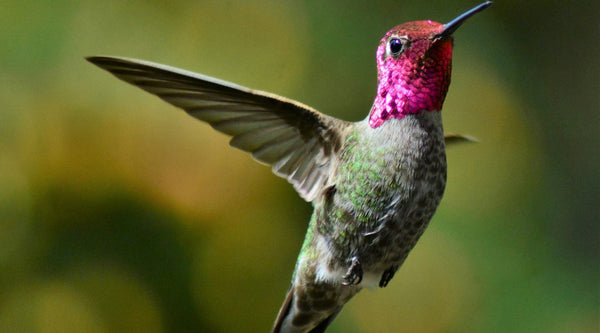
Window collisions are one of the more overlooked dangers backyard birders can actually do something about, and hummingbirds sit closer to the center of that problem than most people realize. A year-round monitoring study at the Virginia Tech Corporate Research Center, published in PeerJ, found that the Ruby-throated Hummingbird was the most common window-collision species at the site, accounting for 10% of the 240 deaths documented there. A separate study at Golden Gate Park in San Francisco found hummingbirds made up 56% of all fatal strikes recorded, with Anna's Hummingbird alone responsible for more than 42% of the fatal strikes. Two different studies, two different coasts, two different common species, and the same pattern both times.
Why hummingbirds are especially at risk
Part of the answer is simple physics. The Golden Gate Park research attributes hummingbirds' outsized collision numbers to "their relative fragility, high flight velocities, male territoriality and aggression, and traplining." Traplining is the habit of flying fast, direct routes between a regular circuit of flowers and feeders, rather than the more meandering flight many songbirds use. That directness leaves a hummingbird less time to register and react to a reflective surface suddenly in its path.
The physical stakes are also higher for a bird this small. A hummingbird's feet are built for perching rather than walking or hopping, and its needle-thin bill is its only tool for feeding. An injury that a robin could recover from, like a bruised wing or a cracked bill, can be functionally fatal for a hummingbird. Ruby-throated Hummingbirds feed several times an hour through the day (University of Maine Cooperative Extension puts it at five to six), so a bird that can't fly or feed for even a few hours is in real danger of starving, on top of whatever the collision itself caused.
None of this has anything to do with a bird being sick, old, or careless. Ornithologist Daniel Klem, whose collision research began in the 1970s, found that birds fail to recognize clear or reflective glass as a barrier at all. Clear glass reads as open air, and reflective glass reads as more sky or more trees. A hummingbird moving at full speed toward a feeder or a flowering shrub reflected in your window has no way of knowing the difference.
The scale of the problem is larger than most people expect. The U.S. Fish and Wildlife Service says more than a billion birds collide with glass in the United States every year. The peer-reviewed estimate of how many of those collisions kill the bird is 365 to 988 million a year. More than 99% of those deaths happen at homes and low-rise buildings, with under 1% at skyscrapers. Your house is where this happens.
What actually prevents it
Space window markers two inches apart, not four
The American Bird Conservancy recommends a two-inch-by-two-inch spacing rule, and explains why the older, wider spacing isn't enough: small songbirds, including hummingbirds, can easily fly through four-inch-wide gaps. The U.S. Fish and Wildlife Service makes the same point, noting that because hummingbirds are so much smaller than most birds, spacing as close as 2 inches by 2 inches will be necessary. A single hawk silhouette centered on a picture window doesn't meet that bar. Birds simply fly around it, because the open space on either side still reads as a clear path through. The pattern has to cover the glass, not decorate one corner of it.
Free download: 2" x 2" window spacing stencil. Getting the spacing right by eye is where most DIY attempts fall short. Download our printable spacing stencil (PDF), print it at actual size, tape it to the inside of your window, and mark each point on the glass from outside. It includes a built-in ruler check so you can confirm your printer didn't rescale the page before you tape it up.
Getting real protection without a wall of dots
A full 2-inch grid is a lot of visual coverage, and it's fair to want your windows to still look like windows. UV-reflective decals are often sold as the answer, since many birds can see ultraviolet light and people can't. They're worth understanding before you rely on them, though. The American Bird Conservancy cautions that birds which don't see UV, like Mourning Doves, won't be protected by UV-only products. It also warns that UV patterns are harder for birds to see in low light, such as early morning, evening, shade, and overcast days. Visible markers at 2-inch spacing are the more reliable choice. If you use UV decals, treat them as a supplement, not a guarantee.
One thing worth checking before buying any decal product: many are still marketed around the older, wider spacing guidance. If a product's packaging suggests spacing wider than 2 inches, apply it at the tighter 2-by-2-inch grid anyway. The decals themselves aren't the problem. The suggested spacing just hasn't always caught up with the newer guidance.
Exterior screens and netting: a simple fix if installed right
Exterior window screens are one of the simplest fixes available. The U.S. Fish and Wildlife Service calls external insect screens or netting an effective and relatively inexpensive treatment. The one catch is loose netting. Bird netting over a window has to be stretched completely taut so birds can't get tangled in it, and the Service recommends openings no larger than half an inch. A standard insect screen installed on the outside of the glass is the easier option for most homes.
If a feeder is already near a window, closer beats the middle distance
This isn't a recommendation to put feeders near your windows. The window treatment above is the real fix. But if a feeder already sits close to glass, or you can't move it far away, there's real research on which distances are worse. In a field study, Daniel Klem and colleagues moved feeders to set distances from windows and recorded every strike that followed. None of the collisions with feeders 1 meter (about 3 feet) from the glass were fatal, while most were fatal once feeders sat 5 and 10 meters out (about 16 and 33 feet). A bird taking off from a feeder that close hasn't had room to reach full flight speed. An honest caveat: that study used seed platform feeders in fall and winter, so the birds involved were songbirds, not hummingbirds. No one has repeated it with hummingbird feeders.
A separate study using backyard video footage supports the physics behind that result. Birds that approached a window at higher speed were more likely to be killed or stunned. That study didn't record any hummingbird collisions, and it didn't test feeder distance, so it explains why speed matters rather than confirming a specific distance.
Don't mistake this for a green light, though. Research at residential houses found that having a bird feeder nearly doubled collisions at the study window. Closer changes how severe a strike is likely to be, not whether strikes happen. Treating the window with the 2-inch spacing pattern above is what actually prevents the strike in the first place. Feeder distance only matters for the cases that treatment doesn't catch.
You'll sometimes see advice that placing a feeder far away, 30 feet or more from the house, is the safer choice, and some extension guides still publish it. The American Bird Conservancy doesn't endorse any distance. Its current guidance is that there's no distance from windows that can truly be considered safe. The U.S. Fish and Wildlife Service recommends placing feeders 3 feet or less from windows once the glass is treated, "the closer, the better." Nobody has tested distances beyond about 33 feet, so we can't tell you a far-away feeder is dangerous. What the evidence supports is that close beats the middle range, and that treating the glass matters most.
Where should the feeder actually go? Windows are one piece of the placement puzzle. Height, shade, cover, and spacing between feeders matter too. See Where to Hang a Hummingbird Feeder: The Complete Placement Guide for the full picture.
Does it help to offset the feeder to the side of the window?
This isn't something we've seen directly tested, so take it as reasoning rather than a verified rule. It does follow guidance the U.S. Fish and Wildlife Service already gives for yards: avoid landscaping that funnels birds toward glass, such as walkways, passageways, and edges that lead straight at a window. A feeder positioned slightly to the side of a window, rather than centered directly in front of it, follows the same logic, since it doesn't hand a bird a straight flight line into the glass. It's a reasonable extra step, just not one we can point to a dedicated study for.
Not the Only Risk to Watch For
Window strikes aren't caused by a predator, but they belong in the same conversation, because sometimes the real danger to a hummingbird isn't an animal at all. A 26-year study of 6,908 hummingbirds admitted to three California wildlife rehabilitation centers found window collisions behind 9.6% of admissions, while encounters with domestic animals, mostly cats, accounted for 12.9%. Neither was the most common reason, though. The biggest category, at 42.7%, was simply birds found on the ground, followed by nest-related cases like fallen or orphaned nestlings. Spoiled nectar is a related risk worth knowing about too. The USGS National Wildlife Health Center has documented candidiasis, a fungal infection linked to contaminated sugar-water feeders, causing mouth lesions and a protruding tongue that can leave a hummingbird unable to feed. That's exactly why we're so particular about fresh nectar and feeder hygiene in everything we write.
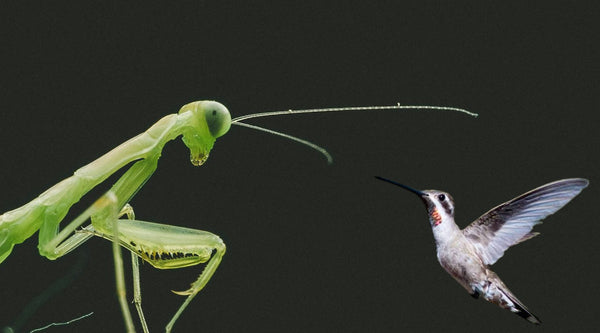
Once you've got the glass and the nectar sorted, it's worth knowing the rest of the picture too. Cats are the single most significant documented predator threat overall, covered in Cats and Hummingbirds. The invasive Chinese praying mantis is a real, if surprising, threat at feeders, covered in When Praying Mantises Prey on Hummingbirds. Orb-weaver spiders and rat snakes are both documented adult-hummingbird predators too. See Do Spiders Eat Hummingbirds? and Snakes and Hummingbird Feeders. Jays, crows, squirrels, and chipmunks are the best-documented threats to eggs and nestlings, covered in What Really Eats Hummingbird Eggs?. A handful of small, fast birds of prey round out the list in The Birds That Actually Prey on Hummingbirds. We should be upfront, though: no study has ranked these threats from most to least common, so we won't pretend otherwise. See every threat, predator and otherwise, honestly caveated and side by side, in Hummingbird Predators: The Complete, Fact-Checked Guide.
Summary
| Fact | Detail |
|---|---|
| Most common collision species (Virginia Tech study) | Ruby-throated Hummingbird, 10% of 240 deaths documented |
| Share of fatal strikes that were hummingbirds (Golden Gate Park study) | 56%. Anna's Hummingbird alone was over 42% of fatal strikes |
| Why hummingbirds are especially vulnerable | Fragile bodies, fast and direct "traplining" flight, territorial chases, and a need to feed several times an hour that makes any injury dangerous |
| U.S. window collisions, all bird species | More than 1 billion collisions a year (USFWS); a peer-reviewed estimate of 365–988 million deaths, over 99% at homes and low-rise buildings |
| Window marker spacing that works for hummingbirds | 2 inches by 2 inches, covering the whole window (American Bird Conservancy, USFWS) |
| UV-only decals | Less reliable: harder for birds to see in low light, and no help for birds that can't see UV. Visible markers are the safer choice |
| If a feeder is already near a window | Keep it within about 3 feet, not at a middle distance (Klem et al., Wilson Bulletin, a songbird study). This reduces how severe strikes are, not how often they happen |
| "30 feet away is safe" advice | Not supported. The American Bird Conservancy says no feeder distance is truly safe, and USFWS recommends 3 feet or less from treated glass |
Frequently Asked Questions
How do I stop hummingbirds from hitting my window?
Cover the full window with visible markers spaced no more than two inches apart in both directions. Dots, tape, or decals all work, as long as the spacing is consistent across the entire pane. A single decal in the middle of the glass doesn't work, because birds simply fly around it through the open space on either side. Exterior insect screens are another effective option.
Will 2-inch spacing make my windows look covered in dots?
It's a visible pattern, but small dots or thin tape are subtler than a solid grid might sound. UV-reflective decals are nearly invisible to people, but the American Bird Conservancy notes they're harder for birds to see in low light and don't protect birds that can't see UV, so they're best treated as a supplement to visible markers rather than a replacement. Whatever you buy, apply it at 2-by-2-inch spacing even if the package suggests wider spacing.
How far should a hummingbird feeder be from a window?
Treat the window first, because that's what actually prevents strikes. If a feeder is near a window, keep it within about 3 feet rather than at a middle distance. In a field study by ornithologist Daniel Klem and colleagues, no collisions were fatal with feeders about 3 feet from windows, while most were fatal at about 16 and 33 feet. That study involved songbirds, not hummingbirds, but the physics are the same: a bird that close can't build up dangerous speed. The U.S. Fish and Wildlife Service recommends 3 feet or less once the glass is treated, and the American Bird Conservancy says no feeder distance is truly safe.
Does it help to place a feeder to the side of a window instead of directly in front?
This hasn't been directly tested, so it's reasoning rather than a verified rule. It follows U.S. Fish and Wildlife Service guidance to avoid yard features that funnel birds toward glass. Offsetting a feeder to the side means a bird isn't flying in a direct line at the window, even from close range. It's worth doing if it's easy for your setup, but it's not a substitute for treating the window.
Are hummingbirds really more likely to hit windows than other birds?
Research points that direction. A year-round collision-monitoring study at the Virginia Tech Corporate Research Center found the Ruby-throated Hummingbird was the most common collision species, at 10% of deaths, and a separate study at Golden Gate Park found hummingbirds accounted for 56% of all fatal strikes recorded, with Anna's Hummingbird making up over 42% of fatal strikes. Their small, fragile bodies and fast, direct flight are the leading explanations.
How do I know if a hummingbird is stunned or just resting?
Hummingbirds regularly enter torpor overnight, a deep energy-saving state that can look alarmingly like unconsciousness: eyes closed, no visible movement, unresponsive to nearby activity. A bird perched normally early in the morning is often just coming out of torpor. A bird found on the ground, against a window, or in a cat's mouth needs help right away no matter how alert it looks, and so does one that's still unresponsive well into the day. Window strikes and cat encounters are true emergencies, not situations to wait and observe.
What should I do if a hummingbird hits my window?
The Cummings School of Veterinary Medicine at Tufts University recommends placing the bird in a dark container with a lid, such as a shoebox, somewhere warm and quiet and out of reach of pets. Don't try to give it food or water, and handle it as little as possible. A stunned bird will often recover within a few minutes. If it hasn't recovered within a couple of hours, or shows signs of injury, contact a veterinarian or wildlife rehabilitator. Handling a migratory bird without a permit is technically restricted, but federal rules allow anyone who finds a sick or injured migratory bird to take it straight to a permitted rehabilitator.
Build Your Feeding Station
Everything you need for a feeding station you'll enjoy watching: a feeder, a perch to hang beside it, hooks to hang both, and fresh nectar.


Bethany Sloan has served as General Manager of Pop's Birding since 2010, continuing the legacy of her grandfather, William "Pops" Sloan, inventor of the Original Hummingbird Swing. A lifelong hummingbird enthusiast, educator, and independent researcher, she leads the company's educational content, including its 50-State Hummingbird Guide series, Regional Guide, Species Guide and Hummingbird Learning Center. Bethany combines scientific research, regional migration data, and more than 16 years of hands-on experience to create trusted educational resources for bird enthusiasts across North America.