Aug 15, 2026
When Praying Mantises Prey on Hummingbirds — And How to Protect Yours
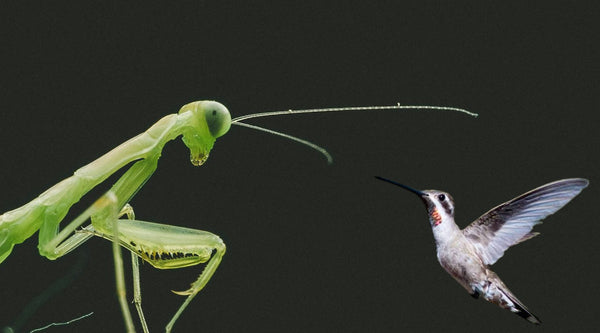
If you've spent any real time watching your feeder, you've probably gotten used to the regular cast of characters — bees, wasps, the occasional curious lizard. A praying mantis sitting nearby might not even catch your attention. It's easy to assume it's just passing through, harmless. Most of the time, what it's actually hunting is exactly what you'd guess: the bees and wasps the sugar water draws in. But every once in a while, the target turns out to be something a lot more surprising — and it's happened often enough that scientists have actually studied it.
Short answer: Yes — large praying mantises really do prey on and eat hummingbirds, most often at feeders and flowers where they're actually hunting bees and other insects. The most thorough study on record found this happens often enough in North American gardens that its authors urged caution about releasing large, non-native mantises into gardens — while also stressing that how often it truly happens, relative to the countless times mantises and hummingbirds coexist, has never actually been measured. It's a real, documented risk, driven mostly by large adult females and concentrated at feeders in late summer and early fall. If you spot one on or near your feeder, gently relocate it rather than harm it; if you're buying mantis egg cases for garden pest control, skip the non-native ones entirely.
Yes, this really happens — here's the actual research
The most thorough look at this comes from a 2017 peer-reviewed study by ornithologist Martin Nyffeler and colleagues, published in The Wilson Journal of Ornithology. The researchers compiled 147 documented incidents of mantises capturing small birds across 13 countries — about 114 of those involved hummingbirds specifically, and more than 70% of all cases were reported in the United States, where mantises are frequently seen going after birds visiting feeders and hummingbird-pollinated flowers. Of the birds captured, the study found roughly 78% were killed and eaten.
Worth being precise about what that number represents: it's not 147 separate scientific field studies. Fewer than a third of the recorded cases had been formally published before; most came from photos, videos, and firsthand accounts submitted by birders and gardeners, which the researchers then compiled and verified. That doesn't make it less real — it's still a genuine, peer-reviewed synthesis of documented cases — but it means the true frequency of this happening is still, by the study's own admission, not something science has fully quantified. The researchers' own conclusion, in their words: mantises "frequently prey on hummingbirds in gardens in North America." When they say "frequently," they mean it's the common case among documented mantis-on-bird predation, and frequent enough at feeders and gardens specifically to justify real caution — not that any individual hummingbird is likely to be caught. That distinction matters, and it's why we don't put a specific likelihood on this page: the study is explicit that the actual rate has never been measured.
One popular claim worth retiring: that mantises are "the second most common hummingbird predator after cats." That specific ranking doesn't actually trace back to the research. Cats remain, by a wide margin, the leading human-linked cause of bird deaths in the U.S. — that's the scale for birds generally, not a hummingbird-specific ranking, which no study has actually measured. The American Bird Conservancy estimates free-roaming cats kill about 2.4 billion birds annually in this country alone, a figure that dwarfs anything mantises could account for. What the research does support is narrower and still notable: mantises are a real, documented predator of hummingbirds specifically at feeders and gardens, and very likely the most significant *insect* predator hummingbirds face.
There's a real cast of other documented predators worth knowing too. Cats are the most significant documented threat overall — our Cats and Hummingbirds guide covers exactly what helps. Orb-weaver spiders and rat snakes are both documented adult-hummingbird predators as well, covered in our Spiders and Insect Predators and Snakes guides. Eggs and nestlings face a different set of threats — mainly jays, crows, squirrels, and chipmunks — detailed in our Hummingbird Egg Predators guide. And a handful of small, fast birds of prey, like the Sharp-shinned Hawk, are genuine adult-hummingbird predators too, covered in our guide to birds that prey on hummingbirds. Sometimes the danger isn't a predator at all, either — a feeder placed too close to a window can be just as risky, which is why we wrote a dedicated Window Strikes guide. In fact, predators as a whole aren't even the leading cause of hummingbird rehab admissions — simply being found on the ground, weak from exhaustion or bad weather, is the single most common reason of all. We should be upfront: no study has actually ranked hummingbird predators from most to least common, so we won't pretend otherwise. See the complete picture, honestly caveated, side by side, in Hummingbird Predators: The Complete Guide.

Why a mantis would ever go after a bird
Mantises don't stake out feeders because they want the nectar — they're there for the bees, wasps, and other insects the sugar water attracts. They're ambush predators: a mantis will sit motionless on a feeder perch or a flower for hours, then strike in a fraction of a second with spiked, grasping forelegs once prey comes within range — typically just a few inches. A fast-moving hummingbird can trigger the same reflex as an incoming bee, especially if the mantis hasn't eaten in a while.
Dr. Joshua Martin, who studies mantis behavior, explained the mechanism to Audubon this way: as a mantis's hunger increases, its internal sense of what counts as fair prey broadens along with it — a hungry mantis will strike at targets it would normally ignore. Nearly every hummingbird species is light enough that a large adult mantis can outweigh it, and the encounters that end badly are almost always driven by large, well-fed females capturing the birds — likely because they need the extra protein for egg production.
It's also worth knowing that species and size matter enormously here. Most mantises are far too small to threaten a hummingbird at all. The ones capable of it are the larger species — several inches long as adults — not the small native mantises most people picture.

The species that actually pose a risk — and the invasive angle worth knowing
Of the North American cases in the study where the mantis species could be identified, just over half involved non-native mantises — a real majority, but the study itself is careful to note that bird predation here isn't solely a non-native phenomenon: native mantises are documented doing this too, and the behavior predates the first non-native species' arrival in North America. Two species show up repeatedly:
- Chinese mantis (Tenodera sinensis) — the single most frequently recorded predator species in the entire study. It's not native; it was introduced near Philadelphia in 1896 and is now the largest mantis found across much of the eastern and central U.S., with scattered populations extending into the Pacific Northwest and California, and adult females reaching roughly 4 inches.
- European mantis (Mantis religiosa) — also non-native, introduced in the early 1900s, originally as an attempt at pest control.
- Native Stagmomantis species — including the Carolina mantis, a genuinely native North American species. It's noticeably smaller than the Chinese mantis and shows up in the research too, just less often.
This is where a real, practical warning comes in: the Maryland Invasive Species Council specifically flags egg cases sold for "natural garden pest control" as a genuine concern, since Chinese and European mantis oothecae are widely sold online and in garden centers without any indication that they're non-native, indiscriminate predators — not just of pests, but of pollinators, native mantises, and occasionally hummingbirds. If you're buying mantis egg cases for your garden, skip the non-native ones. If you find and can confidently identify a non-native egg case already in your yard, conservation groups recommend destroying it — crushing it or cutting it open and submerging it in water. A native Carolina mantis egg case is fine to leave alone.
What to actually do if you find one
The advice from Audubon and other wildlife sources is consistent, and it's simpler than you'd expect: if you spot a mantis sitting on or near your feeder, gently move it with a stick or long-handled tool to another part of your yard, well away from the feeder. Relocating rather than harming it matters — mantises are genuinely useful predators of garden pests most of the time, and the goal isn't to eliminate them, just to keep one from fixating on your feeder as an easy hunting spot.
The single most useful thing you can do is also the simplest: give the feeder some open space. Mantises hunt from concealment — they need to be camouflaged and stationary to ambush anything, hummingbird or otherwise. A feeder tucked directly against a shrub or low branch gives a mantis exactly the hiding spot it needs; a feeder out in the open, with a clear flight path on all sides, doesn't. That distance rule comes from general predator-avoidance research (mainly cats and hawks), not a study built around mantises specifically, but the same logic applies directly: an ambush predator needs concealment, and removing the concealment removes the ambush.

📍 How far from cover, exactly?
Our complete guide to feeder placement covers this in full — roughly 10 to 15 feet of clearance from dense shrubs or trees, close enough for a nearby perch, far enough that nothing can hide within striking distance.
A few other things that help:
- A wide feeder cover or dome can help deter a mantis from reaching the feeder itself, though it's not foolproof — many mantis species can fly.
- Never use insecticides around a feeder to try to solve this. They put the hummingbirds you're trying to protect at just as much risk as the mantis.
- If a mantis keeps returning after being relocated, moving it farther — Audubon-cited advice suggests well outside the yard rather than just to the other side of it — or taking the feeder down for a few days can break the pattern.
When to actually watch for this
Risk isn't constant through the season. Mantises are largest, hungriest, and most active as adults in late summer and early fall — which overlaps directly with fall hummingbird migration, when feeders are busiest with adults and inexperienced juveniles fueling up for the trip south. That overlap is exactly why this predation pattern shows up in the data as often as it does; it isn't random timing. A quick feeder check during this stretch of the season is a reasonable habit, not paranoia.
Summary
| Fact | Detail |
|---|---|
| Documented cases (Nyffeler et al., 2017) | 147 incidents of mantises capturing small birds worldwide; ~114 involved hummingbirds; ~78% of captured birds were killed |
| How common is this, really? | The study's own word is "frequently" in North American gardens — but it also states the true rate has never been measured, so we don't call it rare or common |
| "Second most common predator after cats" claim | Not supported by the research — cats remain the dominant predator by far (~2.4 billion birds/year, per ABC) |
| Species most often responsible | Just over half of identifiable cases were large, non-native species — Chinese mantis and European mantis — though native Stagmomantis species are documented too |
| Which mantises do this | Almost always large, well-fed adult females, likely hunting extra protein for egg production |
| What to do if you see one | Relocate it gently, away from the feeder — don't kill it, don't use insecticide |
| Egg cases | Don't buy/release non-native (Chinese/European) egg cases for pest control; native Carolina mantis egg cases are fine to leave alone |
| Highest-risk season | Late summer through early fall — overlaps with fall hummingbird migration |
Frequently Asked Questions
Do praying mantises really eat hummingbirds?
Yes. A 2017 peer-reviewed review compiled 147 documented cases worldwide, about 114 of them hummingbirds, and concluded mantises "frequently prey on hummingbirds in gardens in North America." What's not known is the actual rate — the same study says the frequency of occurrence "has yet to be quantified" — so we treat this as a documented, real risk at feeders rather than a numbered likelihood. Roughly 78% of captured birds in the study were killed and eaten.
Are praying mantises really the second-biggest hummingbird predator after cats?
That specific ranking isn't supported by the research. Cats remain by far the dominant predator of birds in the U.S. generally — the American Bird Conservancy estimates free-roaming cats kill about 2.4 billion birds a year — though no study has actually ranked hummingbird predators specifically. Mantises are a real, documented threat at feeders specifically, and likely the most significant insect predator hummingbirds face, but not a close second to cats overall.
What should I do if I see a praying mantis on my hummingbird feeder?
Gently relocate it with a stick or long-handled tool to another part of your yard, away from the feeder. Don't kill it and don't use insecticide — mantises are genuinely useful garden predators most of the time, and the goal is just to keep one from fixating on your feeder as a hunting spot.
Should I buy praying mantis egg cases for my garden?
Skip the non-native ones. Chinese and European mantis egg cases are commonly sold as "natural pest control," but conservation groups specifically warn against them, since these species are large, indiscriminate predators that also threaten pollinators, native mantises, and occasionally hummingbirds. Native Carolina mantis egg cases, if you find one already in your yard, are fine to leave alone.
When is the risk of mantis predation highest?
Late summer through early fall, when mantises are largest and most active as adults — which happens to overlap with fall hummingbird migration, when feeders see the most traffic from adults and inexperienced juveniles.

Bethany Sloan has served as General Manager of Pop's Birding since 2010, continuing the legacy of her grandfather, William "Pops" Sloan, inventor of the Original Hummingbird Swing. A lifelong hummingbird enthusiast, educator, and independent researcher, she leads the company's educational content, including its 50-State Hummingbird Guide series, Regional Guide, Species Guide and Hummingbird Learning Center. Bethany combines scientific research, regional migration data, and more than 16 years of hands-on experience to create trusted educational resources for bird enthusiasts across North America.