Jul 24, 2026
Black-chinned Hummingbird: The West's Most Adaptable Hummingbird
Ask ten backyard birders across the American West what the most adaptable hummingbird in their yard is, and a striking number will describe the same bird without ever quite agreeing on its color — because the Black-chinned Hummingbird's signature throat patch is a genuine optical trick, invisible from most angles and only revealing its true iridescent purple in exactly the right light. It's a fitting quirk for a species whose entire life strategy is built on adaptability: found equally at home in scorching low-desert washes and cool mountain forests, on wild canyon walls and suburban patios alike.
Quick Facts
- Scientific name: Archilochus alexandri
- Length: 3.5–4.3 inches (9–11 cm)
- Wingspan: 4.7–5.5 inches (12–14 cm)
- Weight: 0.1–0.2 oz (2–5 g); females average larger than males — and young birds average larger than their parents
- Lifespan: most live only a few years; the oldest known individual was a female of at least 11 years, 2 months, recaptured and released during banding operations in Texas in 2008 — one of the longest lifespans on record for any North American hummingbird
- Population: an estimated 8.8 million (Partners in Flight), rated 9 out of 20 on the Continental Concern Score — a species of low conservation concern
- Population trend: Breeding Bird Survey data show an increase of about 0.3% per year between 1966 and 2019. A 2021 analysis in Scientific Reports adds a caveat worth knowing: looking at the shorter 2009–2019 window, trend maps show populations relatively stable or declining across most of the mapped range
- Conservation status: Least Concern (IUCN) — widespread, common, and considered stable
- Claim to fame: one of the most habitat-flexible hummingbirds in North America, equally common in low desert, mountain forest, and dense urban neighborhoods, provided there are tall trees and flowering shrubs
The Origin Story: How the Black-chinned Hummingbird Got Its Name
The Black-chinned Hummingbird was formally described for science in 1846 by French ornithologists Jules Bourcier and Étienne Mulsant, who gave it the original binomial Trochilus alexandri, based on a specimen from the Sierra Madre of Mexico. The species name honors Dr. Alexandre, a physician practicing in Mexico who sent biological specimens back to Paris in the 1840s — and for a time the bird was known in English as the Alexander Hummingbird.
The genus name Archilochus was coined in 1854 by German naturalist Ludwig Reichenbach, honoring Archilochus, a Parian poet of around 600 BC remembered for his savage wit and his disregard for convention. As with many hummingbird genus names from this era, the connection to the bird itself is more classical flourish than direct description. The genus is a small one — just two species, the Black-chinned and its eastern counterpart the Ruby-throated Hummingbird, which divide North America almost cleanly between them. Cornell Lab's Birds of the World account for Archilochus alexandri covers the full taxonomic record.
Where the Black-chinned Hummingbird Lives: A True Habitat Generalist
According to Cornell Lab's All About Birds, the Black-chinned Hummingbird is a genuine habitat generalist — found in lowland deserts and mountainous forests alike, in untouched natural habitat and heavily urbanized neighborhoods alike, with the only real requirement being tall trees paired with flowering shrubs and vines nearby. The overall range stretches from southern British Columbia down through most of the western United States and into central and northern Mexico.
The northern edge of that range is still moving. The Atlas of the Breeding Birds of British Columbia reports that the species has been expanding in the province since it was first recorded there in the early 1900s, pushing out from a population core in the Okanagan and Similkameen valleys into the Shuswap, Thompson-Nicola, Creston Valley, and Southern Rocky Mountain Trench — an expansion that has continued since the atlas survey period, confirmed by banding records. Feeders are often where these birds are first noticed.
Individual birds also wander well beyond the core range. The UC Davis School of Veterinary Medicine's hummingbird program lists documented records from more than twenty states and provinces outside the western breeding range, reaching as far east as Alabama, Florida, Georgia, South Carolina, Tennessee, and West Virginia, and as far north as Saskatchewan. Wintering birds are found primarily in Mexico, but a small and increasingly regular wintering population now spends the colder months along the U.S. Gulf Coast instead of migrating all the way south — more of them, Cornell notes, than was once believed.
How to Identify the Black-chinned Hummingbird: Males vs. Females
Adult Males
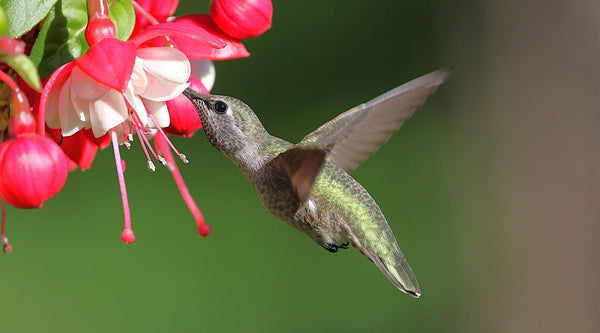
Dull metallic green above, dull grayish-white below, with a velvety black throat underlaid by a thin strip of iridescent purple that most often reads as simply black — the purple only becomes visible at specific angles and in good light, which is exactly why so many casual observers never notice it at all. Sacramento Audubon points out that the white collar just below the purple band is usually the easier field mark to catch. Cornell Lab adds that males often perch conspicuously high, on treetop twigs or dead snags, to survey their territory for rivals and passing insects.

Adult Females
A pale, unmarked white throat, metallic green upperparts, and whitish underparts, often with a subtle pale collar visible when perched. The three outermost tail feathers show broad white tips. Because males spend much of their time perched high on exposed twigs while females work at garden level, backyard observers often report seeing mostly females and juveniles — and once fledglings appear in midsummer, the female-plumaged share of the local population climbs further.

Distinguishing From Ruby-throated Hummingbird
Where their ranges overlap, telling female Black-chinned and female Ruby-throated Hummingbirds apart is genuinely difficult. The most reliable structural difference is the shape of the outermost flight feather: knife-shaped in the Ruby-throated, club-shaped in the Black-chinned. eBird cautions that this and every other structural difference between them is extremely subtle. More usable in the field: the Black-chinned's slightly longer, faintly drooping bill, its whitish underparts with almost no buff tones, and its habit of pumping and flaring its tail while hovering.
In practice, geography settles most sightings. According to the Texas Breeding Bird Atlas, the two species' breeding ranges overlap only in Texas between the 96th and 98th meridians — a narrow seam, plus a second contact zone in southwestern Oklahoma where hybridization between the two has actually been documented.
A Note on Sound
Black-chinned Hummingbirds produce a variety of sharp call notes — Audubon describes the basic call as a low tup, and Cornell Lab counts at least five distinct high-pitched chips and ticks combined in different ways depending on the situation — mostly heard while chasing off intruders, along with a low humming produced by the wings in flight. The dive display generates a separate, higher-pitched sound that can include pure, bell-like tones, and it has only ever been recorded from diving birds, never from perched ones. A true song is close to unheard-of in this species: Cornell Lab notes only two published accounts of a male Black-chinned singing, both near Austin, Texas, and both described as a sweet, very high-pitched warble — like someone whistling through their teeth.
Behavior: Tail-Pumping and Territorial Patience
One of the most distinctive Black-chinned behaviors is a habit of flicking, pumping, and spreading its tail noticeably more than most other hummingbird species, especially while hovering — one of the more reliable field marks available even before you get a good look at plumage. According to the Washington Department of Fish and Wildlife's species profile, males and females often use different habitat during the breeding season, with males typically favoring drier areas than nearby females.
Feeding and Diet
Like other hummingbirds, Black-chinned Hummingbirds hover at flowers and feeders for nectar, while also darting out erratically to snatch tiny swarming insects mid-air — an important source of protein that nectar alone doesn't provide. They feed at every level, from close to the ground to high in the trees, and will glean insects from vegetation or pull them straight out of spider webs. Cornell Lab notes the species will also perch conspicuously atop tall dead snags, using the vantage point both to spot passing insects and to keep watch over its territory for rival hummingbirds.
Courtship and Mating
According to the Audubon Field Guide, courtship in the Black-chinned Hummingbird centers on a "pendulum" display: the male flies back and forth in a wide U-shaped arc above a perched female, producing a whirring sound with each pass, then follows up with short buzzing flights directly in front of her. The detailed high-speed study of the display (Feo & Clark 2010, summarized in Clark, Feo & Bryan 2012) found the male ascends roughly 10 to 15 meters — about 35 to 50 feet (some popular accounts cite a higher range) — before swooping at a shallow angle over the female along that U-shaped path. Washington's Department of Fish and Wildlife describes the same maneuver as a long, pendulum-like swoop ending in a drawn-out vocalization at the bottom, with the wing and tail feathers producing an audible whistling sound throughout — and notes the display sometimes takes the shape of a narrow horizontal figure eight instead of a simple arc.
There's a hidden bit of engineering here worth knowing. Like Anna's and Costa's Hummingbirds, the Black-chinned makes part of its dive sound with its outermost tail feather — but it does it differently. Feo and Clark found that where Anna's and Costa's flutter the trailing edge of that feather, the Black-chinned flutters the tip, which is tapered rather than rounded. Three closely related birds, three variations on the same tiny instrument.
As with most hummingbirds, the male's role ends after mating; females handle nest-building, incubation, and raising the young entirely on their own.
Nesting and Family Life
The female alone selects the nest site and does all the building. Washington's Department of Fish and Wildlife describes nests placed 3 to 10 feet off the ground in a fork or branch of a deciduous tree, often over a small creek bed; Sacramento Audubon reports a typical range of 4 to 8 feet with nests occasionally as high as 30, frequently on horizontal, exposed, bare branches. The nest itself is a compact cup of plant down bound with spider webbing and adorned on the outside with lichen, bud scales, bark, and other small debris — and it stretches lengthwise as the nestlings grow. One more quirk worth knowing: for a bird this territorial, females have been known to nest within sight of several other Black-chinned nests.
Clutch size is almost always two white eggs, each about the size of a coffee bean, with rare records of one or three. Incubation runs 13 to 16 days, handled entirely by the female, and the young are independent at about 20 to 21 days. Females typically raise one or two broods a year, occasionally three — and have been observed feeding young in one nest while already incubating eggs in another.
Migration
The Black-chinned Hummingbird is strictly migratory, arriving at breeding grounds in spring and departing again in fall. The UC Davis hummingbird program puts the two main movement windows at March through May on arrival and August through September on departure, and the Texas Breeding Bird Atlas gives a similar picture at the southern end: most birds arrive between mid-March and early May, and most southbound migrants depart between mid-July and mid-October.
Nearly the entire population winters in Mexico, and Audubon notes the species is almost entirely absent from the West in winter. The one real exception is the Gulf Coast, where a small but genuinely established wintering population has become increasingly regular in recent decades — a pattern worth knowing if you feed birds anywhere from Texas to Florida in December.
Following the Black-chinned Across the Regions
This bird fills the West from the bottom up. Arrival runs south to north as spring moves up the map — Arizona and Texas by March, the Great Basin by April, eastern Washington not until May — and the retreat is just as orderly, with most birds gone from the northern edge by early September while Southwest populations linger into fall. Read the regions in that order and you're watching the range fill and empty on a schedule.

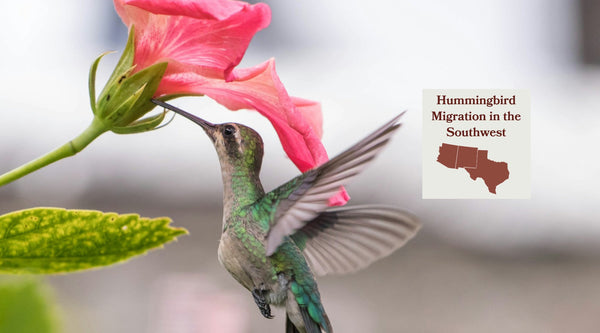
- Southwest — The stronghold, and the first to fill. Arizona, New Mexico, and Texas hold birds from March onward; in New Mexico this is one of the most widespread breeding hummingbirds in the state. Southern Arizona sees thousands of additional birds moving through on top of the nesting population. The Texas breeding range pushes east toward the Gulf, and it doesn't stop at the state line: the Oklahoma City Audubon Society reports the species holds the western quarter of Oklahoma, is most common in the southwestern corner around Lawton and Altus, and has expanded steadily eastward over the past three decades — now common as far east as Chickasha.
- Pacific & West — Inland, not coastal. California's nesting birds are an interior story; along the coast and in the far south, Black-chinneds are mostly passing through rather than staying to breed.
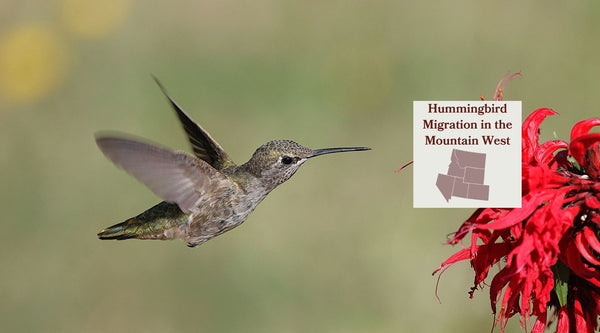
- Mountain West — The wide middle. Nevada, Utah, and Idaho hold nesting birds across most of their area, and Colorado's population sits in the western half of the state. Montana and Wyoming are the true edge — the breeding range reaches only extreme western Montana and southwest Wyoming, so these are local, peripheral birds rather than a statewide presence. After breeding, Cornell Lab notes that many adults move up into higher mountain habitat while flowers are still abundant, then turn south.
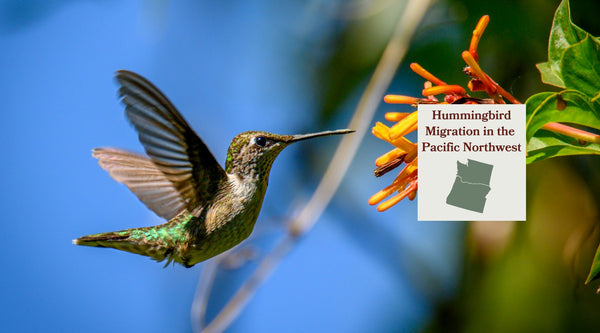
- Pacific Northwest — The northern limit, and the last to fill. Eastern Washington and northeastern Oregon mark the top of the U.S. breeding range, with birds arriving in May and gone again by early fall. WDFW calls it the least common of Washington's breeding hummingbirds, with the highest densities around Spokane and Turnbull National Wildlife Refuge. Beyond that lies the southern interior of British Columbia, where the range is still actively pushing north.
Unlike the Rufous Hummingbird, whose numbers have fallen sharply enough to earn it a Near Threatened listing, the Black-chinned has held up well over the long run — Breeding Bird Survey data show a slight increase since 1966, likely helped by backyard feeders and this bird's unusual tolerance for a wide range of habitats. The shorter view is less rosy: a 2021 analysis in Scientific Reports found populations relatively stable or declining across most of the mapped range between 2009 and 2019. And there's one habitat dependency worth naming — Cornell notes that across much of the arid western U.S., Black-chinned Hummingbirds depend on intact streamside habitat, making those corridors a real conservation priority even for a species that otherwise seems to thrive anywhere.
Torpor: A Small Bird With Fewer Options
Like other North American hummingbirds, the Black-chinned Hummingbird relies on torpor — a controlled overnight drop in body temperature and metabolic rate — to conserve energy through cold nights and lean stretches. In deep torpor, a hummingbird's body temperature can fall by 23 to 37°C below its normal operating range.
What's interesting is that torpor isn't a simple on-off switch. A 2022 study in the Journal of Experimental Biology (Shankar et al.) used infrared thermal imaging to watch Black-chinned Hummingbirds and two larger species overnight in Arizona's Chiricahua Mountains, and found that all three used both deep torpor and a lighter, "shallow" torpor — sometimes on the same night. But the Black-chinned, by far the smallest of the three at roughly 3 grams, used shallow torpor the least. The researchers concluded that the smallest species may have the least flexibility in managing its nighttime energy budget: where a larger hummingbird can dial its thermostat down partway, a Black-chinned more often has to commit.
That commitment has a cost. Rewarming from shallow torpor takes under five minutes; from deep torpor it takes 20 to 30. For a bird in a desert canyon where an afternoon can hit triple digits and the same night can drop toward freezing, that's the daily arithmetic of survival — and it's a large part of why a reliable, clean feeder matters more than most people realize.
Habitat
Few North American hummingbirds cover as wide a habitat range as this one. Audubon lists arroyos and canyons, desert and arid habitats, forests and woodlands, high mountains, shrublands, savannas, thickets, and urban and suburban habitats — noting that in the Southwest the species avoids most open desert but turns up readily along dense washes and desert rivers. The elevation span is just as broad: in Texas alone, breeding has been recorded from 400 to 8,750 feet, in habitats ranging from agave-cactus desert to semi-humid juniper–live oak.
Washington's Department of Fish and Wildlife notes that in that state specifically, the species is found in steppe and Ponderosa pine vegetation zones, favoring wetland areas, river corridors, and towns within them. Sacramento Audubon Society describes much the same breadth across the species' California range, and Cornell Lab adds that the bird does equally well in untouched wild habitat and heavily developed urban neighborhoods, as long as tall trees and flowering shrubs are present.
Black-chinned Hummingbird by Region: Where and When to Find Them
Build a Black-chinned Hummingbird Sanctuary in Your Own Yard
Because this species is such a genuine habitat generalist, a Black-chinned Hummingbird sanctuary can look dramatically different depending on where you live — a desert wash, a mountain canyon, or a suburban yard with mature trees can all work equally well, provided the fundamentals are in place.
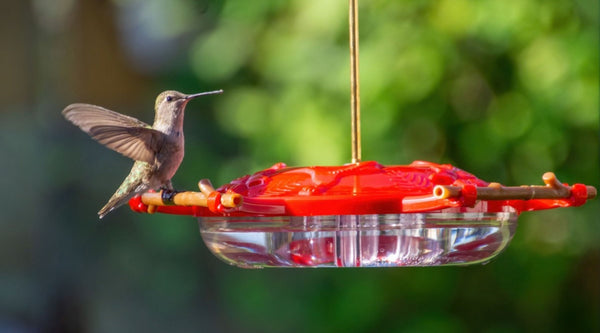
- Use a leak-proof, easy-to-clean feeder like the AspenPerch® Hummingbird Feeder, with a comfort perch so this species can rest between sips rather than hovering the entire time.
- Keep nectar fresh throughout the spring-through-fall breeding window, adjusting more frequently during the hottest stretches common across much of this species' desert range — in hot weather, nectar can ferment in a day or two. Pop's Nectar, with added electrolytes and calcium, supports the demands of nesting season in these often-harsh conditions.
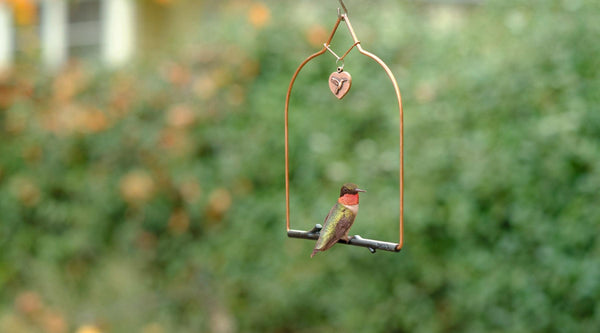
- Add a swing near your feeder — a Pop's Original Hummingbird Swing gives a Black-chinned Hummingbird a place to perch and survey its territory, much like the tall dead snags this species naturally favors.
- Include tall trees in your landscaping plan if you can. Since this species specifically favors habitat with tall trees paired with flowering shrubs and vines — in both wild and urban settings — a yard with even one or two mature trees has a real advantage over one with only low shrubs.
- Skip the insecticide. Since this species relies on darting out to catch tiny swarming insects as a genuine part of its diet, pesticide use removes a food source it depends on. Use HummGuard™ nectar tips instead to keep bees and wasps out of your feeder without harming anything else.
Because arrival runs south to north, the right week to hang your feeder shifts by two full months across this bird's range. Attracting hummingbirds in Arizona and Texas means being ready in early March, while New Mexico and Utah follow through spring. In Oklahoma, where the species has been pushing eastward for decades, timing is still settling. Find your own state in the full hummingbird guide by state series.
Frequently Asked Questions
Why is it called the Black-chinned Hummingbird if the throat looks purple in photos? The male's throat is actually two colors: a velvety black upper chin with a band of iridescent purple below it. In most lighting and from most angles, that purple band simply doesn't catch the light, so the throat reads as solid black, which is where the common name comes from.
How can you tell a female Black-chinned Hummingbird from a female Ruby-throated Hummingbird? Honestly, often you can't — every structural difference between them is extremely subtle. The outermost flight feather is club-shaped in the Black-chinned and knife-shaped in the Ruby-throated, and the Black-chinned's bill is slightly longer with a faint droop, but both take a very good look. In practice the breeding ranges overlap only in a narrow band of Texas and a corner of southwestern Oklahoma, so location settles most sightings before plumage does.
Where do Black-chinned Hummingbirds live? Across most of the western United States in summer, from the southern interior of British Columbia down through the desert Southwest and into Mexico for winter, with a small but increasingly regular wintering population on the U.S. Gulf Coast.
What is the Black-chinned Hummingbird's courtship display like? Males perform a "pendulum" display, climbing roughly 35 to 50 feet and then swooping in a wide U-shaped arc above a perched female, making a whirring sound on each pass, with the wing and tail feathers producing an audible whistle. The dive sometimes takes the shape of a narrow horizontal figure eight instead of a simple arc, and ends in a long, drawn-out vocalization. Males use the same display against intruders, not just in courtship.
How long do Black-chinned Hummingbirds live? Most live only a few years, but they can do considerably better: the oldest known individual was a female of at least 11 years and 2 months, recaptured during banding operations in Texas in 2008 — one of the longest documented lifespans of any North American hummingbird.
Is the Black-chinned Hummingbird endangered? No. It's rated Least Concern by the IUCN, with an estimated population of 8.8 million and a Breeding Bird Survey trend that is stable to slightly increasing — likely helped by backyard feeders and this bird's unusual tolerance for varied habitat.
How can I attract Black-chinned Hummingbirds to my yard? Keep a leak-proof feeder up during their spring-through-fall window, and take advantage of this species' genuine adaptability by planting nectar-rich natives suited to your specific setting, whether that's a desert, a mountain canyon, or a suburban yard with tall trees and flowering shrubs.
At Pop's Birding, we believe every backyard — big or small — has room for a little more wonder. Explore our feeders, nectars, swings, and wildflower seed blends to start building your own hummingbird sanctuary today.

Bethany Sloan has served as General Manager of Pop's Birding since 2010, continuing the legacy of her grandfather, William "Pops" Sloan, inventor of the Original Hummingbird Swing. A lifelong hummingbird enthusiast, educator, and independent researcher, she leads the company's educational content, including its 50-State Hummingbird Guide series, Regional Guide, Species Guide and Hummingbird Learning Center. Bethany combines scientific research, regional migration data, and more than 16 years of hands-on experience to create trusted educational resources for bird enthusiasts across North America.