Jul 19, 2026
Hummingbird Migration in the Southwest: How Fifteen Species Share One Canyon
Quick overview: Southeastern Arizona has more hummingbird species than anywhere else in the United States or Canada — about fifteen that turn up regularly. Which raises a question worth answering: how do that many birds share one canyon without a single bully taking it all? The answer, worked out at feeders in the Chiricahua Mountains, is the most interesting thing about this region. Keep a feeder up nearly year-round in the low desert, and pay attention from July through September, when monsoon rains trigger a second bloom and the migrants pour through.
🗓️ Feeder Timing at a Glance
Put your feeder up: Nearly year-round in the low desert; by April in the sky islands and high country
Take it down: Not before October — the busiest stretch of the year here is July through September
Which Hummingbirds You'll See in the Southwest
More species occur here than in any other region in this series, so it's worth sorting them into groups rather than one long list.
Black-chinned Hummingbird
The region's workhorse — the most widely distributed hummingbird across Arizona, New Mexico, and Texas, from low desert washes up into the canyons. Males show a velvety black throat edged with a violet band that only flashes at the right angle. Small, adaptable, and — as you'll see below — quietly one of the cleverest birds in the canyon.

Anna's Hummingbird
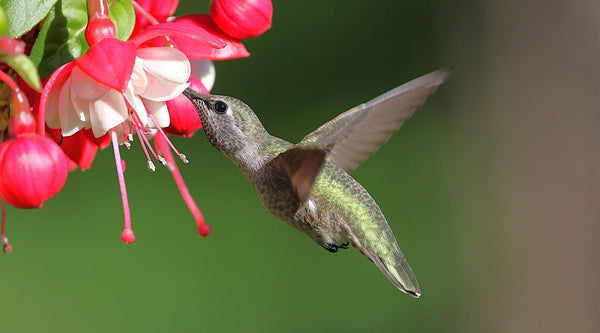
Increasingly a fixture of the low desert, including through winter. Males wear an iridescent rose-red crown and throat, a full-head shimmer no other North American hummingbird has. Anna's has expanded dramatically over the past century — it now breeds east through southern Arizona — and it's the bird most likely to be at your Phoenix or Tucson feeder in January.

Costa's Hummingbird
The desert specialist, and the one that runs on desert time. Males have a violet gorget that flares dramatically at the sides like a moustache. Costa's occupies Sonoran and Mojave desert scrub, typically below 3,000 feet, and nests to the earliest winter and spring bloom rather than to summer. It's common around Phoenix and Tucson, especially in the cooler months.

Rufous Hummingbird
The late-summer visitor, and the one that changes the mood at your feeder. Bright coppery-orange males, unmistakable. Rufous doesn't breed here — it passes through southbound from July onward on the return leg of its clockwise loop, having flown north up the Pacific Coast in spring. Cornell Lab describes Rufous as relentless attackers at flowers and feeders, "going after (if not always defeating) even the large hummingbirds of the Southwest, which can be double their weight." That parenthetical matters here more than anywhere else — see below.

Calliope Hummingbird
North America's smallest bird, and a regular migrant through the region's mountains — scarce in spring, more numerous in late summer. Males have a magenta gorget that splits into separate rays rather than forming a solid patch, flaring like whiskers when they display. Easy to overlook among bigger birds at a busy feeder.

Broad-tailed Hummingbird
The high-country breeder, common in the mountains of northern Arizona and New Mexico rather than a sky-island rarity. Males produce a loud metallic cricket-like trill with their outer wing feathers — you'll usually hear one before you see it.

Broad-billed Hummingbird
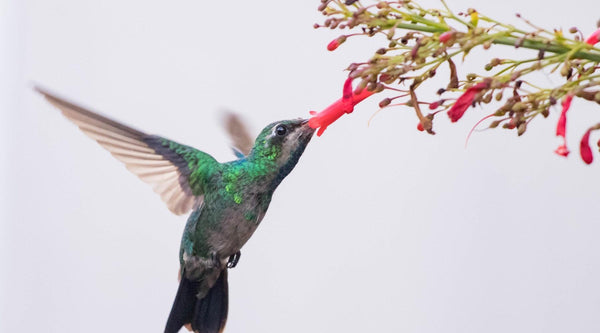
A Southwest specialty of the oak-studded canyons of southeastern Arizona, and one of the most striking birds at any feeder in the region — glittering blue-green throat, deep green body, and an unmistakable orange-red bill tipped in black.

Buff-bellied Hummingbird
The Texas bird, and a genuine year-round resident of the Gulf Coast and Rio Grande Valley — soft tan belly, reddish bill, metallic green throat. It barely crosses the border into the United States. After breeding, some move northeast into Louisiana for the winter, which is the opposite of what you'd expect.

The sky island specialties
Southeastern Arizona's Madrean "sky islands" — the Huachucas, Chiricahuas, Santa Ritas, and Santa Catalinas — hold species that occur essentially nowhere else in the country:
- Rivoli's Hummingbird — large, dark, with a green gorget and purple crown that both look black in poor light. Called Magnificent Hummingbird until 2017, when the species was split; Cornell Lab notes they "brought back the name Rivoli's for the species that occurs between the U.S. and Nicaragua."
- Blue-throated Mountain-gem — the largest hummingbird in the United States, and the one that runs the canyon. Fewer than 2,000 are thought to occur north of the border.
- Violet-crowned Hummingbird — snow-white underparts and a bright red bill, unlike anything else here.
- Lucifer Hummingbird — a decurved bill and a flaring magenta gorget; the region's flagship conservation concern among the specialties, with a global population near 200,000.
Rarer still, and worth a careful second look: White-eared, Berylline, and Plain-capped Starthroat all reach the northern edge of their range in these canyons.
Why So Many Species End Up Here
The Madrean sky islands are forested mountain ranges standing in a sea of desert and grassland, and they work as a bridge — the northern tip of Mexico's Sierra Madre Occidental reaching up toward the Rockies. Birds that are otherwise Mexican species find familiar habitat at the top of these ranges.
The numbers bear it out. Wethington, West and Carlson (2005), in a U.S. Forest Service proceedings paper, report that the north end of the Madrean Archipelago "has the greatest number of hummingbird species in the United States and Canada," with southeastern Arizona holding "15 regularly occurring species." For comparison, they note south Texas has nine and Big Bend National Park has ten. Species richness peaks not at the summits but in the middle: between about 1,500 and 1,800 metres, roughly 5,000 to 6,000 feet.
A note on that figure: fifteen is the count of species that occur regularly in southeastern Arizona specifically. Arizona's all-time list runs higher once you include vagrants. And the source is a conference proceedings paper rather than a peer-reviewed journal article, which is worth knowing.
How Fifteen Species Share One Canyon
Here's the question that makes this region genuinely different. Hummingbirds are famously aggressive. Put fifteen species in one canyon and you'd expect the biggest one to take everything. That isn't what happens — and a series of experiments at the Southwestern Research Station in the Chiricahua Mountains worked out why, using feeders.
The cast is three species. Blue-throated Mountain-gem is the giant: Powers and Conley (1994, The Condor) measured a mean mass of 8.77 grams and a field metabolic rate of 81.7 kilojoules a day. Black-chinned is a third of that — 3.67 grams, running on 29.1 kilojoules. Rivoli's sits in between in size but behaves nothing like either.
Blue-throated wins by brute force. It holds territory along the richest riparian nectar and drives everything else off. But holding that territory is expensive, which turns out to be the whole point.
Powers and colleagues (2010, Wilson Journal of Ornithology) describe what the other two do instead: Blue-throated "is a dominant species, defending territories along borders of riparian canyons." Black-chinned "is non-territorial at our study site and robs nectar from territories defended by" the bigger bird. And Rivoli's "is also non-territorial, but appears to forage as a trapliner, avoiding many competitive interactions at dense flower aggregations."
Three species, three completely different strategies:
- Fight for it. Blue-throated defends the richest patch and pays a heavy energy bill to do it.
- Steal it. Black-chinned is too small to win a fight and doesn't try — it sneaks into defended territory and takes nectar anyway. At a third the body mass, it needs far less to get by.
- Skip it. Rivoli's runs a circuit — a trapline — between widely scattered flowers that aren't worth anyone defending. No fight, no theft, just a longer commute.
The feeder experiments sharpened this further. Pimm, Rosenzweig and Mitchell (1985, Ecology) and Sandlin (2000, Behavioral Ecology) found that as Blue-throated density rose, both subordinates shifted away from the rich feeders — each in its own way — rather than escalating.
And there's a detail from the same research station, described in Cornell's Living Bird, that every backyard birder should know. Researchers set up ten feeders in a tight cluster, and one male Blue-throated defended all ten. As they spread the feeders farther apart, he first tolerated Black-chinned, then the larger Rivoli's, then even rival male Blue-throateds — and finally abandoned the territory altogether, because guarding scattered food stopped being worth the effort.
Coexistence here isn't politeness. It's economics.
The Century Plant Truce
The same pattern turns up again in west Texas, on a completely different plant.
Kuban, Lawley and Neill (1983, The Southwestern Naturalist) studied how Black-chinned and Lucifer Hummingbirds divide up flowering century plants — agaves — in Big Bend National Park. Lucifer is the subordinate: most Lucifers feed at agaves nobody is defending, or at ones tucked into dense vegetation where a territory holder can't easily patrol.
Different canyon, different plant, same solution. The smaller or less aggressive bird doesn't win the contest; it finds food that isn't worth contesting.
The Second Spring
Most of the country has one growing season. Much of the Southwest has two.
The desert runs a long dry stretch — Powers et al. (2010) describe the Chiricahua forest enduring "a pronounced dry season from November until monsoon rains begin in early July that can dramatically affect the amount of nectar available." Then the monsoon breaks, and the desert flowers all over again.
Hummingbird author Sheri Williamson, quoted by Audubon, calls it the desert's "second spring": the July monsoon "brings frequent afternoon rains throughout the area and a burst of vegetation and insects — perfect for locally breeding species such as Violet-crowned Hummingbirds."
Worth being precise about what that is: "second spring" is a well-observed regional description from an expert, not a term from a controlled study. The underlying pattern — a hard dry season followed by a monsoon bloom, and a huge late-summer movement of birds — is documented in the research literature.
When the Rufous Arrive
Late summer is the busiest hummingbird season in the Southwest, and it isn't close.
Banding work in southeastern Arizona by Wethington, Russell and West (2005) — over 8,000 birds of twelve species — found "a massive southbound fall migration occurred at the study sites with fewer hummingbirds moving northward in spring." The order matters if you're watching a feeder: "Fall-migrant Black-chinned peaked earliest, followed by Rufous (predominantly juveniles), then Anna's."
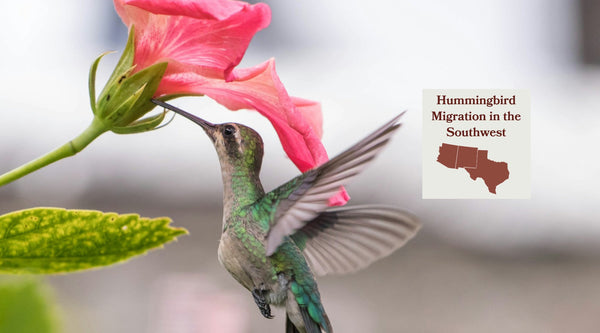
Rufous passage runs from July into September, generally peaking in early-to-mid August, with adult males moving through first. They arrive into canyons where residents have been holding territory all season, and they are not shy about it.
But here's the Southwest twist. Rufous weighs about 3.2 grams. Blue-throated Mountain-gem males average around 8.4. Cornell's phrasing — going after larger hummingbirds "if not always defeating" them — is doing real work in this region. Elsewhere Rufous is the bully. Here it can meet something considerably bigger that has been defending the same canyon since May.
🌵 What You Can Do: Plant Something That Blooms in August
If there's one action that matters most in this region, it's this — and the research behind it is the same economics that runs the canyon.
A single feeder is a concentrated, extremely rich food source, which makes it close to the perfect thing for one dominant bird to guard. Scattered flowers aren't. As Gill and Wolf (1975) established and Carpenter, Paton and Hixon (1983, PNAS) confirmed in hummingbirds specifically, defending a resource only pays under certain conditions — birds actively resize territories to match how dense the food is, and abandon defense when it stops being worth the energy.
So planting natives spread around your yard won't necessarily stop the chasing. What it does is make it impossible for any one bird to guard all the food — which means more hummingbirds, and more species, actually get to feed. That's the honest version, and it's the one the evidence supports.
Aim for July through September. That's when the monsoon breaks, the Rufous come through, and your yard can do the most good. Good monsoon-window bloomers include flame acanthus (Anisacanthus quadrifidus), desert honeysuckle (Anisacanthus thurberi), agave, desert willow, Mexican bush sage, and the long-season red salvias. Pair them with spring bloomers — chuparosa, ocotillo, penstemon — so something is always open.
For plant lists matched to your specific conditions, see our state guides: Arizona, New Mexico, and Texas.
What Feeders Actually Do Here
We sell feeders, so we'd rather show you the research than make a claim.
McCaffrey and Wethington (2008, The Condor) spent a year watching hummingbirds in southern Arizona and tracked whether they went to feeders or flowers. The result: "Feeder visits represented approximately 59% of all visits during our yearlong study, but were less common in times of high floral abundance."
Two things follow. Feeders matter — they carried well over half of all visits. And birds lean on them hardest when flowers are scarce, switching back to natural nectar when the desert is blooming. A feeder isn't a replacement for habitat; it's a bridge across the lean stretches, and in this region the lean stretch is long — that November-to-July dry season.
Which is why the best setup here is both: a clean feeder through the dry months, and plants that carry the load once the rains come.
The Night Shift
One more thing that happens here and almost nowhere else. If your feeder is mysteriously empty each morning in late summer, you may not have a hummingbird problem.
Southern Arizona has two nectar-feeding bats — the lesser long-nosed bat and the Mexican long-tongued bat — that drain hummingbird feeders after dark, especially from July through October. Fleming and colleagues (2021, Journal of Mammalogy) documented this through an eleven-year community-science project in the Tucson area.
These bats normally feed at agave and columnar cactus flowers — the same century plants that Lucifer and Black-chinned Hummingbirds work by day. Your feeder is just an easier version. If you'd like to know who's visiting, Arizona Game and Fish runs a project that identifies bats from DNA swabbed off feeders.
Migration Timing by Sub-Region
Pop's tip: If you take one thing from this guide, make it this — don't put your feeder away in August. That's the peak, not the tail end. And run more than one, spaced well apart, so a single Blue-throated or Rufous can't hold the whole yard.
Conservation: What's at Stake Here
- Rufous Hummingbird — the region's clearest concern. Down about 2.2% per year between 1968 and 2023, a cumulative loss of 72%, an Orange Alert Tipping Point species and IUCN Near Threatened. It doesn't breed here, but the Southwest is a critical refuelling corridor.
- Lucifer Hummingbird — the flagship among the specialties, with a global population near 200,000, a Continental Concern Score of 14 out of 20, and a place on the State of the Birds Watch List.
- Costa's Hummingbird — around 3.4 million birds and 11 out of 20 on the Concern Score, but Cornell Lab is blunt about the threat: "Clearing of desert scrub for development and grazing is their biggest threat." It's listed as Threatened in New Mexico.
- Blue-throated Mountain-gem — around 12 of 20 on the Concern Score, with fewer than 2,000 birds north of the border. The canyon's dominant species is also one of its scarcest.
- Black-chinned, Broad-billed, Violet-crowned, Rivoli's — all rated low concern, with Black-chinned up slightly since 1966.
Worth noticing: the species in trouble here are the ones tied to narrow habitat — desert scrub being cleared, or a few canyons at the top of a Mexican range — plus one long-distance migrant that's declining across its whole range.
Should I Take My Feeder Down in Fall?
No — and in the Southwest that's not a close call. Fall is the season. The monsoon bloom and the southbound rush both land between July and September, so a feeder taken down in August misses the busiest weeks of the year.
In the low desert, run one nearly year-round. Costa's is present much of the year and Anna's increasingly winters there, and the long dry stretch from November into early July is exactly when natural nectar is scarcest.
The old worry that a feeder will strand a migrant doesn't hold up. Departure runs on day length and the hormonal cascade that follows, not on whether your feeder is full.
How to Help Hummingbirds Through This Region
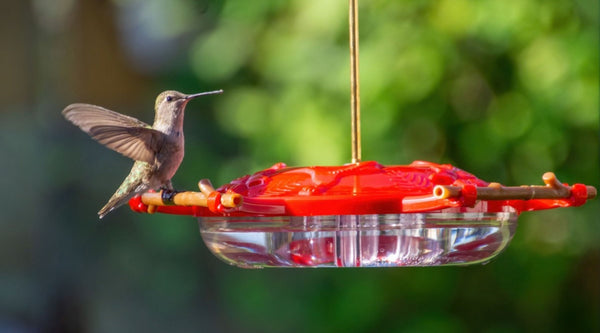
- Run several feeders, spaced out of sight of each other. This is the single most useful thing you can do in a region with this many species — one feeder means one dominant bird
- Don't stop in August. Late July through September is peak season here, not the end of it
- Change nectar every one to two days in real heat, and daily if the feeder sits in direct sun — high temperatures accelerate fermentation and mould sharply
- Put feeders in afternoon shade where you can, and fill them only partway so nectar gets used before it spoils
- Plant for the monsoon window — see the section above, and your state guide for specifics
- Skip the insecticide. Insects supply protein nectar can't, and nesting females hunt them heavily
- Expect the cast to change. The birds at your feeder in April are not the ones there in August
Frequently Asked Questions
Why does the Southwest have so many more hummingbird species than other regions?
The Madrean sky islands of southeastern Arizona are forested mountain ranges surrounded by desert, forming a bridge between Mexico's Sierra Madre and the Rockies. Species that are otherwise Mexican reach the northern edge of their range there. A U.S. Forest Service study found the region has the greatest number of hummingbird species in the United States and Canada, with about fifteen occurring regularly, and richness peaking at middle elevations around 5,000 to 6,000 feet.
How do that many species share the same canyon?
By using completely different strategies. Research in the Chiricahua Mountains found the large Blue-throated Mountain-gem defends the richest nectar; the much smaller Black-chinned doesn't fight for it but robs nectar from those defended territories; and Rivoli's avoids the conflict entirely by traplining — running a circuit between scattered flowers not worth defending. Nobody wins outright because each bird makes a living a different way.
What is the monsoon "second spring"?
Summer monsoon rains arriving in July trigger a fresh wave of desert bloom after a long dry season, creating a second flowering pulse. Hummingbird author Sheri Williamson, quoted by Audubon, calls it the desert's "second spring." It's why peak hummingbird diversity here comes in late summer rather than spring.
When do Rufous Hummingbirds come through the Southwest?
July into September, generally peaking early-to-mid August, with adult males moving through first. Banding work in southeastern Arizona found a massive southbound fall migration with far fewer birds moving north in spring — Black-chinned peaking earliest, then Rufous, then Anna's.
Will planting more flowers stop the fighting at my feeder?
Probably not stop it — but it does something better. Defending food only pays when that food is concentrated enough to guard, which is why a single feeder is so easy for one bird to monopolise. Scattered flowers can't be guarded the same way, so more birds get to feed even if the chasing continues. Aim for plants that bloom July through September, when the migrants arrive.
Should I keep my feeder up year-round in the Southwest?
In the low desert, close to it — Costa's is present much of the year, Anna's increasingly winters there, and the November-to-July dry season is when natural nectar is scarcest. In the sky islands and high country, run feeders at least from April through September.
Why is my feeder empty every morning?
In southern Arizona, possibly bats. Two nectar-feeding species drain hummingbird feeders overnight, particularly from July through October. An eleven-year community-science study in the Tucson area documented the behaviour, and Arizona Game and Fish can identify the species from DNA swabbed off your feeder.
Is "Magnificent Hummingbird" the same as Rivoli's?
Yes. The Magnificent Hummingbird was split into two species in 2017, and the bird occurring in Arizona took back its older name, Rivoli's Hummingbird. Older field guides and websites still use "Magnificent."
How We Know This
Species status and range draw on the Cornell Lab of Ornithology's All About Birds accounts for Rufous, Costa's, and Rivoli's. Regional diversity figures come from Wethington, West & Carlson (2005) and migration timing from Wethington, Russell & West (2005), both U.S. Forest Service proceedings papers. The coexistence research comes from Pimm, Rosenzweig & Mitchell (1985, Ecology), Sandlin (2000, Behavioral Ecology), Powers & Conley (1994, The Condor), and Powers et al. (2010, Wilson Journal of Ornithology). Agave partitioning comes from Kuban, Lawley & Neill (1983, The Southwestern Naturalist). The economics of territorial defence come from Gill & Wolf (1975, Ecology) and Carpenter, Paton & Hixon (1983, PNAS). Feeder use comes from McCaffrey & Wethington (2008, The Condor), nectar bats from Fleming et al. (2021, Journal of Mammalogy), and the "second spring" from Audubon.
Key Takeaways
- Southeastern Arizona has about fifteen regularly occurring hummingbird species — the most anywhere in the United States or Canada — with richness peaking around 5,000 to 6,000 feet
- They coexist through different strategies, not truce: Blue-throated defends, Black-chinned robs, Rivoli's traplines
- Defending food only pays when it's concentrated — which is why one feeder gets monopolised and scattered plantings don't
- Monsoon rains in July trigger a "second spring," making late summer the region's peak hummingbird season
- Rufous moves through July into September, peaking in early-to-mid August — but here it can meet residents nearly three times its weight
- Feeders carried about 59% of visits in a year-long Arizona study, and were used most when flowers were scarce — a bridge across the long dry season, not a replacement for habitat
- Nectar-feeding bats drain feeders overnight in southern Arizona from July through October
- Don't take your feeder down in August — that's the busiest stretch of the year here
At Pop's Birding, we believe every backyard — big or small — has room for a little more wonder. Explore our feeders, nectars, swings, and wildflower seed blends to start building your own hummingbird sanctuary today.

Bethany Sloan has served as General Manager of Pop's Birding since 2010, continuing the legacy of her grandfather, William "Pops" Sloan, inventor of the Original Hummingbird Swing. A lifelong hummingbird enthusiast, educator, and independent researcher, she leads the company's educational content, including its 50-State Hummingbird Guide series, Regional Guide, Species Guide and Hummingbird Learning Center. Bethany combines scientific research, regional migration data, and more than 16 years of hands-on experience to create trusted educational resources for bird enthusiasts across North America.