Jul 16, 2026
How to Attract Hummingbirds in Oregon: A Backyard Sanctuary Guide
On the south Oregon coast around Bandon, birders have a habit that looks like indecision and is actually the opposite. When a small orange hummingbird turns up, they often decline to name it, logging it simply as "Rufous or Allen's" rather than picking one. They do this far more often here than anywhere else in the state, and there's a good reason: this is the northern edge of where Allen's Hummingbird breeds, and in the field the females of the two species are genuinely impossible to tell apart.
Whether you're gardening on the coast, in the Willamette Valley, down in the Rogue, or out in the high desert east of the Cascades, this guide covers what you need: who's around and when, feeder and nectar care, pest-safe cleaning, and the native plants that actually belong in an Oregon yard.
The short version, if you're in a hurry:
To attract hummingbirds in Oregon, keep a leak-proof feeder up year-round west of the Cascades — Anna's are there all winter — and put one out by early April east of the Cascades for arriving Rufous. Fill it with fresh, dye-free nectar, keep it clean, skip the insecticide so hummingbirds can still hunt insects for protein, and plant red-flowering currant, which blooms in February and March exactly when the first Rufous arrive.
- Best feeder type: leak-proof design with a comfort perch, like the AspenPerch® Hummingbird Feeder
- Best nectar: plain 4:1 water-to-sugar ratio, no red dye — or Pop's Nectar with added electrolytes and calcium
- Feeder timing: year-round west of the Cascades; early April in the east
- Earliest arrivals in the series: Rufous reach the south Oregon coast in mid-February — earlier than any other state we've mapped
- Nectar change frequency: about every three days in warm weather, weekly when cool
- Winter feeding: nectar starts to freeze around 27°F — rotate two feeders, or use a heated one
- Pest control: no insecticide — use vinegar-water spray and HummGuard™ nectar tips instead
- Top native plants: red-flowering currant, orange honeysuckle, salmonberry, western columbine, twinberry
- One to avoid: butterfly bush is a Class B noxious weed in Oregon and has been quarantined since 2004
Free download
Take Oregon with you
Everything on this page on one page you can print and keep by the back door — species, timing by region, feeder care, and the best native plants for your part of Oregon.
Download the Oregon cheat sheetOne page · PDF · free to print and share
Which Hummingbirds You'll See in Oregon

Nine hummingbird species are on Oregon's official state checklist, and each occupies a different piece of the state. Anna's Hummingbird is the state's only true year-round resident — first recorded in Oregon in 1944, it now appears on 27 to 47 percent of Portland's bird lists depending on the season. Rufous Hummingbird is ODFW's own pick for "most common and widespread," reaching the south coast by mid-February and completing an entire migration loop without ever leaving the state. Allen's Hummingbird genuinely breeds along the south coast north to Bandon, though its females are essentially impossible to tell apart from Rufous in the field. Calliope Hummingbird and Black-chinned Hummingbird are both east-of-the-Cascades specialists — Calliope concentrated in the Blue and Wallowa Mountains, Black-chinned in canyons, juniper woodland, and desert riparian country. Among the rarities, Costa's Hummingbird is genuinely annual in the Rogue Valley (28 accepted records before its 2001 removal from the state's review list), Broad-tailed Hummingbird is an annual visitor to Oregon's eastern edge (five accepted records before its own 1981 removal), Broad-billed Hummingbird has two accepted records (John Day in 1998, Gearhart in 2001), and Ruby-throated Hummingbird, the eastern species, has three.
For full identification help — photos, field marks, how to tell Rufous and Allen's apart on the south coast, and the county-by-county breakdown behind these numbers — see our complete Hummingbirds in Oregon species guide.
When Do Hummingbirds Arrive and Leave Oregon?
The Cascade crest is the dividing line for almost everything in Oregon, and hummingbirds are no exception. West of it, Anna's are present all year and Rufous arrive absurdly early. East of it, the season is short, later, and belongs to different species.
Arrival Times by Region
| Region | First Rufous | Rufous Peak | Anna's | Feeders By |
|---|---|---|---|---|
|
South Coast (Coos Bay, Bandon) |
Mid-February | Late March | Year-round; February high | Leave up all year |
|
North & Central Coast (Newport, Astoria) |
Late February | April | Year-round; December high | Leave up all year |
|
Willamette Valley (Portland, Salem, Eugene) |
Early March | April | Abundant year-round | Leave up all year |
|
Southern Oregon (Medford, Ashland, Grants Pass) |
Late February | August | Year-round; February and September highs | Leave up all year |
|
East of the Cascades (Bend, Burns, Ontario) |
Mid-April | Late July | Summer and fall only — scarce in winter | Early April |
Windows derived from eBird bar chart data (Cornell Lab of Ornithology), 2016–2025, for Coos, Lincoln, Multnomah, Jackson, and Deschutes counties, cross-checked against Oregon Department of Fish and Wildlife and OSU Extension guidance. Note that a 2017 study in The Wilson Journal of Ornithology found Rufous arriving eight to eleven days later in two coastal Oregon cities in recent decades compared with 1895–1969 — Oregon's arrival dates are not static.
For the full month-by-month breakdown — the statewide bell-curve chart, the complete Rufous migration loop explained month by month, and the east-side Anna's inversion that flips everything east of the Cascades — see our complete Oregon hummingbird calendar.
When to Put Your Feeder Up (and Take It Down)
🗓️ Feeder Timing at a Glance
West of the Cascades: leave a feeder up year-round. Anna's are there in January, and OSU Extension notes that a maintained feeder during an ice storm is a welcome sight to a hummingbird coming out of overnight torpor.
East of the Cascades: put feeders out around the first week of April, and take them down in mid-November if nothing has visited for a fortnight.
And no, it won't hold them here. Hummingbirds migrate on day length and hormonal cycles, not food supply. A feeder left up simply helps the last birds through — and sustains the Anna's that were never going anywhere.
Attracting Hummingbirds No Matter Your Space
You don't need acres of land to invite wonder into your yard. Hummingbirds are famously adaptable — all they're really looking for is a dependable food source, a safe place to perch, and a little color.

Small Patio or Balcony
One feeder hung from a bracket or shepherd's hook, paired with a container of red or orange tubular blooms, is plenty to get noticed. Hummingbirds are solitary feeders by nature, so a single feeder works great in tight spaces. We put together a guide to which hummingbird products work best on a small patio or balcony if space is tight.
Average Backyard
Add a mix of feeders and native blooms along a fence line or garden bed, and give your visitors a swing or two nearby to rest and survey their territory between sips.
Large Yard with Trees
Take advantage of the shade. Hummingbirds prefer feeders and plantings tucked out of harsh, direct afternoon sun, with a nearby branch to perch on and watch for rivals. Spread multiple feeders far apart — Rufous in particular will try to run every other hummingbird off a single feeder.
Choose a Saucer Type Feeder to Prevent Leaks
A feeder is only as good as what's in it — and how well it's kept. A leaky feeder does more than waste nectar: it can attract ants, bees, and other pests, turning your sanctuary into a mess that can deter hummingbirds.
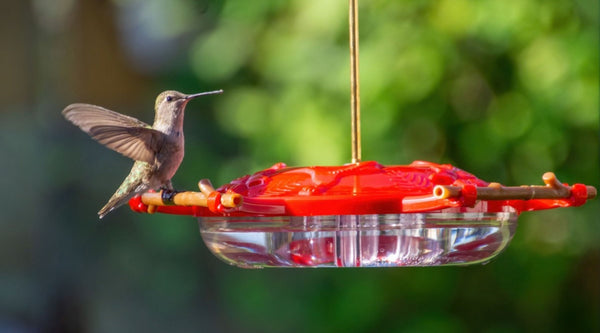
Saucer-style feeders, like our AspenPerch® feeder, hold nectar in a shallow basin below the ports, so there's no sealed air pocket to cause problems; bottle-style, gravity-fed feeders tend to leak more, especially in hot weather, since the air trapped above the nectar expands with heat and pushes nectar out through the ports.
West of the Cascades, where Anna's need a feeder every single day of the year, that reliability matters even more than it does in states where a feeder only has to survive one migration season.
Shop the feeder
AspenPerch® Hummingbird Feeder, 8 oz

Leak-proof by design, with a patented Polyperch® comfort perch built in — so your hummingbirds can rest and feed at the same time instead of hovering through the whole meal. West of the Cascades, that's a feeder Anna's will use every single day of the year.
Shop the AspenPerch® Feeder →Keep Feeders Clean with Fresh Nectar
Skip the Red Dye
Your feeder's color does the attracting; dyed nectar offers no benefit and can be harmful to a hummingbird's health. OSU Extension is explicit on the recipe itself: use only white granular sugar, never honey or sugar substitutes, and no food coloring — and they advise against commercial mixes with additives, which spoil faster.
Use a Real Nectar Recipe
Use a 4:1 plain sugar-water ratio to make your hummingbird nectar, and read our full recipe guide to get your batch right. You can also use our nectar mixing calculator for any unit of choice to get the full breakdown on sugar to water ratio. Or skip the math with the ready-to-use option below.

Oregon's south coast sees the earliest Rufous arrivals anywhere in this 50-state series — mid-February, months before most of the country. Nectarade® Ready to Use Liquid comes pre-mixed and ready to pour, so an unusually early scout doesn't catch you unprepared.
Shop the Ready to Use Nectar →Only Fill Enough to Change Often
Only fill what they'll drink in a few days — overfilling just means more nectar sitting around long enough to spoil.
Wondering how long nectar actually lasts? Our full guide to hummingbird nectar storage and shelf life covers exactly when to toss it, even before your temperature-based schedule says to.
How Often to Change Nectar in Oregon
OSU Extension's baseline is to change nectar roughly every three days in warm weather, cleaning with hot water and a scrub brush. Oregon's two climates need the same rule applied to very different summers:
| Outdoor Temp | Change Nectar Every |
|---|---|
| Below 70°F | 5–6 days |
| 70–80°F | 3–4 days |
| 80–90°F | 2–3 days |
| Above 90°F | 1–2 days |
Our full guide to how often to change hummingbird nectar covers the reasoning in more depth.
Winter Feeding West of the Cascades
Nectar begins to freeze at around 27°F, which in the Willamette Valley means a handful of nights most winters and rather more in a cold snap. Options, roughly in order of effort:
- Rotate two feeders — one indoors thawing, one outside. Swap at dawn and dusk.
- Use a heated feeder, or a purpose-made feeder warmer.
- Rig a heat source: an incandescent bulb near the feeder works; LEDs don't, because they don't produce meaningful heat. A dark-coloured baffle above the feeder collects what winter sun there is.
Whatever you use, clean it more often in winter than you would in summer, not less — a heated feeder is a warm sugar solution, which is exactly what mould likes.
Keep Feeders Pest-Free Without Insecticide
Hummingbirds don't live on nectar alone — small insects make up a big part of their protein diet, especially for feeding chicks. That means insect spray is off the table around your feeding station; it removes a food source hummingbirds depend on and can be harmful to them directly.
Instead:
- Clean your feeder every time you change the nectar, using hot water and a bottle brush — no soap residue, no bleach. A little vinegar and water solution works well for sticky buildup or the beginnings of mould. Our practical guide to cleaning hummingbird feeders walks through the whole routine.
- Deter ants and bees with a vinegar-water spray around (not on) the feeder ports, or wipe down the hanging hook where ants tend to march down. For the full set of options, see our guide to keeping ants away from hummingbird feeders.
- Use HummGuard™ nectar tips if bees and wasps keep crashing the party. They slide right onto the AspenPerch's feeding ports — the flexible membrane opens easily for a hummingbird's beak but closes tight against anything bigger.

Still crashing the party? HummGuard® Nectar Tips slide right onto the AspenPerch's feeding ports — the flexible membrane opens easily for a hummingbird's beak but closes tight against anything bigger — so your nectar stays exclusively for the birds it's meant for, wherever you are in Oregon.
Shop HummGuard® Tips →Plant an Oregon Native Hummingbird Garden
Feeders are a wonderful supplement, but nothing beats real, native nectar — and in Oregon there's one plant that matters more than any other.
Best Native Nectar Plants for Oregon
| Plant | Why It Works |
|---|---|
|
Red-flowering currant (Ribes sanguineum) |
The single most important plant in this guide. Blooms February through April — exactly when the first Rufous arrive and when overwintering Anna's are nesting. Nothing else in a western Oregon garden is reliably flowering that early. |
|
Orange honeysuckle (Lonicera ciliosa) |
A native climbing vine with tubular orange flowers built for hummingbird bills |
|
Salmonberry (Rubus spectabilis) |
Another very early bloomer west of the Cascades, and it gives you a berry harvest too |
|
Western columbine (Aquilegia formosa) |
Native statewide, spring into summer |
|
Twinberry honeysuckle (Lonicera involucrata) |
A tough native shrub for damp ground, west and east |
|
Scarlet gilia and native penstemons (Ipomopsis aggregata) |
The east-side equivalents — built for dry, sunny, high-desert conditions |
Pop's tip: If you plant one thing in western Oregon, plant red-flowering currant. Rufous arrival is timed to its bloom, and a mature shrub will feed birds for weeks before anything else opens.
And one to avoid. Butterfly bush (Buddleja davidii) is sold everywhere as a pollinator plant, but the Oregon Department of Agriculture classified it a Class B noxious weed in 2004 and it has been under quarantine since. Only approved sterile cultivars — producing under two percent viable seed — may be sold. If you want the look, ask specifically for an approved sterile variety, or plant a native shrub instead.
If You're Near the Border
Hummingbirds don't check a map before deciding where to feed, so if you're near a state line, your best guide might be a blend of both.
Near Washington: Both states split into a wet west side and a dry east side, and share the same Anna's and Rufous patterns. See our Washington hummingbird guide for more.
Near California: Southern Oregon shares the coastal fog belt where Allen's breeds, and a Mediterranean-type summer. See our California hummingbird guide for more.
Near Idaho: Eastern Oregon shares Idaho's dry, high-desert conditions and its Calliope and Black-chinned country. See our Idaho hummingbird guide for more.
Near Nevada: Southeastern Oregon shares the northern Great Basin. See our Nevada hummingbird guide for more.
To make this easy, our Perfect Little Sanctuary® Wildflower Seed Blend is designed to bring nectar-rich color into your yard with minimal fuss.
When to Plant the Perfect Little Sanctuary® Blend in Oregon

Timing splits along the Cascades. In western Oregon's milder, wetter climate, aim for October through November and let the wet winter do the work. In eastern Oregon, where winters are colder and drier, early spring planting once the soil is workable is often more reliable. Nine of the blend's twelve varieties either need or benefit from a cold, moist stratification period — how best to deliver that depends entirely on which side of the state you're on.

Ready to plant? Perfect Little Sanctuary® Wildflower Seed Blend packs all 12 varieties into one packet — sown in October–November west of the Cascades, or early spring in the east, whenever your side of the state's window opens.
Shop the Seed →Top Performers in Oregon — and an Honest Note on Natives
Oregon has an exceptionally well-documented flora, so it's worth being straight about which varieties actually belong here. Four genuinely do:
- White Yarrow (Achillea millefolium) — native at the species level in Oregon, in western varieties. Extremely low-maintenance once established. Source regional native seed where you can, since European stock is also widely sold.
- Scarlet Gilia (Ipomopsis aggregata) — a true Oregon native and one of the best hummingbird plants for the dry east side
- Black-Eyed Susan (Rudbeckia hirta) — considered native in Oregon, widespread and variable
- Columbine — western columbine (Aquilegia formosa) is the Oregon native; the common European garden columbine is not
And one worth calling out separately. Clarkia (Clarkia unguiculata, elegant clarkia or mountain garland) is endemic to California — it grows wild nowhere else, so it isn't an Oregon native. But it's built for exactly the climate western Oregon has: a wet winter followed by a long dry summer. In most of this 50-state series Clarkia is a variety we'd tell you not to expect much from. West of the Cascades it should genuinely thrive, and it blooms in summer when a lot of the blend has finished.
The rest perform to varying degrees but came from elsewhere: Purple Coneflower and Lance-Leaved Coreopsis (eastern and central North America), Perennial Lupine (an eastern species — though note that big-leaf lupine, Lupinus polyphyllus, genuinely is a Pacific Northwest native and is the one to look for here), Indian Blanket (a Great Plains annual — Oregon's native blanketflower is Gaillardia aristata), Palmer Penstemon (a Great Basin species, though well suited to eastern Oregon conditions), and Siberian Wallflower and Painted Daisy, neither of which is North American.
Pop's tip: Gardeners on the wet west side will get more out of true Pacific Northwest natives — red-flowering currant above all — than out of a blend built largely for drier climates. East of the Cascades, the blend is a much closer match to your conditions.
Give Them a Place to Rest
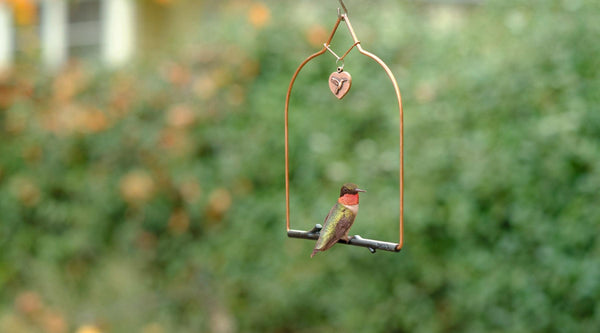
Hummingbirds spend a surprising amount of their day perched, not flying — watching their territory, digesting, and simply resting between feedings. A Pop's Original Hummingbird Swing hung near your feeder gives them exactly that spot, and it turns your feeding station into a front-row seat for watching them up close. Hang it about 1 foot from your feeder, at the same height (Pop's rule of thumb), and don't be surprised if a hummingbird claims it as their own personal lookout post. Our guide to where to hang your hummingbird swing covers placement in more detail — height, distance, and the sightlines that make one get used.
Shop the Perfect Perch
Original Series Hummingbird Swing, Onyx

Rufous Hummingbirds are famously territorial and will try to run every other hummingbird off a single feeder. A second feeder and a nearby swing give a chased-off bird somewhere else to land instead of giving up on your yard entirely.
Shop the Original Swing →Keep Your Sanctuary Safe from Predators
Cats and window strikes remain the two best-documented hummingbird hazards nationally: the U.S. Fish and Wildlife Service estimates free-roaming and feral cats kill 1.4 to 3.7 billion birds a year, with window collisions adding roughly another billion.
Oregon's own research points to a more specific, nest-level threat. Portland citizen scientist Beverly LaBelle has tracked more than 350 Anna's Hummingbird nests since 2012 at Oaks Bottom Wildlife Refuge — one of the most detailed Anna's nesting datasets anywhere — and Audubon magazine reported that most of her 2025 nest failures came down to predation, not weather or accident. Jays are a documented culprit: the Oregon Forest Resources Institute lists western scrub-jays, alongside snakes, among Anna's known predators. Because Anna's nest so early here — starting in December, well before most other birds are even active — their nests sit exposed through a stretch of the year when jays and crows have few other active nests around to raid, which may be part of why predation shows up so often in LaBelle's records.
Keeping cats indoors, and giving a nesting Anna's some cover from open sightlines rather than a fully exposed perch, is the most useful thing a yard can do.
Summary: Key Takeaways for Attracting Hummingbirds in Oregon
Building a hummingbird-friendly yard doesn't take a green thumb or a big budget — just a little consistency and the right setup. Here's everything from this guide in one place:
- Anna's Hummingbird is Oregon's most-encountered hummingbird and its only regular winter species. First recorded in the state in 1944, it now appears on 27 to 47 percent of all bird lists around Portland.
- Anna's nest astonishingly early — from December into May or June, with two and sometimes three broods.
- Rufous arrive in mid-February on the south coast, earlier than almost anywhere in the country, and nine weeks before they reach Bend.
- You can watch the entire Rufous migration loop inside Oregon: the coast and Willamette Valley peak in April on the way north, while Medford and Bend peak in July and August on the way back south.
- Allen's Hummingbird genuinely breeds on the south Oregon coast north to Bandon, but is almost impossible to count — on that stretch of coast, birders leave Selasphorus records unidentified far more often than anywhere else in the state.
- Calliope and Black-chinned are east-of-the-Cascades specialists, essentially absent from the coast and valley.
- Feeder timing: leave one up year-round west of the Cascades; early April to mid-November in the east.
- Nectar begins freezing around 27°F — rotate two feeders, use a heated one, or rig an incandescent bulb nearby.
- Skip red dye, honey, and sugar substitutes. OSU Extension recommends plain white sugar at 4:1, changed about every three days in warm weather.
- Clean the feeder at every nectar change with hot water — no soap or bleach — and clean more often in winter if you're running a heated feeder.
- Never use insecticide near feeders; hummingbirds rely on insects for protein. Use vinegar-water spray and HummGuard™ nectar tips instead.
- Add a swing near the feeder to give hummingbirds a place to rest and be observed up close.
- Plant red-flowering currant above all else in western Oregon — it blooms in February, exactly when the first Rufous arrive. Avoid butterfly bush, a Class B noxious weed in Oregon.
- Sow wildflower seed in October–November west of the Cascades, or early spring in the east. White Yarrow, Scarlet Gilia, Black-Eyed Susan, and Columbine are the varieties genuinely native to Oregon — and Clarkia, though a California endemic rather than a native here, is unusually well suited to western Oregon's dry-summer climate.
- Cats and window strikes are the two best-documented predator threats nationally; in Oregon, jays and other nest predators are a real, tracked risk to Anna's unusually early December-through-June nesting season.
Get these basics in place, and the wonder takes care of itself.
This guide covers what's specific to Oregon — the species, the timing, the plants that belong here. For the fundamentals that apply anywhere, including water sources, shelter, and how the pieces work together, read our guide to building the ultimate hummingbird sanctuary.
Frequently Asked Questions
A few of the questions we hear most from fellow hummingbird lovers across Oregon:
Should I keep my hummingbird feeder up all year in Oregon?
West of the Cascades, yes. Anna's Hummingbirds are year-round residents there and are most conspicuous in winter, when natural nectar is scarce. East of the Cascades the picture is different — Anna's are a late-summer bird around Bend and thin out sharply by December, so a feeder from early April to mid-November covers most of the season.
What is the most common hummingbird in Oregon?
Anna's Hummingbird, by a wide margin, and especially west of the Cascades — it appears on more than a quarter of all bird lists submitted around Portland even in its quietest month. Rufous is the most widespread migrant and the one most people notice arriving in spring.
When do hummingbirds arrive in Oregon?
Rufous reach the south coast around mid-February, the north and central coast and the Rogue Valley in late February, the Willamette Valley in early March, and east of the Cascades in mid-April. Anna's never left.
Why do I see more hummingbirds in August in Medford but April in Portland?
Because Rufous migrate in a loop. They travel north up the Pacific coast in spring, which is why the coast and the Willamette Valley peak in April — then return south through the interior in late summer, which is why Medford peaks in August and Bend in late July.
How do I stop my hummingbird feeder freezing in winter?
Nectar starts to freeze around 27°F. The simplest fix is to rotate two feeders, keeping one indoors to thaw and swapping them at dawn and dusk. A heated feeder or feeder warmer does the job with less effort, and an incandescent bulb near the feeder works too — LEDs don't, since they produce almost no heat.
How often should I clean my hummingbird feeder in Oregon?
OSU Extension recommends changing the nectar about every three days in warm weather and cleaning with hot water and a scrub brush. In cooler weather every five or six days is fine. If you run a heated feeder through winter, clean it more often rather than less.
What are the best plants to attract hummingbirds in Oregon?
Red-flowering currant is the standout in western Oregon — it blooms in February and March, exactly when the first Rufous arrive. Orange honeysuckle, salmonberry, western columbine, and twinberry are all strong natives. East of the Cascades, scarlet gilia and the native penstemons are better suited. Avoid butterfly bush, which is a noxious weed in Oregon.
Oregon Hummingbird Resources
Audubon Chapters
Oregon is home to the Bird Alliance of Oregon (formerly Portland Audubon) and numerous other local chapters across the state. Find the one closest to you with Audubon's Find Your Local Audubon tool.
If You Find an Injured or Grounded Hummingbird
Hummingbirds are protected under federal and Oregon state law, so only a licensed wildlife rehabilitator can legally care for one.
- ODFW — Oregon's Licensed Wildlife Rehabilitators — the official statewide list, searchable by city and authorized species
- Bird Alliance of Oregon — Wildlife Care Center (Portland) — Oregon's oldest wildlife hospital; 503-292-0304
- Chintimini Wildlife Center (Corvallis) — permitted since 1988, treats all birds; serves Benton, Linn, Lane and Marion counties
- Think Wild (Bend, Central Oregon) — wildlife hotline 541-241-8680
Hummingbird Research & Banding in Oregon
- Klamath Bird Observatory (Ashland) is the flagship bird research and banding organization for southern Oregon and the Klamath-Siskiyou bioregion, running long-term monitoring across the region. It operates a public banding station at Crater Lake National Park on Tuesday mornings in partnership with the National Park Service — one of the better ways in Oregon to see banding up close.
- Oregon doesn't have a dedicated annual hummingbird festival. Klamath Bird Observatory's public programmes and banding days are the closest thing, and worth checking seasonally.
Sources
- eBird bar chart data, Cornell Lab of Ornithology — Oregon statewide plus Coos, Lincoln, Multnomah, Jackson, and Deschutes counties, 2016–2025. Source for all arrival, peak, and regional figures.
- Oregon Department of Fish and Wildlife — Hummingbirds. Source for species status and distribution.
- Oregon Bird Records Committee, Oregon Birding Association — official state checklist and accepted rarity records.
- Oregon State University Extension — Hummingbird Visitors to Pacific Northwest Gardens. Source for nectar recipe, cleaning, and winter feeding guidance.
- Bird Alliance of Oregon — native plants and Anna's nesting.
- Battey, C. J. (2019). Ecological release of the Anna's Hummingbird during a northern range expansion. The American Naturalist, 194(3).
- Greig, E. I., Wood, E. M., & Bonter, D. N. (2017). Winter range expansion of a hummingbird is associated with urbanization and supplementary feeding. Proceedings of the Royal Society B, 284(1852), 20170256.
- Courter, J. R. (2017). Changes in spring arrival dates of Rufous Hummingbirds in western North America in the past century. The Wilson Journal of Ornithology, 129(3), 535–544.
- Oregon Department of Agriculture — Noxious Weed Program. Source for the butterfly bush classification.
- Audubon magazine — "This Woman May Know Anna's Hummingbirds Better Than Anyone". Source for the Oaks Bottom nest-predation finding.
- Oregon Forest Resources Institute — Anna's Hummingbird. Source for documented predators including western scrub-jays.
Why We Built This Guide
Pop's Birding has been helping hummingbird lovers for three generations. One of the questions our customers ask most often is "How do I actually attract more hummingbirds to my yard?" — we built this guide to give a direct, practical answer, not a generic one. Most feeder advice online treats every state the same way, but Oregon genuinely splits in two: a mild, wet western half where Anna's never leaves, and a hot, dry eastern half where every species is a seasonal migrant on a completely different schedule — plus a Rufous migration loop most guides never mention at all. We wanted a guide that actually accounts for Oregon's climate, regions, and timing, not one that happens to mention Oregon in the title.
How We Built This Guide
The species accounts and regional timing here draw on eBird bar chart data for Oregon statewide and five representative counties, cross-checked against Oregon Department of Fish and Wildlife range descriptions and the Oregon Bird Records Committee's official checklist and Review List. The nectar and winter-feeding guidance follows OSU Extension directly. The predators section's Anna's nest-predation finding was verified against Audubon magazine's own reporting on a real, ongoing Portland dataset, not assumed from a generic mantis story reused from another state.
Haven't grabbed it yet? Download the free Oregon Quick Reference Guide — one page, print and keep.
Know before they arrive
You don't have to keep this calendar taped to the fridge. Insider Birding Access members get seasonal notes timed to your region — when to have feeders out, what the birds are doing right now, and what's worth doing in your yard this season. We take the guesswork out of the calendar. Joining takes about thirty seconds, and there's 10% off your first order in it.
Join Insider Birding Access →Free to join. 10% off your first order.
Your Oregon Backyard Sanctuary
Every real hummingbird sanctuary comes down to the same staples: mess- and pest-free food, a place to perch, native flowers, and fresh nectar. Here's everything from this guide to get all the bases covered in your own Oregon yard.


Bethany Sloan has served as General Manager of Pop's Birding since 2010, continuing the legacy of her grandfather, William "Pops" Sloan, inventor of the Original Hummingbird Swing. A lifelong hummingbird enthusiast, educator, and independent researcher, she leads the company's educational content, including its 50-State Hummingbird Guide series, Regional Guide, Species Guide and Hummingbird Learning Center. Bethany combines scientific research, regional migration data, and more than 16 years of hands-on experience to create trusted educational resources for bird enthusiasts across North America.