Jul 19, 2026
Hummingbird Migration in the Great Plains: Where the Eastern Hummingbird Runs Out of Trees
Quick overview: The Great Plains is where the eastern hummingbird runs out of continent. Ruby-throated Hummingbird breeds across the eastern half of North America and then stops — along a line so straight that Cornell describes it as "remarkably" so, just east of the 100th meridian. What stops it isn't another hummingbird. It's the end of the trees. Spring arrival runs mid-April in Oklahoma to late May in the Dakotas, and fall departure follows the same gradient in reverse.
🗓️ Feeder Timing at a Glance
Put your feeder up: Mid-April in Oklahoma; late April to mid-May in Kansas and Nebraska; mid-to-late May in the Dakotas
Take it down: Early September in the north; into early October in the south — and watch for western strays in fall
Which Hummingbirds You'll See in the Great Plains
One species dominates, one holds the far western corner, and a handful of western birds turn up in fall. Knowing which is which matters more here than in most regions.
Ruby-throated Hummingbird
The region's breeding hummingbird, and the one this guide is really about. Males show the classic iridescent ruby gorget; females and juveniles are green above and white below. It breeds across the eastern three-quarters of Oklahoma, the eastern half of Kansas, the Missouri and lower Platte valleys of Nebraska, and the eastern portions of both Dakotas. Go far enough west in any of those states and it simply stops.

Black-chinned Hummingbird
The western counterpart — but be precise about where. It is a genuine breeding bird only in the western quarter of Oklahoma. The Oklahoma City Audubon Society reports it is "most common in the southwestern corner… around the cities of Lawton and Altus," and that it "has expanded its range eastward over the past three decades and is now common as far east as Chickasha."
Elsewhere in this region it is genuinely scarce. In Kansas it remains on the state records committee's review list — a 2024 Russell County bird was logged as only the fifteenth accepted state record, and there is a single confirmed nesting, in Morton County. In Nebraska, Birds of Nebraska Online calls it a "rare regular summer visitor west, rare casual elsewhere," with the first state record in 2012 and the first confirmed successful breeding not until 2025. In the Dakotas it's an accidental stray that doesn't breed at all.

Rufous Hummingbird
The fall surprise. Bright coppery-orange males, unmistakable. Rufous doesn't breed anywhere near here, but it swings east through the Plains on its southbound journey — Birds of Nebraska Online rates it an "uncommon regular fall migrant west and central, rare regular east," and notes it's "accidental in spring." If a hummingbird turns up at a Nebraska or Dakota feeder in August or September that doesn't look right, this is the first thing to check.

Broad-tailed Hummingbird
Reaching the far western edge, and apparently increasing. Males produce a metallic cricket-like trill with their wings. In Nebraska it has been recorded roughly 48 times in May and June, with 45 of those since 2018, and probable breeding in Dawes and Scotts Bluff counties. It also breeds in small numbers in the South Dakota Black Hills.

And in fall, occasionally
Calliope Hummingbird — North America's smallest bird — turns up as a rare western migrant, mostly in the west. Anna's Hummingbird is increasingly recorded east of the Rockies in late fall and winter, part of a range expansion running at roughly 2.7% per year since 1970. Broad-billed is accidental. All of these are worth a photograph rather than a guess.
What's Actually Happening in This Region
Most descriptions of the Great Plains call it an overlap zone where eastern and western hummingbirds mix. That framing is appealing, and it's wrong.
What's actually here is an edge — and a strikingly abrupt one. Cornell's Birds of the World puts it plainly: "In the United States, the western boundary of its breeding range ends along a remarkably straight north–south line, just east of the 100th meridian." Not a gradient. A line.
And the same sentence explains why. The Ruby-throated's breeding range "conforms closely to the range of eastern deciduous and mixed boreal forests."
The bird isn't stopping because it meets a competitor. It's stopping because it runs out of trees.
Why the Line Is So Straight
The 100th meridian is one of the most famous dividing lines in North American geography, and it isn't really about longitude. It approximates where annual rainfall drops below roughly twenty inches — the boundary between the humid East and the arid West. East of it, forests. West of it, shortgrass prairie.
Ruby-throated Hummingbirds nest on tree limbs, in woodland edges and along wooded streams. They're birds of the forest edge, and where forest stops being possible, so do they. That's why the line looks drawn with a ruler: it's tracing a climate boundary, not a bird's decision.
Worth knowing that the line itself may be moving. Climate researchers have found the effective arid–humid boundary has shifted east in recent decades, toward the 98th meridian. Whether the hummingbird's range is tracking that shift hasn't been directly studied — but if the trees move, the bird has always followed.
Where the Two Species Actually Meet
They do meet, and they do interbreed — just not where most people say.
The Texas Breeding Bird Atlas is specific: the breeding ranges of Ruby-throated and Black-chinned "overlaps only in Texas between the 96th and 98th meridians." Its Ruby-throated account adds a second location — "Comanche and Stephens counties in Oklahoma." That's the contact zone: a narrow band across central Texas and south-central Oklahoma. Not Kansas. Not Nebraska. Not the Dakotas.
Within that band, something genuinely unusual happens. These two are the only members of the genus Archilochus — each other's closest relatives — and where they overlap, they hybridise. Banding work in southwestern and central Oklahoma reported by Judd, Butler and Batchelder (2011) found 11 apparent hybrids among 118 adult males banded, about 9%. Those were identified by plumage; Graves, Dittmann and Cardiff (2016) later confirmed the pairing genetically from specimens in Grayson County, Texas and East Baton Rouge Parish, Louisiana.
The wider context is striking too. Clark, Rankin and Rudeen (2021) went through nearly a million banding records and found roughly one hybrid per thousand birds where multiple species breed together — with almost every record west of the Mississippi, because only Ruby-throated breeds east of it. They note Black-chinned's eastward push in western Oklahoma has created "a small hybrid zone" there, possibly helped along by feeders.
The Trees Are Moving the Line
Here's the part that matters for your yard.
If Ruby-throated's western limit is really about tree cover, then anything that pushes trees west pushes the bird west too. And two things do exactly that.
The first is rivers. Birds of Nebraska Online traces it precisely: the species breeds "mostly in the Missouri and lower Platte River Valleys, with summer records extending regularly farther west in the Niobrara, Elkhorn, and Platte river valleys," reaching "breeding records west to Keith Co, but not yet in the Panhandle itself." Those wooded corridors are fingers of eastern forest reaching out into grassland, and the hummingbird follows them.
The second is us. Farmstead windbreaks, shelterbelts, town plantings, and cemetery groves are functionally small woodlands in a treeless landscape. A hummingbird crossing western Kansas isn't finding forest — it's finding the trees somebody planted eighty years ago.
🌳 What You Can Do: Plant a Tree — or Protect the One You Have
Every other region in this series asks you to plant flowers. Here, the highest-value thing you can do is plant something with a trunk.
Ruby-throated Hummingbirds nest on tree limbs and forage along wooded edges, and their western limit tracks where trees stop being possible. On the Plains, that means the birds are living on river corridors and human plantings — the cottonwoods along the creek, the shelterbelt behind the barn, the old elms in town. Those aren't scenery. They're the habitat.
So: keep the trees you have, especially along water. If you're planting, native cottonwood, hackberry, or a mixed native shrub thicket does more for hummingbirds here than any flower bed will.
Then fill the two gaps that matter. Prairie bloom peaks in midsummer, which leaves arriving and departing birds short. For April and May arrivals, plant wild columbine, golden currant, and early penstemons. For September departures, dotted blazing star carries into early October. Your existing wild bergamot, prairie blazing star, and trumpet vine cover the summer in between.
For plant lists matched to your conditions, see our state guides: Oklahoma, Kansas, Nebraska, South Dakota, and North Dakota.
Migration Timing by Sub-Region
Pop's tip: Oklahoma birders can set their calendar by it — the Oklahoma City Audubon Society puts the return "usually between the 10th and 20th of April." Further north, add roughly a week for every hundred miles.
The Fall Surprise
Spring in the Plains is predictable. Fall isn't.
From late July through September, western hummingbirds drift east across this region on their way south — Rufous most often, with Calliope, Broad-tailed, and increasingly Anna's turning up too. The further west you are, the better your odds. Oklahoma's wildlife department notes that Black-chinned, normally a far-western bird there, "will frequent feeders elsewhere in the state during fall migration."
This is the strongest argument for leaving your feeder up. A September feeder in Nebraska or Kansas isn't serving Ruby-throateds that have mostly gone — it's serving a bird that bred in Montana or Idaho and is passing through your yard once.
Conservation: What's at Stake Here
- Ruby-throated Hummingbird — abundant and rated low concern, with a global breeding population near 36 million and 8 out of 20 on the Continental Concern Score. But research published in 2021 found the species has declined roughly 17% since 2004 across much of its breeding range, so the long-term picture and the recent one differ.
- Rufous Hummingbird — the fall migrants passing through belong to a population down about 72% since 1968, an Orange Alert Tipping Point species and IUCN Near Threatened.
- Black-chinned Hummingbird — broadly stable and expanding eastward in Oklahoma, one of the few range stories in this region moving in a positive direction.
- The trees — worth naming directly. Riparian woodland along Plains rivers has been reduced by channelisation, groundwater withdrawal, and clearing, and many shelterbelts planted in the 1930s and 40s are now aging out without replacement. Those are the habitat this region's hummingbirds actually depend on.
Should I Take My Feeder Down in Fall?
Not early, and here the reason is specific: your feeder's most interesting visitors arrive after your breeding birds have left.
Keep it up through early-to-mid September in the Dakotas and into early October across Oklahoma and southern Kansas. The old worry that a feeder keeps birds from migrating doesn't hold up — Oklahoma's wildlife department puts it plainly, noting that hummingbird migration "is not triggered by changes in their food supply but by changes in day length."
How to Help Hummingbirds Through This Region
- Keep and plant trees, especially along water — on the Plains, tree cover is the limiting factor for the region's breeding hummingbird
- Time your feeder to your sub-region — a North Dakota birder should expect arrivals roughly a month behind southern Oklahoma
- Leave it up into fall for the western strays, which are the region's real reward for patience
- Fill the spring and fall bloom gaps — prairie natives peak in midsummer, leaving arrivals and departures short
- Change nectar every two to three days when afternoons run above 85°F, and every five to seven in cooler spring and fall weather
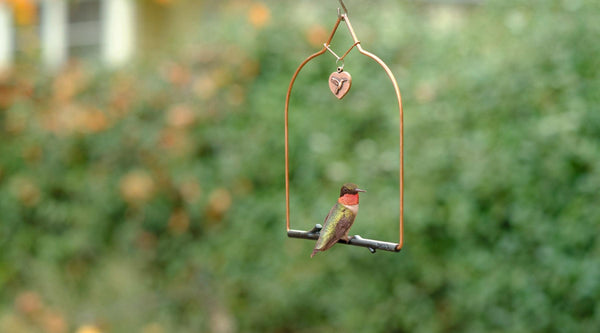
- Add a perch near the feeder with some wind protection — hummingbirds spend a large share of the day perched, and open country is breezy. This is sensible backyard practice rather than documented science, but it costs nothing
- Look twice in the west. In western Oklahoma you may have both Archilochus species at one feeder, and a small number of birds there are hybrids
Frequently Asked Questions
Why do hummingbirds stop at the middle of the country?
Because the trees do. Cornell's Birds of the World describes the Ruby-throated's western breeding boundary as ending "along a remarkably straight north–south line, just east of the 100th meridian," and notes the range "conforms closely to the range of eastern deciduous and mixed boreal forests." The 100th meridian roughly marks where annual rainfall drops below twenty inches — the divide between the wooded East and the arid West. The bird is tracking habitat, not avoiding a competitor.
Is the Great Plains an overlap zone between eastern and western hummingbirds?
Not really, and this is commonly misstated. The Texas Breeding Bird Atlas puts the Ruby-throated and Black-chinned breeding overlap "only in Texas between the 96th and 98th meridians," plus two counties in south-central Oklahoma. Across most of the Plains, you have one species or the other, not both.
Where does Black-chinned Hummingbird actually occur in this region?
Mainly the western quarter of Oklahoma, where it's common around Lawton and Altus and has spread east as far as Chickasha. In western Kansas and the Nebraska Panhandle it's a rare visitor — Kansas has one confirmed nesting record, and Nebraska's first confirmed breeding came only in 2025. In the Dakotas it's an accidental stray.
Can Ruby-throated and Black-chinned Hummingbirds interbreed?
Yes. They're each other's closest relatives, the only two members of the genus Archilochus. Banding in southwestern and central Oklahoma found 11 apparent hybrids among 118 adult males, and the pairing has since been confirmed genetically. Broader banding analysis puts hybridisation at roughly one bird per thousand where multiple hummingbird species breed together.
When should I put my feeder out in the Great Plains?
Mid-April to early May in Oklahoma and southern Kansas, late April to mid-May across Nebraska and most of Kansas, and mid-to-late May in the Dakotas. Oklahoma's return is usually between the 10th and 20th of April.
Why should I keep my feeder up in September if my hummingbirds have left?
Because that's when the western birds come through. From late July into September, Rufous, Calliope, Broad-tailed, and occasionally Anna's drift east across the Plains heading south. Those are birds you'd otherwise never see, and they're passing through once.
Do hummingbirds here double their weight before migrating?
Some do, but it's often overstated for this region. Birds of the World says individuals "often double their body mass" before departure — the most extreme fattening belongs to birds preparing to cross the Gulf of Mexico nonstop. Great Plains birds generally migrate overland, and research suggests many fatten far less dramatically.
Does leaving a feeder up delay migration?
No — this is a persistent myth. As the Oklahoma Department of Wildlife Conservation puts it, migration "is not triggered by changes in their food supply but by changes in day length." A late feeder helps birds still moving through; it doesn't hold anyone back.
How We Know This
The range boundary comes from Cornell's Birds of the World Ruby-throated account, with contact-zone detail from the Texas Breeding Bird Atlas. State status draws on the Oklahoma City Audubon Society, the Oklahoma Department of Wildlife Conservation, and Birds of Nebraska Online, a publication of the Nebraska Game and Parks Commission. Hybridisation research comes from Judd, Butler & Batchelder (2011, Bulletin of the Oklahoma Ornithological Society 44:1–7), Graves, Dittmann & Cardiff (2016, Proceedings of the Biological Society of Washington), and Clark, Rankin & Rudeen (2021, Ornithology). Population figures come from All About Birds.
Key Takeaways
- The Great Plains is where the Ruby-throated Hummingbird's breeding range ends — along a "remarkably straight north–south line, just east of the 100th meridian"
- What stops it is tree cover and rainfall, not competition; its range tracks eastern deciduous and boreal forest
- This is not a broad overlap zone: the two Archilochus species meet only in central Texas and south-central Oklahoma
- Black-chinned breeds regularly only in western Oklahoma; it's a rare visitor in Kansas and Nebraska and accidental in the Dakotas
- Where they do meet, they hybridise — about 9% of adult males banded in one Oklahoma study were apparent hybrids
- Ruby-throateds push west along river corridors and human-planted shelterbelts, which makes tree cover the single most valuable thing you can add here
- Fall brings western strays — Rufous, Calliope, Broad-tailed, and increasingly Anna's — which is the best reason to leave your feeder up into autumn
At Pop's Birding, we believe every backyard — big or small — has room for a little more wonder. Explore our feeders, nectars, swings, and wildflower seed blends to start building your own hummingbird sanctuary today.

Bethany Sloan has served as General Manager of Pop's Birding since 2010, continuing the legacy of her grandfather, William "Pops" Sloan, inventor of the Original Hummingbird Swing. A lifelong hummingbird enthusiast, educator, and independent researcher, she leads the company's educational content, including its 50-State Hummingbird Guide series, Regional Guide, Species Guide and Hummingbird Learning Center. Bethany combines scientific research, regional migration data, and more than 16 years of hands-on experience to create trusted educational resources for bird enthusiasts across North America.