Jul 19, 2026
Hummingbird Migration in the Midwest: The Woodpecker That Makes It Possible
Quick overview: The Midwest is where the Ruby-throated Hummingbird reaches the top of its range — and in the north, it arrives weeks before anything blooms. What it lives on until the flowers open is sap, drilled by a woodpecker that gets there first. Arrival runs mid-to-late April in Missouri and southern Illinois, early May through the central states, and mid-to-late May in northern Wisconsin, Michigan's Upper Peninsula, and northern Minnesota. Keep your feeder up into October — the late-season strays are the region's best surprise.
🗓️ Feeder Timing at a Glance
Put your feeder up: Mid-to-late April in Missouri and southern Illinois; early May in the central Midwest; mid-to-late May in the north
Take it down: Late August to early September in the north; into October farther south, and later if you want the vagrants
Which Hummingbirds You'll See in the Midwest
One species breeds here — and then, in fall, the map gets interesting.
Ruby-throated Hummingbird
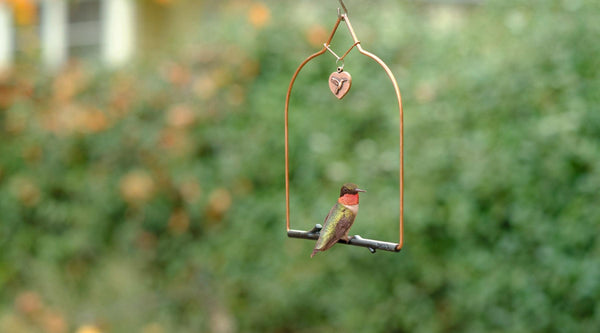
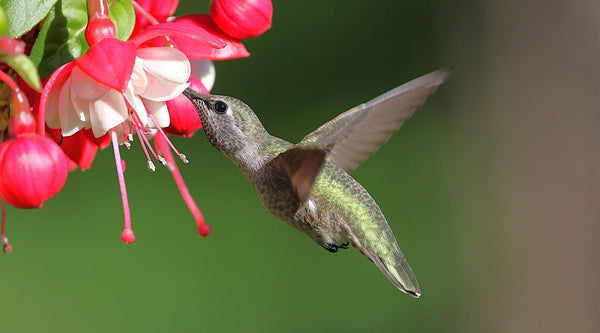
The Midwest's only breeding hummingbird, and present in every state in the region. Males show an iridescent ruby gorget that reads nearly black without direct light; females and juveniles are green above and white below. It breeds all the way to the Canadian border — Minnesota's breeding bird atlas confirms nesting as far north as Koochiching and Roseau counties, and Wisconsin records occupied nests up in Douglas County.

Rufous Hummingbird
The most frequent western stray, and a genuine possibility at any Midwest feeder from late summer into winter. Bright coppery-orange males are unmistakable; females and immatures are green with rufous flanks and much harder to call. A Rufous at an Ohio or Michigan feeder in November isn't a lost bird so much as one using a route that more and more western hummingbirds seem to be taking.

And the rest of the fall list
Rufous is the likeliest, but it isn't alone. Calliope, Anna's, Black-chinned, Broad-billed, Allen's, Broad-tailed, and even Mexican Violetear have all been documented in Midwest states. Ohio alone has records of Rufous, Allen's, Black-chinned, Broad-tailed, and Mexican Violetear; Michigan has a state record of Broad-billed.
Female and immature hummingbirds in this group often can't be identified in the field at all. If something turns up at your feeder in late fall, photograph it before you name it — and if a licensed bander can get a look, better still.
What's Actually Happening in This Region
The northern Midwest poses a problem that sounds impossible when you say it plainly.
A hummingbird weighing about three grams arrives in northern Minnesota in the second half of May. At that latitude, at that date, the flowers it needs largely haven't opened yet. It has just flown a couple of thousand miles. And it has to survive the gap.
How it does that is the most interesting thing about hummingbirds in this region — and the answer involves another bird entirely.
The Woodpecker That Gets There First
Yellow-bellied Sapsuckers drill neat horizontal rows of shallow wells in tree bark and return to keep them running. The sap that pools in them is essentially free sugar, available early in spring, and it draws a crowd — kinglets, nuthatches, chickadees, warblers, squirrels, bats, and insects all use them.
So do hummingbirds. Cornell's Birds of the World describes the association directly: the Ruby-throated "appears to be closely allied with sapsuckers. This hummingbird places its nest near sap wells, follows sapsuckers in their daily movements, and may even time its migration to coincide with that of sapsuckers."
That's not a casual observation. Work in northern Michigan found nesting female Ruby-throateds feeding almost exclusively on tree sap, with all six nests studied located within 300 metres of a sapsucker tree.
And the sapsucker gets there first. It arrives on northern breeding grounds roughly a month ahead of the hummingbird, which means the wells are already open and flowing when the hummingbirds turn up. In the upper Midwest they favour aspen, birch, and maple — so those are the trees that matter.
Does the Woodpecker Set the Boundary?
Here's where it gets genuinely interesting, and where we want to be careful with you.
Miller and Nero (1983, Canadian Journal of Zoology) proposed something bold: that the Ruby-throated's spring arrival dates and its entire northern breeding limit "are determined by a commensal relationship with the yellow-bellied sapsucker, in which the principal energy source for the hummingbirds is sucrose in sap from trees drilled by the sapsuckers."
In other words — the hummingbird can live as far north as it does because a woodpecker makes it possible.
The idea has been cited ever since, including in a 1993 PNAS paper describing sapsuckers as a keystone species. The geography fits: Yellow-bellied Sapsucker breeds across the boreal forest well north of where the hummingbird stops, so there's sap available at and beyond the hummingbird's edge.
But it has never been directly tested. We looked. No study since 1983 has actually tested whether sapsuckers set that boundary, and Cornell hedges its own wording — "appears," "may even." Birds of the World attributes the range primarily to habitat, noting it "conforms closely to the range of eastern deciduous and mixed boreal forests."
So the honest version is this: the range tracks the forest, and within that forest, sap wells plausibly let hummingbirds survive the cold northern edge before the flowers arrive. It's a strong hypothesis that has been quoted for forty years without anyone confirming it. If you have sapsuckers and hummingbirds in the same northern woodlot, you're looking at an open scientific question.
About That Flyway
You'll often read that Midwest hummingbirds take the Mississippi Flyway north while eastern birds cross the Gulf of Mexico. We've written a version of that ourselves. It doesn't hold up.
The four-flyway map was drawn in the 1930s for managing waterfowl hunting. The U.S. Geological Survey is blunt about its limits: the concept "is probably most applicable to those birds that migrate in family groups, namely geese, swans, and cranes, but does not appear to be very helpful in understanding the movements of the more widely dispersing ducks or most other groups of birds." Even the American Bird Conservancy notes that flyways "are not rigid or narrowly defined routes, nor are they used by all migrating birds," and that "the boundaries between flyways can be fuzzier for songbirds."
For this species specifically, the evidence points the other way. Zenzal and colleagues (2018, Movement Ecology) used feather isotopes to trace 150 young Ruby-throateds caught at a single Alabama stopover, and found birds bound for the entire breeding range — Gulf Coast states through Canada — passing through the same place. What varies isn't the route. It's the timing: southern breeders move first, northern breeders later, in a staggered chain.
As for the Gulf itself, Cornell says the split between birds that cross it and birds that go around is "largely unknown," and All About Birds notes the preferred strategy "may be different between spring and fall migration."
Midwest hummingbirds arrive later than Gulf Coast birds because they're farther north and spring gets there later. That's the whole explanation, and it's a better one than a flyway map.
The Great Lakes Effect
The lakes do matter — just not quite the way it's usually told.
What's well documented is concentration. Migrants moving north hit a hundred miles of open water and pile up along the shore looking for a way around. Whitefish Point, at the tip of Michigan's Upper Peninsula, has monitored this for forty years, documenting "tens of thousands of birds that funnel to the Point every Spring and Fall." A 2018 radar study found the highest densities of migrant landbirds within 1.5 kilometres of the Point, and higher densities along the shore than inland.
The claim that lakeshore yards see later hummingbird arrivals than inland yards at the same latitude is plausible — big cold lakes do hold spring back, and local bloom follows — but we haven't found it tested for hummingbirds specifically. Treat it as a reasonable expectation rather than a rule.
🌲 What You Can Do: Keep the Trees the Sapsuckers Use
In most regions the best thing you can do is plant flowers. In the northern Midwest, hummingbirds arrive before the flowers do — so the priority is different.
Protect your aspen, birch, and maple. Those are the trees Yellow-bellied Sapsuckers drill in the upper Midwest, and their sap wells are what carry early-arriving hummingbirds through the weeks before bloom. If you find neat horizontal rows of small holes in a trunk, that's not damage to fix — it's a working feeder that has been operating for millions of years. Leave it, and leave the sapsucker alone too.
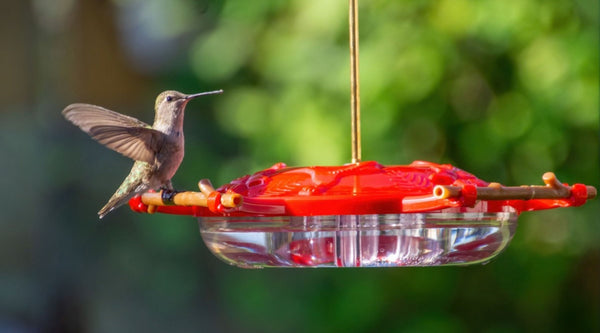
Have your feeder out before you expect the first bird. In the north especially, a feeder in early May is filling exactly the gap the sap wells fill. Being two weeks early costs you nothing.
Then plant for the two ends of the season. Eastern red columbine (Aquilegia canadensis) is the classic spring-arrival plant — the U.S. Forest Service calls it one of the first food plants returning ruby-throats depend on. For the late-August and September departure, cardinal flower and spotted jewelweed do the work; jewelweed's peak bloom tracks peak Ruby-throated fall migration more closely than any other eastern plant. Wild bergamot and trumpet honeysuckle cover the summer between.
For plant lists matched to your conditions, see our state guides: Minnesota, Wisconsin, Michigan, Ohio, and Missouri.
Migration Timing by Sub-Region
Pop's tip: Minnesota's DNR puts first migrants in the south of the state around the first week of May, with most birds gone by the end of September and a few lingering into October. Use that as your anchor and adjust for how far north you are.
Conservation: What's at Stake Here
- Ruby-throated Hummingbird — abundant on paper. All About Birds puts the global breeding population at 36 million with a Continental Concern Score of 8 out of 20, "indicating a species of low conservation concern," and it carries no Tipping Point listing. But English and colleagues (2021, Scientific Reports) found the species "declined since approximately 2004 throughout most of the species' breeding range." Both are true; they describe different timescales.
- Regionally, the picture is steady. Minnesota's breeding bird atlas found "little evidence of any large-scale distributional change," and notes the same for Iowa, Wisconsin, and Ontario. Minnesota alone is estimated to hold around 500,000 breeding adults.
- Rufous Hummingbird — the fall strays belong to a population down about 72% since 1968, an Orange Alert Tipping Point species and IUCN Near Threatened.
- The sapsucker trees — aspen, birch, and maple in the northern forests. If the sap-well relationship is doing what researchers think it is, those trees matter to hummingbirds in a way that isn't obvious from looking at them.
Should I Take My Feeder Down in Fall?
No — and in this region the reason is the vagrants. Your Ruby-throateds will be gone by late September in most of the Midwest, but October and November are when the western birds turn up. A feeder that comes down on schedule misses them entirely.
The old worry that a feeder delays migration doesn't hold up. Departure runs on day length and the hormonal cascade that follows, not on whether food is available. Keep it up into October in the southern Midwest, and later if you're curious — some of the region's best hummingbird records have come from feeders nobody had gotten around to putting away.
How to Help Hummingbirds Through This Region
- Keep mature aspen, birch, and maple — and leave sapsucker wells alone; they're feeding hummingbirds before your flowers open
- Put the feeder out early, especially in the north, where birds arrive well ahead of bloom
- Plant columbine for spring, cardinal flower and jewelweed for fall — the two windows that matter most
- Leave it up into late fall for the western strays, and photograph anything unusual
- Change nectar every two to three days in typical conditions and more often in heat; once a week is the absolute floor even in cool weather
- Add a perch near the feeder — hummingbirds spend a large share of the day perched rather than flying
- Skip the red dye. The feeder does the attracting; dye adds nothing
Frequently Asked Questions
What do hummingbirds eat when they arrive before the flowers bloom?
Tree sap, largely. Yellow-bellied Sapsuckers drill rows of wells in aspen, birch, and maple, and they arrive on northern breeding grounds about a month ahead of the hummingbirds — so the wells are running when the hummingbirds show up. Research in northern Michigan found nesting females feeding almost exclusively on sap, with every nest studied within 300 metres of a sapsucker tree.
Is it true that a woodpecker determines how far north hummingbirds can live?
That's the hypothesis, proposed in 1983, and it's still cited today — the idea being that sapsucker wells provide the energy that lets Ruby-throateds survive at the cold northern edge of their range before flowers open. It has never been directly tested, though, and Cornell attributes the range more cautiously to the extent of eastern deciduous and boreal forest. Treat it as a strong, unproven idea rather than settled fact.
Do Midwest hummingbirds use the Mississippi Flyway instead of crossing the Gulf?
Not in the way it's usually described. Isotope research tracing 150 young Ruby-throateds at a single Alabama stopover found birds bound for every part of the breeding range passing through the same place — southern breeders first, northern breeders later. Cornell says the split between Gulf-crossing and around-the-Gulf birds is "largely unknown," and the four-flyway map was designed for waterfowl, not songbirds.
When should I put my feeder out in the Midwest?
Mid-to-late April in Missouri and the southern tier, late April into early May across the central Midwest, and early to mid-May in Wisconsin, Michigan, and Minnesota — later still in the far north. Set it out a week or two ahead of when you expect the first bird.
Does living near the Great Lakes change arrival timing?
Possibly, though it hasn't been tested for hummingbirds specifically. Large cold lakes hold spring back, which delays local bloom, so a slightly later arrival on the shoreline is a reasonable expectation. What is well documented is that the lakes concentrate migrants — Whitefish Point in Michigan's Upper Peninsula has recorded tens of thousands of birds funnelling past each spring and fall.
Do hummingbirds really double their weight before migrating?
Some do, but it's often overstated. The most extreme fattening belongs to birds staging near the Gulf Coast for a nonstop crossing. On breeding grounds, research has found only a portion of birds fatten substantially before leaving — and in one study, no juveniles fattened at all before departure.
What western hummingbirds turn up in the Midwest?
Rufous most often, but Calliope, Anna's, Black-chinned, Broad-billed, Allen's, Broad-tailed, and Mexican Violetear have all been recorded. Most arrive in late fall or winter. Females and immatures usually can't be identified in the field, so photograph first and identify second.
Does leaving a feeder up delay migration?
No — this is a persistent myth. Migration timing runs on day length and hormonal changes, not food supply. A late feeder helps birds still on the move, and in this region it's how most of the unusual records get found.
How We Know This
Range and status draw on Cornell Lab's All About Birds, Birds of the World, the Minnesota Breeding Bird Atlas, and the Minnesota Department of Natural Resources. The sapsucker hypothesis comes from Miller & Nero (1983, Canadian Journal of Zoology), with keystone context from Daily, Ehrlich & Haddad (1993, PNAS). Migration-route findings come from Zenzal, Contina, Kelly & Moore (2018, Movement Ecology), and the flyway caveats from the U.S. Geological Survey and the American Bird Conservancy. Fattening research comes from Hou & Welch (2016, Animal Behaviour), plant relationships from Bertin (1982, Canadian Journal of Zoology), and population trends from English et al. (2021, Scientific Reports).
Key Takeaways
- Ruby-throated is the Midwest's only breeding hummingbird, reaching the Canadian border in Minnesota, Wisconsin, and Michigan
- In the north it arrives weeks before flowers bloom and lives largely on sap from Yellow-bellied Sapsucker wells — one Michigan study found every nest within 300 metres of a sapsucker tree
- Researchers proposed in 1983 that sapsuckers set the hummingbird's northern range limit; it's still cited and still untested
- The "Midwest birds use the Mississippi Flyway" story doesn't hold up — isotope work shows birds bound for the whole breeding range share the same stopovers, differing in timing rather than route
- The Great Lakes concentrate migrants along their shorelines, which is well documented; the shoreline arrival delay is plausible but untested for hummingbirds
- Fall is when western strays appear — Rufous most often, but seven other species have been recorded
- Protecting aspen, birch, and maple does more for early-season hummingbirds here than any flower bed
At Pop's Birding, we believe every backyard — big or small — has room for a little more wonder. Explore our feeders, nectars, swings, and wildflower seed blends to start building your own hummingbird sanctuary today.

Bethany Sloan has served as General Manager of Pop's Birding since 2010, continuing the legacy of her grandfather, William "Pops" Sloan, inventor of the Original Hummingbird Swing. A lifelong hummingbird enthusiast, educator, and independent researcher, she leads the company's educational content, including its 50-State Hummingbird Guide series, Regional Guide, Species Guide and Hummingbird Learning Center. Bethany combines scientific research, regional migration data, and more than 16 years of hands-on experience to create trusted educational resources for bird enthusiasts across North America.