Jul 19, 2026
Hummingbird Migration in the Northeast & Mid-Atlantic: When They Arrive, Where They're Headed, and How to Help
Quick overview: Something unusual has happened to hummingbirds in parts of the Northeast. Across most of their range, Ruby-throated Hummingbirds have been slipping since about 2004. In Massachusetts they have done the opposite, going from a third of survey blocks to nearly four-fifths between two breeding bird atlases. The reason has less to do with feeders than with what happened to the land. Arrival runs mid-to-late April in Maryland and Delaware, early May across southern New England, and mid-to-late May in northern Maine.
🗓️ Feeder Timing at a Glance
Put your feeder up: Mid-to-late April in the Mid-Atlantic; early May in southern New England; mid-to-late May in northern New England
Take it down: Not before late October — and later still if you'd like a shot at a western stray
Which Hummingbirds You'll See in the Northeast & Mid-Atlantic
One species breeds here, and one shows up uninvited.
Ruby-throated Hummingbird
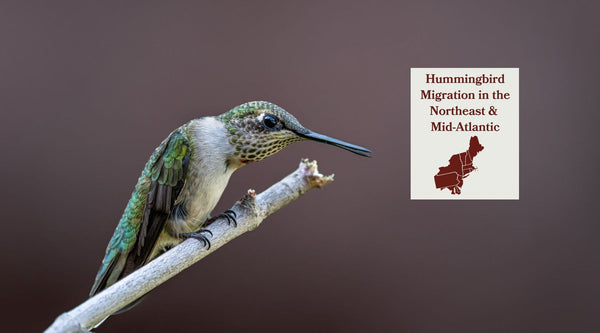
The region's only breeding hummingbird, from Maryland's Eastern Shore to the Canadian border. Males show a brilliant iridescent gorget that reads nearly black until the light catches it; females and juveniles are green above and white below. If you see a hummingbird here between May and August, this is what it is.

Rufous Hummingbird
A genuine rarity, and the western species most likely to turn up. Audubon puts it plainly: "Of the various typically western hummingbirds, the Rufous Hummingbird is the one that wanders most often to eastern North America, with many now found east of the Mississippi every fall and winter." Males are coppery-orange and unmistakable; females and immatures usually need a bander to confirm.
Calliope, Allen's, Black-chinned, and a handful of others have been accepted by state records committees too — but in ones and twos. Massachusetts has around six Allen's records; Maine has two Calliope. These are events, not patterns.

One correction worth making: you'll sometimes read that the Northeast gets more western vagrants than anywhere else in the East. It doesn't. eBird describes the phenomenon as "equally applicable to Canada, the Midwest, the Gulf Coast (rich in wintering hummingbirds), the West, and even south-coastal Alaska." The Gulf Coast and Southeast document far more, and have for decades. Keep your feeder up anyway — but for the right reason.
What's Actually Happening in This Region
Here's a number worth sitting with.
When Massachusetts ran its first breeding bird atlas in the late 1970s, surveyors found Ruby-throated Hummingbirds in 35.4% of survey blocks. When they ran the second, between 2007 and 2011, that figure was 78.1%. Mass Audubon summarises the species in three words: "Nearly ubiquitous and strongly increasing."
That's remarkable on its own. It's more remarkable in context, because across most of the breeding range this species has been going the other way — English and colleagues (2021, Scientific Reports) found Ruby-throateds "declined since approximately 2004 throughout most of the species' breeding range."
Massachusetts is the extreme case, and it is worth saying so. Vermont’s atlas recorded a rise of only 2%, from 166 blocks to 169 — but Vermont was already close to full, with hummingbirds in nearly every block to begin with. Pennsylvania saw an 11% increase between its two atlases. Ohio, just west, recorded a 5% decline. The direction is broadly upward across the Northeast, and Mass Audubon notes "significant increasing Breeding Bird Survey trends in Massachusetts, in the New England/Mid-Atlantic Region, and in the Eastern US overall" — but Massachusetts had the most room to grow, and grew the most.
So the Northeast is doing something different. And the explanation is a two-hundred-year story about land.
The Edge Came Back
Start with what this bird actually wants. Despite living in a region defined by forest, the Ruby-throated is not a deep-woods bird. Cornell Lab describes it as "commonly associated with old fields, forest edges, meadows, orchards, stream borders, and backyards." Rutgers is blunter: it shows "no stringent habitat preferences," turning up in "old fields, forest edges, meadows, and stream borders."
It's an edge species. It wants the seam between open and closed — sunlight, flowers, and a branch to perch on.
Now the land history. New England was largely cleared for farming in the nineteenth century. Harvard Forest puts the peak between 1830 and 1880, when "60 to 80 percent of the land was cleared for pasture, tillage, orchards and buildings." Then the farms failed or moved west, and the forest came back. New England is roughly 80% forested today.
You might expect that to be straightforwardly good for a woodland bird. It wasn't, not at first. Mass Audubon's account traces the arc: hummingbirds once "thrived in the bountiful orchards then in vogue," and then "with farmlands and orchards gradually vanishing and forests returning, the population likely began to diminish." Wide-open farmland is poor hummingbird habitat. So is unbroken closed canopy.
What the modern Northeast has instead is the middle — and that turns out to be the sweet spot. Mass Audubon attributes the atlas-era surge to "the proliferation of natural beaver clearings and cultivated suburban gardens," and notes that "hummingbirds have taken readily to suburban living, and they have prospered accordingly as towns have grown."
Beaver ponds punching holes in the forest. Suburban yards with flower beds and shrub borders. Regrowing woodlots with sunny gaps. Powerline cuts, roadsides, old fields halfway back to trees. A landscape that would look messy to a forester is close to ideal for this bird.
The Northeast didn't restore a wilderness. It built a mosaic — and a hummingbird happened to be exactly the right shape for it.
The Short End of Summer
The other thing this region does is squeeze.
A hummingbird arriving in northern Maine in the third week of May has perhaps fourteen to sixteen weeks before it needs to go. In that time it must claim territory, build a nest, incubate for roughly two weeks, feed nestlings for another three, see the young through independence, and then put on fuel for a journey to Central America.
Run those numbers and a single nesting attempt eats six or seven weeks. Two is tight. In the south there's room for more — Birds of the World reports two broods a season are common in Alabama, with third broods on record. Northern birds generally get one shot.
We'll be honest that the line isn't perfectly clean: Birds of the World also notes females with eggs in New Brunswick as late as 18 July, "possibly indicating second broods there as well." So it isn't a hard rule. But the pressure is real, and it explains why northern arrivals look so urgent — there simply isn't slack in the calendar.
One genuinely odd finding from the research: Courter and colleagues (2013, The Auk) found Ruby-throated arrival dates have advanced across the eastern United States by 11 to 18 days, but with "less pronounced changes above 41°N." Most of this region sits at or above that line. Whatever is shifting spring arrival elsewhere is having less effect here.
🌿 What You Can Do: Keep the Edges
Every other region in this series asks you to add something. This one asks you to stop removing something.
The Ruby-throated Hummingbird boomed here because the Northeast became a mosaic of half-open ground — brushy borders, regrowing clearings, gardens against woods. The two landscapes that serve it worst are the two we tend to aim for: a clean mown lawn, and a closed unbroken canopy.
So keep an edge somewhere. A hedgerow along the property line. A brushy corner you don't mow. A flowering vine on a fence. A gap in the tree line you let stay sunny. That transition zone is where this bird actually lives, and it's the easiest habitat in the country to accidentally tidy away.
Then plant for the two ends of the season. Wild columbine (Aquilegia canadensis) blooms as the first birds arrive and is the classic spring plant here. Coral honeysuckle (Lonicera sempervirens) is the right vine for that fence — native, long-blooming, and not the invasive Japanese kind. For the late-August and September departure, cardinal flower and jewelweed carry the load, with scarlet bee balm covering midsummer.
For plant lists matched to your conditions, see our state guides: Maine, Massachusetts, New York, Pennsylvania, and Maryland.
Migration Timing by Sub-Region
Pop's tip: Put your feeder out a week or two before you expect the first bird. In northern New England especially, early arrivals land in a season that hasn't fully started — a reliable feeder in the third week of May is worth more than one in July.
The Journey at Both Ends
Birds reaching this region have come from Mexico and Central America, and the last stretch of that trip is the famous part. Some cross the Gulf of Mexico nonstop — the USDA Forest Service describes "a nonstop flight of up to 500 miles over a period of 18 to 22 hours." Others follow the coast around through Texas. Cornell says the split between the two is largely unknown, and the preferred route may differ between spring and fall.
What that means for a Northeast yard: your birds did the Gulf leg weeks before they reached you, then travelled overland the rest of the way. The dramatic near-doubling of body weight you read about happens on the Gulf Coast right before that crossing — not in your garden.
Fattening on the breeding grounds is real but more variable. Hou and Welch (2016, Animal Behaviour) studied birds preparing to leave and found some adults adding 35 to 40% of their body mass in the four days before departure — while others fattened barely at all. And notably, no juveniles fattened before departure. Young birds leave lean and refuel along the way, which makes a late-season feeder genuinely useful to the birds that need it most.
Conservation: What's at Stake Here
- Ruby-throated Hummingbird — Cornell Lab reports populations "steadily increased every year from 1966 to 2019," with a global breeding population near 36 million and 8 out of 20 on the Continental Concern Score. No Tipping Point listing.
- But the recent trend diverges by region. English et al. found a decline since roughly 2004 across most of the breeding range. Mass Audubon, meanwhile, reports "significant increasing Breeding Bird Survey trends in Massachusetts, in the New England/Mid-Atlantic Region, and in the Eastern US overall." The Northeast has been a stronghold while other regions slipped.
- The habitat that made it possible isn't permanent. The mosaic this bird thrives in — regrowing clearings, brushy edges, beaver meadows, gardens — is a transitional state. Forests close in. Development replaces edge with pavement. Beaver ponds fill and forest reclaims them. Holding onto edge habitat takes some deliberate untidiness.
- Rufous Hummingbird — the rare fall strays come from a population down about 72% since 1968, an Orange Alert Tipping Point species and IUCN Near Threatened.
Should I Take My Feeder Down in Fall?
Not early. Your breeding birds will be gone by late September in most of the region, but late migrants keep moving through — and October and November are when a western stray might turn up. eBird's advice for anyone hoping to document one is to leave feeders out into mid-December or later.
The old worry that a feeder keeps birds from leaving doesn't hold up. Departure runs on day length and the hormonal cascade that follows, not on food supply. If temperatures drop below freezing and you're still hosting a bird, bring the feeder in overnight and put it back out before dawn.
How to Help Hummingbirds Through This Region
- Keep an edge. A hedgerow, an unmown corner, a sunny gap in the trees — this is the habitat that drove the region's hummingbird boom
- Plant columbine for spring, cardinal flower and jewelweed for fall, with coral honeysuckle covering the middle
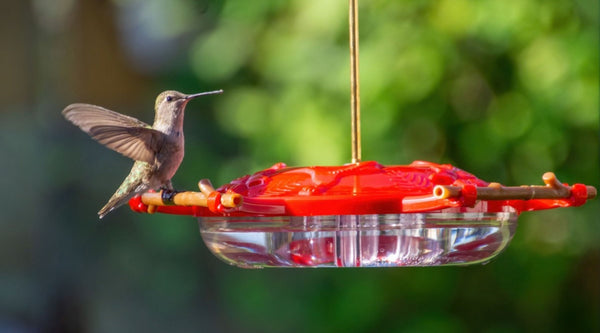
- Put the feeder out early and leave it up late — juveniles head south without fattening first, so a September and October feeder matters
- Change nectar every two to three days in warm weather, more often in heat
- Skip the red dye. The feeder does the attracting
- Add a perch near the feeder — hummingbirds spend a large share of the day perched
- Photograph anything unusual in late fall before identifying it, and report it — that's how the region's vagrant records get made
Frequently Asked Questions
Why are there more hummingbirds in New England than there used to be?
Because the landscape changed in their favour. Massachusetts recorded Ruby-throated Hummingbirds in 35.4% of survey blocks in its first breeding bird atlas and 78.1% in its second — Mass Audubon calls the species "nearly ubiquitous and strongly increasing," and credits beaver clearings and suburban gardens. This is an edge bird, and the modern Northeast is full of edges.
Does the Northeast get more rare western hummingbirds than other regions?
No, despite what you'll often read. eBird describes western strays in the East as a broad pattern "equally applicable to Canada, the Midwest, the Gulf Coast… the West, and even south-coastal Alaska," and the Gulf Coast and Southeast document far more than the Northeast does. Northeastern state totals run to handfuls of records per species. Keep your feeder up late anyway — just know the odds.
When should I put my feeder out?
Mid-to-late April in Maryland and Delaware, late April into early May across most of New York, New Jersey, Pennsylvania and southern New England, and mid-to-late May in northern Maine, New Hampshire, and Vermont. A week or two early costs nothing.
How many broods do hummingbirds raise here?
Usually one in the north, where the season runs only fourteen to sixteen weeks and a single nesting attempt takes six or seven. Further south there's more room — two broods a season are common in Alabama, and third broods have been recorded. It isn't an absolute rule, though: females with eggs have been found in New Brunswick as late as mid-July, which hints at occasional second attempts even at the northern edge.
Do hummingbirds double their weight before leaving?
Some do, but not here and not all of them. The dramatic fattening happens on the Gulf Coast just before the nonstop crossing. On breeding grounds, research found some adults adding 35 to 40% of their body mass in the four days before leaving while others barely fattened — and no juveniles fattened at all before departure. Young birds leave lean and refuel en route.
Is it true that leaving a feeder up delays migration?
No — this is a persistent myth. Migration is triggered by day length and the hormonal changes that follow, not by food availability. A feeder left up in October helps birds still travelling; it doesn't hold anyone back.
Are hummingbirds in this region in trouble?
Less than elsewhere. Cornell rates Ruby-throated a species of low conservation concern with a population near 36 million, and research shows a range-wide decline since about 2004 — but Mass Audubon reports increasing survey trends for Massachusetts and the wider New England and Mid-Atlantic region. The longer-term question is whether the edge habitat that drove the increase persists as forests close in and development spreads.
What should I plant if I only plant one thing?
Wild columbine. It blooms as the first birds arrive, when almost nothing else is open and a long flight is behind them. If you can manage two, add cardinal flower for the September departure.
How We Know This
Regional population data come from the Massachusetts Breeding Bird Atlas (Mass Audubon), with range-wide status from Cornell Lab's All About Birds and Birds of the World. Habitat descriptions come from All About Birds and Rutgers New Jersey Agricultural Experiment Station, with New England land-use history from Harvard Forest. Vagrancy patterns come from eBird and the Audubon Field Guide. Arrival-timing research comes from Courter et al. (2013, The Auk), fattening research from Hou & Welch (2016, Animal Behaviour), population trends from English et al. (2021, Scientific Reports), and migration physiology from the USDA Forest Service. Regional phenology draws on the University of Maine Cooperative Extension.
Key Takeaways
- Ruby-throated Hummingbird has boomed in the Northeast even as it declined across most of its range since 2004 — Massachusetts went from 35.4% to 78.1% of survey blocks between atlases
- The reason is habitat: this is an edge species, and the region's regrowth into a mosaic of clearings, brushy borders, and gardens suits it better than either open farmland or closed forest
- Beaver clearings and suburban gardens are both credited by Mass Audubon for the increase
- The northern season is genuinely tight — fourteen to sixteen weeks in Maine, enough for one nesting attempt where southern birds fit two or three
- The Northeast does not receive more western vagrants than other eastern regions; the Gulf Coast and Southeast document far more
- Juvenile hummingbirds leave without fattening first, which makes late-season feeders genuinely useful
- Edge habitat is transitional — keeping some of it takes deliberate untidiness
At Pop's Birding, we believe every backyard — big or small — has room for a little more wonder. Explore our feeders, nectars, swings, and wildflower seed blends to start building your own hummingbird sanctuary today.

Bethany Sloan has served as General Manager of Pop's Birding since 2010, continuing the legacy of her grandfather, William "Pops" Sloan, inventor of the Original Hummingbird Swing. A lifelong hummingbird enthusiast, educator, and independent researcher, she leads the company's educational content, including its 50-State Hummingbird Guide series, Regional Guide, Species Guide and Hummingbird Learning Center. Bethany combines scientific research, regional migration data, and more than 16 years of hands-on experience to create trusted educational resources for bird enthusiasts across North America.