Jul 13, 2026
How to Attract Hummingbirds in New York: A Backyard Sanctuary Guide
There's a certain fitting symmetry to hummingbirds in New York: the state that's home to the Cornell Lab of Ornithology — the research institution ornithologists worldwide turn to — also produces some of the country's most detailed hummingbird migration tracking. In just two months of spring migration in 2025, New York logged more than 400 confirmed Ruby-throated Hummingbird sightings alone.
Whether you're gardening on Long Island, in the Hudson Valley, the Finger Lakes, or up near the Adirondacks, this guide will walk you through everything you need to turn your space into a New York hummingbird destination: how to size your setup to any space, feeder and nectar care, pest-safe cleaning, and the native plants and wildflower seed varieties that thrive in New York's climate.
The short version, if you're in a hurry:
To attract hummingbirds in New York, put up a leak-proof feeder filled with fresh, dye-free nectar by mid-to-late April in the New York City area and by early-to-mid May farther upstate, keep it clean and refilled every 1–6 days depending on heat, skip the insecticide so hummingbirds can still hunt insects for protein, and plant native, nectar-rich flowers like coral honeysuckle, cardinal flower, and wild bergamot so your yard offers real food alongside the feeder.
- Best feeder type: leak-proof design with a comfort perch, like the AspenPerch® Hummingbird Feeder
- Best nectar: plain 4:1 water-to-sugar ratio, no red dye — or Pop's Nectar with added electrolytes and calcium
- Feeder timing: up by late April in the NYC area and Long Island, early May in the Hudson Valley and Finger Lakes, mid-to-late May in the North Country and Adirondacks
- Nectar change frequency: every 1–2 days above 90°F, every 5–6 days below 70°F
- Pest control: no insecticide — use vinegar-water spray and HummGuard® nectar tips instead
- Top native plants: coral honeysuckle, cardinal flower, wild bergamot, eastern columbine, great blue lobelia (varies by region — see below)
- Best wildflower planting window: October through November, for spring bloom timed to spring migration
Which Hummingbirds You'll See in New York

Ruby-throated Hummingbird is New York's only breeder, present statewide from late April into October and behind essentially every sighting most people ever see. But the state's real list runs to seven species. Rufous Hummingbird is a genuine, recurring winter visitor — fall through winter, sometimes into spring — and famously territorial enough to claim a single feeder as its own. The other five are all real, committee-accepted New York rarities, each with its own specific story: Allen's Hummingbird has exactly one record, an immature that over-wintered in Riverhead from October 2023 into April 2024; Black-chinned Hummingbird also has just one, found on Randall's Island in Manhattan that same November; Broad-billed Hummingbird is the state's rarest of all, with just two accepted records, both from a single summer in 2006; Calliope Hummingbird has five accepted records spanning 2001 to 2022, all of them in November; and Anna's Hummingbird has only three confirmed New York records in the entire historical record, the most recent in 2017.
For full identification help — photos, field marks, and how to tell Rufous and Allen's apart (New York's own records committee treats many individuals as inseparable in the field) — see our complete Hummingbirds in New York species guide.
When Do Hummingbirds Arrive and Leave New York?
Ruby-throated Hummingbirds move across New York on a predictable gradient each spring, and an early arrival doesn't always buy a longer season. Buffalo and Syracuse go quiet by early October, and Long Island and Brooklyn follow right along with them, also by early October. Putnam County and Westchester hold on into mid-October, and Manhattan holds birds longest of anywhere in the state — into late October, nearly a month after Upstate empties.
For the full month-by-month breakdown — every region, the bell-curve chart, and exactly when New York's rarer species turn up — see our complete New York hummingbird calendar.

Arrival and departure windows by region, based on eBird checklist data (Cornell Lab of Ornithology), 2016–2025. See our New York hummingbird calendar for the full month-by-month breakdown.
🗓️ Feeder Timing at a Glance
Put your feeder up: Late April in New York City, Brooklyn, on Long Island, and in Putnam County; early May in Buffalo, Syracuse, and Westchester — the one lower Hudson Valley county that runs on Upstate's later spring schedule
Take it down: Early October in Buffalo, Syracuse, on Long Island, and in Brooklyn; mid-October in Putnam County and Westchester; late October in Manhattan
Keep one feeder up through winter if you can. Rufous Hummingbird is a real, recurring visitor to New York in the colder months — not a long shot, a documented pattern the state's records committee reviews every year — and a feeder left up is a genuine chance at something rarer.
Attracting Hummingbirds No Matter Your Space
You don't need acres of land to invite wonder into your yard. Hummingbirds are famously adaptable — all they're really looking for is a dependable food source, a safe place to perch, and a little color.

- Small patio or balcony: One feeder hung from a bracket or shepherd's hook, paired with a container of coral honeysuckle or cardinal flower — both genuine New York natives that do well in containers — is plenty to get noticed. Hummingbirds are solitary feeders by nature, so a single feeder works great in tight spaces. For the full setup, see our guide to the best hummingbird products for a small patio or balcony.
- Average backyard: Add a mix of feeders and native blooms along a fence line or garden bed, and give your visitors a swing or two nearby to rest and survey their territory between sips.
- Large yard with trees: Take advantage of the shade. Hummingbirds prefer feeders and plantings tucked out of harsh, direct afternoon sun, with a nearby branch to perch on and watch for rivals. Spread multiple feeders far apart, since hummingbirds are territorial and will happily chase each other off a single feeder — worth taking seriously in New York specifically, since Rufous Hummingbird, one of the state's own regular visitors, is known for guarding a single feeder aggressively rather than sharing it.
Choose a Saucer Type Feeder to Prevent Leaks
A feeder is only as good as what's in it — and how well it's kept. A leaky feeder does more than waste nectar: it can attract ants, bees, and other pests — turning your sanctuary into a mess that can deter hummingbirds.
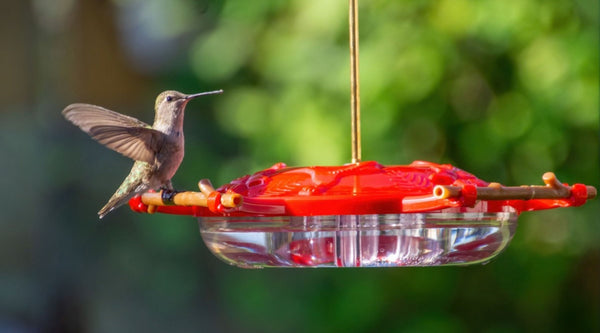
Saucer-style feeders, like our AspenPerch® feeder, hold nectar in a shallow basin below the ports, so there's no sealed air pocket to cause problems; bottle-style, gravity-fed feeders tend to leak more, especially in hot weather, since the air trapped above the nectar expands with heat and pushes nectar out through the ports.
Keeping your feeder filled is also important because hummingbirds need a dependable, fresh source they can count on every visit, not a gamble.
Shop the feeder
AspenPerch® Hummingbird Feeder, 8 oz

Leak-proof by design, with a patented Polyperch® comfort perch built in — so your hummingbirds can rest and feed at the same time instead of hovering through the whole meal. You get to see their tongue in action versus their back!
Shop the AspenPerch® Feeder →Keep Feeders Clean with Fresh Nectar
Clean your feeder every time you change the nectar, using warm water and a bottle brush — no soap residue, no bleach or harsh commercial cleansers. A little vinegar and water solution works great for breaking down sticky buildup or the beginnings of mold. See our full guide to cleaning a hummingbird feeder for the complete how-to.
Skip the Red Dye
Your feeder's color does the attracting; dyed nectar offers no benefit and can be harmful to a hummingbird's health.
Use a Real Nectar Recipe
Use a 4:1 plain sugar-water ratio to make your hummingbird nectar and read our full recipe guide to get your batch right. You can also use our nectar mixing calculator for any unit of choice to get the full breakdown on sugar to water ratio. Or skip the math with the ready-to-use option below.

Just getting your first feeder going? Nectarade® Ready to Use Liquid comes pre-mixed and ready to pour — no measuring, no mixing, nothing to commit to while you get your New York setup dialed in.
Shop the Ready to Use Nectar →Only Fill Enough to Change Often
An 8 oz feeder rarely needs to be topped all the way off — overfilling just means more nectar sitting around long enough to spoil. A better approach is to fill only enough that your hummingbirds empty your feeder every couple of days.
Wondering how long nectar actually lasts? Our full guide on how long hummingbird nectar lasts covers exactly what spoilage looks like and why the timeline shifts with heat.
How Often to Change Nectar in New York
Sugar water ferments faster the hotter it gets, and New York's climate shifts a lot from a Long Island summer to a North Country spring. Use this as your rule of thumb:
| Outdoor Temp | Change Nectar Every |
|---|---|
| Below 70°F | 5–6 days |
| 70–80°F | 3–4 days |
| 80–90°F | 2–3 days |
| Above 90°F | 1–2 days |
If the nectar ever looks cloudy before that window is up, change it early — cloudiness means it's already started to ferment.
Keeping Feeders Pest-Free Without Insecticide
Hummingbirds don't live on nectar alone — small insects make up a big part of their protein diet, especially for feeding chicks. That means insect spray is off the table around your feeding station; it removes a food source hummingbirds depend on and can be harmful to them directly. Here's how to handle the two most common pest problems without it.
Ants
Ants are drawn to any spilled or leaking nectar, and once a trail forms, they'll march straight up the feeder pole or hanging hook to reach the source. A vinegar-water spray works well as a deterrent — mist it around (not directly on) the feeder ports, and wipe down the hook or pole where ants tend to travel. A leak-proof feeder design also does real work here: with nothing dripping down in the first place, there's less to draw them in to begin with.
Dealing with a real ant problem? See our full guide to keeping ants out of a hummingbird feeder for more fixes.
Bees and Wasps
Bees and wasps are trickier than ants, since they're after the same nectar hummingbirds are drinking, not just what's spilled. A vinegar-water spray around the ports can help, but the more reliable fix is a feeder design that keeps them out entirely rather than just discouraging them.
Bees and wasps still crashing the party? See our full guide to keeping bees away from a hummingbird feeder for the complete picture.

Still crashing the party? HummGuard® Nectar Tips slide onto the AspenPerch's feeding ports — a flexible membrane lets hummingbird beaks through and closes tight against anything bigger.
Shop HummGuard® Tips →Plant a New York Native Hummingbird Garden
Feeders are a wonderful supplement, but nothing beats real, native nectar. Native plants evolved right alongside New York's hummingbirds, so they bloom on the right schedule and produce exactly the nectar these birds are looking for.
Best native nectar plants by New York region:
| Region | Best Native Nectar Plants |
|---|---|
| Long Island & NYC | Coral honeysuckle, eastern columbine, cardinal flower |
| Hudson Valley & Southern Tier | Wild bergamot, coral honeysuckle, great blue lobelia |
| Finger Lakes & Central/Western NY | Scarlet bee balm, trumpet honeysuckle, cardinal flower |
| North Country & Adirondacks | Wild bergamot (especially hardy and well-adapted to harsher conditions), eastern columbine |
Pop's tip: In the milder microclimates of southern New York, eastern columbine and trumpet honeysuckle both do especially well. Farther north, where conditions are harsher, wild bergamot is one of the most reliable choices — it's tough, well-adapted to the local climate, and a genuine hummingbird magnet.
If You're Near the Border
Hummingbirds don't check a map before deciding where to feed, so if you're near a state line, your best guide might be a blend of both.
Near Pennsylvania: Nearly identical Northeast timing and native plant list. See our Pennsylvania guide for more.
Near New Jersey: Shared timing and a closely overlapping species list. See our New Jersey guide for more.
Near Connecticut: Nearly identical timing and native confirmations. See our Connecticut guide for more.
Near Massachusetts: Western New York and the Berkshires share similar timing. See our Massachusetts guide for more.
Near Vermont: Shared cold-winter pattern and native plant list. See our Vermont guide for more.
To make this easy, our Perfect Little Sanctuary® Wildflower Seed Blend is designed to bring nectar-rich color into your yard with minimal fuss.
When to Plant the Perfect Little Sanctuary® Blend in New York

Fall is the best planting window across most of New York — aim for October through November. This timing is based on the germination needs of the blend's own 12 varieties: 9 of the 12 either need or benefit from a cold, moist stratification period before they'll germinate well, including Purple Coneflower, Black-Eyed Susan, Perennial Lupine, and White Yarrow, and New York's winter cold does that work naturally. In the North Country and higher elevations of the Adirondacks, aim for the earlier end of that window (October) so seed is down well before the ground freezes solid, or hold off until early spring (March–April) instead.

Ready to plant? Perfect Little Sanctuary® Wildflower Seed Blend packs all 12 varieties into one packet — no separate shopping trips before New York's fall planting window.
Shop the Seed →Top Performers in New York
The Perfect Little Sanctuary® blend contains 12 varieties, and New York's cold winters and confirmed native ranges point to a clear set of standouts:
- Perennial Lupine (Lupinus perennis) — a genuine New York native, confirmed in the official USDA/Wildflower Center distribution for the state; a true standout, since this species misses the native cut in several other states in this series
- Purple Coneflower (Echinacea purpurea) — native to New York per Northeast regional native plant references, and a long summer-to-fall bloomer
- Black-Eyed Susan (Rudbeckia hirta) — native to New York, reliable and low-maintenance
- White Yarrow (Achillea millefolium) — native, extremely cold-hardy and drought tolerant once established
- Lance-Leaved Coreopsis (Coreopsis lanceolata) — not confirmed as a true New York native in official USDA records, but a well-adapted, reliable performer commonly recommended for Northeast gardens
- Painted Daisy (Chrysanthemum carinatum) — not a New York native, but a dependable, heat-tolerant annual bloomer that rounds out the bloom season
Pop's tip: You don't need to do anything special to favor these — just sow the blend as directed. The rest of the mix still adds seasonal color, but these varieties are the ones that will do the heaviest lifting in a New York yard.
Give Them a Place to Rest
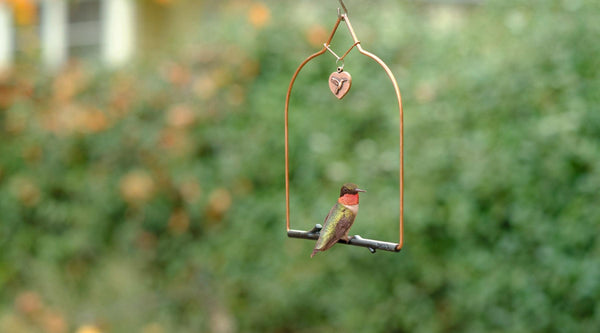
Hummingbirds spend a surprising amount of their day perched, not flying — watching their territory, digesting, and simply resting between feedings. A Pop's Original Hummingbird Swing hung near your feeder gives them exactly that spot, and it turns your feeding station into a front-row seat for watching them up close. Hang it about 1 foot from your feeder, at the same height (Pop's rule of thumb), and don't be surprised if a hummingbird claims it as their own personal lookout post — worth a second feeder-and-swing pairing, spaced out of sight of the first, once Rufous Hummingbird's fall window arrives; it's a genuinely territorial species that will otherwise guard a single station and chase everything else off.
Shop the Perfect Perch
Original Series Hummingbird Swing, Onyx

A second swing gives a chased-off bird its own perch to fall back to — especially once Rufous Hummingbird's territorial fall window arrives, when one bird will often claim both the feeder and the nearby swing as guarded turf.
Shop the Original Swing →Keep Your Sanctuary Safe from Predators
A feeding station draws more than hummingbirds, and knowing what's actually worth worrying about — and what isn't — makes for a safer yard. Cats and window strikes are the two best-documented threats to hummingbirds around any home. See our full Hummingbird Predators guide for the complete picture.
Summary: Key Takeaways for Attracting Hummingbirds in New York
- Feeder timing: up by late April on Long Island and NYC, early May in the Hudson Valley and Finger Lakes, mid-to-late May in the North Country and Adirondacks
- Any size space works — one feeder is plenty for a balcony; larger yards can support multiple feeders spaced apart, since hummingbirds are territorial
- Use a leak-proof feeder with a comfort perch, like the AspenPerch®, and fill it only as full as it'll be drunk in a few days
- Skip red dye in nectar; a plain 4:1 sugar-water ratio or Pop's Nectar (with electrolytes and calcium) both work
- Change nectar every 1–2 days above 90°F, up to every 5–6 days below 70°F
- Clean the feeder at every nectar change with warm water and vinegar — no soap or bleach
- Never use insecticide near feeders; hummingbirds rely on insects for protein. Use vinegar-water spray and HummGuard® nectar tips for pest control instead
- Add a swing near the feeder to give hummingbirds a place to rest and be observed up close — a second feeder-and-swing pairing helps once Rufous Hummingbird's territorial fall season arrives
- Native, nectar-rich plants (coral honeysuckle, cardinal flower, wild bergamot, eastern columbine, depending on region) do more for hummingbirds long-term than feeders alone
- Sow wildflower seed in October–November for blooms timed to spring migration; Perennial Lupine, Purple Coneflower, Black-Eyed Susan, White Yarrow, Lance-Leaved Coreopsis, and Painted Daisy are the strongest New York performers in Pop's Perfect Little Sanctuary® blend
Get these basics in place, and the wonder takes care of itself.
Frequently Asked Questions
A few of the questions we hear most from fellow hummingbird lovers across New York:
When should I put my hummingbird feeder out in New York? Late April is a safe target for Long Island and the NYC area. The Hudson Valley and Finger Lakes can wait until early May, and the North Country and Adirondacks into mid-to-late May.
What are common mistakes when feeding hummingbirds in New York? Taking the feeder down the moment local Ruby-throateds disappear is the biggest one — Rufous Hummingbird is a real, recurring New York visitor through the colder months, and a feeder that comes down in September misses it entirely. The other common mistake is running one feeder in a yard that draws more than one bird: Rufous in particular will guard a single feeder aggressively, so a second feeder and swing, spaced out of sight of the first, does more than a bigger feeder would.
Do hummingbirds like feeders without perches? They'll use either, but hovering burns real energy — a comfort perch like the AspenPerch's Polyperch® lets a bird feed while resting instead of hovering the whole time, which matters more during New York's own late-August-through-September push, when local birds are feeding heavily to fuel migration.
What happens if you don't boil sugar water for hummingbirds? Boiling helps dissolve sugar fully, but it isn't the safety-critical step — a consistent change schedule matters more, especially in a New York summer where nectar left in the sun can ferment within a day or two above 90°F.
Is it bad to leave my feeder up in fall? Not at all — it's a myth that a feeder left up will delay migration. Hummingbirds migrate based on daylight and instinct, not food availability, and in New York specifically, a feeder left up through fall is a real, documented chance at Rufous Hummingbird's recurring winter visit, not just a symbolic gesture.
What are the best plants to attract hummingbirds in New York? Coral honeysuckle, cardinal flower, and wild bergamot perform well across most of the state, with eastern columbine especially strong in southern New York, and wild bergamot a dependable, hardy choice for the North Country and Adirondacks. Native, tubular, red or orange flowers are the general rule of thumb.
New York Hummingbird Resources
Audubon Chapters
New York is home to numerous local Audubon chapters across the state. Find the one closest to you with Audubon's Find Your Local Audubon tool.
If You Find an Injured or Grounded Hummingbird
Hummingbirds are protected under federal and New York state law, so only a licensed wildlife rehabilitator can legally care for one.
- NYS DEC — Find a Wildlife Rehabilitator Near You — the official, searchable statewide database
- NY State Wildlife Rehabilitation Council — a directory organized by DEC region
- In New York City specifically, the Wild Bird Fund accepts injured and orphaned wild birds, including hummingbirds
Hummingbird Research & Banding in New York
- Crown Point Bird Banding Station at Crown Point State Historic Site, on Lake Champlain — a general songbird banding operation running continuously since 1976, that includes dedicated Ruby-throated Hummingbird banding as part of its work, led by licensed Master Bander Ted Hicks. The station is open to public visitors for a two-week window each May, and children are often invited to help release banded birds.
Sources
- eBird bar chart data, Cornell Lab of Ornithology — for feeder-timing dates; full methodology on the New York hummingbird calendar.
- New York State Avian Records Committee (NYSARC) — source for New York's accepted hummingbird records, and for Rufous Hummingbird's status as a statewide review species and the most frequently encountered non-breeding hummingbird in the state.
Why We Built This Guide
Pop's Birding has been helping hummingbird lovers for three generations. One of the questions our customers ask most often is "How do I actually attract more hummingbirds to my yard?" — we built this guide to give a direct, practical answer, not a generic one. Most feeder advice online is the same handful of tips repeated regardless of where you live, but a nectar-change schedule written for a mild climate is genuinely wrong for a Long Island August, and a plant list that ignores how differently the North Country and NYC's own growing seasons behave will send a reader shopping for the wrong flowers. We wanted a guide that actually accounts for New York's climate, regions, and real hummingbird behavior — not one that happens to mention New York in the title.
How We Built This Guide
The feeder-timing figures on this page come from our New York hummingbird calendar's own eBird-based regional analysis — this guide carries the actionable conclusion, not a second copy of the underlying data. The native-plant lists are broken out by region rather than given as one statewide list, since a plant suited to the NYC area's milder microclimate can struggle in the North Country's harsher winters and vice versa, and each neighboring state's border cross-links were checked against that state's own native-plant and timing records rather than assumed to match at the line. The regional plant breakdown, the Rufous-specific swing and feeder-timing advice, and the border-specific notes are Pop's Birding's own research tied to New York's real climate and documented hummingbird behavior, not generic national advice with a state name inserted.
Know before they arrive
You don't have to keep this calendar taped to the fridge. Insider Birding Access members get seasonal notes timed to your region — when to have feeders out, what the birds are doing right now, and what's worth doing in your yard this season. We take the guesswork out of the calendar. Joining takes about thirty seconds, and there's 10% off your first order in it.
Join Insider Birding Access →Free to join. 10% off your first order.
Your New York Backyard Sanctuary
Every real hummingbird sanctuary comes down to the same staples: mess- and pest-free food, a place to perch, native flowers, and fresh nectar. Here's everything from this guide to get all the bases covered in your own New York yard.


Bethany Sloan has served as General Manager of Pop's Birding since 2010, continuing the legacy of her grandfather, William "Pops" Sloan, inventor of the Original Hummingbird Swing. A lifelong hummingbird enthusiast, educator, and independent researcher, she leads the company's educational content, including its 50-State Hummingbird Guide series, Regional Guide, Species Guide and Hummingbird Learning Center. Bethany combines scientific research, regional migration data, and more than 16 years of hands-on experience to create trusted educational resources for bird enthusiasts across North America.