Sep 11, 2026
Connecticut Hummingbird Season: A Month-by-Month Calendar
Connecticut is small enough that you might expect one date to cover the whole state. In spring, it nearly does: Ruby-throated Hummingbird shows up in the Litchfield Hills, along the Southwest Coast, and on the Southeast Coast in the very same week each year. Fall is a different story. The hills peak first and empty first, the Southwest Coast holds its birds two weeks longer than anywhere else we track, and the state's second hummingbird — Rufous Hummingbird — doesn't even start its Connecticut season until the Ruby-throateds are gone. Here's how the year actually unfolds, month by month.
The short answer: the last week of April everywhere in the state, reliably common by the first week of May, a statewide peak in the last week of August, and gone by early October — late September in the hills, mid-October along the Southwest Coast.
| Question | Answer |
|---|---|
| When do they arrive? | Last week of April, statewide — the hills, the Southwest Coast, and the Southeast Coast all in the same week |
| When should feeders go up? | Mid-April, as a buffer ahead of the earliest scout birds |
| When do they nest? | Late May through July, statewide |
| Busiest month? | August — the statewide peak comes in the last week of the month, when about one in four checklists reports a Ruby-throated; the Litchfield Hills peak the week before, at more than one in three |
| When do they leave? | In stages — the hills by late September, the Southeast Coast by early October, the Southwest Coast by mid-October |
| Any in winter? | Rufous, regularly enough that Connecticut's records committee no longer asks for documentation — mostly November through January, and mostly in Fairfield County. Calliope Hummingbird has six accepted state records, every one of them October through January |
Free download
The whole year on one page
Arrival and departure region by region, when to hang feeders in your part of the state, and when to watch for Rufous — sized 8.5" x 11" for easy reference and printing.
Download the printable calendarOne page · PDF · free to print and share
Connecticut's Hummingbird Season at a Glance
Before the month-by-month detail, here's the whole season in two pictures. The first is Ruby-throated's full-year curve — the only species with enough Connecticut sightings to fill a chart on its own. The second is the same year for Rufous. It gets its own chart because Ruby-throated's peak is roughly seventy times higher than Rufous's: drawn on one shared scale, Rufous flattens into a line along the bottom axis and its real season disappears. Scaled to its own numbers, the shape is plain — nothing in spring or summer, then a genuine late-fall and winter season.


How often each species turns up on eBird checklists, week by week — statewide, 2016-2025. Source: eBird bar chart data (Cornell Lab of Ornithology), 2016-2025 (pulled Aug 2026). Connecticut's four rarer species — Calliope, Black-chinned, Broad-billed, and Mexican Violetear — are all real, committee-accepted birds, but with between one and six records apiece they never register above eBird's reporting floor and can't be charted.
Regions used below
We track three counties chosen to span Connecticut's real geography: the Litchfield Hills — Litchfield County (Torrington), the state's highest ground; the Southwest Coast — Fairfield County (Bridgeport, Stamford, Norwalk, Danbury); and the Southeast Coast — New London County (New London, Norwich, Groton). Statewide figures cover the whole state, including the Hartford area and New Haven, which we don't break out separately; the three counties show how much the statewide average hides.
Regional Arrival and Departure Snapshot
Here's the same timing on the map. Every region arrives in the same week — but look at the departure lines: the hills empty by late September, the Southeast Coast by early October, and the Southwest Coast holds on into mid-October.

One thing to know before you start
Connecticut's Ruby-throated season fully resets every winter. From November through mid-April our data shows Ruby-throated at or below eBird's noise floor statewide — nothing but isolated single-week blips too thin to count as real presence. The hummingbird you might see at a Connecticut feeder in December is almost certainly not a lingering Ruby-throated; it's far more likely a Rufous, or one of the genuine western rarities that turn up between October and January. That distinction matters for what you do in the fall, and it's why this calendar keeps talking after the Ruby-throateds leave.
January: Quiet for Ruby-throated, Watch for Rufous
Ruby-throated numbers sit at zero across all three counties we track in January. But the first week of the month is one of the better Rufous Hummingbird stretches of Connecticut's entire year — statewide, only the November weeks and the first week of December are busier, and in Fairfield County the opening week of January outranks every week in December. These are birds that arrived in the fall and stayed. If you've left a feeder up, this is a week to keep an eye on it. Our winter hummingbird feeder care guide covers heated feeders and the two-feeder swap.
January is also the tail end of Connecticut's Calliope season. Of the state's six accepted Calliope Hummingbird records, the Guilford bird of 2010 was first identified on 10 December and last seen on 1 January 2011 — a western species wintering on the Connecticut shoreline. If you see any hummingbird in Connecticut this month, photograph it and report it to the Avian Records Committee of Connecticut.
February & March: The Deep Quiet
February and March are the two months where our data shows nothing at all — no Ruby-throated, and after the first two weeks of February, no Rufous either. There's no scouting, no stragglers, no regional exception in any county. If you're the type to plan ahead, this is the stretch to give your feeders a thorough off-season cleaning so they're ready by mid-April.
April: The First Scouts, Then Everyone at Once
April is when Connecticut's season begins — barely, and then all at once. The third week of the month brings the first real scouts: a handful of reports in Fairfield and New London counties, nothing yet in the hills. Then in the last week of April the whole state switches on together. Litchfield, Fairfield, and New London all cross the same threshold in the same week, and the Southeast Coast leads the way with more than twice the reporting rate of either other county. This is the earliest, most adventurous males pushing north ahead of the main wave. A late-April cold snap isn't unusual in Connecticut, and a stocked feeder is a real help to an early arrival caught in one.

Get your feeder up before the first bird arrives, not after.
Connecticut's arrival is unusually synchronized — the whole state lights up in one week — so there's no "my region gets them later" cushion here; a feeder that goes out mid-April costs you nothing, while one still in the garage on the last week of April costs you the sighting. April is also the month to check last year's feeder for cracked seals and worn ports before the season depends on it. AspenPerch® has a built-in ant moat and a Polyperch® comfort perch, so birds rest between sips instead of hovering through the whole meal.
Shop AspenPerch® →May: The Wave Fills the State
May is Connecticut's real arrival month. Statewide, Ruby-throated goes from fewer than one in thirty checklists in the last week of April to more than one in ten in the first week of May, and about one in seven by the third. Every county we track is reliably common by the first week of May — no regional lag at all. What does differ is intensity: New London County runs hotter than anywhere else in spring, with nearly one in four checklists reporting a Ruby-throated in the third week of May, while Fairfield and Litchfield run between about one in eight and one in six. If you live in southeastern Connecticut, your May feeders are the busiest in the state.
| Region | Ruby-throated Arrives | Reliably Common |
|---|---|---|
| Litchfield Hills (Torrington) | Last week of April | First week of May |
| Southwest Coast (Bridgeport, Stamford, Danbury) | Last week of April | First week of May |
| Southeast Coast (New London, Norwich) | Last week of April | First week of May |
"Arrives" is the first of two consecutive weeks where at least 1% of a county's checklists report the species, backed by at least five actual checklists — not the scattered scout birds of mid-April. "Reliably common" is the first week a county's reports reach 25% of that county's own seasonal peak. We checked the number of checklists behind each of these, not just the percentage: the arrival week rests on 71 to 127 checklists per county and 627 statewide, so the same-week result is real, not an artifact of one thinly-birded county crossing a threshold on weak data.
June: Nesting Season Settles In
Statewide activity eases slightly through June, holding at roughly one in eight checklists as birds settle into nesting. Females become secretive around the nest during this stretch, which can make feeder activity look quieter even though the birds haven't gone anywhere — they're spending more time incubating and less time visibly perched. Males take no part in nest duties and stay visible and territorial. The Southeast Coast still leads, with the Litchfield Hills close behind at roughly one in seven checklists all month.
Why nesting season is the demanding one
There's a wrinkle specific to hummingbirds. Most female birds build up a temporary calcium store in their bones, called medullary bone, and draw on it to make eggshell. Hummingbirds have very little of it, so a laying female has less in reserve. Researchers have seen nesting females eating wood ash and other mineral-rich materials, which they think helps replace the calcium that goes into eggs. In one 1994 study, every bird seen eating ash was a female tending a nest.

It's part of why Pop's Nectar includes calcium and electrolytes rather than sugar alone. Nesting females need extra calcium during egg-laying, and plain sugar water has essentially none. Read more on the research behind it.
Shop Nectarlyte® 8 oz →July: Building Toward the Peak
Activity climbs steadily through July, from about one in seven checklists statewide early in the month to a little under one in five by month's end, as the first broods fledge and juveniles join adults at feeders and flowers. The climb is steepest in the hills: Litchfield County goes from a little under one in five checklists to nearly one in four across the month, already ahead of both coastal counties. This is typically the most crowded a Connecticut feeder gets before the true peak arrives in August.

Keep pests off without pesticides.
AspenPerch®'s built-in ant moat blocks ants with a water barrier, and HummGuard® Nectar Tips keep bees and wasps out without changing anything for the birds.
Shop HummGuard® →August: The Statewide Peak
August is Connecticut's busiest hummingbird month by a clear margin. Statewide, Ruby-throated climbs from about one in five checklists in the first week to about one in four in the last — the single highest point of the year. The Litchfield Hills peak first and highest, with more than one in three checklists reporting a Ruby-throated in the third week of August, the top figure anywhere in the state all year. Birds are in hyperphagia, the intensive pre-migration feeding phase: a Ruby-throated Hummingbird weighs about three grams and packs on fat worth roughly another quarter to a third of that before heading south — banding work on the Gulf Coast has found the heaviest birds arriving with nearly double their lean weight in fuel. A thin scatter of Rufous reports appears in the third week of August, but the real Rufous season doesn't begin until October.
This is the month to be generous, not economical.
Connecticut's birds are putting on fuel for a flight that ends thousands of miles south, and a feeder that runs dry mid-surge is a missed meal at the worst possible time. The 2lb Nectarlyte® powder or the Nectarade® liquid concentrate keeps you topped up through the busiest weeks of the year.


September: The Hills Leave, the Coast Holds
September is when Connecticut's hummingbirds leave — but not together. Statewide, about one in four checklists still reports a Ruby-throated in the first week, but only about one in fourteen by the last: a drop of nearly three-quarters in three weeks. The Litchfield Hills go first and fastest, sliding from more than one in four checklists in the first week to fewer than one in twenty in the last — by late September the hills are effectively done. The Southeast Coast follows a week behind. The Southwest Coast does something different: Fairfield County actually reaches its own seasonal peak in the second week of September, with nearly one in three checklists reporting a Ruby-throated, and still has about one in four in the third week when the hills have collapsed. The most likely explanation is birds from farther north moving through the shoreline as the local nesters leave — either way, Fairfield's feeders stay busy well after inland ones have gone quiet. Wherever you live, keep feeders full through September — a departing bird's last Connecticut meals are the ones that matter most.
October: Last Stragglers Leave, First Real Rufous
October is when the last Ruby-throated Hummingbirds leave Connecticut, region by region. The Litchfield Hills drop to scattered reports in the first week; the Southeast Coast follows in the second; the Southwest Coast is the last to empty, still turning up on about one checklist in a hundred into the second week of October before fading to scattered stragglers. Statewide, the third and fourth weeks of October still show a few lingering birds — thin, but real. October is also when Rufous activity genuinely begins, with the third week of the month the first real pulse of the season. And it's the single most important month in Connecticut's rarity record: four of the state's six accepted Calliope Hummingbird records began in October (Simsbury 2008, Stonington 2011, West Haven 2015, Stamford 2020), and both accepted Black-chinned Hummingbird records were October arrivals — Fairfield in 2013 and South Windsor in 2022. Pop's tip: keep at least one feeder up for two to three weeks after your last Ruby-throated sighting, and consider leaving it up through November if you'd like a shot at Rufous — or something rarer.

October is the planting month, not the tidying-up month.
Sow native wildflower seed now and it gets the cold, moist Connecticut winter most varieties need before they'll bloom reliably next spring — the same spring your hummingbirds come back to.
Shop the Perfect Little Sanctuary® blend →November: Peak Rufous-Watching
Ruby-throated is essentially absent statewide in November. This is instead the best month of the year to watch for Rufous Hummingbird, Connecticut's one regular hummingbird visitor from the west. The second week of November is the single busiest Rufous week of the year both statewide and in Fairfield County, where the reporting rate runs more than four times the statewide figure — this is a Fairfield County story above all. Rufous turns up often enough that the Avian Records Committee of Connecticut removed it from its review list years ago "because the number of sightings has increased"; as early as its tenth report the committee was already calling the pattern "an especially strong recent trend of western hummers appearing in the east in autumn." If a feeder-visiting hummingbird looks fiery orange rather than green-backed this month, there's a real chance it's a Rufous.

If one bird is chasing everything else off, that's Rufous behaving exactly as expected.
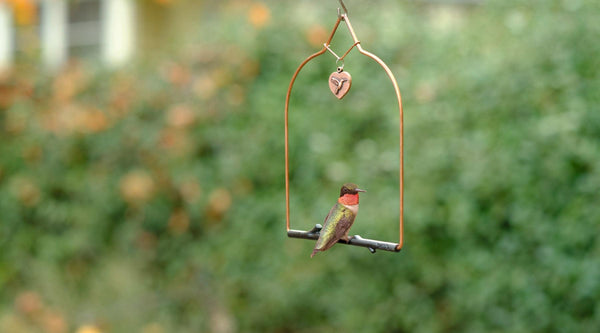
Rufous is genuinely territorial, and a single feeder with a swing beside it tends to become one bird's guarded patch — it perches on the swing to watch the feeder it's already defending. A second feeder and a second swing, placed out of sight of each other, gives the next bird its own station to claim instead of a fight over yours.
Shop a second swing →December: Rufous Tapers, Rarities Linger
December carries the tail of Connecticut's Rufous season, with reports easing week by week but never quite reaching zero — and, as January shows, some of these birds stay right through the turn of the year. December is also when the state's rarest hummingbird records have run to their end. Connecticut's first Calliope Hummingbird, a female at the butterfly garden at Lighthouse Point Park in New Haven, was present from 2 to 7 December 2006 and banded on the third. The second Black-chinned Hummingbird ever recorded in the state, a young bird at a private feeder in South Windsor, arrived in mid-October 2022 and stayed until 23 December, when the committee's report notes it "probably succumbed to the extreme cold." Both were birds that turned up where somebody was still paying attention in the cold.
The Year at a Glance
| Months | Statewide Activity |
|---|---|
| January | No Ruby-throated; one of the better Rufous weeks of the year opens the month, mostly in Fairfield County |
| February — March | None — deep winter quiet in every county |
| April | First scouts on the coast mid-month; the whole state switches on in the last week |
| May | Fast arrival; reliably common everywhere by the first week; Southeast Coast the busiest |
| June — July | Steady; nesting through fledging, activity building toward August, hills leading |
| August | Statewide peak (26%); Litchfield Hills hit 35% in the third week |
| September | Hills leave first and fast; Southwest Coast peaks in the second week and holds |
| October | Last Ruby-throated leave, Southwest Coast last; first real Rufous; the month rarities arrive |
| November | Peak Rufous-watching window, strongest in Fairfield County |
| December | Rufous tapering; rare winter visitors still possible |
Frequently Asked Questions
When do hummingbirds come back to Connecticut?
The last week of April, statewide. Unusually for a state with real hills and a real coast, our data shows Litchfield, Fairfield, and New London counties all crossing the arrival threshold in the same week, and all reliably common by the first week of May. Feeders should be up by mid-April — the first scouts appear on the coast in the third week of the month.
When do hummingbirds leave Connecticut?
In stages, from the hills to the coast. Ruby-throated Hummingbirds leave the Litchfield Hills by late September, the Southeast Coast by early October, and the Southwest Coast by mid-October. Statewide, reports fall from about one in four checklists in the first week of September to about one in fourteen in the last, and to about one in fifty by the first week of October. A few stragglers linger into late October, but for most of the state the season is over by the second week.
When do hummingbirds leave the Connecticut shoreline?
Later than the rest of the state — and Fairfield County later still. The Southwest Coast doesn't even reach its own seasonal peak until the second week of September, and about one in four checklists there still reports a Ruby-throated in the third week, while the hills have dropped to about one in eight. Fairfield County is the last part of Connecticut to empty, in the second week of October. New London County, on the Southeast Coast, sits in between: past its peak by early September, and effectively empty by the first week of October.
When do hummingbirds migrate south from Connecticut?
Southbound movement is under way by the second week of September and largely finished by the first week of October. The birds are fueling for it through all of August — Connecticut's statewide peak in the last week of August is the pre-migration surge, and the Fairfield County peak two weeks later most likely reflects birds from farther north passing through the coast on their way south.
How long do hummingbirds stay in Connecticut?
Roughly five and a half months for the typical Connecticut yard — the last week of April to early October, with a couple of extra weeks along the Southwest Coast. Add the Rufous season, which runs October through January, and the practical "hummingbird watching" window stretches to about nine months.
Should I keep a feeder up through a Connecticut winter?
If you want a real shot at Rufous, yes — November is the peak month, the first week of January is worth watching too, and Fairfield County is where the odds are best. Every one of Connecticut's six accepted Calliope Hummingbird records and both accepted Black-chinned records fall between October and January, and more than one was found at a feeder somebody had left up. If a hummingbird shows up at your feeder after the Ruby-throateds have gone, photograph it and report it — the state's committee still reviews Calliope, Black-chinned, Broad-billed, and Mexican Violetear.
Why We Built This Calendar
Pop's Birding has been helping hummingbird lovers for three generations, and "When do hummingbirds arrive and leave my state?" is one of the questions our customers ask most. Most timing advice online gives a single date for an entire state, and for Connecticut's spring that's almost defensible. For its fall, it isn't: in the third week of September the Litchfield Hills are down to about one in eight checklists while Fairfield County is still at about one in four, and Fairfield doesn't empty until mid-October. A single "they leave in September" line would be two to three weeks wrong along the Southwest Coast, so we built a calendar that tells you the truth for where you actually live.
How We Built This Calendar
We pulled eBird data (Cornell Lab of Ornithology) for Connecticut statewide and for three counties that span the state's geography — Litchfield (hills), Fairfield and New London (coast) — covering 2016 through 2025. A county's arrival or departure only counts when sightings hold for two weeks running on enough real checklists. Connecticut's four rarest species are committee-accepted birds too rare to chart, so we describe them from the Avian Records Committee of Connecticut's own records. The finding that shaped this page: Connecticut arrives as one state and leaves as three. The county comparison is our own analysis, not a rewrite of eBird's bar charts.
Sources
- eBird bar chart data, Cornell Lab of Ornithology — Connecticut statewide and county-level (Litchfield, Fairfield, New London), 2016-2025. Source for all month-by-month seasonal figures and the regional arrival/departure pattern.
- Avian Records Committee of Connecticut, ARCC Review List (Connecticut Ornithological Association). Source for which hummingbird species currently require documentation in Connecticut.
- ARCC Reports Index of Species, with the committee's Tenth, Twelfth, Thirteenth, Nineteenth, and Twenty-eighth reports. Source for the dates, locations, and details of every Calliope, Black-chinned, and Rufous record cited on this page, and for Rufous's removal from the review list.
- Zenzal & Moore, "Stopover biology of Ruby-throated Hummingbirds during autumn migration", The Auk 133:237–250 (2016). Source for the pre-migration fat-load figures in the August section.
- des Lauriers, J. R. (1994). Hummingbirds eating ashes. The Auk, 111(3), 755–756. Documents five nesting female hummingbirds eating wood ash; no males were seen doing so in that study.
- Adam, M. D., & des Lauriers, J. R. (1998). Observations of hummingbirds ingesting mineral-rich compounds. Journal of Field Ornithology, 69, 257–261. Source for hummingbirds' greatly reduced medullary bone and for the mineral-rich materials they eat.
- Werning, S. (2018). Medullary bone is phylogenetically widespread and its skeletal distribution varies by taxon. Journal of Ornithology, 159, 527–543. Source for medullary bone being confirmed in hummingbirds.
Know before they arrive
You don't have to keep this calendar taped to the fridge. Insider Birding Access members get seasonal notes timed to your region — when to have feeders out, what the birds are doing right now, and what's worth doing in your yard this season. We take the guesswork out of the calendar. Joining takes about thirty seconds, and there's 10% off your first order in it.
Join Insider Birding Access →Free to join. 10% off your first order.
Shop Connecticut's Hummingbird Favorites


Bethany Sloan has served as General Manager of Pop's Birding since 2010, continuing the legacy of her grandfather, William "Pops" Sloan, inventor of the Original Hummingbird Swing. A lifelong hummingbird enthusiast, educator, and independent researcher, she leads the company's educational content, including its 50-State Hummingbird Guide series, Regional Guide, Species Guide and Hummingbird Learning Center. Bethany combines scientific research, regional migration data, and more than 16 years of hands-on experience to create trusted educational resources for bird enthusiasts across North America.