Sep 04, 2026
Hummingbirds in Connecticut: The Complete Guide to All 6 Species
Connecticut's documented hummingbird list runs to six species — tied with Massachusetts, just behind neighboring New York's seven, and well ahead of Rhode Island's three. Ruby-throated Hummingbird is the only regular breeder. Rufous Hummingbird is a real, recurring fall-into-winter visitor. The other four are documented rarities that split into two genuinely different strength levels — two with a real, if thin, recurring pattern, and two down to a single accepted record each.
Free download
All 6 species, one page
A one-page reference to every hummingbird documented in Connecticut — Ruby-throated Hummingbird plus five rarer visitors, with each species' status and record history at a glance.
Download the Connecticut species guideOne page · PDF · free to print and share

All 6 documented Connecticut hummingbird species, grouped by tier — statewide eBird data, 2016–2025, cross-checked against the Avian Records Committee of Connecticut's own accepted-record history.
The Hummingbird You're Most Likely to See
Ruby-throated Hummingbird Breeds Here
Connecticut's only breeding hummingbird, and the only hummingbird that breeds regularly anywhere east of the Mississippi River. It dominates the state's hummingbird activity almost completely — statewide eBird frequency peaks near 26% in mid-August, roughly seventy times higher than the next most frequent species. Recent Connecticut Bird Atlas fieldwork (2018–2022) documents nesting across nearly the entire state, a real expansion since the first atlas in the 1980s. Present late April through late September/early October; no winter population.

Quick ID: Males flash a brilliant ruby-red throat in good light, but it reads as solid black most of the time — the forked black tail is the more reliable everyday mark. Females have a plain whitish throat and a more rounded, white-tipped tail.

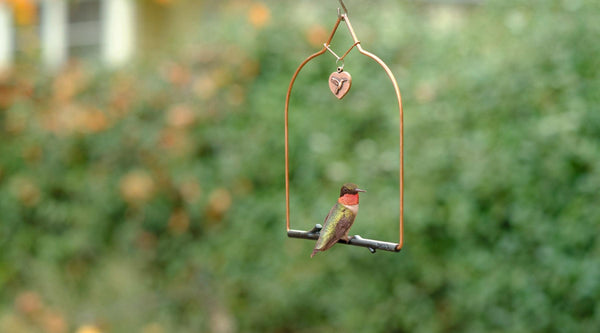
A Little Throne for Your Ruby-throated
Connecticut's only breeder nests across nearly the entire state each summer. A stable perch gives it somewhere to watch from besides your feeder port — a place to hold territory before migration and the season's rarities start filtering through each fall.
Shop Charm Redwood Swing →Connecticut's Regular Fall-into-Winter Visitor
Once Ruby-throated numbers taper off in September, Connecticut sees one more genuine, if easy to overlook, species — the state's most regularly recorded vagrant hummingbird of any kind.
Rufous Hummingbird Migrant/Winter
The most regularly recorded rare visitor east of the Rockies, and Connecticut's own Avian Records Committee (ARCC) has removed it from the official Review List entirely — too regular to require documentation. Sightings run from fall into winter, part of what one ARCC report calls "an especially strong recent trend of western hummers appearing in the east in autumn."

Quick ID: Males glow with a fiery orange-red throat and a coppery-orange body — one of the most recognizable hummingbirds in North America. Females and immatures are green above with rusty flanks and rufous patches at the base of the tail.

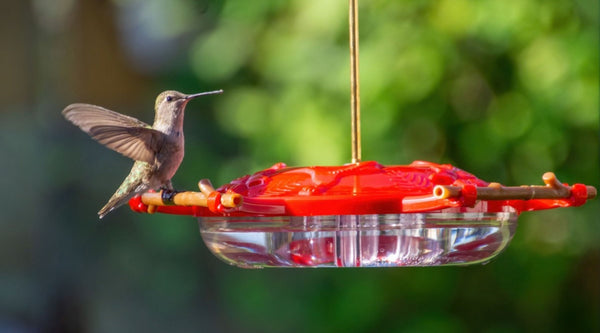
An Extra Feeder for Your Rufous Visitor
Rufous is famously aggressive at a feeder and will chase off anything else in the yard, regardless of size. A second station spread across the yard gives a lingering Ruby-throated or a passing rarity room of its own instead of one bird claiming the whole supply.
Shop AspenPerch Feeder →Connecticut's Recurring Rarities
Two more species have accepted Connecticut records with a genuine, if thin, recurring pattern — Calliope considerably more so than Black-chinned.
Calliope Hummingbird Rare / Casual Visitor
6 accepted ARCC records, and the committee's own report language is direct: all six fall "Oct to Jan," a real recurring seasonal pattern with activity as recent as 2020 (Stamford). Earlier records include New Haven (2006), Simsbury (2008), Guilford (2010–11), Stonington (2011), and West Haven (2015).

Quick ID: North America's smallest breeding hummingbird, with a hunched posture and short tail. Males have a unique streaked, ray-like magenta throat unlike any other species' solid gorget. Females are tiny even by hummingbird standards, with very little rufous in the tail.
Black-chinned Hummingbird Rare / Casual Visitor
2 accepted ARCC records, genuinely spread apart — Fairfield in October 2013, and South Windsor in October–December 2022 — rather than a tight cluster. A real 9-year gap between the two, with the most recent only a few years old, but a meaningfully thinner pattern than Calliope's six records; the 2022 bird likely didn't survive an extreme late-December cold snap.

Quick ID: Males show a velvety black throat, only revealing a thin purple band in direct light — otherwise it just looks solid black. Females are plain and pale-throated, best told apart by white-tipped outer tail feathers and a small white spot behind the eye.

Make Your Sanctuary Worth a Detour
Calliope and Black-chinned are both genuinely recurring here, not one-time flukes — real electrolytes beyond plain sugar water give a documented rarity a reason to linger instead of just passing through.
Shop Nectarlyte® Powder →If You're Lucky: Connecticut's Historic Rarities
Two more species are each down to a single accepted Connecticut record, with nothing before or since.
Broad-billed Hummingbird Historic / Accidental
A single accepted record, ever — an adult male at a private Montville feeder for one day in August 2008, photographed by the feeder owner's daughter. ARCC's own report credits "a digital camera and the quick-thinking daughter of the feeder's owner" for this stunning first state record. Nothing since.

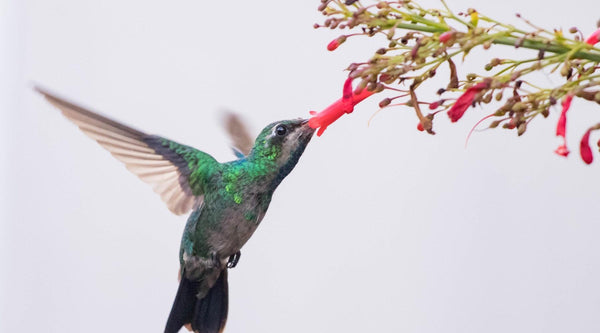
Quick ID: Named for the field mark that settles it at a glance — a bright red bill tipped in black. Males show a shimmering sapphire-blue throat over an emerald-green body; females are duller, golden-green above and gray below, but carry that same diagnostic red-and-black bill.
Mexican Violetear Historic / Accidental
Connecticut's other single-record rarity — a homeowner photographed an unfamiliar large hummingbird in Winchester in August 2017, formally accepted by ARCC as the state's first record of "a species with a history of forays into the United States and even Canada." A worth-noting honest caveat: this page's underlying weekly eBird data shows a thin signal for this species in Litchfield County that doesn't line up precisely with the accepted record's date, which was likely a misidentification of a more expected species rather than a second Mexican Violetear — the accepted-record count from ARCC remains the reliable figure.

Quick ID: A larger hummingbird than the rest of Connecticut's list, glittering metallic green overall with a violet-blue patch across the breast and a violet ear patch — the field mark that gives the species its name. Sexes look nearly identical.

Give Every Visitor a Reason to Stay
Whether it's your resident Ruby-throated or a genuine one-off like Mexican Violetear, real nectar sources give any visitor, common or rare, more reason to stick around your yard.
Shop Wildflower Seed →Connecticut Hummingbirds at a Glance
Ruby-throated Hummingbird's dominance here isn't a close call — its statewide eBird frequency peaks near 26%, and every other documented species stays well under 2% at its own peak. With a gap that wide, a bar chart wouldn't show anything the numbers below don't already say plainly, so this section skips straight to the table.
| Species | Status | Connecticut Records |
|---|---|---|
| Ruby-throated Hummingbird | Breeding | Connecticut's only breeder; statewide eBird frequency peaks near 26%, dwarfing every other species. |
| Rufous Hummingbird | Migrant / Winter Visitor | Removed from the ARCC Review List — too regular to require documentation; a real fall-into-winter pattern. |
| Calliope Hummingbird | Rare / Casual Visitor | 6 accepted ARCC records, all Oct–Jan, most recent 2020 — a real recurring pattern per ARCC's own language. |
| Black-chinned Hummingbird | Rare / Casual Visitor | 2 accepted records (2013, 2022), genuinely spread apart — a thinner pattern than Calliope's. |
| Broad-billed Hummingbird | Historic / Accidental | 1 accepted record ever (Montville, Aug 2008), nothing since. |
| Mexican Violetear | Historic / Accidental | 1 accepted record ever (Winchester, Aug 2017), nothing before or since. |
Frequently Asked Questions
How many hummingbird species have been recorded in Connecticut?
Six — tied with Massachusetts, just behind New York's seven, well ahead of Rhode Island's three. Ruby-throated is the only breeder, Rufous is a regular fall-into-winter visitor, and four more species are documented rarities of varying strength.
What's the only hummingbird that breeds in Connecticut?
Ruby-throated Hummingbird is Connecticut's only breeding species, and the only hummingbird that breeds regularly anywhere east of the Mississippi River. Recent breeding bird atlas surveys show it now nesting across nearly the entire state, a real expansion since the 1980s.
How reliable is Calliope Hummingbird in Connecticut, compared to Black-chinned?
Calliope has the stronger pattern — 6 accepted records, all October through January, with activity as recent as 2020. Black-chinned has only 2 accepted records, genuinely spread nine years apart (2013 and 2022). Both are real, documented occurrences, but Calliope's pattern runs meaningfully deeper.
What's Connecticut's rarest documented hummingbird?
Broad-billed and Mexican Violetear Hummingbird are each down to a single accepted record — Broad-billed in 2008, Mexican Violetear in 2017 — with nothing before or since either sighting.
How can you tell a Ruby-throated from a Rufous Hummingbird in Connecticut?
Color and season together settle it. Ruby-throated males show a red throat and a green back; Rufous males are almost entirely orange-red overall, unlike anything else expected in Connecticut. Timing helps too — Rufous shows up from fall into winter, well after most Ruby-throateds have already left.
Why We Created This Guide
Pop's Birding has been helping hummingbird lovers for three generations. One of the questions our customers ask most often is "what hummingbirds actually show up in my state" — we built this guide to give a direct, sourced answer, not a generic one. Most general references lump Connecticut's four rare hummingbirds into one undifferentiated "rare visitor" bucket. That misses a real distinction the state's own records committee draws clearly: Calliope Hummingbird's six-record, Oct-through-January pattern is a meaningfully different case from Broad-billed and Mexican Violetear's single accepted sightings, each verified against ARCC's own record-by-record documentation.
How We Created This Guide
We pulled eBird checklist data for Connecticut, 2016–2025, statewide plus three representative counties — Fairfield in the southwest, Litchfield in the rural northwest, and New London in the southeast — and cross-checked it against the Avian Records Committee of Connecticut's own current Review List and Reports Index of Species, since tier and status here come from that record-by-record documentation rather than eBird frequency alone; a species clearing a percentage point in raw data isn't automatically a real pattern, because a single well-photographed rarity can draw enough birders to create a real-looking statistic on its own. One thing worth flagging directly: Mexican Violetear shows a thin eBird signal in Litchfield County that doesn't line up with its one accepted record's actual date, which more likely reflects a misidentification than a second bird. Ruby-throated's statewide lead is real and wide regardless — its eBird frequency clears the next-highest species by more than 24 percentage points, which is why this page uses a table rather than a chart.
Sources
- eBird bar chart data, Cornell Lab of Ornithology — Connecticut statewide, 2016–2025.
- Avian Records Committee of Connecticut, Connecticut Ornithological Association — source for every rare-species record count and status on this page.
Know before they arrive
You don't have to keep this calendar taped to the fridge. Insider Birding Access members get seasonal notes timed to your region — when to have feeders out, what the birds are doing right now, and what's worth doing in your yard this season. We take the guesswork out of the calendar. Joining takes about thirty seconds, and there's 10% off your first order in it.
Join Insider Birding Access →Free to join. 10% off your first order.
Shop Connecticut's Hummingbird Favorites


Bethany Sloan has served as General Manager of Pop's Birding since 2010, continuing the legacy of her grandfather, William "Pops" Sloan, inventor of the Original Hummingbird Swing. A lifelong hummingbird enthusiast, educator, and independent researcher, she leads the company's educational content, including its 50-State Hummingbird Guide series, Regional Guide, Species Guide and Hummingbird Learning Center. Bethany combines scientific research, regional migration data, and more than 16 years of hands-on experience to create trusted educational resources for bird enthusiasts across North America.