Aug 01, 2026
Broad-tailed Hummingbird: The High-Altitude Specialist of the Rockies
Long before you ever see one, you'll likely hear a Broad-tailed Hummingbird — a loud, metallic trill produced entirely by air rushing through the male's specially modified wingtip feathers, audible up to 50 meters away and unmistakable once you know what it is. It's the calling card of a genuine high-altitude specialist: a bird that breeds at elevations over 10,000 feet, survives nights that regularly drop below freezing even in the height of summer, and has become one of the most scientifically important hummingbird species in the country for exactly that reason.
Quick Facts
- Scientific name: Selasphorus platycercus
- Length: about 3.5 inches (9 cm)
- Wingspan: approximately 5.25 inches (13 cm)
- Weight: roughly 0.1–0.14 oz (3–4 g); females average slightly larger than males
- Population: an estimated 9.8 million, per Partners in Flight
- Conservation status: Least Concern (IUCN), but rated 13 out of 20 on Partners in Flight's Continental Concern Score and included on the Yellow Watch List for species facing possible decline without conservation action — and the North American Breeding Bird Survey has documented a cumulative decline of roughly 45% between 1966 and 2019
- Claim to fame: one of the highest-elevation-breeding hummingbirds in North America, and a genuine research favorite for studying torpor, courtship displays, and the effects of climate change on mountain ecosystems
The Origin Story: How the Broad-tailed Hummingbird Got Its Name
The Broad-tailed Hummingbird was formally described in 1827 by English naturalist William Swainson, from a specimen collected in Mexico by the collector William Bullock and his son during their travels there in the early 1820s. Bullock brought the collection back to London, where it was exhibited before Swainson described the birds in his 1827 synopsis — giving the species its original name, Trochilus platycercus. It wasn't collected within the United States until 1851, when J. H. Clark found one near El Paso, Texas.
One persistent historical myth is worth setting straight: 19th-century ornithologist Elliott Coues once incorrectly credited the discovery of this species to the Lewis and Clark Expedition in Idaho — a claim later debunked by researchers Banks and Calder, who pointed out that the north-central Idaho locality in question falls outside the Broad-tailed Hummingbird's breeding range, making the original attribution a case of mistaken identity rather than genuine discovery.
Sources: Cornell Lab of Ornithology, Birds of the World — Selasphorus platycercus account; U.S. Fish & Wildlife Service — Species Profile
Where the Broad-tailed Hummingbird Lives: A True High-Elevation Specialist
The Broad-tailed Hummingbird breeds across highland regions from the western United States down through Mexico and into Guatemala. Within the U.S., Tucson Bird Alliance describes the species' summer range as centered on the southern and central Rocky Mountains, the mountains of the Southwest, and parts of eastern California — anywhere offering the brief but intense high-altitude flowering season this species depends on. Its core breeding states are Colorado, Wyoming, Utah, Nevada, New Mexico, Arizona, eastern California, and West Texas, with marginal breeding at the northern fringe in the southern reaches of Idaho and Montana. Populations in Mexico, by contrast, are year-round residents rather than migrants.
A multi-year citizen-science survey conducted by the National Park Service in Rocky Mountain National Park between 2003 and 2012 found the species present at essentially all surveyed elevations, with a preference for montane valleys, and documented that female survival rates stayed relatively constant across the study period while male survival varied significantly from year to year — a pattern researchers still don't fully understand.
How to Identify the Broad-tailed Hummingbird: Males vs. Females
Adult Males
A solid rose-magenta throat patch, or gorget, paired with an iridescent green back and crown. According to the Montana Field Guide, the tail is notably long and broad — extending beyond the wingtips, a genuinely useful field mark — with the base of the outer tail feathers rufous in color, edged in green and a thicker black or purplish-black band, and tipped in white.

Adult Females
A white throat showing varying amounts of light speckling — sometimes faint bronze, sometimes iridescent green, and occasionally a few feathers in the same rose-magenta as the male's gorget. According to the Audubon Field Guide, females are similar to female Rufous Hummingbirds but have a noticeably larger tail, one of the more reliable ways to separate the two in the field. Females are also, on average, slightly larger overall than males.

A Note on Sound: The Famous Wing Trill
This species is genuinely easier to detect by ear than by sight. Both sexes produce a lower wingbeat hum ranging from about 35 to 100 Hz, but males additionally produce a distinctive courtship "wing trill" generated when air passes rapidly through the modified, attenuated tip of the outermost primary feather (P10, with the adjacent P9 contributing) — a buzzing sound audible to other males up to 50 meters away and to females up to 75 meters away. In one documented experiment, researchers found that males experimentally prevented from producing this trill lost territorial disputes more easily to more aggressive rivals, suggesting the sound itself functions as a genuine signal of a male's fitness or status, not just a byproduct of flight.
Key paper: Miller, S. J. & Inouye, D. W. (1983). "Roles of the wing whistle in the territorial behaviour of male Broad-tailed Hummingbirds." Animal Behaviour 31: 689–700.
Behavior: Territorial, Vocal, and Built for Altitude
Male Broad-tailed Hummingbirds defend territory by perching conspicuously high, scanning for and aggressively chasing off intruders — a similar pattern to several other North American hummingbird species. What sets this species apart is how much of its behavior is shaped directly by elevation: since nighttime temperatures at its breeding elevations regularly drop below freezing even at the height of summer, male Broad-tailed Hummingbirds — unlike incubating females, who are tied to a nest — can simply relocate to a warmer microclimate or move upslope out of a valley's coldest pooled air, reducing their thermoregulation energy costs by an estimated 15%, according to Tucson Bird Alliance.
Feeding and Diet
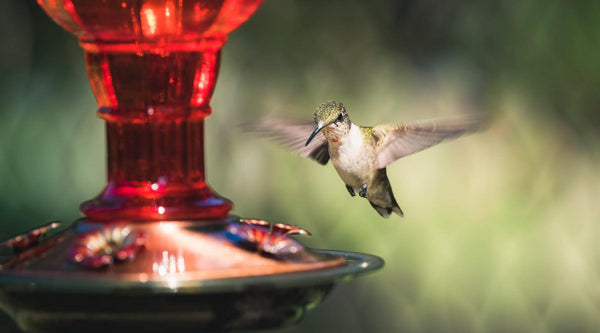
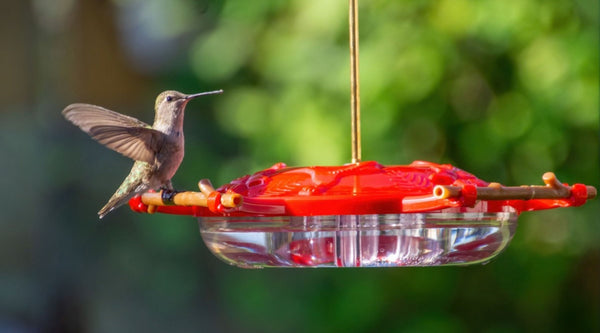
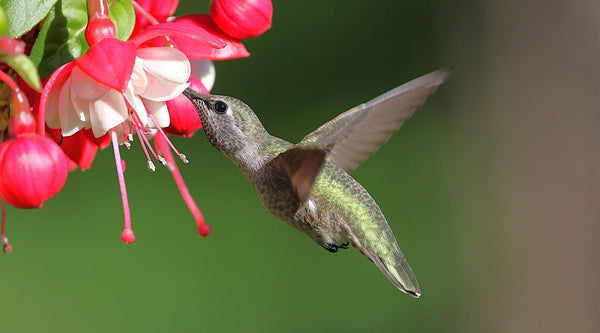
According to the Audubon Field Guide, Broad-tailed Hummingbirds feed while hovering, extending their bill and long tongue deep into the center of a flower, favoring red tubular blooms in particular. They also readily use sugar-water feeders, either hovering or perching to feed. Small insects — caught mid-air, plucked from foliage, or occasionally taken directly from spider webs — supply essential protein alongside the nectar diet. Cornell Lab notes the species will also use sap wells excavated by Red-naped Sapsuckers as a nectar substitute when flowers are scarce.
Courtship and Mating
Courting males perform a spectacular aerial display: a series of high climbs, dives, and hovers accompanied by the species' signature wing trill, according to Cornell Lab's Birds of the World, with the display doubling as a territorial signal during aggressive encounters as well as courtship. The Pajarito Environmental Education Center describes the dive specifically as tracing a U-shaped pattern, with males diving from as high as 60 feet above the ground, producing a loud wing buzz at the bottom of each pass. Birds of the World characterizes the species as a promiscuous breeder — a male courts a particular female only briefly, mates, and then moves on to seek additional mates, providing no further parental care.
Notably, this species has also been the subject of some of the most detailed scientific analysis of hummingbird courtship dives ever conducted: researchers studying wild Broad-tailed Hummingbirds at the Rocky Mountain Biological Laboratory in Gothic, Colorado, used high-speed video, acoustic analysis, and computational models of hummingbird color vision to determine exactly how a male's speed, the sound his dive produces, and the way his iridescent gorget would appear to a female all change and synchronize throughout the display — a level of quantitative detail rarely achieved in studies of animal courtship behavior.
Key paper: Hogan, B. G. & Stoddard, M. C. (2018). "Synchronization of speed, sound and iridescent color in a hummingbird aerial courtship dive." Nature Communications 9:5260, available via the National Institutes of Health (PMC).
Nesting and Family Life
Females build and tend their nests entirely alone, typically choosing an evergreen or aspen branch with cover overhead, or a willow or alder thicket, usually 1 to 5 feet above the ground — though the Texas Breeding Bird Atlas notes nests are also documented on conifer, cottonwood, and other tree species depending on the specific mountain range. Nest placement is driven directly by the female's need to protect her eggs and chicks from the genuinely cold nights common at these elevations.
The nest itself is a tiny cup built from spiderweb and gossamer — materials chosen specifically for their excellent insulating properties — often positioned beneath an overhanging branch that helps keep the nest warmer than the surrounding air and reduces the incubating female's nighttime energy demands. She shapes the cup by twisting material around her body and feet while sitting inside it, then camouflages the exterior with lichen, moss, and bark fragments, sometimes stealing material from other nests. More material is frequently added throughout incubation, and a nest can grow noticeably taller over the course of a season.
Clutch size is typically two eggs, incubated for about 16 to 19 days. Young fledge at around 21 to 26 days, with the nest itself stretching to accommodate the growing chicks — a functional benefit of the elastic spiderweb construction.
Source: Cornell Lab of Ornithology, All About Birds — Life History
Migration
Broad-tailed Hummingbirds spend only a few short months each year in their U.S. breeding range, timing their arrival to the brief high-altitude flowering season and departing again as that window closes. Long-term research from the Rocky Mountain Biological Laboratory has tracked glacier lilies — a critical early nectar source for newly arrived migrants — flowering within just days of snowmelt each year, illustrating just how tightly this species' migration timing is bound to a narrow, fast-moving seasonal window. Populations in Mexico, by contrast, remain year-round residents rather than migrating at all.
Following the Broad-tailed Across the Regions
This is a mountain bird, first and last. It doesn't spread across the map the way the wide-ranging western hummingbirds do — it tracks elevation, filling high meadows and conifer slopes across the Rockies and the desert sky islands, then clearing out as the short alpine summer ends. Arrival climbs the mountains as the snow line retreats, and the whole population is tied to how fast the high country blooms. It reaches three U.S. birding regions as a breeder.
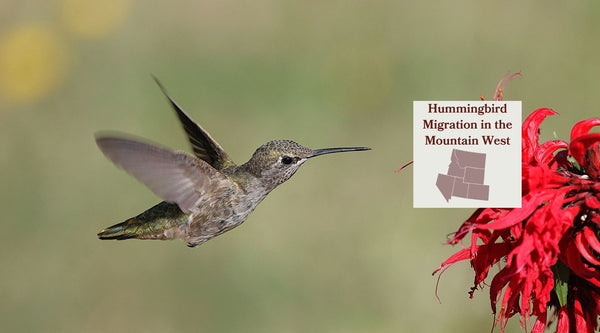
- Mountain West — The heartland. Colorado, Wyoming, and Utah hold the densest breeding populations, with birds nesting in high meadows and montane forest from May through September. Nevada's mountain ranges breed too, and the species reaches the very edge of its range in the southern corners of Idaho and Montana.
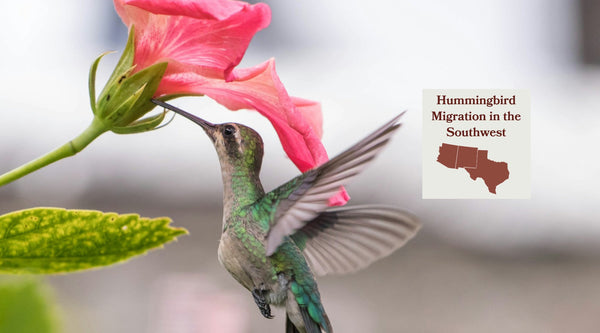
- Southwest — The sky islands. New Mexico and Arizona hold strong breeding numbers in their mountain ranges, and the isolated high country of West Texas — the Guadalupe, Davis, and Chisos Mountains — marks the species' southeastern breeding limit in the U.S.
- Pacific & West — The western edge. Eastern California's Sierra Nevada holds a regular breeding population at the far western limit of the range, separate from the coastal hummingbird community entirely.
Come fall, the whole population funnels south into Mexico and Guatemala — where, at the southern end of the range, some birds skip migration altogether and stay put year-round.
Torpor: A Textbook Case of High-Elevation Survival
Few North American hummingbirds have been studied for torpor as extensively as the Broad-tailed Hummingbird, and for good reason: breeding at elevations up to and over 10,000 feet means genuinely freezing nighttime temperatures are routine, even at the height of summer. According to Cornell Lab's All About Birds, the species maintains a body temperature of about 54°F when ambient air temperatures drop below 44°F, slowing its heart rate and metabolism dramatically to survive the night. Nesting females — tied to their eggs or chicks and unable to simply relocate — rely on torpor combined with a well-insulated nest to make it through, while males can often avoid the coldest air entirely by moving upslope or finding a warmer microclimate instead.
Habitat
Preferred nesting habitat includes high mountain meadows, pinyon-juniper woodlands, dry ponderosa pine forest, and mixed conifer forest, according to the Pajarito Environmental Education Center — nearly always somewhere offering both nectar-rich flowers and the specific cold-night protection a nesting female needs.
A Real Climate Change Concern
This is one of the more well-documented climate vulnerabilities among North American hummingbirds. Cornell Lab's All About Birds notes that in parts of the Rocky Mountain breeding range, rising temperatures have caused high-elevation wildflowers to bloom earlier than they used to — creating a potential mismatch between when nectar is actually available and when hungry, recently arrived hummingbirds need it most. Long-term monitoring at the Rocky Mountain Biological Laboratory has documented this shift directly: the glacier lily, a key early-season nectar source, now blooms around 17 days earlier than it did in the 1970s, well ahead of the hummingbirds that depend on it. The exact causes of the Broad-tailed Hummingbird's documented population decline — roughly 45% between 1966 and 2019 per the Breeding Bird Survey — aren't fully understood, but this nectar-timing mismatch is considered a genuine contributing factor.
Key paper: McKinney, A. M. et al. (2012). "Asynchronous changes in phenology of migrating Broad-tailed Hummingbirds and their early-season nectar resources." Ecology 93(9): 1987–1993.
Broad-tailed Hummingbird by Region: Where and When to Find Them
Build a Broad-tailed Hummingbird Sanctuary in Your Own Yard
Because this species is so tightly tuned to a short, high-elevation flowering season, timing and native plant choices matter more here than almost anywhere else in this guide series.
- Use a leak-proof, easy-to-clean feeder like the AspenPerch® Hummingbird Feeder, with a comfort perch so this species can rest between the frequent visits its high-energy mountain lifestyle demands.
- Time your feeder to your specific elevation and region — Broad-tailed Hummingbirds arrive later and depart earlier the higher up you are. Pop's Nectar, with added electrolytes and calcium, supports the intense energetic demands of nesting and torpor recovery at high elevation.
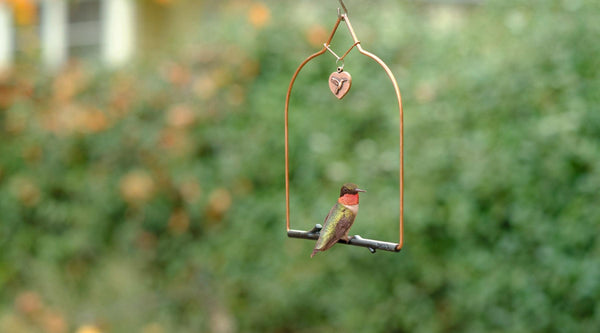
- Add a swing near your feeder — a Pop's Original Hummingbird Swing gives a Broad-tailed Hummingbird a place to perch and conserve energy between feeding bouts, especially valuable given how much this species' survival depends on smart energy management.
- Plant early, native, tubular red flowers like scarlet gilia and columbine — both documented favorites that this species depends on immediately after arrival, when the flowering window is shortest and most critical.
- Skip the insecticide. Since insects are a genuine part of this species' diet, especially important for feeding chicks, pesticide use removes food this bird depends on. Use HummGuard™ nectar tips instead to manage bees and wasps without harming anything else.
Because this bird tracks elevation and a short mountain summer, feeder timing shifts with altitude as much as latitude. Attracting hummingbirds in Colorado, Wyoming, and Utah means being ready for a compressed May-to-September mountain season, while New Mexico and Arizona catch birds a little earlier in their sky-island ranges. Find your own state in the full hummingbird guide by state series.
Frequently Asked Questions
Why do male Broad-tailed Hummingbirds make a loud trilling sound in flight?
The trill is produced when air rushes rapidly through the modified tip of the male's outermost wing feathers. It can be heard up to 50 meters away by rival males and 75 meters away by females, and research has shown males without this trill lose territorial disputes more easily to more aggressive rivals.
How does the Broad-tailed Hummingbird survive freezing nights at high elevation?
It enters torpor, a controlled drop in body temperature and metabolic rate, maintaining a body temperature around 54°F even when the surrounding air drops below 44°F. Males, not tied to a nest, can also simply move to a warmer microclimate or head upslope to avoid the coldest pockets of air.
Where does the Broad-tailed Hummingbird breed?
Primarily in mountain meadows and forests of the southern and central Rocky Mountains, the mountains of the Southwest, and parts of eastern California, at elevations that regularly exceed 10,000 feet. Its core breeding states are Colorado, Wyoming, Utah, Nevada, New Mexico, Arizona, eastern California, and West Texas, reaching the northern edge of its range in southern Idaho and Montana.
Is the Broad-tailed Hummingbird threatened by climate change?
There's real evidence for concern. Long-term research at the Rocky Mountain Biological Laboratory has documented high-elevation wildflowers blooming earlier due to warming temperatures, creating a mismatch with the timing of returning hummingbirds and shortening the window they have to access critical nectar sources. The Breeding Bird Survey has documented a roughly 45% population decline between 1966 and 2019.
How can you tell a male and female Broad-tailed Hummingbird apart?
Males have a solid rose-magenta throat patch, or gorget. Females have a white throat, sometimes lightly speckled with bronze, green, or magenta feathers, and are generally slightly larger overall than males.
How can I attract Broad-tailed Hummingbirds to my yard?
If you're at higher elevation within its Rocky Mountain or Southwestern mountain range, keep a feeder up through the short summer breeding season and plant native, tubular red flowers like scarlet gilia and columbine, timed to bloom as early as possible after snowmelt.
At Pop's Birding, we believe every backyard — big or small — has room for a little more wonder. Explore our feeders, nectars, swings, and wildflower seed blends to start building your own hummingbird sanctuary today.

Bethany Sloan has served as General Manager of Pop's Birding since 2010, continuing the legacy of her grandfather, William "Pops" Sloan, inventor of the Original Hummingbird Swing. A lifelong hummingbird enthusiast, educator, and independent researcher, she leads the company's educational content, including its 50-State Hummingbird Guide series, Regional Guide, Species Guide and Hummingbird Learning Center. Bethany combines scientific research, regional migration data, and more than 16 years of hands-on experience to create trusted educational resources for bird enthusiasts across North America.