Jul 02, 2026
How to Attract Hummingbirds in California: A Backyard Sanctuary Guide
California is where the hummingbird story of the American West begins. It's the ancestral home of Anna's, the species that has since colonized Oregon, Washington, British Columbia, Idaho and Alaska. It hosts most of the world's Allen's Hummingbirds. It has a desert species that nests in February and a mountain species that nests at 10,000 feet. Fourteen hummingbird species have been documented here.
Anna's Hummingbird is reported on close to a third of every bird list submitted in California — in January, in July, every week of the year. Its quietest week of the year still beats the busiest week most states ever see. And eighty years ago it barely occurred north of Santa Barbara.
Whether you're gardening on a coastal balcony, a Central Valley patio, a foothill property with oaks and chaparral, or out in the low desert, this guide covers what you need: who's around and when, feeder and nectar care, pest-safe cleaning, and the native plants that actually belong in a California yard.
The short version, if you're in a hurry:
To attract hummingbirds in California, keep a leak-proof feeder up year-round filled with fresh, dye-free nectar — Anna's are here every month, and in Southern California so are Allen's. Clean and refill it every one to six days depending on heat, skip the insecticide so hummingbirds can still hunt insects for protein, and plant natives that bloom in winter — because Anna's start nesting in December.
- Species you'll see: Anna's year-round statewide; Allen's year-round in Southern California; Costa's, Black-chinned, Rufous, and Calliope seasonally depending on region
- Best feeder type: leak-proof design with a comfort perch, like the AspenPerch® Hummingbird Feeder
- Best nectar: plain 4:1 water-to-sugar ratio, no red dye — or Pop's Nectar with added electrolytes and calcium
- Feeder timing: year-round, everywhere except the high Sierra. This is not a state where you put feeders away.
- Most abundant hummingbird in the country: even in its quietest week, Anna's still turns up on nearly a third of California bird lists
- Nectar change frequency: every 1–2 days above 90°F — which in the Central Valley and deserts means most of the summer
- Pest control: no insecticide — use vinegar-water spray and HummGuard® nectar tips instead
- Top native plants: manzanita and fuchsia-flowered gooseberry for winter, hummingbird sage and monkeyflower for spring, California fuchsia for late summer
- Two to avoid: tree tobacco and sweet alyssum are both listed invasives in California, despite being widely recommended
Free download
Take California with you
One page covering all six California regions — plus the exact month Anna's start nesting in your part of the state.
Download the California cheat sheetOne page · PDF · free to print and share
What Types of Hummingbirds Are in California?

Anna's is California's constant — the most abundant hummingbird in North America, present every month of the year and never dropping below about a third of statewide bird lists even in its quietest week. Allen's lives two different lives here: a migratory population along the coastal fog belt, and a resident population that never leaves Southern California at all. Costa's is the desert specialist, breeding in spring timed to the desert bloom; Black-chinned is the Central Valley's riparian-corridor bird; Rufous passes through the Pacific lowlands each spring; and Calliope, North America's smallest bird, breeds high in the Sierra Nevada. Beyond those six regulars, California's official state list runs to fourteen species, including genuine rarities like Broad-tailed, Broad-billed, and a mountain-gem or violetear turning up only a handful of times ever.
For full identification help — photos, field marks, telling Allen's from Rufous, and the full story behind California's fourteen-species list — see our complete Hummingbirds in California species guide.
When Do Hummingbirds Arrive and Leave California?
California barely has an off-season. What changes is which species you have, and that varies more across this state than anywhere else in the country.
The clearest regional pattern belongs to Rufous — the one species with a real statewide passage rather than a year-round presence — arriving anywhere from late February to late March depending on region and departing anywhere from early May to late September.

For the full month-by-month breakdown — every region, every species, and exactly when each one moves through — see our complete California hummingbird calendar.
When to Put Your Feeder Up (and Take It Down)
🗓️ Feeder Timing at a Glance
Leave it up. All year. In almost all of California, taking a feeder down in autumn means removing food from resident birds that are about to start nesting. Anna's are here in every month; in Southern California, so are Allen's.
The one exception is the high Sierra and eastern California, where the season runs roughly late March through September.
Cleaning matters more here than timing. California's heat is the real hazard — see below.
Attracting Hummingbirds No Matter Your Space
You don't need acres of land to invite wonder into your yard. Hummingbirds are famously adaptable — all they're really looking for is a dependable food source, a safe place to perch, and a little color.

- Small patio or balcony: One feeder hung from a bracket or shepherd's hook, paired with a container of red or orange tubular blooms like California fuchsia, is plenty to get noticed. Hummingbirds are solitary feeders by nature, so a single feeder works great in tight spaces. See our guide to which hummingbird products work best on a small patio or balcony if space is tight.
- Average backyard: Add a mix of feeders and native blooms along a fence line or garden bed, and give your visitors a swing or two nearby to rest and survey their territory between sips.
- Large yard with trees: Take advantage of the shade. Hummingbirds prefer feeders and plantings tucked out of harsh, direct afternoon sun — which matters enormously in the Central Valley and deserts. Spread multiple feeders far apart, since hummingbirds are territorial and will happily chase each other off a single feeder.
Choose a Saucer Type Feeder to Prevent Leaks
A feeder is only as good as what's in it — and how well it's kept. A leaky feeder does more than waste nectar: it can attract ants, bees, and other pests — turning your sanctuary into a mess that can deter hummingbirds.
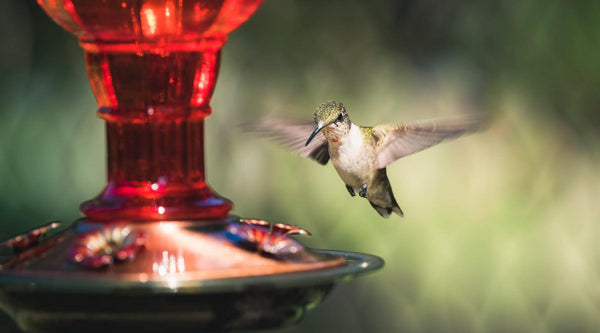
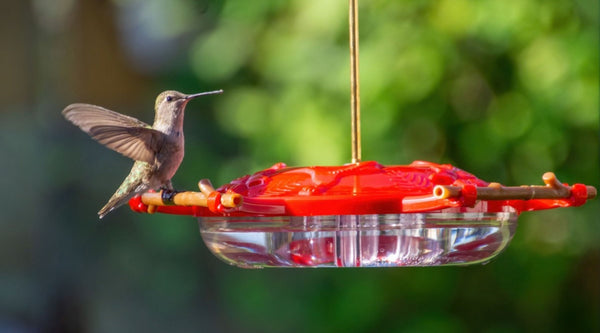
Saucer-style feeders, like our AspenPerch® feeder, hold nectar in a shallow basin below the ports, so there's no sealed air pocket to cause problems; bottle-style, gravity-fed feeders tend to leak more, especially in hot weather, since the air trapped above the nectar expands with heat and pushes nectar out through the ports.
Keeping your feeder filled is also important because hummingbirds need a dependable, fresh source they can count on every visit, not a gamble.
Shop the feeder
AspenPerch® Hummingbird Feeder, 8 oz

Leak-proof by design, with a patented Polyperch® comfort perch built in — so your hummingbirds can rest and feed at the same time instead of hovering through the whole meal. You get to see their tongue in action versus their back!
Shop the AspenPerch® Feeder →Keep Feeders Clean with Fresh Nectar
Clean your feeder every time you change the nectar, using warm water and a bottle brush — no soap residue, no bleach or harsh commercial cleansers. A little vinegar and water solution works great for breaking down sticky buildup or the beginnings of mold. Dirty feeders spread disease, too — avian pox has been documented in California Anna's Hummingbirds, and a neglected feeder is exactly how such things move between birds. See our full guide to cleaning a hummingbird feeder for the complete how-to.
Skip the Red Dye
Your feeder's color does the attracting; dyed nectar offers no benefit and isn't necessary. Never use honey, either — fermented honey can cause a fatal fungal infection — nor brown sugar, molasses, or artificial sweeteners.
Use a Real Nectar Recipe
Use a 4:1 plain sugar-water ratio to make your hummingbird nectar and read our full recipe guide to get your batch right. You can also use our nectar mixing calculator for any unit of choice to get the full breakdown on sugar to water ratio. Or skip the math with the ready-to-use option below.

Just getting your first feeder going? Nectarade® Ready to Use Liquid comes pre-mixed and formulated with added electrolytes and calcium to support hummingbirds through the demands of nesting season and migration — no dyes, no preservatives, nothing to commit to before you know how much traffic you'll get.
Shop the Ready to Use Nectar →Only Fill Enough to Change Often
An 8 oz feeder rarely needs to be topped all the way off — overfilling just means more nectar sitting around long enough to spoil, and California summers are unforgiving. A better approach is to fill only enough that your hummingbirds empty your feeder every couple of days.
Wondering how long nectar actually lasts? Our full guide on how long hummingbird nectar lasts covers exactly what spoilage looks like and why the timeline shifts with heat.
How Often to Change Nectar in California
California runs from foggy coastline to 115°F desert, so use the thermometer rather than the calendar. When temps rise above 90°F that means changing your nectar daily and keeping the feeder in shade — in the Central Valley and low desert that can mean daily changes for weeks at a stretch. Use the table below as a general rule of thumb.
If the nectar ever looks cloudy before that window is up, change it early — cloudiness means it's already started to ferment, which happens fast once triple-digit heat sets in across the Central Valley and low desert. A smaller feeder in deep shade is far better than a large one in sun. In the mountains and colder inland areas, the opposite problem applies in winter — bring feeders in overnight or insulate them when temperatures approach freezing.
Keeping Feeders Pest-Free Without Insecticide
Hummingbirds don't live on nectar alone — small insects make up a big part of their protein diet, especially for feeding chicks. That means insect spray is off the table around your feeding station; it removes a food source hummingbirds depend on and can be harmful to them directly. Here's how to handle the two most common pest problems without it.
Ants
Ants are drawn to any spilled or leaking nectar, and once a trail forms, they'll march straight up the feeder pole or hanging hook to reach the source. A vinegar-water spray works well as a deterrent — mist it around (not directly on) the feeder ports, and wipe down the hook or pole where ants tend to travel. An ant moat filled with water creates a simple physical barrier, and a leak-proof feeder design does real work here too: with nothing dripping down in the first place, there's less to draw them in to begin with.
Dealing with a real ant problem? See our full guide to keeping ants out of a hummingbird feeder for more fixes.
Bees and Wasps
Bees and wasps are trickier than ants, since they're after the same nectar hummingbirds are drinking, not just what's spilled. A vinegar-water spray around the ports can help, but the more reliable fix is a feeder design that keeps them out entirely rather than just discouraging them.
Bees and wasps still crashing the party? See our full guide to keeping bees away from a hummingbird feeder for the complete picture.

Still crashing the party? HummGuard® Nectar Tips slide onto the AspenPerch's feeding ports — a flexible membrane lets hummingbird beaks through and closes tight against anything bigger.
Shop HummGuard® Tips →Plant a California Native Hummingbird Garden
Feeders are a wonderful supplement, but nothing beats real, native nectar. And California has a requirement most states don't: because Anna's nest in December, your garden needs something flowering in winter.
Best Native Nectar Plants by Season
| Season | Plants |
|---|---|
|
Winter (the critical one) |
Manzanita (Arctostaphylos) — its urn-shaped flowers are the single most important winter nectar source for nesting Anna's. Also fuchsia-flowered gooseberry (Ribes speciosum) and chuparosa (Justicia californica) in the desert. |
| Spring | Hummingbird sage (Salvia spathacea), Cleveland and black sage, sticky monkeyflower (Diplacus aurantiacus), pink-flowering currant, ocotillo in the desert |
| Summer | Penstemons, coral bells (Heuchera), desert willow, scarlet monkeyflower in the mountains |
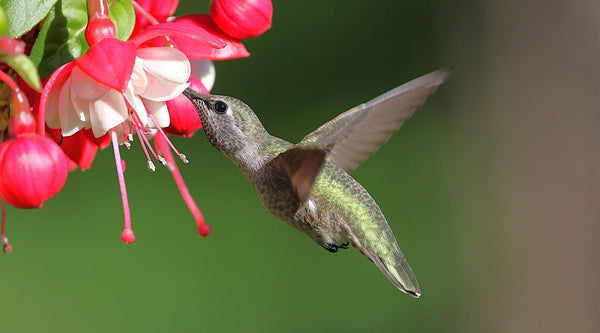
| Late summer & fall | California fuchsia (Epilobium canum) — blooms when almost nothing else does, and is co-evolved with hummingbirds |
Pop's tip: If you plant two things, make them manzanita and California fuchsia. Between them you cover the two hardest gaps in the year — midwinter, when Anna's are nesting, and late summer, when the spring bloom is long finished.
Three Widely Recommended Plants to Avoid
These come up constantly in hummingbird and pollinator planting advice, including from sources that ought to know better. All three are problems in California specifically.
Sweet alyssum (Lobularia maritima) is the one that catches people out. It's sold in every garden centre, it's in countless "pollinator" seed mixes, and almost nobody thinks of it as invasive — but the California Invasive Plant Council documents it escaping cultivation into coastal dunes, scrub, bluffs, prairies and riparian areas, where its long flowering season and rapid colonisation can crowd out native plants. If you garden anywhere near the coast, leave this one out.
Tree tobacco (Nicotiana glauca) is a South American shrub that hummingbirds genuinely do feed from — which is exactly why it keeps getting recommended. Calflora and Cal-IPC both flag it as an invasive plant in California native habitats. Plant chuparosa or California fuchsia instead and you'll get the same birds without the problem.
Eucalyptus deserves a more nuanced note. It genuinely did help Anna's expand — the winter-blooming blue gums planted around San Francisco Bay in the early 1900s gave the birds a nectar source in the leanest months. But it's an introduced tree with well-documented problems of its own. Treat it as a piece of California history rather than a planting recommendation.
If You're Near the Border
Hummingbirds don't check a map before deciding where to feed, so if you're near a state line, your best guide might be a blend of both.
Near Oregon: The north coast shares Oregon's fog belt, its migratory Allen's, and the same year-round Anna's pattern. See our Oregon hummingbird guide for more.
Near Nevada: The eastern Sierra and California's high desert share the Great Basin community — Calliope, Broad-tailed, and Palmer Penstemon's true native range. See our Nevada hummingbird guide for more.
Near Arizona: California's Colorado Desert blurs into Arizona's Sonoran Desert, sharing Costa's and the ocotillo-and-chuparosa bloom that drives its breeding season. See our Arizona hummingbird guide for more.
To make this easy, our Perfect Little Sanctuary® Wildflower Seed Blend is designed to bring nectar-rich color into your yard with minimal fuss.
When to Plant the Perfect Little Sanctuary® Blend in California

Late fall is prime planting season across most of California — aim for October through November, just before the winter rains. Seed settles in, gets natural moisture, germinates through winter, and blooms from early spring into summer. The exception is higher-elevation Sierra gardens, where spring planting after the last frost beats fighting a real mountain winter.

Ready to plant? Perfect Little Sanctuary® Wildflower Seed Blend packs all 12 varieties into one packet — no separate shopping trips before California's fall planting window.
Shop the Seed →Top Performers in California
California is the best fit for this blend of any state in the series — and the only one where several varieties are genuine natives:
- Clarkia (Clarkia unguiculata) — endemic to California, meaning it grows wild nowhere else on Earth. Where it struggles in humid states, this is its home. Primarily a bee plant, but hummingbirds use it too.
- Palmer Penstemon (Penstemon palmeri) — genuinely native to California's desert mountains in Inyo and San Bernardino counties, and a real hummingbird favourite. Strongest inland and in the high desert.
- Scarlet Gilia (Ipomopsis aggregata) — a California native of the mountains and east side, and one of the better hummingbird plants in the mix.
- White Yarrow (Achillea millefolium) — California native, extremely drought tolerant once established.
- Columbine — the California native is western columbine (Aquilegia formosa), an excellent hummingbird plant. Common European garden columbine is not native here.
The remaining varieties came from elsewhere: Purple Coneflower, Black-Eyed Susan, Lance-Leaved Coreopsis and Perennial Lupine are all eastern or midwestern natives — California has its own lupines, including arroyo lupine and sky lupine, worth seeking out instead. Indian Blanket is a Great Plains annual, though heat and drought tolerant enough to hold its own. Siberian Wallflower and Painted Daisy are not North American at all.
Pop's tip: Sow the blend as directed and it will do its job. But California gardeners have an advantage nobody else in this series has — an extraordinary native flora that evolved alongside these exact birds. Manzanita, California fuchsia and hummingbird sage will outperform anything in a seed packet.
Give Them a Place to Rest
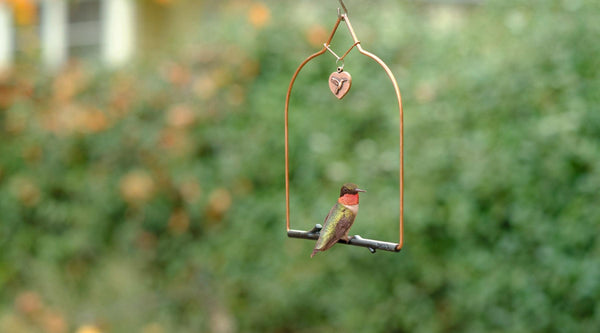
Hummingbirds spend a surprising amount of their day perched, not flying — watching their territory, digesting, and simply resting between feedings. It matters even more in California, where Anna's and resident Allen's are territorial year-round rather than just for a season — more perches spread further apart genuinely means fewer standoffs. A Pop's Original Hummingbird Swing hung near your feeder gives them exactly that spot, and it turns your feeding station into a front-row seat for watching them up close. Hang it about 1 foot from your feeder, at the same height (Pop's rule of thumb), and don't be surprised if a hummingbird claims it as their own personal lookout post. Our guide to where to hang your hummingbird swing covers placement in more detail — height, distance, and the sightlines that make one get used.
Shop the Perfect Perch
Original Series Hummingbird Swing, Onyx

A second swing gives a chased-off bird its own perch to fall back to — especially useful in California, where territorial disputes between Anna's and resident Allen's play out twelve months a year, not just one season.
Shop the Original Swing →Keep Your Sanctuary Safe from Predators
A feeding station draws more than hummingbirds, and knowing what's actually worth worrying about — and what isn't — makes for a safer yard. Cats and window strikes are the two best-documented threats to hummingbirds around any home. See our full Hummingbird Predators guide for the complete picture.
California has its own well-documented, if uncommon, predators worth knowing. A 2017 study in The Wilson Journal of Ornithology documented a native praying mantis (Stagmomantis limbata — not one of the introduced Asian species) killing and eating an Allen's Hummingbird at a San Juan Capistrano feeder; a large mantis staked out near a feeder is worth relocating rather than removing outright, since they're beneficial insects the rest of the year. California Department of Fish and Wildlife's own life-history account for Anna's Hummingbird lists the scrub jay among documented predators of eggs and young, and hummingbirds can occasionally become entangled in spider webs — a San Diego case published in The Condor in 1951 involved an Anna's caught in an orb-weaver's web for over forty minutes before being freed. Hawks rarely manage to catch an adult hummingbird at all: a 1963 account of a Sharp-shinned Hawk taking an adult male Anna's in Berkeley is recorded as the only such case on file, a rarity that says more about how agile these birds are than about any real risk. Greater Roadrunners have also been documented ambushing feeders in Southern California backyards — a behavior tied to chaparral and scrub habitat, not open desert specifically.
Summary: Key Takeaways for Attracting Hummingbirds in California
Building a hummingbird-friendly yard doesn't take a green thumb or a big budget — just a little consistency and the right setup. Here's everything from this guide in one place:
- Anna's Hummingbird is reported on close to a third of all California bird lists in every week of the year, never dropping below 32% — the most abundant hummingbird in North America, and California is its ancestral home.
- Anna's nest in December, so winter-blooming natives like manzanita matter more here than in any other state.
- Fourteen hummingbird species are on California's official state list. Six occur regularly.
- Allen's Hummingbird lives two different lives: a migratory subspecies on the north and central coast, and a resident subspecies in Southern California that has expanded from the Channel Islands across the LA basin since the 1960s.
- Costa's is the desert specialist, breeding March through May, timed to the ocotillo and chuparosa bloom.
- Black-chinned is the Central Valley's bird, tied to riparian corridors, and reported there among the highest rates we've found anywhere in this series.
- The eastern Sierra is California's outlier — Anna's are scarce and no species dominates.
- Keep feeders up year-round everywhere except the high Sierra. In California, taking a feeder down in autumn removes food from birds about to nest.
- Use a leak-proof feeder with a comfort perch, like the AspenPerch®, and fill it only as full as it'll be drunk in a few days.
- Skip red dye in nectar; a plain 4:1 sugar-water ratio or Pop's Nectar (with electrolytes and calcium) both work. Never use honey, brown sugar, or artificial sweeteners.
- Change nectar daily above 90°F, and keep feeders in shade — Central Valley and desert summers are the real hazard here. Clean at every change; avian pox has been documented in California Anna's.
- Never use insecticide near feeders; hummingbirds rely on insects for protein. Use vinegar-water spray and HummGuard® nectar tips for pest control instead.
- Add a hummingbird swing near the feeder to give them a place to rest and be observed up close.
- Cats and window strikes are the two best-documented threats to hummingbirds around any home; California's own documented, uncommon risks include a native praying mantis, scrub jays at the nest, and rare hawk and roadrunner predation.
- Plant manzanita for winter and California fuchsia for late summer above all else. Avoid sweet alyssum and tree tobacco — both are sold widely as pollinator plants and both are listed invasives in California.
- Sow wildflower seed in October–November. Clarkia, Palmer Penstemon, Scarlet Gilia, White Yarrow and western columbine are genuine California natives in the blend.
Get these basics in place, and the wonder takes care of itself.
This guide covers what's specific to California — the species, the timing, the plants that belong here. For the fundamentals that apply anywhere, including water sources, shelter, and how the pieces work together, read our guide to building the ultimate hummingbird sanctuary.
Frequently Asked Questions
A few of the questions we hear most from fellow hummingbird lovers across California:
When should I put my hummingbird feeder out in California?
In most of the state, you don't put it away in the first place. Anna's Hummingbirds are here every month of the year and begin nesting in December, so leaving a feeder up year-round is the standard advice, not a special exception. In Southern California, resident Allen's make the case even stronger. The one real exception is the high Sierra and eastern California, where a spring-through-fall season (roughly late March through September) is genuinely all you need.
What are common mistakes when feeding hummingbirds?
The big ones in California specifically: taking the feeder down in fall the way you might in a state with a real winter, which pulls food from birds about to start nesting; letting a feeder sit in full sun through a Central Valley or desert summer, where nectar can spoil in a single day; and using honey, which can cause a fatal fungal infection once it ferments, instead of a plain sugar-water recipe.
Do hummingbirds like feeders without perches?
They don't need one — hovering while feeding is their default — but they'll use a perch readily when it's there, resting between sips instead of burning energy the whole meal. That's the reasoning behind the AspenPerch's built-in Polyperch® comfort perch. It matters more than usual in California, where Anna's and resident Allen's defend feeders year-round rather than just seasonally, so more perch options mean fewer birds forced to hover and wait their turn.
What happens if you don't boil sugar water for hummingbirds?
Nothing dangerous — boiling isn't strictly required. Its real purpose is helping sugar dissolve fully in cooler water and giving nectar a slightly longer shelf life before fermenting, not eliminating some hidden risk. What actually matters more in California is sticking to the change schedule for the temperature — nectar left out through a Central Valley or desert afternoon will ferment fast regardless of whether it was boiled going in.
Is it bad to leave my feeder up in fall?
Not at all — it's a myth that a feeder left up will delay migration, and in California it's not even the relevant question for most residents. Anna's and resident Allen's don't migrate away in fall; a feeder left up simply keeps feeding the birds that live there year-round and helps fuel Anna's toward its December nesting season.
What are the best plants to attract hummingbirds in California?
Manzanita for winter, when Anna's are nesting and almost nothing else is flowering. Hummingbird sage and sticky monkeyflower for spring. California fuchsia for late summer and fall. Those three cover the year. Avoid tree tobacco and sweet alyssum — both are listed invasives in California despite being widely recommended.
California Hummingbird Resources
Audubon Chapters
California has one of the largest Audubon networks in the country, with dozens of chapters and centres statewide. Find the one closest to you with Audubon's Find Your Local Audubon tool.
If You Find an Injured or Grounded Hummingbird
Hummingbirds are protected under federal and California state law, so only a licensed wildlife rehabilitator can legally care for one.
- CDFW — Licensed Wildlife Rehabilitation Facilities — the official statewide directory. Wildlife emergency line: 888-334-2258.
- Hummingbird Rescue Center (San Diego County) — a rehabilitation organisation specialising specifically in hummingbirds.
- Terry Masear's Hummingbird Rescue (Los Angeles) — 310-804-3715. One of the country's best-known hummingbird rehabilitators, and the subject of the 2024 documentary Every Little Thing.
Hummingbird Research & Banding in California
- UC Davis Hummingbird Health and Conservation Program, led by Dr. Lisa Tell — one of very few federally permitted hummingbird master banders in California, overseeing banding stations across the state including sites along Putah Creek and at the UC Davis Arboretum.
- Hummingbird Monitoring Network — a hemispheric banding and monitoring effort using a standardised protocol.
- Point Blue Conservation Science and the Institute for Bird Populations run long-term banding and monitoring programmes across California.
Hummingbird Events in California
- The Kern River Valley Hummingbird Celebration, run by the Audubon Kern River Preserve in Weldon, is California's flagship hummingbird festival — held annually in early August and running for well over a decade. Check the Preserve's site for the current year's dates.
Sources
- eBird bar chart data, Cornell Lab of Ornithology — California statewide plus Humboldt, Alameda, Sacramento, Mono, San Diego and Riverside counties, 2016–2025.
- California Bird Records Committee, Western Field Ornithologists — official state checklist and accepted rarity records.
- California Department of Fish and Wildlife — species life-history accounts, including documented predators of Anna's Hummingbird eggs and young.
- Calscape, California Native Plant Society — native plant status and hummingbird associations.
- California Invasive Plant Council — invasive status of tree tobacco and sweet alyssum.
- Clark, C. J. (2017). eBird records show substantial growth of the Allen's Hummingbird (Selasphorus sasin sedentarius) population in urban Southern California. The Condor, 119(1), 122–130.
- Battey, C. J. (2019). Ecological release of the Anna's Hummingbird during a northern range expansion. The American Naturalist, 194(3), 306–315.
- Greig, E. I., Wood, E. M., & Bonter, D. N. (2017). Winter range expansion of a hummingbird is associated with urbanization and supplementary feeding. Proceedings of the Royal Society B, 284(1852), 20170256.
- Alexandre, N. M., et al. (2025). Supplemental feeding as a driver of population expansion and morphological change in Anna's Hummingbird. Global Change Biology.
- Nyffeler, M., Maxwell, M. R., & Remsen, J. V. (2017). Bird Predation by Praying Mantises: A Global Perspective. The Wilson Journal of Ornithology, 129(2), 331–344. Source for the San Juan Capistrano praying mantis record.
- Stott, K. Jr. (1951). An Anna Hummingbird Caught in a Spider Web. The Condor, 53:49. Source for the San Diego spider-web entanglement.
- Peeters, H. J. (1963). Two observations of avian predation. Wilson Bulletin, 75:274. Source for the Berkeley Sharp-shinned Hawk record.
- Audubon Field Guide, Greater Roadrunner. Source for the Southern California roadrunner-at-feeders account.
Why We Built This Guide
Pop's Birding has been helping hummingbird lovers for three generations. One of the questions our customers ask most often is "How do I actually attract more hummingbirds to my yard?" — we built this guide to give a direct, practical answer, not a generic one. California breaks nearly every rule that applies elsewhere in this series: there's no real off-season, the state's most common bird nests in the dead of winter, and the same species behaves like two entirely different birds depending on whether you're on the fog-belt coast or in the Los Angeles basin. Most feeder advice assumes a spring-to-fall season and a single arrival date; neither assumption holds anywhere in California except the high Sierra. We wanted a guide that treats California's genuine complexity — six regions, six regularly occurring species, a nesting calendar that starts in December — as the actual story, not a footnote to generic national advice.
How We Built This Guide
The timing figures on this page come from the same eBird checklist data behind our California hummingbird calendar — see that page for the full county-by-county methodology. The species and range claims are checked against peer-reviewed literature rather than general knowledge, including four separate studies behind the Anna's range-expansion claim (Battey 2019, Greig et al. 2017, Alexandre et al. 2025, and Clark 2017 for Allen's). The native plant and predator sections are checked against primary sources rather than assumed — Calscape and the California Invasive Plant Council flagged sweet alyssum and tree tobacco as invasive despite their wide use as recommended pollinator plants, and a 2017 peer-reviewed study plus CDFW's own scrub-jay account back the predator note, while two commonly assumed threats (the Joro spider, Southeastern-style snake predation) were checked and found not to apply here. This California-specific framing is original to this page, not a rewrite of generic national hummingbird-gardening advice with the state's name inserted.
Haven't grabbed it yet? Download the free California Quick Reference Guide — one page, print and keep.
Know before they arrive
You don't have to keep this calendar taped to the fridge. Insider Birding Access members get seasonal notes timed to your region — when to have feeders out, what the birds are doing right now, and what's worth doing in your yard this season. We take the guesswork out of the calendar. Joining takes about thirty seconds, and there's 10% off your first order in it.
Join Insider Birding Access →Free to join. 10% off your first order.
Your California Backyard Sanctuary
Every real hummingbird sanctuary comes down to the same staples: mess- and pest-free food, a place to perch, native flowers, and fresh nectar. Here's everything from this guide to get all the bases covered in your own California yard.


Bethany Sloan has served as General Manager of Pop's Birding since 2010, continuing the legacy of her grandfather, William "Pops" Sloan, inventor of the Original Hummingbird Swing. A lifelong hummingbird enthusiast, educator, and independent researcher, she leads the company's educational content, including its 50-State Hummingbird Guide series, Regional Guide, Species Guide and Hummingbird Learning Center. Bethany combines scientific research, regional migration data, and more than 16 years of hands-on experience to create trusted educational resources for bird enthusiasts across North America.