Sep 03, 2026
Hummingbirds in Oregon: The Complete Guide to All 9 Species
Most states in this series have one hummingbird that nests, and everything else is a visitor. Oregon has four. Drive from the narrow strip of southern coastline near Bandon to the sagebrush canyons east of the Cascades, and you'll cross the breeding range of four genuinely different hummingbirds — on top of a fifth species that never actually leaves, and is often the only hummingbird in the state at all by January.
Nine hummingbird species are on the Oregon Bird Records Committee's official state checklist. Four are confirmed breeders, each with its own preferred corner of the state. One is Oregon's only true year-round resident. The remaining four are review-list rarities — two of them still occurring often enough that the state's own wildlife agency describes them as recurring, not one-off.
Free download
All 9 species, one page
Every Oregon hummingbird with its status — from Anna's, present in Portland essentially every week of the year, down to a species Oregon hasn't recorded since 2012 — sized 8.5" x 11" for easy reference and printing.
Download the Oregon species guideOne page · PDF · free to print and share

All 9 documented Oregon hummingbird species, grouped by tier — statewide eBird data, 2016–2025, cross-checked against the Oregon Bird Records Committee's official Checklist and Review List.
The Hummingbirds You're Most Likely to See
The Oregon Department of Fish and Wildlife calls Rufous Hummingbird "the most common and widespread of Oregon hummingbirds," and three more breeders fill in around it — each with its own preferred piece of the state.
Rufous Hummingbird Breeds Here
Oregon's most widely distributed breeder, present across most of the state's forested regions west of the Cascades and beyond. Statewide frequency peaks near 11% of checklists in mid-April, but that single number undersells how much the timing shifts by region — Deschutes County (Bend), east of the Cascades, peaks much higher and later, near 22% in late July, while the South Coast around Coos Bay peaks earlier, in March. Oregon has no real wintering population: ODFW's own Anna's Hummingbird page states that Anna's "is the only hummingbird regularly found in Oregon in winter," meaning Rufous, like the state's other breeders, is a breeding-season bird here, not a year-round one.

Quick ID: Adult males are almost entirely orange-rufous with a glowing orange-red throat — the only largely rufous-backed hummingbird in North America. Females and immatures are green above with cinnamon-washed flanks, a coppery rump, and rufous at the base of the tail feathers, which Oregon's other regular species don't show.
Black-chinned Hummingbird Breeds Here
An east-of-the-Cascades specialist. ODFW describes it as "a rare to locally common resident east of the Cascades," favoring canyons, juniper woodlands, and desert riparian zones, with foothill populations along the Blue and Wallowa Mountains. The eBird data draws that boundary sharply: Deschutes County shows a real, sustained breeding-season signal peaking near 1.4% of checklists in late July, while Portland's Multnomah County — west of the Cascades — shows almost nothing at all, a single floor-level week across the entire 2016–2025 window.

Quick ID: Adult males show a velvety black chin and upper throat, bordered below by a thin band of iridescent purple visible only in good light — from most angles it just reads black. Look for a small white spot behind the eye and a long, straight black bill. Females have a plain, essentially unmarked pale throat and aren't reliably separable from other female western species by sight alone.
Calliope Hummingbird Breeds Here
Another high-country specialist, and ODFW's language is specific about where: "a common summer resident of the Blue and Wallowa Mountains and other high ranges east of the Cascade summit." The eBird data backs that up precisely — Deschutes County, in the shadow of the Cascades, shows Oregon's strongest Calliope signal by far, peaking near 7.6% of checklists in mid-May, well above the statewide figure of about 1.2%. Portland shows a real but much smaller spring signal, more consistent with migratory passage through the valley than local breeding.

Quick ID: North America's smallest hummingbird, and identifiable by that alone in most cases — hunched posture, short bill and tail. Adult males show a gorget of separate magenta rays radiating outward against a white throat, rather than a solid patch, unique among North American hummingbirds. Females are green above with fine dark streaking on a whitish throat.
Allen's Hummingbird Breeds Here
Oregon's most geographically restricted breeder by far. ODFW describes it as "a fairly common spring and summer resident along the southern Oregon coast as far north as Bandon" — the tail end of a range that runs up from coastal California, and nowhere else in the state. That narrow footprint shows up clearly in the data: statewide, Allen's barely registers above the eBird rounding floor, but Coos County, which contains Bandon, carries the entire real signal, a modest March peak consistent with a small, genuinely local population rather than a statewide presence diluted by averaging.

Quick ID: A Rufous look-alike. Adult males show a deep reddish-orange gorget and a coppery eye patch contrasting against a green back — but some male Rufous are green-backed too, so the back alone isn't conclusive. Females and immatures are essentially identical to female Rufous in the field; away from the South Coast in breeding season, assume any Selasphorus hummingbird you see is a Rufous.

A Feeder for Whichever Breeder Claims Your Yard
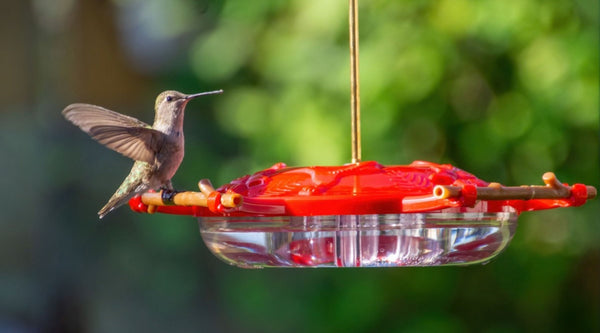
Rufous, Black-chinned, Calliope, and Allen's split Oregon by geography more than they overlap, so only one of them is likely to be the breeder that actually claims your particular patch of the state. Whichever one shows up, an AspenPerch Feeder gives it a reliable place to refuel between territorial patrols.
Shop AspenPerch Feeder →Oregon's Year-Round Resident
Once Rufous, Black-chinned, Calliope, and Allen's head south for the season, Oregon's hummingbird story doesn't end — it just narrows to a single species, one that never really left in the first place.
Anna's Hummingbird Year-Round Resident
ODFW states it plainly: Anna's "is the only hummingbird regularly found in Oregon in winter." It's a year-round resident of western Oregon — the Willamette Valley and the coast — that first bred in the state in the mid-1980s, with Bird Alliance of Oregon (formerly Portland Audubon) documenting active nesting in Portland itself. The eBird numbers make an unusual point: Anna's actually posts a higher statewide peak frequency, nearly 31%, than any of Oregon's four migratory breeders manage individually. That's not because Anna's is more numerous overall — it's because for months at a stretch in winter, it faces zero competition from any other hummingbird species for a share of the checklists. In Portland that effect is even more dramatic: Anna's accounts for close to 47% of all checklists in some weeks, a number no breeding species anywhere in this guide's coverage comes close to. East of the Cascades in Deschutes County, by contrast, Anna's presence is real but thinner — a smaller, more marginal population at the edge of its range.

Quick ID: The only North American hummingbird with an iridescent crown as well as throat — adult males glow rose-pink from the top of the head down, unlike anything else on Oregon's list. Females carry a small central patch of rose-red spotting on an otherwise pale throat. From November through February, especially west of the Cascades, a hummingbird at an Oregon feeder is almost certainly this one.

A Place of Its Own, Every Season
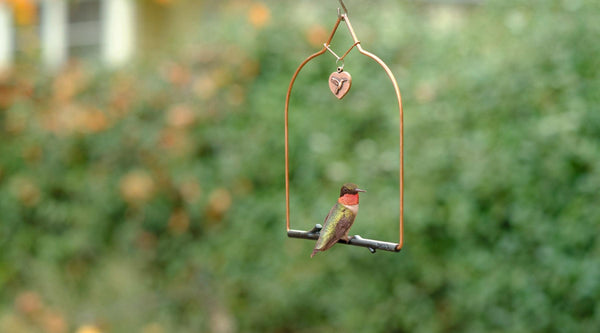
Anna's is the one Oregon hummingbird that sticks around long enough — through fall, winter, and spring alike — to actually settle into a favorite perch near your feeder instead of just passing through. The Charm Redwood Swing gives it a real one to hold, right where you can watch, in every season.
Shop Charm Redwood Swing →Oregon's Recurring Rarities
Two more species turn up in Oregon often enough that neither requires individual documentation from the state's records committee, even though both remain genuinely scarce.
Broad-tailed Hummingbird Rare / Casual Visitor
ODFW calls it "perhaps the most enigmatic hummingbird found regularly in Oregon," noting its "hard-to-define breeding range seems to reach its limit at Oregon's eastern edges where reports of this beautiful and rare species arise each summer." That's a state wildlife agency describing annual recurrence in plain language — and OBRC's own Review List backs it up structurally: Broad-tailed isn't on it, meaning the committee doesn't require individual sightings to be documented, the same non-review status it gives genuinely regular species elsewhere. Breeding is suspected here but has never been formally documented, and because it's non-review, there's no OBRC accepted-record count to cite. The species' entire Oregon eBird signal sits right at the standard rounding floor — real, but too thin for a specific regional story.

Quick ID: Adult males show a rose-magenta throat patch and produce a distinctive loud, metallic trilling whistle with their wings in flight — audible before the bird is even in sight. Females have a green-spotted throat and cheeks, plainer than the male.
Costa's Hummingbird Rare / Casual Visitor
ODFW's own language is direct: "a very rare spring and summer visitant to central and southwestern Oregon," with males "sometimes present for the entire year in the Rogue Valley" and functioning as "a casual winter visitor in the south Cascades." OBRC removed it from the Review List back in 2001 — scarce enough that it's rarely reported, but established enough as a known pattern that individual sightings no longer need formal documentation. The eBird data matches that Rogue Valley focus precisely: Jackson County (Medford) carries real signal across twelve different months, including a genuine December peak near 0.8% of checklists — exactly the lingering, out-of-season individuals ODFW describes, not a tight seasonal window.

Quick ID: Adult males show an iridescent deep purple gorget that flares out along the sides of the neck into elongated points — sometimes called an "overgrown mustache" — with a matching purple crown; it can look solid black without good light. Small and compact with a short tail and a slightly drooping bill. Females are mostly plain whitish below, with about half showing a small patch of metallic purple throat feathers.

Make Your Sanctuary Worth a Detour
Broad-tailed and Costa's both turn up in Oregon in real, repeatable numbers each year — real electrolytes and calcium beyond plain sugar water give a wandering visitor a genuine reason to linger long enough to be seen and confirmed.
Shop Nectarlyte® Powder →If You're Lucky: Oregon's Historic Rarities
The remaining two species on Oregon's checklist are true one-off or near-one-off records.
Broad-billed Hummingbird Historic / Accidental
Four accepted Oregon records, spanning 1998 to 2019 and all falling in the same narrow window — late August through mid-October. Two of the four came in 2019 alone, one at Malheur NWR headquarters in Harney County and one near John Day in Grant County, a real sign this is an ongoing vagrancy pattern rather than a closed historical chapter. Even so, the eBird data stays thin: a handful of scattered late-summer checklists right at the rounding floor, consistent with a genuine but scarce visitor rather than anything approaching an annual expectation.

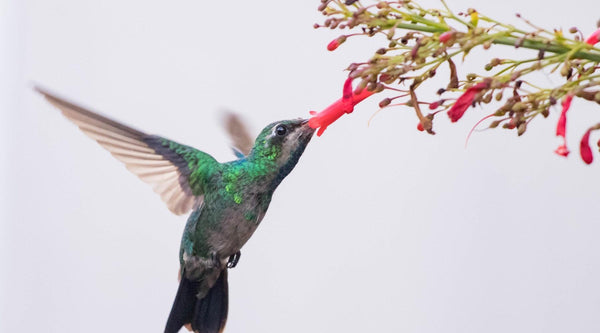
Quick ID: The bright red, black-tipped bill is diagnostic in every plumage — no regular Oregon species shows red on the bill. Adult males add a shimmering sapphire-blue throat on a mostly green body; females are duller and grayer below with the same red-based bill.
Ruby-throated Hummingbird Historic / Accidental
Exactly three accepted records, all from the state's dry eastern half: Pendleton in September 2006, Keno in September 2008, and Hart Mountain in June 2012. Nothing has been accepted since — OBRC's own records compilations through 2019 and 2020 show no new activity, meaning at least a dozen years without a fourth record as of this page. The species carries zero eBird signal in the 2016–2025 data; its most recent accepted record predates that entire window.

Quick ID: Adult males show a brilliant ruby-red throat that reads black without direct light, an emerald crown and back, and a short forked black tail. Females and immatures are green above and whitish-gray below, with white-tipped outer tail feathers and no rufous anywhere — the one Oregon rarity that can't be confused with the state's western species.

Give Every Visitor a Reason to Stay
Breeding Rufous or Black-chinned, a wintering Anna's, or a once-in-a-lifetime Broad-billed or Ruby-throated — what keeps any hummingbird coming back is real habitat. Perfect Little Sanctuary® Wildflower Seed packs 12 nectar-rich varieties into one packet for lasting native forage, planted before the next rarity ever shows up.
Shop Wildflower Seed →Oregon Hummingbirds at a Glance
Unlike most states in this series, Oregon doesn't have a single species so dominant that a chart would be pointless — the year-round resident and the state's most common breeder are both genuinely competitive with each other, and two more species clear real, chartable signal too. Here's how the four species with a measurable statewide peak stack up.

Statewide peak weekly frequency, eBird checklist data (Cornell Lab of Ornithology), 2016–2025. Anna's high peak reflects winter weeks with no competing species, not necessarily greater overall abundance than Rufous — see the note under Anna's above. Five species aren't plotted because their statewide signal sits at or below the standard eBird rounding floor: Allen's, Broad-billed, Broad-tailed, and Costa's Hummingbirds, plus Ruby-throated Hummingbird, with zero statewide eBird rows in this window. Full details in the Sources section below.
| Species | Status | Oregon Records |
|---|---|---|
| Anna's Hummingbird | Year-Round Resident | Only hummingbird regularly present in winter; statewide peak 31%, up to 47% in Portland |
| Rufous Hummingbird | Breeding | ODFW's "most common and widespread" Oregon hummingbird; statewide peak 11% |
| Black-chinned Hummingbird | Breeding | East of the Cascades only; non-review species |
| Calliope Hummingbird | Breeding | Blue and Wallowa Mountains; non-review species |
| Allen's Hummingbird | Breeding | South Coast only, north to Bandon; non-review species |
| Broad-tailed Hummingbird | Rare / Casual | Non-review; ODFW documents annual recurrence in far-eastern Oregon |
| Costa's Hummingbird | Rare / Casual | Non-review since 2001; recurring in the Rogue Valley (Jackson Co.) |
| Broad-billed Hummingbird | Historic / Accidental | 4 accepted records, 1998–2019, all late Aug–mid Oct |
| Ruby-throated Hummingbird | Historic / Accidental | 3 accepted records, 2006–2012, none since |
Frequently Asked Questions
How many kinds of hummingbirds have been documented in Oregon?
Nine, all on the Oregon Bird Records Committee's official state checklist. Four are confirmed breeders — Rufous, Black-chinned, Calliope, and Allen's — Anna's is the state's only year-round resident, and the remaining four are review-list rarities.
What is the most common hummingbird in Oregon?
By the state wildlife agency's own description, Rufous Hummingbird — ODFW calls it "the most common and widespread" species in Oregon. Anna's Hummingbird actually posts a higher peak percentage of checklists, but that's because it has no competition from other species in winter, not because it's more numerous overall.
Are there hummingbirds in Oregon in the winter?
Yes, one — Anna's Hummingbird, which ODFW describes as the only species regularly found in the state in winter. All four of Oregon's breeders head south for the cold months.
Where in Oregon can I find Allen's Hummingbird?
Only one place: the immediate South Coast, from the California border north to about Bandon. Allen's is Oregon's most geographically restricted breeder, and away from that narrow strip, any similar-looking hummingbird is almost certainly a Rufous instead.
How do I tell Anna's and Rufous Hummingbirds apart?
Color and season together settle it in most cases. Anna's males show a rose-pink crown as well as throat, and are the only hummingbird you're likely to see between November and February. Rufous males are almost entirely orange-copper with no pink crown, and are present only from roughly March through September.
Why We Created This Guide
Pop's Birding has been helping hummingbird lovers for three generations. One of the questions our customers ask most often is "what hummingbirds are actually in my state?" — we built this guide to give a direct, sourced answer for Oregon specifically, not a generic one. Most identification content treats the Pacific Northwest as interchangeable with the rest of the West Coast, and that misses what makes Oregon distinctive: four breeders that split the state by geography rather than competing head-on, a year-round resident whose checklist share is actually higher than any of them, and two "rare" species the state's own wildlife agency describes as recurring every year despite their scarcity.
How We Created This Guide
We started with statewide eBird checklist data from the Cornell Lab of Ornithology, covering 2016 through 2025. Since a decade of checklists alone can't tell the whole story, we also pulled data from five counties that show Oregon's real geography — the Willamette Valley, the high desert east of the Cascades, the Rogue Valley, the South Coast, and the central coast — and checked every species against the Oregon Bird Records Committee's official checklist and Review List. Oregon turned out to be one of the more interesting states to chart: unlike most states in this series, where one hummingbird dominates so completely that a chart wouldn't tell you much, Anna's, Rufous, Black-chinned, and Calliope are all genuinely competitive here. Where the raw numbers and the state's own guidance seemed to disagree — Anna's posts the highest statewide peak percentage, yet the Oregon Department of Fish and Wildlife calls Rufous the state's "most common and widespread" hummingbird — we followed ODFW's language, since Anna's high number partly reflects having no competition from other hummingbirds through the winter months. Every rarity's status here traces back to a specific accepted record, or to the state wildlife agency's own words about how often a species turns up.
Sources
- eBird bar chart data, Cornell Lab of Ornithology — Oregon statewide plus Multnomah, Deschutes, Jackson, Coos, and Lincoln counties, 2016–2025.
- Oregon Bird Records Committee (OBRC), Official Checklist of Oregon Birds (current edition through May 2026) and Review List — source for all 9 species, their review status, and individual accepted-record dates.
- Oregon Department of Fish and Wildlife (ODFW) — source for range, abundance, and seasonal-status language for every species on this page.
- Bird Alliance of Oregon (formerly Portland Audubon) — source for Anna's Hummingbird's documented Portland breeding history.
Know before they arrive
You don't have to keep this calendar taped to the fridge. Insider Birding Access members get seasonal notes timed to your region — when to have feeders out, what the birds are doing right now, and what's worth doing in your yard this season. We take the guesswork out of the calendar. Joining takes about thirty seconds, and there's 10% off your first order in it.
Join Insider Birding Access →Free to join. 10% off your first order.
Shop Oregon's Hummingbird Favorites


Bethany Sloan has served as General Manager of Pop's Birding since 2010, continuing the legacy of her grandfather, William "Pops" Sloan, inventor of the Original Hummingbird Swing. A lifelong hummingbird enthusiast, educator, and independent researcher, she leads the company's educational content, including its 50-State Hummingbird Guide series, Regional Guide, Species Guide and Hummingbird Learning Center. Bethany combines scientific research, regional migration data, and more than 16 years of hands-on experience to create trusted educational resources for bird enthusiasts across North America.