Jul 14, 2026
How to Attract Hummingbirds in Idaho: A Backyard Sanctuary Guide
Somewhere in Boise right now, in the middle of winter, there is almost certainly a hummingbird. Anna's Hummingbird was first recorded in Idaho in 1976 and stayed genuinely rare for decades — fewer than ten reported statewide in a typical year as recently as 2015. Today researchers at Boise State University band around two hundred of them every winter, and in 2020 they documented the first confirmed Anna's nest in state history, in a southeast Boise garden. One bird banded near New Meadows survived a stretch of a hundred days that included forty-five when the temperature never rose above freezing, and lows of ten below.
Idaho has four breeding hummingbirds, a fifth that has decided to spend the winter here, and one of the most dramatic migration routes on the continent running straight through the state. Whether you're gardening in the Treasure Valley, the Panhandle, the central mountains, or out east toward the Tetons, this guide covers everything you need: feeder and nectar care, pest-safe cleaning, and the native plants that actually belong in an Idaho yard.
The short version, if you're in a hurry:
To attract hummingbirds in Idaho, put up a leak-proof feeder filled with fresh, dye-free nectar by early April in the Panhandle, late April in the Treasure Valley and central mountains, and early May in eastern Idaho, keep it clean and refilled at least weekly and more often in summer heat, skip the insecticide so hummingbirds can still hunt insects for protein, and plant native, nectar-rich flowers like scarlet gilia, western columbine, and orange honeysuckle so your yard offers real food alongside the feeder.
- Species you'll see: four breeders — Black-chinned, Rufous, Calliope, Broad-tailed — plus Anna's through the winter
- Best feeder type: leak-proof design with a comfort perch, like the AspenPerch® Hummingbird Feeder
- Best nectar: plain 4:1 water-to-sugar ratio, no red dye — or Pop's Nectar with added electrolytes and calcium
- Feeder timing: early April in the Panhandle, late April in the Treasure Valley and central mountains, early May in eastern Idaho
- Four breeding species: Black-chinned, Rufous, Calliope, and Broad-tailed — where most eastern states have just one
- Busiest stretch: late July into mid-August, when the southbound Rufous migration funnels through
- Winter feeding: in the Treasure Valley and West-Central Mountains, keep one heated feeder going for Anna's
- Nectar change frequency: weekly, and more often in hot weather when nectar ferments fast
- Pest control: no insecticide — use vinegar-water spray and HummGuard® nectar tips instead
- Top native plants: scarlet gilia, western columbine, orange honeysuckle, golden currant, firecracker penstemon
Free download
Take Idaho with you
Everything on this page on one page you can print and keep by the back door — all five species, arrival windows by region, the August Rufous surge, and how to run a feeder through an Idaho winter for Anna's.
Download the Idaho cheat sheetOne page · PDF · free to print and share
What Types of Hummingbirds Are in Idaho?
Four species breed here — Black-chinned (dominant in the valleys), Rufous (the driver of Idaho's huge August surge), Calliope (North America's smallest bird, strongest in the northern mountains), and Broad-tailed (the high-country specialist of eastern Idaho) — plus Anna's, a genuinely new winter resident still expanding its range around Boise in real time. Which ones you get depends less on where you are north to south than on how high you are. Beyond these five, Idaho's official list includes a small number of genuine vagrants — Costa's, Broad-billed, and about four records of Ruby-throated — all extreme rarities, not birds to expect at a feeder.

For full identification help — photos, field marks, elevation ranges, and Idaho's remarkable, still-unfolding Anna's winter story — see our complete Hummingbirds in Idaho species guide.
When Do Hummingbirds Arrive and Leave Idaho?
Regional timing in Idaho follows a four-way split more than a simple elevation gradient. First arrivals reach the Panhandle in early April, driven by Calliope; the central mountains and the Treasure Valley both get going by late April; and eastern Idaho doesn't see its first birds until early May. The busiest stretch of the year statewide is late July into mid-August, when the southbound Rufous migration funnels through the Rockies.

Earliest arrival and latest departure by region, based on eBird checklist data (Cornell Lab of Ornithology), 2016–2025.
For the full month-by-month breakdown — every region, the statewide chart plus four regional comparison charts, and exactly how each part of Idaho differs from the state average — see our complete Idaho hummingbird calendar.
🗓️ Feeder Timing at a Glance
Put your feeder up: Mid-March in the Panhandle, mid-April in the Treasure Valley and central mountains, mid-to-late April in eastern Idaho — about two weeks before you expect the first birds in your region.
Take it down: End of September, per Idaho Fish and Game, so late migrants coming down from the north have somewhere to stop.
Unless you have an Anna's. In the Treasure Valley and mountain valleys, keep one feeder running through the winter — heated, or brought in overnight and set out before dawn. If a wintering Anna's has committed to your yard, don't take the feeder down.
How to Attract Hummingbirds in a Small Yard, Balcony, or Big Property
You don't need acres of land to invite wonder into your yard. Hummingbirds are famously adaptable — all they're really looking for is a dependable food source, a safe place to perch, and a little color.

Small Patio or Balcony
One feeder hung from a bracket or shepherd's hook, paired with a potted scarlet gilia or western columbine — both native, both do well in containers — is plenty to get noticed. Hummingbirds are solitary feeders by nature, so a single feeder works great in tight spaces. We put together a guide to which hummingbird products work best on a small patio or balcony if space is tight.
Average Backyard
Add a mix of feeders and native blooms — scarlet gilia, western columbine, and orange honeysuckle all do well in a bed or along a fence line — and give your visitors a swing or two nearby to rest and survey their territory between sips.
Large Yard with Trees
Take advantage of the shade. Hummingbirds prefer feeders and plantings tucked out of harsh, direct afternoon sun — which matters more in Idaho's dry summer heat than in most states. Spread multiple feeders far apart, since hummingbirds are territorial and will happily chase each other off a single feeder.
Choose a Leak-Proof Feeder to Prevent Nectar Waste
A feeder is only as good as what's in it — and how well it's kept. A leaky feeder does more than waste nectar: it can attract ants, bees, and other pests, turning your sanctuary into a mess that can deter hummingbirds.
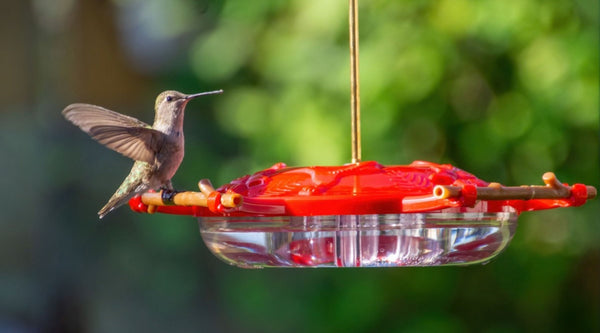
Saucer-style feeders, like Pop's AspenPerch® Hummingbird Feeder, hold nectar in a shallow basin below the ports, so there's no sealed air pocket to cause problems; bottle-style, gravity-fed feeders tend to leak more, especially in Idaho's dry summer heat, since the air trapped above the nectar expands and pushes nectar out through the ports. It's paired with our patented Polyperch® comfort perch, too, so your hummingbirds can rest and feed at the same time instead of hovering the whole meal.
Keeping your feeder filled is also important because hummingbirds need a dependable, fresh source they can count on every visit, not a gamble.
Shop the feeder
AspenPerch® Hummingbird Feeder, 8 oz

Leak-proof by design, with a patented Polyperch® comfort perch built in — so your hummingbirds can rest and feed at the same time instead of hovering through the whole meal, right through Idaho's long feeding season.
Shop the AspenPerch® Feeder →Keep Feeders Clean with Fresh Nectar
Clean your feeder every time you change the nectar, using warm water and a bottle brush — no soap residue, no bleach. A little vinegar and water solution works great for breaking down sticky buildup or the beginnings of mold. Our practical guide to cleaning hummingbird feeders walks through the whole routine.
Skip the Red Dye
Your feeder's color does the attracting; dyed nectar offers no benefit and can be harmful to a hummingbird's health. The same goes for honey, which can cause a fungal growth in a hummingbird's mouth that can kill the bird.
Put Out More Than One Feeder
If a single male is monopolizing yours, add a second one spaced out of sight of the first — a standard Idaho Fish and Game recommendation, and a real issue with Rufous in the yard specifically, given how aggressively they defend a food source.
Use a Real Nectar Recipe
Use a 4:1 plain sugar-water ratio to make your hummingbird nectar, or save yourself the math with the ready-to-use option below.

Just getting your first feeder going? Nectarade® Ready to Use Liquid comes pre-mixed and formulated with added electrolytes and calcium to support hummingbirds through the demands of nesting season and migration — no dyes, no preservatives, nothing to commit to before you know how much traffic you'll get.
Shop the Ready to Use Nectar →How Often to Change Nectar in Idaho
Idaho Fish and Game's baseline is to change the solution and clean the feeder every week, and more often in hot weather, since heat causes the nectar to ferment. In practice that means scaling with the thermometer:
| Outdoor Temp | Change Nectar Every |
|---|---|
| Below 70°F | 5–6 days |
| 70–80°F | 3–4 days |
| 80–90°F | 2–3 days |
| Above 90°F | 1–2 days |
If the nectar ever looks cloudy before that window is up, change it early. In winter, a heated feeder needs cleaning more often than an unheated one, not less.
Wondering how long nectar actually lasts? Our full guide on how long hummingbird nectar lasts covers exactly what spoilage looks like and why the timeline shifts with heat.
Keeping Feeders Pest-Free Without Insecticide
Hummingbirds don't live on nectar alone — small insects make up a big part of their protein diet, especially for feeding chicks. That means insect spray is off the table around your feeding station; it removes a food source hummingbirds depend on and can be harmful to them directly.
Ants
Ants are drawn to any spilled or leaking nectar, and once a trail forms, they'll march straight up the feeder pole or hanging hook to reach the source. A vinegar-water spray works well as a deterrent — mist it around (not directly on) the feeder ports, and wipe down the hook or pole where ants tend to travel. A leak-proof feeder design also does real work here: with nothing dripping down in the first place, there's less to draw them in to begin with.
Dealing with a real ant problem? See our full guide to keeping ants out of a hummingbird feeder for more fixes.
Bees and Wasps
Bees and wasps are trickier than ants, since they're after the same nectar hummingbirds are drinking, not just what's spilled — a genuine issue in Idaho's dry-summer foothills, where wasps in particular go looking for any sugar source late in the season. A vinegar-water spray around the ports can help, but the more reliable fix is a feeder design that keeps them out entirely rather than just discouraging them.
Bees and wasps still crashing the party? See our full guide to keeping bees away from a hummingbird feeder for the complete picture.

Still crashing the party? HummGuard® Nectar Tips slide onto the AspenPerch's feeding ports — a flexible membrane lets hummingbird beaks through and closes tight against anything bigger.
Shop HummGuard® Tips →Plant an Idaho Native Hummingbird Garden
Feeders are a wonderful supplement, but nothing beats real, native nectar. Idaho's native plants evolved right alongside these four species — and in the case of scarlet gilia, arguably alongside them quite literally.
Best Native Nectar Plants for Idaho
| Plant | Why It Works |
|---|---|
|
Scarlet gilia (Ipomopsis aggregata) |
The classic Idaho hummingbird plant. Its short tubular flowers suit Calliope's short bill particularly well. Lewis and Clark collected the first specimen along the Lolo Trail in northern Idaho. |
|
Western columbine (Aquilegia formosa) |
Native statewide and an early bloomer, timed close to arrival |
|
Orange honeysuckle (Lonicera ciliosa) |
A genuine Idaho-native vine with tubular orange flowers built for hummingbird bills |
|
Golden currant (Ribes aureum) |
An early-season native shrub — one of the first things flowering when the birds arrive |
|
Firecracker and Rocky Mountain penstemon (Penstemon eatonii, P. strictus) |
Native penstemons that handle Idaho's dry summers without irrigation |
|
Fireweed (Chamerion angustifolium) |
A widespread montane native and strong midsummer nectar source. Spreads by rhizome, so give it room. |
Pop's tip: Indian paintbrush (Castilleja) is a beautiful Idaho native and hummingbirds do use it — but it's hemiparasitic, drawing nutrients from the roots of neighbouring plants, which makes it notoriously hard to establish in a garden bed. Enjoy it on the trail rather than fighting it in the yard.
Two to avoid. The non-native bush honeysuckles (Tatarian and Amur) are widely sold and widely invasive — stick with native orange honeysuckle or twinberry instead. And butterfly bush (Buddleja davidii), marketed everywhere as a pollinator plant, is a regulated invasive concern across the Pacific Northwest.
If You're Near the Border
Hummingbirds don't check a map before deciding where to feed, so if you're near a state line, your best guide might be a blend of both.
Near Washington and Oregon: The Rufous that pour through Idaho in August came north through the Pacific Northwest in spring. See our Washington hummingbird guide and Oregon hummingbird guide for more.
Near Montana and Wyoming: Shared Rocky Mountain elevation timing and the same Broad-tailed and Calliope high country. See our Montana hummingbird guide and Wyoming hummingbird guide for more.
Near Utah and Nevada: Southern Idaho shares Great Basin timing and a drier plant palette. See our Utah hummingbird guide and Nevada hummingbird guide for more.
To make this easy, our Perfect Little Sanctuary® Wildflower Seed Blend is designed to bring nectar-rich color into your yard with minimal fuss.
When to Plant the Perfect Little Sanctuary® Blend in Idaho

Fall is the best planting window across Idaho — aim for October into November, once soil temperatures have dropped but before the ground freezes hard. Nine of the blend's twelve varieties either need or benefit from a cold, moist stratification period, and an Idaho winter provides that thoroughly. At higher elevations, sow at the earlier end of that window, or wait for early spring.

Ready to plant? Perfect Little Sanctuary® Wildflower Seed Blend packs all 12 varieties into one packet — no separate shopping trips before Idaho's fall planting window.
Shop the Seed →Top Performers in Idaho — and an Honest Note on Natives
Idaho has an unusually well-documented native flora, and it's worth being straight about which of the blend's varieties actually belong here. Three genuinely do:
- Scarlet Gilia (Ipomopsis aggregata) — a true Idaho native, and the single best hummingbird plant in the mix for this state
- White Yarrow (Achillea millefolium) — the western subspecies is Idaho native. A USDA-released germplasm of it was collected near Eagle, in Ada County.
- Columbine — western columbine (Aquilegia formosa) is native statewide; blue columbine (A. coerulea) is native to southeastern Idaho
The rest perform well in Idaho conditions but arrived from elsewhere: Black-Eyed Susan (native east of the Rockies, introduced in the Northwest), Purple Coneflower and Lance-Leaved Coreopsis (mid-South and Midwest natives), Perennial Lupine (an eastern species — Idaho's native lupines are silvery and silky lupine instead), Indian Blanket (a Great Plains species — Idaho's native blanketflower is Gaillardia aristata), Palmer Penstemon (a Great Basin and Southwest species widely planted here), and Siberian Wallflower and Painted Daisy, neither of which is North American at all.
Pop's tip: Sow the blend as directed and it will do its job. But if you want to plant something unambiguously Idaho, start with scarlet gilia, western columbine, and golden currant — those three will do more for the hummingbirds in your yard than anything else you can put in the ground.
Give Them a Place to Rest
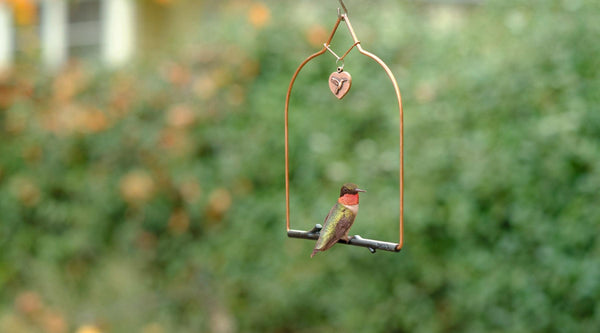
Hummingbirds spend a surprising amount of their day perched, not flying — watching their territory, digesting, and simply resting between feedings. It matters more than usual in Idaho come August, when Rufous flood through on their southbound migration — one of the most pugnacious hummingbirds anywhere, known for trying to run every other bird off a single feeder regardless of size. More perches spread further apart genuinely means fewer standoffs during that stretch. A Pop's Original Hummingbird Swing hung near your feeder gives them exactly that spot, and it turns your feeding station into a front-row seat for watching them up close. Hang it about 1 foot from your feeder, at the same height (Pop's rule of thumb), and don't be surprised if a hummingbird claims it as their own personal lookout post. Our guide to where to hang your hummingbird swing covers placement in more detail — height, distance, and the sightlines that make one get used.
Shop the Perfect Perch
Original Series Hummingbird Swing, Onyx

A second swing gives a chased-off bird its own perch to fall back to — especially valuable come August, when southbound Rufous are running every other bird off a single feeder.
Shop the Original Swing →Keep Your Sanctuary Safe from Predators
A feeding station draws more than hummingbirds, and knowing what's actually worth worrying about — and what isn't — makes for a safer yard. Cats and window strikes are the two best-documented threats to hummingbirds around any home. For the fuller picture, see our Hummingbird Predators guide.
Idaho has its own close-up view of the window half of that. At Boise State, the Intermountain Bird Observatory surveys campus windows for bird strikes every spring and fall, and its education and outreach director has described reports of up to 20 bird deaths at a single building in one day. The fix they've been putting to work is refreshingly simple: high-contrast decals with close spacing, so a bird reads the glass as a solid surface. After student-designed decals went up at the Library! at Cole & Ustick in Boise in 2025, the branch manager reported a substantial drop in bird strikes. Those surveys count birds of every kind, not hummingbirds specifically — but it's the same glass as your kitchen window. Idaho Fish and Game's own bird-feeding advice points the same way: it names free-roaming cats as a predator to plan your feeder placement around, and if you notice birds striking your windows, move the feeder.
What about the praying mantis? Mantis predation on hummingbirds is a real, documented phenomenon nationally — a 2017 peer-reviewed review compiled 147 cases of mantises catching small birds worldwide, most of them hummingbirds, with hummingbird cases reported from 26 U.S. states. But we were not able to confirm an Idaho-specific record before this guide's publication, so treat that risk as real but unconfirmed locally rather than either dismissed or overstated. A quick glance at your feeder ports now and then costs nothing.
Summary: Key Takeaways for Attracting Hummingbirds in Idaho
Building a hummingbird-friendly yard doesn't take a green thumb or a big budget — just a little consistency and the right setup. Here's everything from this guide in one place:
- Idaho has four breeding hummingbirds — Black-chinned, Rufous, Calliope, and Broad-tailed — where most states east of the Great Plains have only Ruby-throated.
- Anna's Hummingbird now winters in Idaho. First recorded in 1976 and rare until the 2000s, it's now banded by the hundreds each winter in the Treasure Valley, and the first confirmed Idaho nest was documented in Boise in 2020.
- Regional timing runs on a four-way split: the Panhandle sees birds first (early April, driven by Calliope), the Treasure Valley and central mountains follow by late April, and eastern Idaho is last, in early May.
- The busiest stretch is late July into mid-August, when the southbound Rufous migration funnels through the Rockies.
- Take feeders down at the end of September — unless you have a wintering Anna's, in which case keep one going, heated or brought in overnight.
- Any size space works — one feeder is plenty for a balcony; larger yards can support multiple feeders spaced apart, since hummingbirds are territorial.
- Use a leak-proof feeder with a comfort perch, like the AspenPerch®, and put out more than one if a single male is monopolizing it.
- Skip red dye and never use honey — both can be harmful to a hummingbird's health, and honey specifically can cause a fatal fungal growth. A plain 4:1 sugar-water ratio or Pop's Nectar both work.
- Change nectar at least weekly, and every 1–2 days above 90°F.
- Clean the feeder at every nectar change with warm water and vinegar — no soap or bleach.
- Never use insecticide near feeders; hummingbirds rely on insects for protein. Use vinegar-water spray and HummGuard® nectar tips instead.
- Add a hummingbird swing near the feeder to give them a place to rest and be observed up close.
- Cats and window strikes are the two best-documented threats to hummingbirds around any home, including Idaho's. If birds are hitting your glass, move the feeder, or add closely spaced, high-contrast decals, the same fix researchers have been using on windows around Boise.
- Native, nectar-rich plants — scarlet gilia, western columbine, orange honeysuckle, golden currant — do more for hummingbirds long-term than feeders alone. Avoid the invasive bush honeysuckles and butterfly bush.
- Sow wildflower seed in October–November. Scarlet Gilia, White Yarrow, and Columbine are the varieties genuinely native to Idaho; the others perform well but came from elsewhere.
Get these basics in place, and the wonder takes care of itself.
This guide covers what's specific to Idaho — the species, the timing, the plants that belong here. For the fundamentals that apply anywhere, including water sources, shelter, and how the pieces work together, read our guide to building the ultimate hummingbird sanctuary.
Frequently Asked Questions
A few of the questions we hear most from fellow hummingbird lovers across Idaho:
When should I put my hummingbird feeder out in Idaho?
It depends on your region: early April in the Panhandle, late April in the Treasure Valley and central mountains, and early May in eastern Idaho. Idaho Fish and Game gives the general season as mid-April through September, but the Panhandle typically sees its first birds a few weeks earlier than that.
What are common mistakes when feeding hummingbirds?
The big ones in Idaho specifically: overfilling the feeder so nectar sits around long enough to ferment in the dry summer heat, adding red dye — it offers no benefit and can be harmful — and using honey instead of sugar, which can cause a fungal growth in a hummingbird's mouth that can kill the bird. A close fourth is running a single feeder when a territorial Rufous is around; IDFG's own advice is to add a second one out of sight of the first.
Do hummingbirds like feeders without perches?
They don't need one — hovering while feeding is their default — but they'll use a perch readily when it's there, resting between sips instead of burning energy the whole meal. That's the reasoning behind the AspenPerch's built-in Polyperch® comfort perch. It matters even more during Idaho's August Rufous surge, when birds are already burning extra energy defending feeders from each other.
What happens if you don't boil sugar water for hummingbirds?
Nothing dangerous — boiling isn't strictly required, and Idaho Fish and Game's own nectar guidance doesn't call for it. Its real purpose is helping sugar dissolve fully in cooler water, not eliminating some hidden risk. What actually matters more in Idaho is sticking to the change schedule for the temperature — nectar left out through a hot, dry Treasure Valley afternoon will ferment on its own timeline regardless of whether it was boiled going in.
Should I keep my feeder up in winter for Anna's?
If one has found your yard, yes. Use a heated feeder, or bring it in overnight and put it out about half an hour before sunrise — pre-dawn is when a hummingbird most needs to refuel after a night of fasting. Clean it more often than you would in summer, not less.
How often should I clean my hummingbird feeder in Idaho?
Idaho Fish and Game recommends changing the solution and cleaning the feeder every week, and more often in hot weather since heat causes nectar to ferment. In practice, every 1–2 days above 90°F, and every 5–6 days in cool weather.
What are the best plants to attract hummingbirds in Idaho?
Scarlet gilia is the standout — it's an Idaho native and its short tubular flowers suit Calliope particularly well. Western columbine, orange honeysuckle, golden currant, and the native penstemons are all strong choices that handle Idaho's dry summers.
Idaho Hummingbird Resources
Audubon Chapters
Idaho is home to several local Audubon chapters, including Golden Eagle Audubon Society in Boise. Find the one closest to you with Audubon's Find Your Local Audubon tool.
If You Find an Injured or Grounded Hummingbird
Hummingbirds are protected under federal and Idaho state law, so only a licensed wildlife rehabilitator can legally care for one.
- Idaho Department of Fish and Game maintains the official directory of licensed wildlife rehabilitators by region — start here to find the nearest permitted rehabber.
- Ruth Melichar Bird Center (Animals in Distress Association), 4650 N. 36th St., Boise — a dedicated avian rehabilitation facility operating since 1987, taking in thousands of injured and orphaned birds a year. Hotline: (208) 338-0897.
Hummingbird Research & Banding in Idaho
- Intermountain Bird Observatory at Boise State University runs the research behind almost everything known about Idaho's winter hummingbirds. Their Team Hummingbird project has been running since 2015 and now bands around two hundred Anna's Hummingbirds each winter, in partnership with homeowners across the state.
- Two 2021 papers in Western Birds came out of that work: one documenting Anna's winter range expansion into Idaho, the other the first confirmed Anna's nest in state history.
- Lucky Peak Banding Station, on the Boise Ridge, is open to the public during fall migration from mid-July into late October — songbird, raptor, and owl banding, and a genuinely good day out.
Hummingbird Events in Idaho
Idaho doesn't have a standalone annual hummingbird festival. What it does have is better: the Intermountain Bird Observatory runs public banding sessions, including hummingbird banding in season, and the Lucky Peak station welcomes visitors through the fall migration. Those are the events worth planning around.
Sources
- eBird bar chart data, Cornell Lab of Ornithology — Idaho statewide, 2016–2025. Source for seasonal patterns and relative species abundance.
- Idaho Department of Fish and Game — Wildlife Express, Vol. 36, Issue 10, June 2023 hummingbird issue. Source for species status, nesting, nectar recipe, and feeder guidance.
- Intermountain Bird Observatory, Boise State University — Winter Hummingbirds. Source for the Anna's winter expansion, banding numbers, and cold-tolerance records.
- Intermountain Bird Observatory, Boise State University — Bird Safe Windows, with Boise State University News (October 15, 2024, and April 27, 2026). Source for the Boise window-collision surveys, the single-building mortality report, and decal results.
- Idaho Department of Fish and Game — How to Feed Wild Birds. Source for feeder guidance on free-roaming cats and window strikes.
- Nyffeler, M., Maxwell, M. R., & Remsen, J. V., Jr. (2017). Bird predation by praying mantises: a global perspective. The Wilson Journal of Ornithology, 129(2), 331–344.
- Pollock, J. J., Ware Carlisle, H., Hayes, H. M., & Robinson, B. W. (2021). Monitoring through community science: Anna's Hummingbird winter range expansion into Idaho. Western Birds, 52(1), 58–67.
- Robinson, B. W., Pollock, J. J., Ware Carlisle, H., Hayes, H. M., & Engle, J. (2021). First documentation of successful breeding for the Anna's Hummingbird in Idaho. Western Birds, 52, 76–79.
- Idaho Bird Records Committee — accepted state records for Costa's, Broad-billed, and Ruby-throated Hummingbirds.
- Idaho Native Plant Society and Utah State University Extension — native plant recommendations for the Intermountain West.
Why We Built This Guide
Pop's Birding has been helping hummingbird lovers for three generations, and we're based right here in Idaho — so this guide is personal in a way most of our state guides aren't. One of the questions our customers ask most often is "How do I actually attract more hummingbirds to my yard?" — we built this guide to give a direct, practical answer, not a generic one. Most feeder advice online doesn't account for Idaho's dry summer heat accelerating nectar spoilage, or for the fact that a huge share of what you'll see isn't a resident bird at all but Rufous funneling south through the Rockies for a few intense weeks in August. And almost nothing accounts for the newest wrinkle: Anna's Hummingbird establishing itself as a genuine Idaho winter resident, something that simply wasn't true a generation ago. We wanted a guide that actually reflects Idaho's climate, Idaho's migration route, and Idaho's still-changing hummingbird population — not a template with the state name swapped in.
How We Built This Guide
The timing figures on this page come from the same eBird checklist data behind our Idaho hummingbird calendar — see that page for the full regional methodology. The care guidance throughout is cross-checked against Idaho Department of Fish and Game's own published guidance (their Wildlife Express hummingbird issue, Vol. 36, Issue 10, June 2023) rather than generic national advice — the red dye warning, the honey warning, and the multiple-feeder recommendation for territorial Rufous all come directly from IDFG. The native plant table is checked against the Idaho Native Plant Society's records, and we're direct about which of our standard wildflower blend's varieties are genuinely Idaho natives (scarlet gilia, white yarrow, columbine) versus which simply perform well here but originated elsewhere — a distinction most native-plant content skips. This Idaho-specific framing is original to this page, not a rewrite of generic national hummingbird-gardening advice with Idaho's name inserted. For the predators section, we looked specifically for an Idaho record of a praying mantis taking a hummingbird rather than assuming the national pattern applies here, and couldn't confirm one, so it's stated as an open question, not a local fact. The window-strikes anchor is instead Idaho's own work: the Intermountain Bird Observatory's collision surveys and decal projects around Boise, which count birds of every kind rather than hummingbirds specifically.
Haven't grabbed it yet? Download the free Idaho Quick Reference Guide — one page, print and keep.
Know before they arrive
You don't have to keep this calendar taped to the fridge. Insider Birding Access members get seasonal notes timed to your region — when to have feeders out, what the birds are doing right now, and what's worth doing in your yard this season. We take the guesswork out of the calendar. Joining takes about thirty seconds, and there's 10% off your first order in it.
Join Insider Birding Access →Free to join. 10% off your first order.
Your Idaho Backyard Sanctuary
Every real hummingbird sanctuary comes down to the same staples: mess- and pest-free food, a place to perch, native flowers, and fresh nectar. Here's everything from this guide to get all the bases covered in your own Idaho yard.


Bethany Sloan has served as General Manager of Pop's Birding since 2010, continuing the legacy of her grandfather, William "Pops" Sloan, inventor of the Original Hummingbird Swing. A lifelong hummingbird enthusiast, educator, and independent researcher, she leads the company's educational content, including its 50-State Hummingbird Guide series, Regional Guide, Species Guide and Hummingbird Learning Center. Bethany combines scientific research, regional migration data, and more than 16 years of hands-on experience to create trusted educational resources for bird enthusiasts across North America.