Jul 26, 2026
Idaho Hummingbird Season: A Month-by-Month Calendar
Timing derived from eBird data, 2016–2025 (sourced July 2026)
Idaho runs two hummingbird seasons a year, and until recently only one of them existed. The breeding season runs April through September and involves four species. The second, built around Anna's Hummingbird, is the result of a range expansion still unfolding around Boise as you read this — and it's less confined to winter than it first looks. Statewide, Anna's reports are heaviest from late September through mid-March. But in the Treasure Valley itself, where nearly all of Idaho's wintering birds actually are, eBird data shows the species reported in every single week of the year. The four breeding migrants aren't replacing Anna's each spring — they're overlapping with a bird that never really left.
Idaho's Hummingbird Season at a Glance
Before the region-by-region detail below, here's the whole season in one picture — five species, and just how much Black-chinned and Rufous dominate everyone else.

How often each species turns up on eBird checklists, week by week — statewide, 2016–2025. The month-by-month, region-by-region breakdown below shows how these five species actually play out on the ground.
The short answer: the state stays quiet through most of April, then turns on almost all at once in the last week — the Panhandle first, the Treasure Valley and Central Mountains the same week. Eastern Idaho follows in early-to-mid May. The busiest week of the year is the first of August. The breeding species leave by early October, and Anna's holds the Treasure Valley year-round, not just through the winter.
| Question | Answer |
|---|---|
| When do they arrive? | Late April almost everywhere at once — Panhandle, Treasure Valley, Central Mountains; early-to-mid May in eastern Idaho |
| When should feeders go up? | Late March in the Panhandle; early April in the Treasure Valley and Central Mountains; mid-April in the east |
| When do they nest? | May through July; young fledge from mid-July |
| Busiest month? | Early August — the southbound Rufous surge |
| When do they leave? | Through September; effectively none after the first week of October |
| Any in winter? | Yes — Anna's, present in the Treasure Valley year-round and peaking in early November around Boise |
Free download
The whole year on one page
Arrival windows by region, the August Rufous surge, when to take feeders down, and when to switch to winter mode for Anna's — printed small enough to tape inside the shed door.
Download the Idaho cheat sheetOne page · PDF · free to print and share
Here's the whole year, month by month.
Regions used below
Panhandle (Kootenai) — Coeur d'Alene, Sandpoint, Moscow
Central Mountains (Blaine) — Sun Valley, McCall, Salmon
Treasure Valley (Ada) — Boise, Nampa, Caldwell
Eastern Idaho (Bonneville) — Idaho Falls, Pocatello, Teton Valley
Listed in arrival order, which is not the order you'd guess. The Panhandle is Idaho's earliest region and eastern Idaho its latest. Outside Ada County, Idaho's birding coverage is thin, so each region's seasonal shape is dependable but individual weeks are less precise.
How Each Region Compares to the State
The statewide chart above is the average. No single region actually lives there — each one runs its own species mix, and some of the gaps are bigger than you'd expect. All four charts below share the same scale and the same season window, so they're directly comparable to each other, not just to the dashed statewide line.
Treasure Valley (Ada / Boise)

Boise's Black-chinned population runs nearly double its statewide peak — 44% of checklists at the height of summer versus 24% for Idaho as a whole. This is the most concentrated Black-chinned real estate in the state. Calliope run the other direction: below their statewide average, since their real stronghold is further north.
Calliope and Rufous both show a real two-wave pattern here that the single statewide curve above smooths flat: a modest spring passage in late April and May, a quiet June, then a second wave that's bigger than the first for both species, building through July and peaking in August. Rufous shows the more dramatic version — its August peak runs more than ten times the size of its May passage, so a Boise yard that seems only lightly visited by Rufous in spring can see it become the dominant bird at the feeder by late summer.
Panhandle (Kootenai / Coeur d'Alene)

Calliope more than double their statewide peak here — 16% of checklists versus 8% statewide — confirming this is genuinely Calliope country, not just a place they happen to pass through. Black-chinned, dominant almost everywhere else in Idaho, run at less than half the state average in the Panhandle.
Central Mountains (Blaine / Sun Valley)

Every species shown here runs above its statewide average — Rufous most dramatically, at roughly 60% higher than the state peak. This is where Idaho's "even mix" reputation genuinely holds up: no single species dominates the way Black-chinned does in Boise or Calliope does in the Panhandle.
Eastern Idaho (Bonneville / Idaho Falls)

Broad-tailed's dominance here isn't subtle: more than six times the statewide peak, by far the largest region-to-state gap found anywhere in Idaho's data. If you're near Idaho Falls, Pocatello, or Teton Valley, Broad-tailed isn't just present — it's unambiguously your bird.
Rufous plays out very differently here than it does statewide, too. Instead of the long late-April-through-mid-September run it keeps elsewhere, eastern Idaho's confirmed Rufous window is a short, late burst — arriving late July and gone again by late August, compressed into about six weeks instead of five months. If you're waiting on Rufous around Idaho Falls, expect it to show up all at once, late in the summer, rather than trickling in with everyone else in spring.
Black-chinned's confirmed window here runs mid-May to early September, but a handful of scattered reports show up as early as late April — too thin on their own to move the arrival date, worth knowing about if you keep a feeder up early.
January
One species, and only in one part of the state.
| Treasure Valley | Anna's Hummingbirds, in the middle of an Idaho winter. Reported steadily all month around Boise. |
| Panhandle & Central | Smaller numbers, but present. |
| Eastern Idaho | Essentially none. Wintering Anna's haven't reached Idaho Falls. |
How a hummingbird survives an Idaho January
Anna's drop into torpor overnight — lowering body temperature dramatically to conserve energy — then need to refuel urgently at first light. Boise State researchers documented one banded bird near New Meadows that came through a hundred-day stretch including forty-five days that never rose above freezing, with lows around ten below zero.
If you're feeding one, the critical window is the half hour before sunrise. Use a heated feeder, or bring it in overnight and set it out early.
February
Still just Anna's — and some of them are already nesting.
| Treasure Valley | Anna's steady through the month. Nest-building has been recorded in Boise as early as February. |
| Everywhere else | The four breeding species are still in Mexico and the Southwest. Six weeks to go. |
What to do: Keep the winter feeder going and keep it thawed. If you're planning native plantings, golden currant and western columbine are the two that will be flowering when the first migrants arrive.
March
The last quiet month, and Anna's begin thinning out.
| Anna's | Declining steadily through the month as birds disperse. |
| Late March | Hang feeders in the Panhandle. It's early, but the first real signal is still about a month out — better to have it up and waiting than to miss the jump. |
| Elsewhere | Nothing yet. |
April
Quiet for three weeks, then the whole state turns on at once.
| Weeks 1–2 | Scattered, isolated reports only — not yet a real pattern anywhere in Idaho. Hang feeders in the Treasure Valley and Central Mountains now, ahead of the wave. |
| Week 3 | The first real signal of the year, and it shows up in the Panhandle before anywhere else — Calliope and Rufous both start crossing into consistent reporting around Coeur d'Alene. |
| Week 4 (late April) | The whole state turns on together. Calliope and Rufous jump sharply in both the Panhandle and the Treasure Valley in the same week, Black-chinned arrive around Boise, and Calliope and Black-chinned pick up in the Central Mountains too. Hang feeders in eastern Idaho. |
What to do: Feeders up everywhere by the last week of April — Idaho's real spring arrival isn't a slow build across the month, it's a single sharp week. Males arrive first and stake out territory, so a single bird guarding your feeder in late April is completely normal.
May
Everyone's here, and the spring Rufous wave passes through.
| Week 1 | Rufous spring peak. These are birds heading north, not staying. |
| Weeks 2–4 | Black-chinned climb hard toward their summer plateau. Calliope reach their spring high in the mountains. Broad-tailed settle into eastern Idaho and the high country. |
| Eastern Idaho | Last region to fill, with Broad-tailed leading. |
Why nesting season is the demanding one
There's a wrinkle specific to hummingbirds. Most female birds build up a temporary calcium store in their bones, called medullary bone, and draw on it to make eggshell. Hummingbirds have very little of it, so a laying female has less in reserve. Researchers have seen nesting females eating wood ash and other mineral-rich materials, which they think helps replace the calcium that goes into eggs. In one 1994 study, every bird seen eating ash was a female tending a nest.

It's part of why Pop's Nectar includes calcium and electrolytes rather than sugar alone. Nesting females need extra calcium during egg-laying, and plain sugar water has essentially none. Read more on the research behind it.
Shop Nectarlyte® 8 oz →What to do: Skip the insecticide entirely. Nesting females need small insects and spiders for protein, and spider silk is what holds the nest together.
June
The quiet month — and the one that fools people.
| Rufous | Their lowest point of the season — down to roughly half the May figure. The northbound wave has passed and the southbound one hasn't started. |
| Everything else | Steady but subdued. Females are on nests rather than at feeders. |
| Anna's | At its lowest point of the year in the Treasure Valley — thin enough some weeks that you won't see one on every visit — but not actually gone. A few birds hold on right through the summer. |
What to do: Don't read a quieter June feeder as the season winding down. Idaho's biggest month is eight weeks away.
July
Young birds fledge, and the Rufous start coming back.
| Mid-July | Watch for juveniles at feeders — Idaho Fish and Game flags this as the moment. They're often noticeably clumsy and unafraid. |
| Rufous | More than double their June low by month's end. The southbound migration has begun. |
| Broad-tailed | Peak in eastern Idaho this month. |
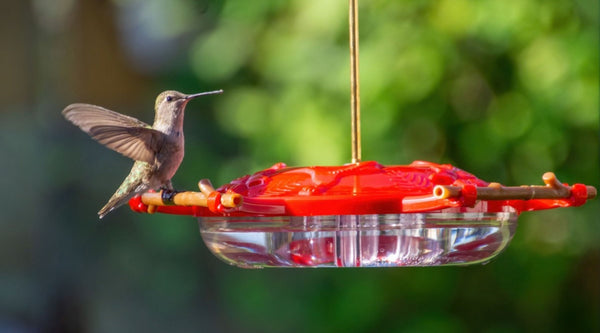
What to do: Rufous are notoriously territorial, and a single male will try to run everything else off. Idaho Fish and Game recommends multiple feeders for exactly this reason — but a second feeder alone often just gives that same dominant bird more to guard, since it tends to claim a nearby perch as a lookout over both stations.

Seeing one bird chase everyone else off?
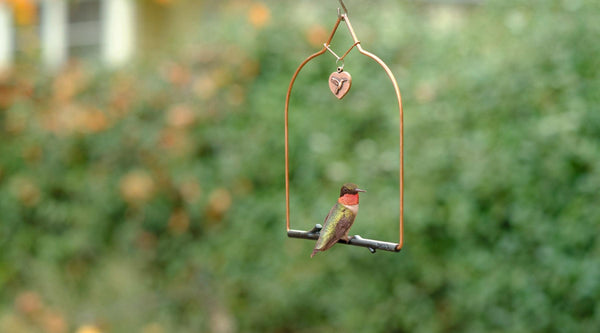
A second feeder and a second swing, spaced out of sight of each other, gives another bird — the incoming migrant or a displaced resident — its own station to guard instead of fighting over one.
Shop a second swing →August
The biggest month of the Idaho year, by a wide margin.
| Week 1 | Peak. Nearly half of all Idaho checklists record a hummingbird — more than at any other point in the year. |
| Why | Rufous return south through the Rocky Mountains rather than back down the coast, and Idaho sits directly on that route. Reports run more than double the spring passage. |
| Weeks 3–4 | Still high, but the decline has started. |
What to do: This is the month to be generous. Fill more often, add feeders, and expect fights. The birds coming through are fueling for a journey to central Mexico.
This is the month to be generous, not economical.
Birds fueling for a long flight need feeders topped up more often — the large 2lb Nectarlyte® powder or the Nectarade® liquid concentrate keeps you from running out mid-surge.


Idaho's hottest stretch of the year lines up with its busiest feeder traffic, which is exactly when ants and bees show up looking for an easy sugar source — right when you can least afford a feeder going dry or getting guarded off-limits.
Keep pests off without pesticides — hummingbirds rely on small insects for protein, so spraying near a feeder can cost them a food source, not just protect one.
AspenPerch®'s built-in ant moat blocks ants with a water barrier, and HummGuard® Nectar Tips keep bees and wasps out without changing anything for the birds.


September
The season empties out fast — this is when most of Idaho sees hummingbirds leave.
| Week 1 | Down to roughly half the August peak. |
| Weeks 2–4 | A steep fall — under a tenth of the peak by month's end, as the breeding species leave for Mexico and the Southwest. |
| Late September | Anna's reports begin climbing. The handover is starting. |
What to do: Idaho Fish and Game's advice is to leave your feeder up until the end of September, so migrants coming down from farther north have somewhere to stop.
October
The changeover.
| Week 1 | The last breeding-species stragglers leave. After this, effectively none until April. |
| All month | Anna's climb steadily in the Treasure Valley and the Panhandle. The second season is opening as the first one closes. |
| Planting | Prime wildflower sowing window, once soil has cooled but before hard freeze. |
What to do: If you're in the Treasure Valley or the Panhandle, don't put the feeder away — switch it over for the winter Anna's season instead.

This is the planting month.
Sow now and native wildflowers get the cold, moist period most varieties need to bloom reliably next spring.
Shop the Perfect Little Sanctuary® blend →November
Anna's peak, in the coldest part of the state's populated valleys.
| Treasure Valley | The Anna's high point of the year. More Anna's are reported around Boise in early November than in any other week. |
| Panhandle | Building toward a December peak. |
| Everything else | Gone. |
What to do: This is the decision month. If an Anna's has settled on your yard, commit — a heated feeder, or two rotated so one is always thawed. Boise State's researchers advise not taking a feeder down once a wintering bird has committed to it.
December
The second season in full.
| Treasure Valley | Anna's holding steady all month. |
| Panhandle | Their own peak arrives now. |
| Research | Boise State's Intermountain Bird Observatory bands roughly two hundred Anna's each winter, largely at private homes. If one is using your feeder, they'd like to know. |
What to do: Keep it thawed, keep it clean — a heated feeder needs cleaning more often than an unheated one, not less — and report what you have. Our winter hummingbird feeder care guide covers heated feeders and the two-feeder swap.
The Year at a Glance
| When | What |
|---|---|
| Late March | Feeders up in the Panhandle — well ahead of the wave |
| Early April | Feeders up in the Treasure Valley and Central Mountains |
| Mid-April | Feeders up in eastern Idaho |
| Late April | The whole state turns on at once — Calliope and Rufous jump in the Panhandle and Treasure Valley; Black-chinned arrive around Boise |
| Early May | Rufous spring passage peak; eastern Idaho fills |
| June | The lull — females on nests, Rufous at their low |
| Mid-July | Juveniles start appearing at feeders |
| Early August | Peak of the year — the southbound Rufous surge |
| End of September | Take feeders down — unless you're switching to winter mode |
| October – November | Sow wildflower seed; Anna's arrive and peak |
| November – March | Winter Anna's season, Treasure Valley and Panhandle |
Frequently Asked Questions
When do hummingbirds come back to Idaho?
Most of the state stays quiet through the first three weeks of April, with only scattered early sightings. The first real signal shows up in the Panhandle in the third week of April, and then the whole state — Panhandle, Treasure Valley, and Central Mountains together — turns on in the fourth week, when Calliope and Rufous arrive nearly everywhere at once. Eastern Idaho is last, filling in through early-to-mid May.
When do hummingbirds leave Idaho?
Numbers fall steeply through September — down to roughly half the August peak by the first week and under a tenth by month's end. The last breeding-species stragglers leave in the first week of October.
Are there hummingbirds in Idaho in winter?
Yes, in the Treasure Valley and the Panhandle. Anna's Hummingbird reports climb through October, peak around Boise in early November, and hold through December, January and February — and in the Treasure Valley specifically, eBird data shows Anna's reported every week of the year, so it's not purely a winter bird there. Eastern Idaho is the exception — wintering Anna's haven't reached Idaho Falls.
Why do I see the most hummingbirds in August?
Because Rufous return south through the Rocky Mountains rather than back down the coast, and Idaho sits directly on that route. In the first week of August, nearly half of all Idaho checklists record a hummingbird — more than double the spring passage.
When should I take my hummingbird feeder down in Idaho?
Idaho Fish and Game's advice is the end of September, so migrants coming down from farther north have somewhere to stop. If you're in the Treasure Valley or the Panhandle, don't put it away — switch it over for the winter Anna's season instead.
Why We Built This Calendar
Pop's Birding has been helping hummingbird lovers for three generations — and Idaho is home, so this one is personal. One of the questions our customers ask most often is "When do hummingbirds arrive and leave my state?" — we built this calendar to give a direct, sourced answer, not a generic one. Idaho's real story is genuinely unusual: it isn't one hummingbird season, it's two, and they overlap more than most timing guides would ever say. A breeding season that runs April through September and involves four migrant species, layered on top of Anna's Hummingbird — a range expansion still unfolding around Boise that, in the Treasure Valley itself, turns out to hold on right through the year rather than clearing out each spring. Most timing guides treat a state as having a single season with a single set of dates; that framing would flatten out the single most interesting thing about Idaho's hummingbirds. We wanted a calendar that actually captures both seasons and how they overlap, and shows how differently each of Idaho's regions experiences the same statewide year.
How We Built This Calendar
Every date on this page comes from eBird checklist data (Cornell Lab of Ornithology), 2016–2025, for Idaho statewide and four counties: Kootenai (Panhandle), Blaine (Central Mountains), Ada (Treasure Valley), and Bonneville (eastern Idaho). We checked it against Idaho Department of Fish and Game's season guidance and the Intermountain Bird Observatory's research on wintering Anna's. Outside Ada County, eBird coverage is thin, so each region's seasonal shape is dependable but individual weeks are less precise. Two findings surprised us enough to check twice. Spring arrival is a single sharp week, not a slow build: the Panhandle, Treasure Valley, and Central Mountains all cross into real numbers the same week in late April. And Ada County's Anna's are reported every week of the year, so Idaho's two seasons overlap there instead of following one another.
Sources
- eBird bar chart data, Cornell Lab of Ornithology — Idaho statewide plus Kootenai, Blaine, Ada, and Bonneville counties, 2016–2025. Source for all seasonal figures.
- Idaho Department of Fish and Game — Windows to Wildlife, June 2023 hummingbird issue. Source for nesting biology, feeder guidance, and season dates.
- Intermountain Bird Observatory, Boise State University — Winter Hummingbirds. Source for wintering Anna's, banding numbers, and cold-weather feeding guidance.
- Pollock, J. J., Ware Carlisle, H., Hayes, H. M., & Robinson, B. W. (2021). Monitoring through community science: Anna's Hummingbird winter range expansion into Idaho. Western Birds, 52(1), 58–67.
- des Lauriers, J. R. (1994). Hummingbirds eating ashes. The Auk, 111(3), 755–756. Documents five nesting female hummingbirds eating wood ash; no males were seen doing so in that study.
- Adam, M. D., & des Lauriers, J. R. (1998). Observations of hummingbirds ingesting mineral-rich compounds. Journal of Field Ornithology, 69, 257–261. Source for hummingbirds' greatly reduced medullary bone and for the mineral-rich materials they eat.
- Werning, S. (2018). Medullary bone is phylogenetically widespread and its skeletal distribution varies by taxon. Journal of Ornithology, 159, 527–543. Source for medullary bone being confirmed in hummingbirds.
Know before they arrive
You don't have to keep this calendar taped to the fridge. Insider Birding Access members get seasonal notes timed to your region — when to have feeders out, what the birds are doing right now, and what's worth doing in your yard this season. We take the guesswork out of the calendar. Joining takes about thirty seconds, and there's 10% off your first order in it.
Join Insider Birding Access →Free to join. 10% off your first order.
Shop Idaho's Hummingbird Favorites


Bethany Sloan has served as General Manager of Pop's Birding since 2010, continuing the legacy of her grandfather, William "Pops" Sloan, inventor of the Original Hummingbird Swing. A lifelong hummingbird enthusiast, educator, and independent researcher, she leads the company's educational content, including its 50-State Hummingbird Guide series, Regional Guide, Species Guide and Hummingbird Learning Center. Bethany combines scientific research, regional migration data, and more than 16 years of hands-on experience to create trusted educational resources for bird enthusiasts across North America.