Aug 02, 2026
Costa's Hummingbird: The Desert Hummingbird That Rewrote the Science of Torpor
A resting Costa's Hummingbird's heart beats somewhere between 500 and 900 times a minute — an almost unbelievable number for an animal you could comfortably hold on a fingertip. Then a cold desert night arrives, and that same heart can slow to around 50 beats per minute, a nearly 90 percent drop, as the bird enters a controlled, hibernation-like state to survive until sunrise. It was exactly this kind of extreme physiology, studied in the Costa's Hummingbird specifically, that gave rise to some of the earliest foundational research into hummingbird torpor — work that's still cited today, more than sixty years later, as the starting point for how scientists understand the way hummingbirds survive on the edge of their own metabolism.
Quick Facts
- Common name: Costa's Hummingbird
- Scientific name: Calypte costae (Bourcier, 1839)
- Family: Trochilidae (hummingbirds); Order Apodiformes
- Length: 3.5 in (9 cm)
- Wingspan: 4.3–4.7 in (11–12 cm)
- Weight: 0.1 oz (2–3 g)
- Lifespan: at least 8 years, 9 months — the oldest banding record
- Range: Sonoran and Mojave Deserts, coastal California, and Baja California, Mexico
- Conservation status: Least Concern (IUCN) — stable population, no major identified threats
- Population: approximately 3.4 million global breeding population (Partners in Flight)
- Claim to fame: one of the two species (alongside Anna's Hummingbird) in the genus Calypte, and a foundational research subject for the physiological study of hummingbird torpor
Sources: Cornell Lab of Ornithology, All About Birds — Overview; Cornell Lab of Ornithology, All About Birds — Identification; Cornell Lab of Ornithology, All About Birds — Life History; Audubon Field Guide — Costa's Hummingbird; ITIS — Integrated Taxonomic Information System
The Origin Story: How Costa's Hummingbird Got Its Name
Costa's Hummingbird was formally described by French ornithologist Jules Bourcier in 1839, who gave it the binomial name Ornismya costae, according to Cornell's Birds of the World. The species is now placed in the genus Calypte, introduced in 1856 by English ornithologist John Gould specifically for this species and its closest relative, Anna's Hummingbird — the two species share several distinguishing features, including an iridescent crown in males and rounded rather than pointed tail feathers, setting them apart from genera like Archilochus (which includes the Ruby-throated and Black-chinned Hummingbirds). The species is monotypic, with no recognized subspecies, per ITIS.
Bourcier named the bird in honor of Louis Marie Pantaléon Costa de Beauregard, Marquis de Beauregard (1806–1864). The scholarly-standard references — Birds of the World and the Helm Dictionary of Scientific Bird Names — describe him simply as a French nobleman and fellow ornithologist who was an avid collector of hummingbirds. Cornell Lab's All About Birds offers a fuller characterization, describing him as a "Sardinian patriot, statesman, military commander, historian, and amateur archaeologist" who also happened to be an enthusiastic collector of hummingbirds. The two descriptions aren't actually in conflict: Costa was a member of the Savoyard nobility of the Kingdom of Sardinia, born in Savoy — which is why some sources call him "Sardinian" while the taxonomic literature settles on "French nobleman." The type specimen was collected around 1837 near Magdalena Bay on the Baja California Peninsula.
Where Costa's Hummingbird Lives: A True Desert Specialist
Costa's Hummingbird breeds in the arid, semi-arid, and Mediterranean climate zones of the southwestern United States and northwestern Mexico, mainly across Southern California and the Baja California Peninsula, according to the Audubon Field Guide. Cornell Lab's All About Birds notes the species occupies Sonoran and Mojave Desert scrub, coastal California chaparral and sage scrub, and desert scrub and deciduous forest in Baja California — favoring desert washes with palo verde, jojoba, desert lavender, or chuparosa in the Sonoran Desert (typically below 3,000 feet) and scrub and woodlands near springs and streams in the Mojave (up to about 4,000 feet).
Costa's Hummingbird is also a documented, if uncommon, wanderer well outside this core desert range. According to Cornell Lab, individuals have shown up multiple times in the Pacific Northwest and have even reached as far as Alaska and British Columbia, Canada — genuinely surprising territory for a bird this tied to hot, dry habitat.
A note on range framing: Arizona's Sonoran Desert is often described as though it holds a year-round population comparable to California's, but that overstates the picture. It is primarily a spring breeding ground: abundance in Arizona and southern California deserts peaks in March and April, when most breeding occurs, and per Birds of the World, "by late June most birds have dispersed, possibly to habitats near the Pacific Coast." Year-round residency is concentrated instead in Southern California and Baja California, which form the species' core range. So while Arizona is genuinely important as a breeding stronghold, it should not be framed as an equally year-round population center.
How to Identify Costa's Hummingbird: Males vs. Females
Adult Males
Small, compact, and distinctively hunch-postured, with a short tail whose tip barely meets the wingtips when perched. According to Cornell Lab's All About Birds, the male's defining feature is an iridescent purple crown and gorget, with the throat feathers flaring outward along the sides of the neck "like an overgrown mustache" — genuinely one of the more memorable and specific field marks in all of North American hummingbird identification. The back is green, with whitish underparts. In poor light the purple can appear black.

Adult Females
Greenish above, with a distinctive white eyebrow stripe, a grayish cheek patch, and whitish underparts — entirely lacking the male's purple coloring, with a notably droopy bill. According to the Audubon Field Guide, female Costa's Hummingbirds are smaller and shorter-billed than female Anna's or Black-chinned Hummingbirds, with a shorter tail, paler belly, and a distinct voice — useful secondary clues where ranges overlap.

Immature Birds
Young males are intermediate between females and adult males, often showing a dark throat outline extending down and back below the eye, with a patch of pinkish-purple appearing on the lower throat as feathers come in. Juveniles reach adult appearance by about one year of age.
A Note on Sound
Male Costa's Hummingbirds are unusually vocal for hummingbirds. They repeatedly perch at just three or four favorite spots within their territory — often a dead twig in a palo verde, acacia, or ironwood tree — singing a thin, high-pitched whistle to proclaim ownership and warn off intruders, according to Cornell Lab's All About Birds. During display dives, males produce a distinct high-pitched, accelerating and decelerating whistle that many desert visitors describe as an eerie, unmistakable sound once you've heard it; most other sounds heard at feeders are aggressive chattering calls.
Behavior: Territorial Defense in a Land of Scarcity
Costa's Hummingbirds hover to take nectar and catch small flying insects in midair, according to Cornell Lab's All About Birds. During the breeding season, males defend territories around prominent perches and nectar sources, relying on their 3–4 favorite perching spots to monitor and enforce those boundaries. Although they defend nectar sources, they are relatively subordinate and less aggressive than larger hummingbirds such as Anna's. Population trends have been fairly stable or only slightly declining between 1968 and 2019, per the North American Breeding Bird Survey.
Feeding and Diet
Costa's Hummingbirds drink nectar from a wide range of desert plants. Cornell Lab notes they visit at least 22 plant species in the Sonoran Desert but feed most frequently on chuparosa and ocotillo, while in California coastal scrub they favor white and black sage, tree tobacco, heart-leaved penstemon, and bush monkeyflower. One striking figure from Cornell's research: a Costa's Hummingbird needs to visit roughly 1,840 flowers a day to meet its energy requirements. Small flying insects, snapped up mid-air, round out the diet with essential protein.
A note on how the tongue actually works: Older accounts describe the tongue as simply "lapping" nectar up via capillary action through grooves, like a straw. More recent research led by biologist Alejandro Rico-Guevara, published with Margaret Rubega in the Proceedings of the Royal Society B, corrects this: the hummingbird tongue functions as an elastic micropump with fringed tips that trap nectar. As the tongue is compressed passing through the bill and then springs back open on contact with nectar, elastic re-expansion of the grooves draws in fluid far faster than capillary action alone could — and the grooves don't extend all the way to the throat, so the tongue isn't functioning as a simple straw.
Courtship and Mating
Male Costa's Hummingbirds perform one of the more elaborate and acoustically sophisticated courtship displays of any North American hummingbird. According to Cornell Lab's All About Birds, males climb high, then dive in a broad U-shaped pattern while giving a high-pitched, accelerating whistle, sometimes continuing this looping dive sequence without pause for up to four minutes, though the typical display lasts closer to 35 seconds. Between dives, males also perform shuttle displays — flying rapidly back and forth directly in front of a perched female with the violet gorget fully flared into finger-like projections, an effect researcher Dr. Christopher Clark has memorably described as making the male look like "an amazing little star," often likened to a baby octopus on his face.
The acoustic engineering behind this display has been the subject of real scientific study. Peer-reviewed research by Christopher Clark of UC Riverside and Emily Mistick, published as "Strategic Acoustic Control of a Hummingbird Courtship Dive" in Current Biology in April 2018, found that a male can amplify the sound produced by his tail feathers by as much as 11 decibels by angling those feathers toward the female during the display. That study found males dive to the side of a female — minimizing an audible Doppler cue that would otherwise reveal how fast they're moving — and twist their tail feathers to direct the sound of the dive toward her. The directional-amplification effect has been demonstrated most directly in Calypte hummingbirds broadly; Costa's sister species, Anna's Hummingbird, was the subject of Clark's original 2008 finding that these birds "sing" with their tail feathers, and his subsequent work spans both species.
Birds of the World notes something else notable about this species' courtship: despite how frequently displays are observed, no researcher has ever documented an entire successful courtship sequence all the way through to copulation, meaning some parts of this species' mating behavior remain genuinely unresolved even today. As with virtually all hummingbirds, males provide no parental care after mating, and one male may court and mate with several different females across a season.
Nesting and Family Life
According to Cornell Lab and the Audubon Field Guide, the nest — built by the female alone — is a small, rather flimsy cup roughly 1.25 inches across and 1 inch deep, woven from strips of bark, small leaves, lichen, and plant down and bound with spider silk, usually with a distinctive grayish appearance. It's typically placed 3 to 7 feet above the ground in palo verde, ironwood, cholla, acacia, or graythorn, often in a fairly open spot, on a horizontal or diagonal branch. She continues adding material to the nest throughout incubation.
Clutch size is typically two white eggs, each about the size of a jelly bean. Incubation lasts about 15 to 18 days, and young fledge in roughly 20 to 23 days. Timing of breeding varies considerably with latitude, habitat, and how much nectar is available in a given year and location — in Southern California and southern Arizona's low desert specifically, breeding typically begins between February and April, with males arriving first to establish and defend territory. Costa's typically raise one to two broods per season, and Birds of the World notes that females nesting in desert scrub occasionally attempt two successive broods within a four-month window, though this appears to be genuinely uncommon; some researchers have hypothesized — though not yet proven — that certain females may raise one brood in desert habitat and a second afterward in chaparral, effectively following the bloom to a second habitat type within a single season. Where feeders and gardens provide reliable food, some pairs extend the breeding season and have even been documented nesting in fall.

Migration: Following the Desert Bloom
Costa's Hummingbird's movements are driven less by a fixed north-south migration schedule than by tracking wherever desert nectar happens to be available at a given time — Cornell Lab describes the species as residents to short-distance migrants. Birds breeding in the Sonoran and Mojave Deserts largely leave in summer and fall, moving toward the coast and areas with abundant flowers. Abundance in Arizona and southern California deserts peaks in March and April, and by late June most birds have dispersed; California chaparral and sage scrub host the species from roughly March to September, after which most withdraw, perhaps mainly into Mexico. Increasingly, where flowers or feeders are available year-round — as in many suburban gardens — growing numbers of birds remain all year. As noted above, the species is also a documented, if uncommon, wanderer as far as the Pacific Northwest, Alaska, and British Columbia. Birds of the World notes candidly that the species' overall status remains poorly understood across much of its range, with some areas showing apparent expansion and others showing a resurgence into historically occupied territory — genuine open questions in a bird that might otherwise seem thoroughly studied.
Torpor: A Desert Survival Trick — and a Foundational Research Species
This is arguably the most scientifically important fact about Costa's Hummingbird: some of the earliest, most foundational research establishing hummingbird torpor as a field of physiological study was conducted specifically on this species. The practical numbers are genuinely dramatic: per Cornell Lab, "the hearts of torpid Costa's Hummingbirds beat about 50 times per minute, while those of awake, resting Costa's Hummingbirds beat 500 to 900 times per minute" — a nearly 90 percent reduction that allows the bird to survive a cold desert night on a fraction of the energy it would otherwise burn.
Torpor sets in on genuinely cold desert nights, and this figure should be treated as approximate rather than tied to a hard temperature cutoff. More recent field physiology, published by Erich Eberts and colleagues in the journal eLife, indicates that torpor onset in hummingbirds is driven mainly by energy balance — chiefly low fat reserves and limited foraging opportunity — with ambient temperature functioning as a contributing factor rather than a strict trigger; torpor duration, closely linked to photoperiod, appears to matter more than temperature alone for total nighttime energy savings.
Researcher R.C. Lasiewski's landmark 1963 and 1964 studies — "Oxygen consumption of torpid, resting, active, and flying hummingbirds" (Physiological Zoology 36:122–140, 1963) and "Body temperatures, heart and breathing rate, and evaporative water loss in hummingbirds" (Physiological Zoology 37:212–223, 1964) — remain cited in the scientific literature to this day as founding work in this entire area of avian physiology. Of the seven hummingbird species studied in the 1964 paper — Costa's, Anna's, Black-chinned, Ruby-throated, Rufous, Allen's, and Calliope — Costa's Hummingbird was demonstrably the dominant subject: it's the sole species in the paper's first data table, appears in six of eight rows of the second, and is the entire subject of the third table, titled "Role of Evaporative Cooling in Heat Economy of Calypte costae." Lasiewski specifically used Costa's for the high-ambient-temperature experiments — noting that "specimens of C. costae were used at the higher temperatures, since this species is found in hotter and drier areas than the others studied" — and it was the species used for the torpor evaporative-water-loss experiments. This dominant-subject status is specific to the 1964 paper; Costa's role in the companion 1963 paper's exact species composition could not be independently confirmed, so it shouldn't be assumed to be equally central there.
Habitat
According to the Audubon Field Guide, Costa's Hummingbird favors deserts, washes, and sage scrub — mostly dry, open habitat with a good variety of plant life, including washes and streamsides in the Sonoran Desert, the lower reaches of dry canyons, and coastal sage scrub, ranging from near sea level to about 4,000 feet. Notably, this species rarely moves up into mountain meadows after breeding season the way some other Southwestern hummingbirds do, staying instead within its characteristic low-elevation, arid habitat. The species has also adapted successfully to suburban desert landscaping in some areas, even as undeveloped desert habitat has been lost to development elsewhere within its range.
Costa's Hummingbird by Region: Where and When to Find Them
| Region | Status | Best Time to See Them |
|---|---|---|
| Arizona (Sonoran Desert) | Major breeding area; most birds depart by summer | February–May, peaking March–April |
| Southern California (low desert) | Common breeder, present much of the year | Year-round presence, breeding February through April |
| Coastal California (sage scrub) | Increasingly year-round; some seasonal movement from desert | Peak May; present roughly March–September |
| Nevada (southern) | Regular, especially in desert habitat | Spring through fall |
| Baja California Peninsula, Mexico | Core range, including wintering birds | All year |
| Pacific Northwest, Alaska, British Columbia | Rare, documented vagrant | Any season |
Sources: Cornell Lab of Ornithology, All About Birds — Life History; Cornell Lab of Ornithology, Birds of the World — Calypte costae; Audubon Field Guide — Costa's Hummingbird
Build a Costa's Hummingbird Sanctuary in Your Own Yard
Because this species is such a genuine desert specialist, supporting it well means leaning into arid-climate gardening rather than fighting against it.
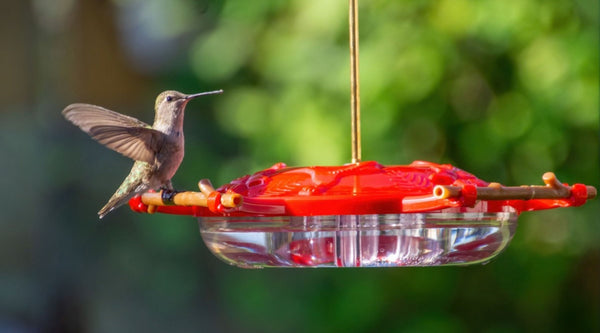
- Use a leak-proof, easy-to-clean feeder like the AspenPerch® Hummingbird Feeder, with a comfort perch so this species can rest between feedings in the desert heat.
- Offer more than one feeder, placing one off to the side — Cornell Lab notes Costa's are relatively subordinate at feeders, so a second, quieter feeding spot helps them avoid competition with larger, more aggressive hummingbirds.
- Keep nectar fresh, checking more frequently during the region's intense heat — Pop's Nectar, with added electrolytes and calcium, supports the demands of this species' unusually early nesting season, which can begin as soon as February in the low desert.
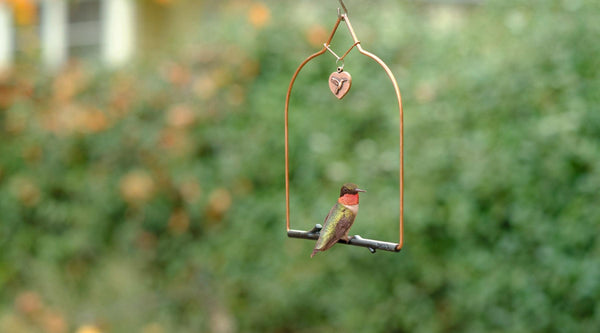
- Add a swing near your feeder — a Pop's Original Hummingbird Swing gives a territorial Costa's Hummingbird a consistent perch to defend its feeding area from, much like the favorite dead twigs this species naturally chooses in the wild.
- Plant true desert natives like chuparosa and ocotillo, both documented favorites this species specifically relies on, plus salvias such as Mexican sage, rather than higher-water-demand ornamentals that don't fit the region's climate.
- Skip the insecticide. Since small flying insects are a real part of this species' diet, pesticide use removes food it depends on. Use HummGuard™ nectar tips instead to manage bees and wasps without harming anything else.
For state-specific feeder timing, native plant lists, and wildflower planting guidance, see our companion guides for Arizona, California, and Nevada, or find your own state in our full hummingbird guide by state series.
Frequently Asked Questions
How can I attract Costa's Hummingbirds to my yard?
Put up one or two sugar-water feeders (1 part plain white sugar to 4 parts water, no dye), place at least one off to the side so the subordinate Costa's can feed away from larger hummingbirds, and plant native desert nectar sources such as chuparosa, ocotillo, and salvias like Mexican sage.
How long do Costa's Hummingbirds live?
The oldest recorded Costa's Hummingbird was a female that was at least 8 years, 9 months old — banded in California in 2001 and recaptured and re-released there during banding operations in 2009.
What does a Costa's Hummingbird look like?
A tiny, compact, hunched hummingbird about 3.5 inches long. Males have a brilliant purple crown and gorget that flares out along the sides of the neck; females are green above with whitish underparts, a pale eyebrow, and a grayish cheek.
Where do Costa's Hummingbirds live?
In the Sonoran and Mojave Deserts, coastal California, and Baja California. Arizona's Sonoran Desert is mainly a spring breeding area (peak March–April), while year-round residency is concentrated in Southern California and Baja California.
What is torpor, and do Costa's Hummingbirds use it?
Torpor is a hibernation-like state in which heart rate and body temperature drop to save energy — a torpid Costa's heart beats about 50 times per minute versus 500–900 when active. Costa's use torpor primarily when fat reserves run low, with cold temperatures a contributing factor rather than a strict trigger.
How did the Costa's Hummingbird get its name?
French ornithologist Jules Bourcier named it in 1839 after Louis Marie Pantaléon Costa de Beauregard (1806–1864), a French nobleman and hummingbird collector from Savoy in the Kingdom of Sardinia.
What's the difference between a Costa's Hummingbird and an Anna's Hummingbird?
Anna's Hummingbirds are larger, less hunched, and have a longer tail that extends past the wings when perched. Male Anna's show a rose-red crown and gorget, while male Costa's show iridescent purple. Females are trickier: female Anna's often show a few red feathers in the center of the throat, which female Costa's lack, and female Costa's have a cleaner white belly.
Are Costa's Hummingbirds aggressive?
No — Costa's Hummingbirds are relatively subordinate at feeders and flowers, giving way to larger, more aggressive species like Anna's Hummingbird. They will defend a nectar patch, but they're far less combative than most other North American hummingbirds, which is why it helps to offer a second, quieter feeder off to the side.
What does a Costa's Hummingbird sound like?
Males give a very thin, high-pitched, almost piercing whistle from favorite perches and during courtship dives — one of the highest-pitched sounds of any North American hummingbird. Females rarely sing; instead they give a sharp, dry "tic" call while foraging or in flight, and males themselves rarely call outside of their whistled song.
Do Costa's Hummingbirds migrate?
Partially. Birds breeding in the Sonoran and Mojave Deserts mostly leave in summer, heading toward the coast or into Mexico, while populations in Southern California, coastal California, and Baja California can be present year-round — especially where feeders and gardens keep flowers blooming throughout the year.
At Pop's Birding, we believe every backyard — big or small — has room for a little more wonder. Explore our feeders, nectars, swings, and wildflower seed blends to start building your own hummingbird sanctuary today.

Bethany Sloan has served as General Manager of Pop's Birding since 2010, continuing the legacy of her grandfather, William "Pops" Sloan, inventor of the Original Hummingbird Swing. A lifelong hummingbird enthusiast, educator, and independent researcher, she leads the company's educational content, including its 50-State Hummingbird Guide series, Regional Guide, Species Guide and Hummingbird Learning Center. Bethany combines scientific research, regional migration data, and more than 16 years of hands-on experience to create trusted educational resources for bird enthusiasts across North America.