Jul 23, 2026
Anna's Hummingbird: How to Identify Males, Females and Immatures
Watch a male Anna's Hummingbird turn his head at just the right angle and his entire crown ignites — a full hood of iridescent rose-magenta running from forehead to throat, unlike almost any other hummingbird in North America. Turn a few degrees more and that same head goes matte black in an instant. That on-off flash is the first thing most people notice about this species. The second thing, usually, is how often they're looking at a female or an immature bird instead — plainer, trickier, and easy to confuse with its closest relative if you don't know what to check.
This guide focuses entirely on identification — what to look for on males, females, and immatures, and how to separate Anna's from the species it's most often confused with. Looking for a different species entirely? Start with our full overview of hummingbird species found in the United States.
One of the most remarkable range expansions in North American bird history — from a thin strip of California coast to Vancouver Island in a century.
The most dramatic courtship display in the hummingbird world, diet, nesting, torpor, and the Costa's Hummingbird this bird calls family.
Quick answer: Adult male Anna's Hummingbirds are unmistakable in good light — a full iridescent rose-magenta hood covering the crown and throat, not just a throat patch. Females and immatures are stockier and plainer, with a small red throat spot that's a genuinely useful mark, especially against Costa's Hummingbird, their closest relative and the trickiest look-alike.
Quick Facts
- Scientific name: Calypte anna
- Length: 3.9–4.3 inches (9.9–10.9 cm)
- Weight: 0.1–0.2 oz (2.8–5.7 g) — no heavier than a nickel
- Wingspan: about 4.7 inches (12 cm)
- Fastest field cue: the only North American hummingbird with iridescence covering the entire head, not just the throat
How to Identify Anna's Hummingbird: Males vs. Females vs. Immatures
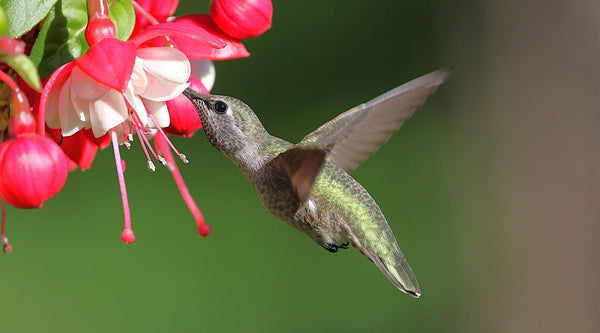
Before splitting hairs between sexes, here's the general shape to look for regardless of age or sex: a stocky, medium-sized hummingbird with a straight, short-to-medium bill — a little heavier-looking than the bill of its close relative, Costa's Hummingbird. Anna's also tends to hold its tail still while hovering, unlike Black-chinned or Costa's, which is a genuinely useful behavioral cue when the light isn't cooperating for a plumage check.
Adult Males
Unmistakable once you know what to look for: a full, iridescent rose-magenta crown and throat that extends over the entire head, not just a throat patch the way most other hummingbirds show it. Depending on the light and viewing angle, this iridescence can look nearly black one moment and flash brilliant fuchsia-pink the next — structural color, produced by microscopic feather structures rather than pigment, which is why it seems to switch on and off as the bird moves. The back is iridescent bronze-green, and the underparts are a dull grayish-green.

Adult Females
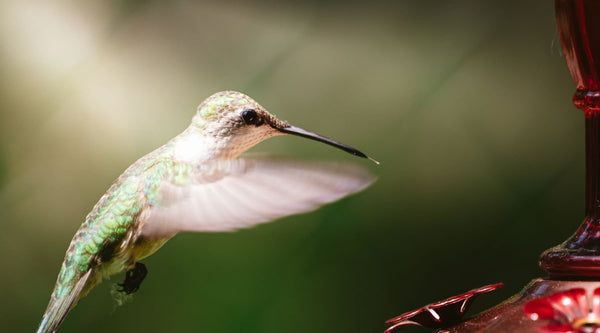
Considerably less flashy: iridescent green upperparts, blackish wings, pale gray underparts, and — unusually for a female hummingbird — a small patch of iridescent reddish-pink in the center of the throat, sometimes forming a partial gorget. Look also for a small white spot behind the eye. That reddish throat patch is a genuinely useful mark, especially for separating female Anna's from female Costa's, though it isn't foolproof: some female Costa's show a small violet throat patch of their own.

Immature Birds
Immature males look similar to females but are duller overall and lack a full gorget — they're still developing their adult throat coloring and may show only a few scattered iridescent flecks. Both immature males and females can be confused with females of other West Coast species, so the reddish throat spotting combined with the stocky build and straight bill are the most reliable combination of field marks.

A Quick Note on Sound
If you can't get a clear look, Anna's Hummingbird is often easier to identify by ear. Males are unusually vocal, frequently singing a scratchy, metallic song from an exposed perch. That's rare behavior in this family: most hummingbirds communicate primarily through visual displays and simple chip notes rather than sustained song, and Anna's sings more conspicuously than any other hummingbird in North America. Its closest relative, Costa's Hummingbird, also sings — but a simpler, purer-toned song that's heard far less often.
Anna's Look-Alikes: How to Tell It Apart From Similar Species
Four species get confused with Anna's regularly enough that Cornell's All About Birds flags them directly on its own species-comparison pages. Costa's — the only other member of Anna's own genus, Calypte — is the genuinely difficult pair, especially for females. The other three lean more on range and behavior than plumage alone.

Costa's Hummingbird
Why they're confused:
The only other species in genus Calypte, overlapping widely across the desert Southwest — the genuinely difficult pair on this list, and the two species are documented to hybridize.
How to tell them apart:
Costa's is noticeably smaller with a proportionately longer bill and shorter tail, and the male's gorget flares out along the sides of the neck like an oversized mustache rather than staying rounded like Anna's. Adult male Costa's shows purple, not the magenta-rose of Anna's. Females are the harder call — Costa's tends toward a cleaner, whiter throat and underparts versus Anna's grayer belly and more frequent throat spotting, but a hybrid can genuinely split the difference.

Black-chinned Hummingbird
Why they're confused:
Widely overlapping range across the West, and Black-chinned is sleeker overall, which can read as "just a smaller Anna's" at a glance.
How to tell them apart:
Black-chinned has a noticeably thinner neck than the stockier Anna's. The male's dark purple gorget stays confined to the throat, where Anna's male shows red covering the crown as well as the throat. Females and immatures are the tough call — Black-chinned tends to look more slender with a cleaner throat, while many (not all) Anna's show a red throat spot Black-chinned lacks.

Broad-tailed Hummingbird
Why they're confused:
Overlapping range across parts of the Mountain West and Southwest, with generally similar green-backed, pale-bellied plumage on females.
How to tell them apart:
Female and immature Anna's show a white eyebrow arc extending down the side of the face — Broad-tailed shows a pale eyering instead, not the extended arc. Broad-tailed's flanks also run more cinnamon-washed than Anna's plainer grayish-green sides.

Rufous Hummingbird
Why they're confused:
Both are common western feeder birds, and their ranges genuinely overlap across much of the Pacific states and Southwest during Rufous's migration windows.
How to tell them apart:
Female and immature Rufous shows cinnamon-washed flanks and rufous in the tail that Anna's never shows — Anna's sides stay grayish-green with no warm rufous tones anywhere on the bird. An adult male Rufous, solid orange from crown to tail, isn't a realistic confusion with any Anna's plumage.
Sources: All About Birds species-comparison pages (Cornell Lab).
The real story with this bird isn't identification — it's the range. A hundred years ago, every Anna's Hummingbird on Earth lived within a few hundred miles of San Francisco Bay. Today the species breeds as far as Vancouver Island and turns up at feeders in Alaska. That full story — how it happened, and exactly where the range stands today — lives on our Range guide.
Frequently Asked Questions
Is Anna's Hummingbird the only hummingbird that sings?
Not quite — but it's the most conspicuous singer in North America. Males regularly produce a scratchy, buzzy song from an exposed perch, unusual behavior in a family that communicates mostly through visual display and simple chip notes. Its close relative Costa's Hummingbird also sings, though a simpler, purer-toned song that's far less often heard.
How do I tell a female Anna's Hummingbird from a female Costa's Hummingbird?
Look at overall size and bill-to-tail proportions first — Costa's is noticeably smaller with a proportionately longer bill and shorter tail. Costa's also tends toward a cleaner, whiter throat and belly, where Anna's is grayer and more often shows some red throat spotting. It isn't foolproof: the two species hybridize, and a hybrid can genuinely split the difference.
What's the fastest way to identify a male Anna's Hummingbird?
Wait for the light to hit the head directly — the full iridescent rose-magenta hood covering the crown and throat, not just a throat patch, is diagnostic among North American hummingbirds. In poor light it can look solid black, but no other regularly-occurring species shows that same full-head coverage once the light catches it.
Are immature Anna's Hummingbirds hard to identify?
They resemble adult females closely — green above, grayish below — but are duller overall and lack a full gorget, showing only scattered iridescent flecks as the adult throat color comes in. The stocky build, straight bill, and any red throat spotting are the most reliable combination of marks at this age.
Is Anna's Hummingbird related to other hummingbirds I might see?
Yes — its closest relative is Costa's Hummingbird, the only other species in genus Calypte. The two overlap widely across the desert Southwest and are documented to hybridize.
Why We Created This
Pop's Birding is a third-generation, Idaho-based family business that invented the hummingbird swing. One of the questions our customers ask us most often is "is this actually an Anna's, or something that just looks like one?" Most identification content treats Costa's as the only real confusion risk and stops there. It's the trickiest pair, but Cornell's own comparison data flags three more species — we built the full four-species comparison specifically because a reader in the overlap zone with Black-chinned or Broad-tailed deserves an answer too, not just the Costa's pairing.
How We Created This
Every field mark and look-alike comparison on this page is checked directly against Cornell Lab's All About Birds species-comparison pages — the live pages themselves, not a secondhand summary of them. All four confusion pairs above were verified this way, including noting plainly where the distinguishing mark is genuinely difficult (Costa's) versus where range does most of the work.
Looking for the rest of the picture on this bird? See our Range guide and Behavior & Family guide, or browse every species in our full U.S. hummingbird guide. At Pop's Birding, we believe every backyard — big or small — has room for a little more wonder. Explore our feeders, nectars, swings, and wildflower seed blends to start building your own hummingbird sanctuary today.

Bethany Sloan has served as General Manager of Pop's Birding since 2010, continuing the legacy of her grandfather, William "Pops" Sloan, inventor of the Original Hummingbird Swing. A lifelong hummingbird enthusiast, educator, and independent researcher, she leads the company's educational content, including its 50-State Hummingbird Guide series, Regional Guide, Species Guide and Hummingbird Learning Center. Bethany combines scientific research, regional migration data, and more than 16 years of hands-on experience to create trusted educational resources for bird enthusiasts across North America.