Aug 21, 2026
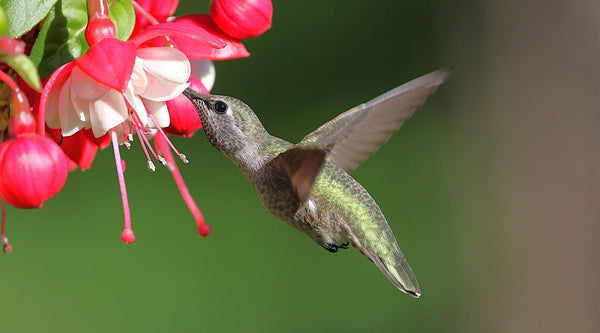
Anna's Hummingbird Behavior: Diet, Courtship, Nesting & Family
A female Anna's Hummingbird sits on her nest through a cold, rainy California night, drops into torpor to conserve energy, and lets her own eggs cool to 52°F — twenty degrees below what a developing embryo is supposed to tolerate. Two days later, they hatch anyway. That's not the most famous thing about this species — the courtship dive that turns a male's own tail feathers into a musical instrument gets that honor — but it's the one that says the most about how tough this bird actually is underneath the flash of color.
This is the guide to everything that isn't about identifying the bird or tracking its range — the diet, the courtship, the nesting, and the one relative this species calls family. Looking for a different species entirely? Start with our full overview of hummingbird species found in the United States.
Quick answer: Anna's Hummingbirds are bold, vocal, and fiercely territorial, with a courtship dive that produces sound through specially modified tail feathers rather than the bird's voice. Females handle nest-building and raising young entirely alone, often starting as early as December. They belong to the genus Calypte, alongside just one other species — Costa's Hummingbird — and both use torpor to survive cold nights, sometimes with startling consequences for incubating eggs.
Quick Facts
- Typical wild lifespan: most live only a few years; the oldest known individual was at least 8 years, 2 months old, recaptured during banding in Arizona
- Clutch size: two small white eggs, incubated 14–19 days
- Broods per season: typically two, occasionally three
- Diet: nectar from a wide range of native and non-native flowers, plus insects and spiders — as many as 2,000 a day for a nesting female
- Claim to fame: the most conspicuous singer of any North American hummingbird
The Origin Story: How Anna's Hummingbird Got Its Name
In 1829, French naturalist René Primevère Lesson described this species for science based on specimens collected by Paolo-Émilio Botta, originally naming it Ornismya anna. As Cornell Lab's Birds of the World account recounts, Lesson considered it one of the most beautiful hummingbirds he'd encountered, drawn to what he described as the "bright sparkle of a red cap of the richest amethyst" crowning the male's head — and he named the species in honor of Anna de Belle Masséna, the Duchess of Rivoli, whose husband owned the specimens.
In 1856, English ornithologist John Gould moved the species into a new genus he created specifically for it: Calypte, from the Greek for "covered" or "hooded" — a direct reference to the male's iridescent crown, which extends up over the entire head rather than staying confined to the throat like most hummingbird gorgets. That full-head iridescence is still one of the easiest ways to recognize a male Anna's today, and it's part of what sets the genus apart; the only other living species in Calypte is Costa's Hummingbird, its close desert-dwelling cousin.
Within the broader hummingbird family tree, Anna's Hummingbird sits in what taxonomists call the "bee" radiation — the tribe Mellisugini, a lineage that also includes the Ruby-throated and Rufous Hummingbirds familiar across the rest of the country. Hybridization with both Allen's and Costa's Hummingbirds is documented in the scientific literature, and hybrids are typically intermediate in plumage, which can make a bird that looks almost like an Anna's genuinely difficult to pin down.
Behavior: Bold, Vocal, and Fiercely Territorial
Anna's Hummingbirds are known for aggressively defending both feeding territories and nesting areas, chasing off rivals — and sometimes much larger birds — in fast, looping aerial pursuits accompanied by sharp chip calls. Males will even drive off large insects like bumblebees and hawk moths. Females, while generally less conspicuous than males, will also defend feeding territories of their own, typically set up away from where males are displaying.

Feeding and Diet
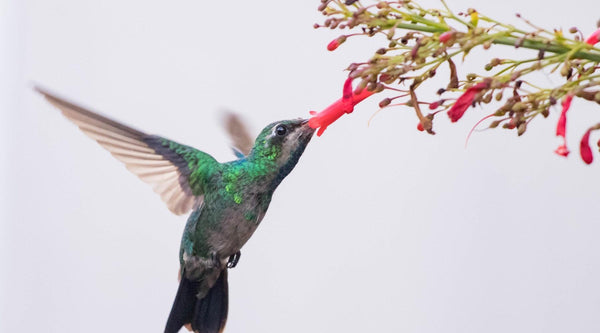
Anna's Hummingbird feeds from an unusually wide range of both native and non-native flowers. In its native chaparral habitat, it shows a particular fondness for currant and gooseberry (genus Ribes) and sage (Salvia) — both classic early-blooming natives that fuel the species through its unusually early nesting season. In developed, urban, and suburban areas, it readily turns to eucalyptus and tree tobacco (Nicotiana glauca), both non-native but abundant nectar sources.
Nectar is only part of the picture, though. Insects and spiders make up a critical part of the diet, providing protein that nectar simply can't. According to the American Bird Conservancy, a nesting female Anna's Hummingbird can capture as many as 2,000 insects a day — mostly tiny prey like midges and leafhoppers, either snatched mid-air or gleaned directly from spiderwebs and foliage. Anna's Hummingbirds have also been documented feeding on tree sap, sometimes visiting wells drilled by sapsuckers.

Courtship and Mating: The Most Dramatic Display in the Hummingbird World
Courtship in Anna's Hummingbird begins when a female enters a male's territory — typically after she's already started building a nest on her own, since males play no role in nest construction or chick-rearing. The resident male responds with one or more elaborate displays.
The dive display is usually what opens the encounter, and it's spectacular. The male climbs as high as 130 feet into the air — Cornell Lab describes the full display lasting around 12 seconds — then plummets back down in a steep dive directly toward the watching female. At the bottom of the dive, he produces a loud, explosive popping or chirping sound. For decades, ornithologists debated whether this was a true vocal sound. High-speed video and wind-tunnel research eventually settled the question: the sound comes from air rushing over the male's specially modified outer tail feathers as he spreads them at the bottom of the dive, at speeds of around 50 miles per hour or more — essentially turning his own tail into a musical instrument, with the feather vanes vibrating like a reed in a clarinet. Bioacoustics researcher Christopher Clark, who helped establish this mechanism, has described watching female hummingbirds sit through the display with their eyes half-closed, "like listening to a symphony."
The shuttle display tends to follow as courtship progresses and the male moves in closer: he swings back and forth about a foot above the perched female, body held horizontal and head angled down toward her, often flashing his gorget with each pass.
The same dive display doubles as a territorial warning to rival males or other intruders — including humans who get too close to an active territory.

Nesting and Family Life
Anna's Hummingbird has one of the earliest nesting seasons of any North American bird — nesting can begin as early as December in California, well before most other backyard birds have even started thinking about spring. This unusually early timing lines up directly with the bloom of early chaparral natives like currant and gooseberry.
The female alone selects the nest site, builds the nest, incubates the eggs, and raises the young — males contribute nothing beyond fertilization. Favored nest sites include a horizontal branch of oak, sycamore, or eucalyptus, typically 6 to 20 feet off the ground and sometimes higher. Vines, shrubs, and even human-built structures like wires and eaves are also used.
The nest itself is a real feat of construction: a compact cup about 1 inch tall and 1.5 inches in diameter, built from plant down and fibers bound together with spider silk, which gives the structure the stretch it needs to expand as the chicks grow. Construction usually takes about a week, and the female continues adding material even after eggs are laid, decorating the exterior with lichen, moss — and in urban settings, sometimes even bits of paint chips for camouflage.
Clutch size is typically two small white eggs, each about half an inch long. Incubation lasts 14–19 days, and the young are altricial — helpless, nearly naked, and entirely dependent on the female — at hatching. A female Anna's Hummingbird may raise two, occasionally three, broods in a single season.

Meet the Family: The Costa's Hummingbird
Anna's shares its genus, Calypte, with exactly one other living species: Costa's Hummingbird, a smaller, more strictly desert-adapted cousin found across the same general Southwest range. The two overlap widely, are documented to hybridize, and share the same full-head genus-defining iridescence on adult males — though Costa's flares out along the sides of the neck like an oversized mustache rather than staying rounded the way Anna's does. Costa's also sings, a trait genus-mates rarely share this consistently, though its song is simpler and purer-toned than Anna's scratchy, metallic performance.

Torpor: How Anna's Hummingbird Survives Cold Nights (and Cold Winters)
Hummingbirds burn energy at an extraordinary rate — awake and flying, a hummingbird is never more than a few hours from running its fuel tank dry. At night, when they can't feed, most hummingbird species — Anna's included — cope by entering torpor: a controlled, dramatic drop in both body temperature and metabolic rate, essentially a nightly mini-hibernation. Body temperature can fall from a normal 107°F (about 41.7°C) down to as low as 48°F (9°C), with breathing and heart rate slowing to match. When temperatures warm again, the bird can be active within minutes.
This is precisely what allows Anna's Hummingbird to survive truly cold winters in places like Seattle, enduring extended stretches of subfreezing temperatures, snow, and high wind that would be lethal to a bird trying to maintain a normal body temperature all night. And the response is flexible rather than fixed: a 2022 study in the Journal of Experimental Biology found that when Anna's were exposed to colder, higher-elevation conditions, they used torpor both more frequently and for longer — dialing the response up as conditions demanded.
Torpor use varies noticeably between individuals — a 2021 study in Functional Ecology documented that variability across hummingbirds generally, though in Anna's specifically the study found sex itself wasn't what drove the difference. The real trade-off shows up in the incubation research instead: letting body temperature crash overnight can slow embryonic development or put chicks at risk, so an incubating female has real reason to limit how deeply she goes torpid. One remarkable exception was documented directly in the scientific literature. Studying Anna's and Black-chinned Hummingbirds nesting in California chaparral, C. M. Vleck found that incubating females left the nest six to nine times an hour during daylight, with eggs usually cooling only 3–6°C — but that one Anna's Hummingbird became torpid for 4.5 hours one night following a rainy day, and her eggs cooled all the way to 11°C (52°F) — yet still hatched successfully two days later, a testament to how much punishment a hummingbird embryo can actually tolerate.
Key papers: Spence, A.R., LeWinter, H. & Tingley, M.W. (2022). Journal of Experimental Biology 225(10):jeb243294. — Vleck, C.M. (1981). "Hummingbird incubation: female attentiveness and egg temperature." Oecologia 51:199–205.
This bird's real story isn't conservation concern — it's the range. A hundred years ago, every Anna's Hummingbird on Earth lived within a few hundred miles of San Francisco Bay. Today the species breeds as far as Vancouver Island and turns up at feeders in Alaska. That full story lives on our Range guide.
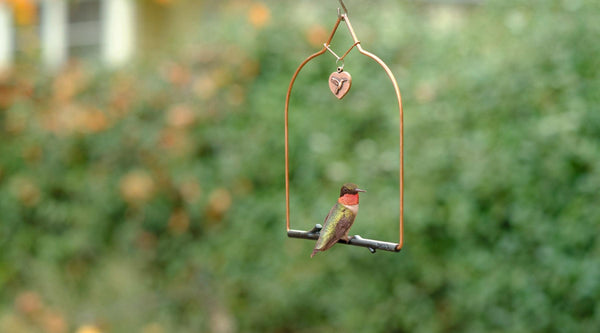
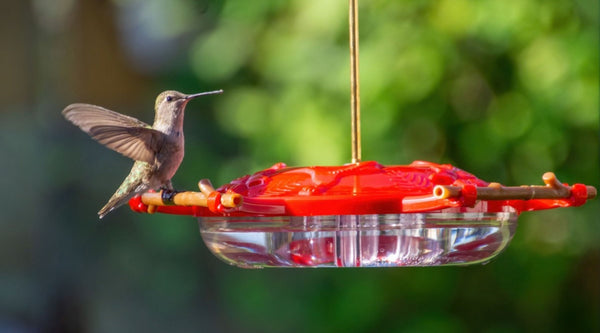
Because Anna's Hummingbird is so often a true year-round resident rather than a seasonal visitor, a well-stocked feeder is a genuine year-round commitment, not just a summer nicety. A leak-proof feeder with a comfort perch lets a territorial bird feed without spending extra energy hovering, and Pop's Nectar supports the energetic demands of a species that may be incubating eggs in the dead of winter. Skip the insecticide, too — a nesting female depends on thousands of insects a day for protein while raising chicks.
Frequently Asked Questions
Why does Anna's Hummingbird's courtship dive make a sound?
The male's tail feathers, not his voice, produce it. As he pulls out of a steep dive at up to 130 feet, air rushes over specially modified outer tail feathers at high speed, making them vibrate like a reed in a musical instrument — a mechanism confirmed through high-speed video and wind-tunnel research.
What does an Anna's Hummingbird eat?
Mostly nectar from a wide range of native flowers like currant, gooseberry, and sage, plus non-native sources like eucalyptus and tree tobacco. Insects and spiders provide essential protein — a nesting female can capture as many as 2,000 a day.
How long do Anna's Hummingbirds live?
Most live only a few years, but the oldest known individual was at least 8 years, 2 months old, recaptured during banding operations in Arizona.
Is Anna's Hummingbird related to other hummingbirds I might see?
Yes — its only close relative is Costa's Hummingbird, the other member of genus Calypte. The two overlap widely across the desert Southwest and are documented to hybridize.
How does Anna's Hummingbird survive freezing winter nights?
Through torpor — a controlled drop in body temperature (from a normal 107°F down to as low as 48°F) and metabolic rate that dramatically reduces how much energy the bird needs to burn overnight.
Why We Created This
Pop's Birding is a third-generation, Idaho-based family business that invented the hummingbird swing. One of the questions our customers ask us most often is some version of "what is that popping sound my hummingbird makes?" — along with the diet, nesting, and family-tree questions that don't fit naturally into an identification or range page. We built this guide to answer those directly, with real sourcing behind the behavior claims.
How We Created This
Every behavior on this page is checked against original research and named sources, not repeated from generic field-guide summary language. The courtship section in particular draws on the specific bioacoustics research that resolved a decades-old ornithological debate over how the dive sound is actually produced, rather than treating it as a settled fact without explaining how it was settled.
Looking for the rest of the picture on this bird? See our Identification guide and Range guide, or browse every species in our full U.S. hummingbird guide. At Pop's Birding, we believe every backyard — big or small — has room for a little more wonder. Explore our feeders, nectars, swings, and wildflower seed blends to start building your own hummingbird sanctuary today.

Bethany Sloan has served as General Manager of Pop's Birding since 2010, continuing the legacy of her grandfather, William "Pops" Sloan, inventor of the Original Hummingbird Swing. A lifelong hummingbird enthusiast, educator, and independent researcher, she leads the company's educational content, including its 50-State Hummingbird Guide series, Regional Guide, Species Guide and Hummingbird Learning Center. Bethany combines scientific research, regional migration data, and more than 16 years of hands-on experience to create trusted educational resources for bird enthusiasts across North America.