Jun 24, 2023
24 Types of Hummingbirds in the United States: The Complete Guide to 14 Species (Plus 10 Rare)
Quick answer: Worldwide, there are 366 recognized hummingbird species, but only a fraction of those ever reach the United States. All told, 24 hummingbird species have been documented on U.S. soil — 14 that breed regularly or turn up reliably enough to have their own dedicated range and species guide, plus 10 more known only from rare, accidental, or purely historic records. The Desert Southwest — especially southern Arizona, New Mexico, and Texas — hosts by far the greatest diversity of any region in the country. Four species have breeding ranges wide enough to cover most of the continental US between them: the Ruby-throated Hummingbird (East), Black-chinned Hummingbird (widespread West), Anna's Hummingbird (Pacific Coast, year-round), and Rufous Hummingbird (Pacific Northwest to Alaska, the widest-ranging migrant).
Identifying hummingbirds comes down to a few key clues: range and season (the single most useful filter), the male's gorget (throat patch) color, body coloration, and size. Females and immature birds are often much harder to distinguish between species than adult males, so range and timing matter even more when you can't rely on a bright throat patch. This guide focuses primarily on the 14 species you're actually likely to encounter — each with a full species guide including identification photos, range maps, and everything else you need to know — but we've also broken out the other 10 further down, because honestly, all 24 species that have ever set foot (or wing) on U.S. ground are a genuine wonder in their own right.

Want this as a printable poster? Grab the free PDF version to keep on hand or share with your local Audubon chapter.
Download the 24 Hummingbirds of the United States PDF (opens in a new tab)
That graphic is the full 24: everything from the Ruby-throated Hummingbird nesting in a million eastern backyards to a Bumblebee Hummingbird that hasn't been confirmed in the country since 1896. Below, we start with the 14 you're most likely to actually see — organized by where you'll find them — and then walk through the other 10 near the end.
Looking for hummingbirds in your own state specifically? This guide covers all 24 species nationwide — for state-by-state species lists, arrival and departure timing, and attracting tips (including Arizona, Texas, New Mexico, and every other state), visit our full Hummingbird Guide by State series, covering all 50 states individually.
Eastern US
Ruby-throated Hummingbird
Range: The only hummingbird that breeds east of the Mississippi River, found throughout the eastern US and southern Canada in summer.
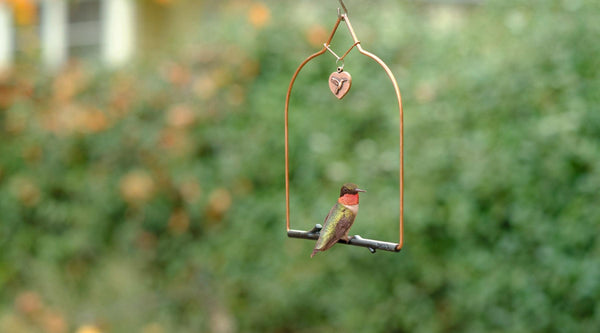
Identification: Males have a brilliant ruby-red gorget that flashes in direct light but can look black in shadow, an emerald-green back, and a dark forked tail. Females lack the red throat, showing white underparts and a green back instead.
Notable fact: With a global breeding population estimated at roughly 34 to 36 million, the Ruby-throated is the most common hummingbird in North America — and it earns that title while making one of the most demanding migrations of any hummingbird, with some individuals flying nonstop across the Gulf of Mexico.
Read the full Ruby-throated Hummingbird guide →

Pacific Coast
Anna's Hummingbird
Range: Year-round resident along the Pacific Coast from British Columbia to Baja California — one of the only hummingbirds most people in this region will see in winter.
Identification: Males have an iridescent rose-pink crown and throat (unlike most species, where the color is confined to the throat alone), with a metallic green back. Females have a green back and paler underside, sometimes with a small patch of pink on the throat.
Notable fact: Unlike nearly every other US species, Anna's doesn't migrate south for winter, making it the default "hummingbird you'll actually see" for much of the Pacific Coast in the colder months.
Read the full Anna's Hummingbird guide →

Allen's Hummingbird
Range: Breeds along a narrow strip of coastal California and southern Oregon, with a separate non-migratory population resident year-round on California's Channel Islands and parts of the Palos Verdes Peninsula.
Identification: Males are a brilliant orange-rufous overall with an iridescent orange-red gorget, closely resembling the Rufous Hummingbird — the most reliable difference is Allen's green (rather than rufous) back, though the two can still be difficult to distinguish in the field. Females are green above with rufous wash on the flanks and tail.
Notable fact: Despite being one of the most range-restricted hummingbirds in the country, Allen's is regularly reported wintering along the upper Texas and Louisiana Gulf Coast — a genuine surprise for a bird whose core range is a thin sliver of Pacific coastline.
Read the full Allen's Hummingbird guide →

Widespread Western Species
Black-chinned Hummingbird
Range: One of the most adaptable North American species, found from southern British Columbia to northern Mexico, across deserts, mountain forests, and even urban parks.
Identification: Males show a velvety black throat with a thin band of iridescent purple at the base, often appearing entirely black except in direct light. Females have a plain, pale throat.
Notable fact: Pumps its tail almost constantly while hovering — a genuinely useful field mark, since the very similar female Ruby-throated Hummingbird holds its tail still.
Read the full Black-chinned Hummingbird guide →

Rufous Hummingbird
Range: Breeds from the Pacific Northwest up into Alaska — the widest-ranging western species, recorded in nearly every US state and Canadian province at some point during migration.
Identification: Males are a brilliant orange-rufous overall with a fiery red-orange gorget.
Notable fact: Known as the most aggressive hummingbird species in North America — a single Rufous will readily defend a feeder against birds twice its size. Worth knowing, though: recent surveys have found the species in real decline, with population losses over the past several decades prompting increased conservation attention.
Read the full Rufous Hummingbird guide →

Calliope Hummingbird
Range: Breeds in mountain meadows of the Pacific Northwest and Rockies, wintering in Mexico.
Identification: North America's smallest hummingbird species, at about 3 inches long and roughly 2.5 grams — lighter than a penny. Males have a distinctive throat pattern of separate magenta-red streaks radiating outward, rather than one solid gorget.
Notable fact: Despite being the smallest bird in the US and Canada, Calliopes are fiercely territorial and have been documented chasing off birds as large as Red-tailed Hawks during breeding season.
Read the full Calliope Hummingbird guide →

Broad-tailed Hummingbird
Range: Mountainous regions of the western US, particularly high-elevation meadows, breeding up to 10,500 feet.
Identification: Males produce a distinctive metallic wing trill audible in flight — often the first clue to their presence before you spot the bird itself.
Notable fact: This species enters torpor on cold mountain nights, dropping its body temperature to around 54°F. Nesting females stay put in insulated nests to cope with the cold, while males often fly upslope overnight to escape pooled cold air in the valleys below.
Read the full Broad-tailed Hummingbird guide →

Desert Southwest Specialties
If you're in southern Arizona, New Mexico, or Texas, the list of species you might see grows considerably. This borderland region is widely considered the hummingbird hotspot of the US — one Arizona State University researcher has noted that parts of southeastern Arizona alone can host up to 14 species, more than anywhere else in the country.
Broad-billed Hummingbird
Range: Primarily a Mexican species that just reaches into the mountain canyons of southeastern Arizona, southwestern New Mexico, and occasionally southwestern Texas during breeding season, with a small but growing number now overwintering near the border.
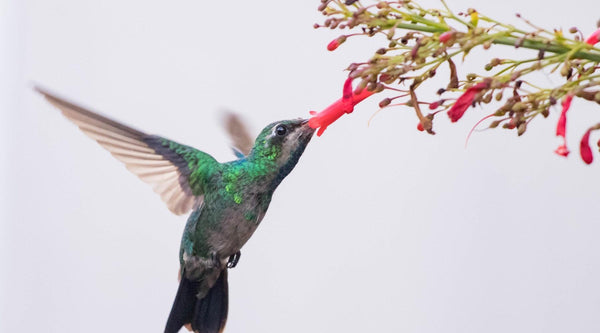
Identification: A bright red bill with a dark tip is the standout feature — unusual among North American hummingbirds, most of which have all-dark bills. Males show a rich blue-green throat and chest.
Notable fact: During courtship, the male performs a precision side-to-side flight display in front of the female, often compared to a hypnotist's swinging pocket watch.
Read the full Broad-billed Hummingbird guide →

Costa's Hummingbird
Range: Found across the arid landscapes and desert scrub of the Southwest.
Identification: Males have a deep violet-purple crown and throat that extends into elongated points along the sides — distinctive even among the region's many colorful species.
Notable fact: Enters torpor, a hibernation-like state that drops body temperature and metabolism, to survive cold desert nights or stretches with little available nectar — a genuine adaptation to its harsh desert habitat.
Read the full Costa's Hummingbird guide →

Buff-bellied Hummingbird
Range: Occurs mainly along the Gulf Coast, breeding in southern Texas and ranging into eastern Mexico.
Identification: A red bill with a dark tip, bronze-green upperparts, and a buff-colored belly.
Notable fact: Unlike most North American hummingbirds, this species regularly disperses northeast along the Gulf Coast after breeding rather than migrating south, showing up as far as Louisiana, Alabama, and the Florida Panhandle in fall and winter.
Read the full Buff-bellied Hummingbird guide →

Lucifer Hummingbird
Range: A true desert specialist with one real US stronghold: the Chisos Mountains of Big Bend, Texas, with smaller numbers in select canyons of southern Arizona and a small breeding population in southwestern New Mexico.
Identification: Look for a long, distinctly curved bill, a deeply forked tail, and a long purple gorget with a distinctive outward flare on males.
Notable fact: This species has a courtship display unlike any other hummingbird's — rather than displaying at a favorite perch or feeding area, the male performs his entire display directly at the female's own nest while she's building it or laying eggs.
Read the full Lucifer Hummingbird guide →

Rivoli's Hummingbird
Range: The mountain canyons of southeastern Arizona and southwestern New Mexico represent the northern edge of a range that otherwise runs south through Mexico to Nicaragua.
Identification: One of the two largest hummingbirds in the US — males appear almost blackish at first glance, but flash a glittering green gorget and violet crown when the light hits just right.
Notable fact: Its common name has officially changed twice in the last 200 years — from Rivoli's, to Magnificent, and back to Rivoli's again in 2017, once genetic research confirmed it was a distinct species from its closest relative.
Read the full Rivoli's Hummingbird guide →

Blue-throated Mountain-gem
Range: A genuinely narrow US range — sky-island canyons of southeastern Arizona and the Chisos Mountains of southwestern Texas.
Identification: The largest hummingbird species breeding in the United States. Males have a brilliant sapphire-colored gorget that glitters only in good, direct light, while both sexes share double white stripes on the face and plain gray underparts.
Notable fact: One of the only hummingbirds anywhere that sings actual duets — both males and females produce complex songs, sometimes performed together during courtship, a trait unknown in any other hummingbird found in the US.
Read the full Blue-throated Mountain-gem guide →

Violet-crowned Hummingbird
Range: One of the rarest and most range-restricted hummingbirds in the country, found regularly only in southeastern Arizona and a single known breeding site in southwestern New Mexico.
Identification: The only US hummingbird with no colorful throat gorget at all — identify it instead by clean white underparts, a glittering violet crown, and a long orange bill with a black tip.
Notable fact: More people have first seen this species at a single Arizona backyard — the Paton Center for Hummingbirds in Patagonia — than anywhere else on Earth.
Read the full Violet-crowned Hummingbird guide →

The Other 10: Rare, Accidental & Historic Hummingbirds of the US
We don't have dedicated species guides for these 10 just yet — that's on our list — but our research workbook already tracks where each one actually comes from and how it's turned up on U.S. soil, so here's the honest rundown while you wait on the full guides.
Berylline Hummingbird — Native to the highland forests of Mexico. First recorded in the US in 1964, it's now a near-annual summer visitor to the mountains of southeastern Arizona, and has even nested there a handful of times.
White-eared Hummingbird — Native range runs from northern Mexico south to Nicaragua. A nearly annual, uncommon visitor to southeastern Arizona, turning up in Texas in many years and, on rare occasion, as far afield as Alabama, Michigan, and Mississippi.
Amethyst-throated Mountain-gem — Native to the highlands of Mexico, Guatemala, El Salvador, and Honduras. One of the genuine rarities on this list: there are only two records ever north of Mexico, a male in the Davis Mountains of Texas and another in Québec, Canada — both in 2016.
Green-breasted Mango — Native from eastern Mexico south through Central America to Panama, with isolated populations in northeastern Colombia and northern Venezuela. Wanders into Texas repeatedly, with scattered US records as far as North Carolina and Wisconsin — almost always young, dispersing birds rather than adults.
Mexican Violetear — Native to the highland forests of Mexico and Central America. An infrequent but nearly annual visitor to Texas, with individuals occasionally straying as far as Wisconsin, Michigan, and Canada. The first North American record came at Santa Ana National Wildlife Refuge in south Texas back in 1961, and Texas alone had logged 81 records by 2017.
Plain-capped Starthroat — Native from northwestern Mexico to Costa Rica. A rare but increasingly regular summer visitor to canyons in southeastern Arizona, with occasional New Mexico records as well.
Bumblebee Hummingbird — Endemic to Mexico's two major mountain ranges, the Sierra Madre Occidental and Sierra Madre Oriental. The entire US record is historic: two specimens collected in Ramsey Canyon, Arizona, in 1896 — an adult female now held at the Smithsonian's National Museum of Natural History (catalog no. USNM 153886) and an immature female at UC Berkeley's Museum of Vertebrate Zoology (MVZ 10299) — and nothing confirmed in the country since.
Cinnamon Hummingbird — Native range runs along Mexico's Pacific Slope from Sinaloa south into northwestern Costa Rica. Just two US strays are on record — one in Arizona around 1992, and one near the New Mexico/Texas border around 1993.
Bahama Woodstar — Endemic to the Bahamas. A genuine rarity on the Florida peninsula, but one with real paper trail: the first confirmed US record, at Lantana, Florida in 1971, was documented in the peer-reviewed ornithological journal The Auk, and a handful of further Florida records have followed since.
Xantus's Hummingbird — Endemic to central and southern Baja California, Mexico. An accidental vagrant, with records reaching Southern California and, remarkably, one all the way to British Columbia.
| Species | Native Range | Status in the US |
|---|---|---|
| Berylline Hummingbird | Highland Mexico | Near-annual summer visitor, SE Arizona |
| White-eared Hummingbird | Northern Mexico to Nicaragua | Nearly annual, SE Arizona; occasional TX |
| Amethyst-throated Mountain-gem | Mexico, Guatemala, El Salvador, Honduras | Historic — one 2016 Texas record |
| Green-breasted Mango | Eastern Mexico to Panama, N. South America | Rare vagrant, mostly TX Gulf Coast |
| Mexican Violetear | Highland Mexico to Central America | Nearly annual, Texas; wide-ranging strays |
| Plain-capped Starthroat | Northwestern Mexico to Costa Rica | Rare, increasingly regular, SE Arizona |
| Bumblebee Hummingbird | Mexico (endemic) | Historic only — two 1896 Arizona specimens |
| Cinnamon Hummingbird | Western Mexico to NW Costa Rica | Historic — two strays, AZ and NM/TX border |
| Bahama Woodstar | The Bahamas (endemic) | Rare vagrant, Florida |
| Xantus's Hummingbird | Baja California, Mexico (endemic) | Accidental, Southern California |
Quick Reference
| Species | Region | Key Field Mark |
|---|---|---|
| Ruby-throated | Eastern US | Ruby-red gorget, only eastern breeder |
| Anna's | Pacific Coast (year-round) | Rose-pink crown and throat |
| Allen's | Coastal CA/OR | Rust-orange, green (not rufous) back |
| Black-chinned | Widespread West | Black throat, thin purple band, tail-pumping |
| Rufous | Pacific NW to Alaska | Overall orange-rufous, aggressive |
| Calliope | Mountain West | Smallest US species, streaked magenta throat |
| Broad-tailed | Mountain West | Audible wing trill in flight |
| Broad-billed | Desert Southwest | Bright red bill with dark tip |
| Costa's | Desert Southwest | Elongated violet-purple gorget |
| Buff-bellied | Gulf Coast/Texas | Red bill, buff belly |
| Lucifer | Desert Southwest (Big Bend, TX) | Curved bill, deeply forked tail |
| Rivoli's | Desert Southwest | Large, dark; violet crown, green gorget |
| Blue-throated Mountain-gem | Desert Southwest | Largest US species, sapphire gorget |
| Violet-crowned | Desert Southwest (AZ/NM) | No colorful gorget; violet crown, orange bill |
Key Takeaways
- All told, 24 hummingbird species have been documented in the US — the 14 profiled above in depth, plus 10 more known only from rare, accidental, or historic records.
- Range and season are the most reliable identification tools — a breeding-season hummingbird in the eastern US is almost certainly a Ruby-throated.
- Four species (Ruby-throated, Black-chinned, Anna's, Rufous) cover the majority of the continental US between them.
- The Desert Southwest hosts by far the greatest diversity, with seven specialty species rarely seen elsewhere in the country, plus most of the 10 rare/accidental species besides.
- Male gorget (throat patch) color is the most useful visual field mark, but it's iridescent and can look black without direct light hitting it.
- Females and immature birds are often difficult or impossible to distinguish between similar species — lean on range and timing when the throat isn't a reliable clue.
Frequently Asked Questions
How many hummingbird species are there?
Worldwide, there are 366 recognized hummingbird species. Far fewer reach the United States — 24 species have been documented here in total, including rare and historic records, though only 14 breed regularly or turn up reliably enough to have their own dedicated species guide.
How many hummingbird species are in North America or the US?
24 hummingbird species have been documented in the US once every historic and accidental record is included. Of those, 14 breed regularly or occur reliably enough to be considered the core US species; the other 10 are rare vagrants or single/double historic records that wandered north from Mexico, Central America, or the Bahamas.
What is the most common hummingbird in the US?
It depends on region. In the East, the Ruby-throated Hummingbird is essentially the only breeding species, with a global population estimated around 34 to 36 million. In the West, Anna's and Rufous Hummingbirds are the most widely encountered.
Which hummingbird is the rarest in the US?
Among species seen with any regularity, the Violet-crowned Hummingbird is the rarest, limited to a small area of southeastern Arizona and a single known breeding site in southwestern New Mexico. True accidental and historic visitors are rarer still — the most extreme case is the Bumblebee Hummingbird, which hasn't been confirmed in the US since two specimens were collected in 1896.
What states have the most hummingbird species?
Arizona is the clear leader, with parts of the southeastern part of the state hosting as many as 14 species thanks to its mix of desert, canyon, and sky-island habitats along the Mexican border. Texas and New Mexico follow, driven by the same borderland diversity.
How do I identify a hummingbird species?
Start with range and season, since that narrows the possibilities significantly before you even look at the bird. Then check the male's gorget (throat patch) color, overall body coloration, and size — keeping in mind gorget color is iridescent and can appear black without direct light. Females and immatures are often best identified by range and timing alone.
Which hummingbirds come to backyard feeders?
Every widespread US species will readily use a feeder: Ruby-throated in the East; Anna's, Black-chinned, Rufous, Broad-tailed, Allen's, and Calliope across the West; and most of the Desert Southwest specialties in their narrow ranges. Use a simple nectar of one part table sugar to four parts water, skip the red dye, and clean the feeder every few days.
What is the smallest hummingbird in the US?
The Calliope Hummingbird, at about 3 inches long and roughly 2.5 grams, is the smallest bird in the United States and Canada — lighter than a penny.
What is the largest hummingbird in the US?
The Blue-throated Mountain-gem is the largest species that breeds in the country, found only in a handful of sky-island canyons in southeastern Arizona and the Chisos Mountains of Texas.
Do any hummingbirds stay in the US year-round?
Anna's Hummingbird is the main exception, remaining along the Pacific Coast through winter rather than migrating south. A small and growing number of Allen's, Broad-billed, and Violet-crowned Hummingbirds also now overwinter near feeders in parts of the Southwest, a pattern that's become more common in recent decades.
Will Pop's Birding cover the other 10 species in more detail?
Yes — full species guides for the rare, accidental, and historic species are in the works. For now, this overview covers the essentials for each one: where it actually calls home, and how it ended up on a US checklist at all.
Ready to attract more hummingbirds to your own backyard? Explore our feeders, nectars, swings, and wildflower seed blends to start building your own hummingbird sanctuary today. Or find your state in our full hummingbird guide by state series.

Bethany Sloan has served as General Manager of Pop's Birding since 2010, continuing the legacy of her grandfather, William "Pops" Sloan, inventor of the Original Hummingbird Swing. A lifelong hummingbird enthusiast, educator, and independent researcher, she leads the company's educational content, including its 50-State Hummingbird Guide series, Regional Guide, Species Guide and Hummingbird Learning Center. Bethany combines scientific research, regional migration data, and more than 16 years of hands-on experience to create trusted educational resources for bird enthusiasts across North America.