Jul 26, 2026
Anna's Hummingbird Range: A Century of Expansion
Draw Anna's Hummingbird's range map in 1900 and you'd get a thin ribbon of California coast — a few hundred miles from northern Baja up to San Francisco Bay, and that was the entire world population of the species. Draw it today and it reaches Vancouver Island, touches Alaska, and turns up as far east as New Mexico and the Dakotas.
Nothing about that is normal. This is a bird that doesn't migrate — no seasonal route, no annual round trip. What moved was the range itself, crawling north and east across a century and never once retreating. This guide covers where Anna's Hummingbird lives today, how it got there, and the conservation picture behind one of the more remarkable expansions in North American bird history. Looking for a different species? Start with our full overview of hummingbird species found in the United States.
Quick answer: Anna's Hummingbird held a narrow California-coast range until the early 1900s, then expanded roughly 700 miles north over the following century, driven by ornamental plants, backyard feeders, and the birds' own shift in nesting timing. Today it's a year-round resident across California, Oregon, Washington, Arizona, Nevada, and parts of Idaho, with real but rare records reaching as far as Alaska and the Dakotas. Unlike nearly every other North American hummingbird, it barely migrates at all.
Quick Facts
- Historic range (pre-1900): a narrow strip of Pacific coast from northern Baja California to the San Francisco Bay area — the entire world population
- Current range: year-round from California to coastal British Columbia, and east through Arizona, Nevada, and parts of Idaho
- Range expansion: roughly 700 miles north beyond the historic range in about a century
- Population: an estimated 9.6 million, and still growing — over 2% per year between 1966 and 2019 per the North American Breeding Bird Survey
- Conservation status: Least Concern (IUCN); 7 out of 20 on Partners in Flight's Continental Concern Score
- Claim to fame: the hummingbird with the northernmost year-round range of any species on Earth
One of the Most Remarkable Range Expansions in North American Bird History
This is arguably the single most interesting fact about Anna's Hummingbird, and it's backed by real, peer-reviewed research: in the early 1900s, this species bred only along a narrow strip of the Pacific coast, from northern Baja California up to the San Francisco Bay area. Today, Anna's Hummingbirds breed as far north as Vancouver Island, British Columbia — roughly 700 miles beyond the northern edge of that historic range — and east through Arizona, with an increasing presence in New Mexico and West Texas.
A 2019 study by researcher C.J. Battey used Christmas Bird Count records going back to the early twentieth century to document the pattern precisely: populations began growing in California in the early 1900s, and sites across the Pacific Northwest show a striking fit to simple exponential-growth models following colonization in the 1960s and 1970s. Battey's conclusion is that the expansion reflects an ecological release driven by a mix of three things: introduced ornamental plants (eucalyptus chief among them), human facilitation such as the explosion of backyard hummingbird feeders, and the birds' own phenological acclimation — northern Anna's now delay the start of the nesting season by at least 16 days. A separate, earlier study — Greig, Wood & Bonter (2017) — reached a consistent conclusion using citizen-science feeder-watching data, tying the winter range expansion specifically to urbanization and supplemental feeding.
Genetic research adds another layer to the story. A 2023 study published in Molecular Ecology (Adams et al.), carried out in partnership with the Bird Genoscape Project at UC Davis, examined the genetic makeup of 241 individuals across the species' full range and found high genetic diversity, low divergence, and no strong evidence of selection on the northern and eastern expansion fronts — Anna's Hummingbird behaves as a single, largely uniform group with no clear barriers to gene flow. The researchers suggest the expansion may simply be too recent, starting in earnest around 1940, for local adaptation to show up in the genome yet — though the authors are careful to note that a genome scan like this can miss smaller, more gradual genetic shifts, so "no strong signal of selection" isn't the same as "no adaptation at all." What the data does support: Anna's Hummingbird likely didn't need to evolve new cold tolerance to survive in Seattle winters — it found enough artificial nectar and ornamental shelter to make survival possible without it.
More recent research has also found the species pushing upward in elevation. A 2022 study in the Journal of Experimental Biology (Spence, LeWinter & Tingley) worked with Anna's across their current elevational range — a range the journal describes as reaching comfortably to about 2,800 m, roughly 9,200 feet, in California's mountains. That upward shift tracks rising temperatures. But the study also found a ceiling: carried to about 1,000 m above their present range limit, the birds' hovering metabolic rate dropped sharply, suggesting thinner air may be what ultimately stops them from climbing further to escape a warming climate.
Key papers: Battey, C.J. (2019). "Ecological Release of the Anna's Hummingbird during a Northern Range Expansion." The American Naturalist 194(3):306–315. — Greig, E.I., Wood, E.M. & Bonter, D.N. (2017). "Winter range expansion of a hummingbird is associated with urbanization and supplementary feeding." Proceedings of the Royal Society B 284(1852):20170256.

How we made this map: each state's status is based on a decade of eBird observations, verified against state wildlife agencies and bird records committees. Darker shading marks where the species is seen more frequently. The three status tiers reflect whether Anna's resides year-round, passes through seasonally, or turns up only rarely in each state.
Following Anna's Across the Regions
One species, one direction. Most range maps in this series describe where a bird migrates to and from each year. Anna's doesn't migrate — the map below describes where a century-long expansion has reached so far, and it's still moving at the edges. All eight U.S. birding regions now have at least a documented record.

Every Anna's alive before 1900 lived within a few hundred miles of San Francisco Bay. California still holds birds year-round today, nesting as early as December. Alaska sits at the opposite end of the story entirely — real and recurring since the 1970s, but Alaska's own wildlife agency classifies it "casual," not an established resident population.
Pacific & West guide →
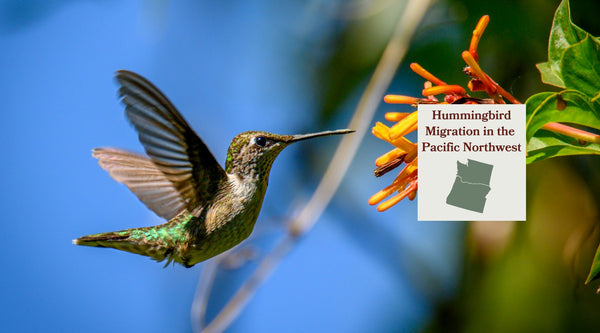
Washington and Oregon both hold Anna's year-round, a status the species has carried since colonizing the region in the 1960s and 70s. Coastal British Columbia just beyond the border marks the northernmost year-round hummingbird range on Earth — the reason a Seattle-area feeder gets visitors in January when nowhere else in the country does.
Pacific Northwest guide →
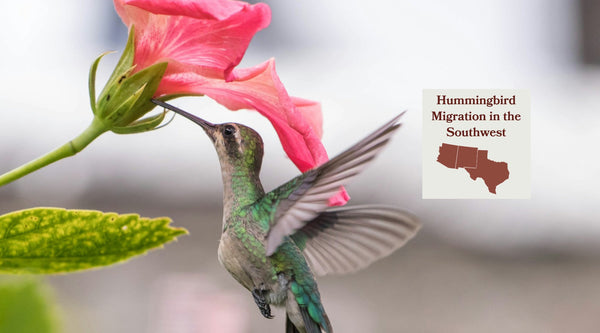
Arizona holds Anna's year-round, though many individuals shift west toward California after nesting and return in late summer — the closest thing this species has to real migration. New Mexico and Texas tell a different, more seasonal story — both fill in each fall and winter and largely empty again by spring, with Texas records concentrated specifically in the Trans-Pecos region rather than statewide.
Southwest guide →
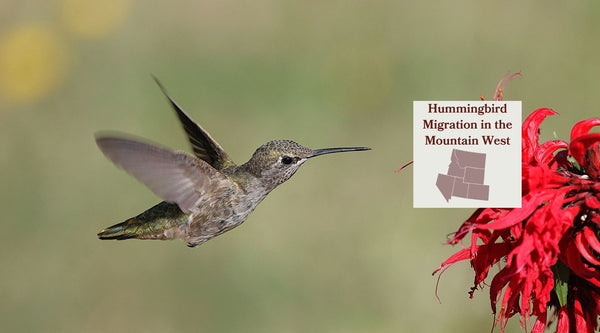
Idaho and Nevada both hold year-round status now — Idaho's presence is concentrated in specific areas rather than statewide, but includes confirmed overwintering and an actual nest near Boise. Montana sees a real, recurring fall pattern without full residency. Utah, Colorado, and Wyoming remain genuine rarities — Utah's own bird records committee codes it a rare winter visitor only, not a resident.
Mountain West guide →
Louisiana and Arkansas both see a genuine, if low-frequency and irregular, winter presence — real multi-week individual records exist, but this is not an annual expectation the way it is out west. The rest of the region — Florida, Georgia, Alabama, Mississippi, North Carolina, South Carolina, Tennessee, Kentucky, and Virginia hold real but rare individual records — part of the same wandering-western-hummingbird pattern the East sees from Rufous and other species.
Southeast guide →
Every state in the region — Illinois, Indiana, Iowa, Michigan, Minnesota, Missouri, Ohio, and Wisconsin — carries at least one documented Rare-tier record. None of it is annual or predictable, but a fall or winter Anna's at a Midwest feeder is a real, if unlikely, possibility rather than an impossibility.
Midwest guide →
Kansas, Nebraska, North Dakota, South Dakota, and Oklahoma all sit at real Rare-tier status — genuine records exist, but this is the thinnest, least predictable part of the entire range.
Great Plains guide →
New Hampshire, New York, Pennsylvania, Maryland, and Delaware each carry genuine but rare individual records — the far eastern edge of a species whose entire range began, and largely still centers on, the opposite coast. Maryland's two records and Delaware's single record — an immature female that overwintered at a Newark feeder in 2012, drawing birders from three states before molting into male-type plumage — both predate the era of routine eBird coverage, confirmed instead through each state's own bird records committee.
Northeast & Mid-Atlantic guide →The map tells two different stories depending on which side you look at. The West Coast core is settled and stable — a fixture, not news. Everything east of the Rockies is still the open question: real records exist almost everywhere, but almost none of it is annual yet. Whether that changes is the same open question Idaho was fifteen years ago.
Conservation: A Population Still Growing
Anna's Hummingbird is rated Least Concern on the IUCN Red List, and Breeding Bird Survey data show the population increasing by over 2% per year between 1966 and 2019, with a global population now estimated at 9.6 million. Unlike most conservation stories in this series, this isn't a species to worry about — it's one that's actively spreading.
The strongest growth isn't happening where the species has been established longest. Research points to the fastest growth occurring at the northern and inland edges of the current range — not in California, where Anna's has been established for the better part of a century and may be approaching capacity. Which is another way of saying the interesting part of this range map is the outside edge of it, not the center.
Habitat
In its original native range, Anna's Hummingbird favors chaparral with nearby broad-leaved trees, especially coast live oak, along with montane woodlands and forests at higher elevations. The expanded range tells a different habitat story: the species is now strongly associated with — though not restricted to — urban and suburban landscapes, meaning this hummingbird's northward and eastward growth has been, in a very real sense, a story of adapting to human landscaping as much as colonizing wild habitat. Today, Anna's Hummingbird is common in yards, parks, residential streets, eucalyptus groves, riverside woodland, coastal scrub, and oak savanna — and, everywhere it can find one, around a well-maintained feeder.

Frequently Asked Questions
Where do Anna's Hummingbirds live?
Year-round along the Pacific Coast from Baja California north through California, Oregon, and Washington, and inland through Arizona, Nevada, and parts of Idaho. Real but rare records reach as far as Alaska, the Dakotas, and the Northeast — part of an expansion that's still ongoing at the edges.
Are Anna's Hummingbirds still expanding their range?
Yes. Breeding Bird Survey data show the population increasing by over 2% per year from 1966 to 2019, and the fastest growth is at the northern and inland edges rather than in the California core.
Do Anna's Hummingbirds migrate?
Mostly not. Most populations are year-round residents, which is what makes the range expansion so unusual — the birds didn't establish a migration route, the range itself moved. The exception is in parts of the desert Southwest, especially Arizona, where some birds shift west toward California after nesting and return in late summer.
Why did Anna's Hummingbird's range expand so dramatically?
Research points to a combination of factors rather than a single cause: widely planted non-native ornamental trees, especially winter-blooming eucalyptus; human facilitation including the rise of backyard feeders; and the birds' own adjustment of their nesting calendar in northern climates.
Can Anna's Hummingbirds show up outside their normal range?
Yes. Individual birds turn up well east of the Rockies most years, especially in fall and winter, part of a broader pattern of western hummingbirds appearing in the East. These are rare-visitor records rather than an established population — a genuine surprise when one arrives, but not a species to expect outside the West.
Why We Created This
Pop's Birding is a third-generation, Idaho-based family business that invented the hummingbird swing. One of the questions our customers ask us most often is "why do I have hummingbirds in my yard in January?" Most range content for this species describes the current footprint without explaining how genuinely unusual it is for a non-migratory bird to have moved 700 miles in a century. We built this guide around that story specifically, state by state, rather than treating the expansion as a footnote to a static range map.
How We Created This
Every range and population figure on this page is checked directly against its primary source — the actual peer-reviewed paper or state wildlife agency page, not a secondhand summary. State-by-state tier claims are cross-checked against our own verified species-status data, built from named records committees and agency checklists for each state, so the narrative text and the underlying classification stay consistent with each other.
Looking for the rest of the picture on this bird? See our Identification guide and Behavior & Family guide, or browse every species in our full U.S. hummingbird guide. At Pop's Birding, we believe every backyard — big or small — has room for a little more wonder. Explore our feeders, nectars, swings, and wildflower seed blends to start building your own hummingbird sanctuary today.

Bethany Sloan has served as General Manager of Pop's Birding since 2010, continuing the legacy of her grandfather, William "Pops" Sloan, inventor of the Original Hummingbird Swing. A lifelong hummingbird enthusiast, educator, and independent researcher, she leads the company's educational content, including its 50-State Hummingbird Guide series, Regional Guide, Species Guide and Hummingbird Learning Center. Bethany combines scientific research, regional migration data, and more than 16 years of hands-on experience to create trusted educational resources for bird enthusiasts across North America.