Jul 14, 2026
How to Attract Hummingbirds in Georgia: A Backyard Sanctuary Guide
Most people think of hummingbird season as a spring-through-summer thing, but the Georgia Department of Natural Resources has a name for what happens next: Georgia's "second hummingbird season," running from November through February. It's counterintuitive, but more hummingbird species turn up in Georgia during these quiet winter months than during the state's entire warm-weather breeding season — twelve species are on the official Georgia list, only one of them nests here, and nearly all the rest are cold-season visitors.
Whether you're gardening in Atlanta, Savannah, the north Georgia mountains, or the Peach State's rural heart, this guide will walk you through everything you need to turn your space into a Georgia hummingbird destination: when to expect them, how to size your setup to any space, feeder and nectar care, pest-safe cleaning, and the native plants and wildflower seed varieties that thrive in Georgia's climate.
The short version, if you're in a hurry:
To attract hummingbirds in Georgia, put up a leak-proof feeder filled with fresh, dye-free nectar in early March in south Georgia, mid-March in the Piedmont, and late March in the mountains — and leave it up year-round if you're on the coast. Keep it clean and refilled every 1–6 days depending on heat, skip the insecticide so hummingbirds can still hunt insects for protein, and plant native, nectar-rich flowers like red buckeye, coral honeysuckle, and cardinal flower so your yard offers real food alongside the feeder.
- Species you'll see: Ruby-throated as the state's only breeder; Rufous most winters, especially on the coast and in south Georgia; several rarer western species in ones and twos
- Best feeder type: leak-proof design with a comfort perch, like the AspenPerch® Hummingbird Feeder
- Best nectar: plain 4:1 water-to-sugar ratio, no red dye — or Pop's Nectar with added electrolytes and calcium
- Feeder timing: early March in south Georgia, mid-March in the Piedmont, late March in the mountains — year-round on the coast
- Busiest month: September, when Georgia's own breeding birds are joined by everything moving down from farther north
- Second season: November through February, for winter visitors — mostly on the coast and in south Georgia
- Nectar change frequency: every 1–2 days above 90°F, every 5–6 days below 70°F
- Pest control: no insecticide — use vinegar-water spray and HummGuard® nectar tips instead
- Top native plants: red buckeye, coral honeysuckle, cardinal flower, bee balm, eastern red columbine (varies by region — see below)
- Best wildflower planting window: October through November, for spring bloom timed to spring migration
Free download
Take Georgia with you
Everything on this page on one page you can print and keep by the back door — species, timing by region, feeder care, and the best native plants for your part of Georgia.
Download the Georgia cheat sheetOne page · PDF · free to print and share
What Types of Hummingbirds Are in Georgia?

Ruby-throated is Georgia's only breeding species and the bird behind nearly every sighting from March through October. Winter brings a genuinely different lineup — Rufous is by far the most common winter visitor, especially on the coast and in south Georgia, with Black-chinned next most regular. Beyond those three, Georgia's official state checklist runs to twelve species: Calliope, Anna's, Allen's, Broad-tailed, Broad-billed, Buff-bellied, Rivoli's, and Blue-throated Mountain-gem have all been documented here — almost entirely as winter visitors.
For full identification help — photos, field marks, Ruby-throated versus the winter visitors, and the full story behind Georgia's remarkable twelve-species list — see our complete Hummingbirds in Georgia species guide.
When Do Hummingbirds Arrive and Leave Georgia?
Georgia runs from barrier islands to the Blue Ridge, and hummingbird timing shifts by nearly a month across that span. The coast barely has an off-season at all; the mountains have the shortest season in the state.
Statewide Picture
One statewide breeder — Georgia's real winter rarities are too regionally concentrated to show at the state level. The region-by-region detail below, and Thomasville's numbers in particular, tell that part of the story.

How often Ruby-throated turns up on eBird checklists, week by week — statewide, 2016–2025.
Arrival Times by Region
| Region | First Arrivals | Reliably Present | Hang Feeders By |
|---|---|---|---|
|
Coast (Savannah, Brunswick) |
Present year-round | April – December | Leave up all year |
|
South Georgia (Valdosta, Thomasville, Albany) |
Mid-March | Late March – early October | Early March |
|
Piedmont (Atlanta, Macon, Columbus) |
Late March | Mid-April – early October | Mid-March |
|
North Georgia Mountains (Blue Ridge, Rabun, Dahlonega) |
Early April | Mid-April – mid-October | Late March |
Windows derived from eBird bar chart data (Cornell Lab of Ornithology), 2016–2025, for Chatham, Lowndes, Fulton, and Rabun counties, cross-checked against Georgia Department of Natural Resources and University of Georgia Extension guidance. "First arrivals" is the first week reporting rates rise clearly above the off-season baseline and keep climbing. Lowndes and Rabun counties have far fewer submitted sighting lists than Chatham or Fulton, so their week-to-week figures are less precise than the coastal and Piedmont numbers — the seasonal pattern is reliable, individual weeks less so.
This matches what Georgia DNR has long said: hummingbirds reach south Georgia in early March and the mountain counties a couple of weeks later. The data puts the full spread closer to four weeks, coast to Blue Ridge.
Leaving in the Fall
September is the busiest month almost everywhere in Georgia — the state's own breeding birds are joined by everything funnelling down from farther north, and by then the summer's young are flying too.
Then it ends quickly. Across the Piedmont and the mountains, sightings collapse through October and are essentially finished by month's end. Adult males slip away first, often by late July, while females and young move last. Georgia DNR puts the main departure around mid-October, with males leaving first and females and young following about two weeks later.
Want the full picture? Our Georgia hummingbird season calendar breaks the year down month by month and region by region — including the second season, and why the coast is busier in December than in March.
A Note on Winter Hummingbirds
Here's what the county-level data makes unusually clear: Georgia's winter hummingbirds are a coastal and south Georgia story. Around Savannah, hummingbirds are reported every single week of December, January, and February. Around Valdosta, most weeks. Around Atlanta and up in Rabun County, the winter figure is essentially zero — not rare, but absent.
Georgia DNR is clear about what those coastal and south Georgia winter birds usually are: Rufous is the most commonly seen wintering hummingbird in the state. Black-chinned is the next most regular, with Calliope, Buff-bellied, Broad-billed and others turning up in ones and twos.
Thomasville is the standout. This corner of south Georgia has a documented history of wintering hummingbirds, and Black-chinned in particular turn up there through December and January most years — a pattern local banders have been tracking for decades. Notably, Georgia's own breeding Ruby-throateds are absent there in midwinter; the birds that stay are western visitors.
There's a real caveat worth knowing, though. Female and immature hummingbirds are extremely difficult to identify in the field, and many winter reports are logged either as "Ruby-throated" by default or simply as "hummingbird species." The only way to know for certain is a licensed bander with the bird in hand — which is exactly why Georgia DNR asks the public to report winter hummingbirds to the Wildlife Conservation Section.
Pop's tip: Georgia's Wildlife Resources Division actively encourages residents to keep at least one feeder up through winter. It won't stop your Ruby-throateds from migrating on schedule — they move on day length, not food supply — and it's the single best way to attract, and help document, the state's excellent lineup of winter rarities.
When to Put Your Feeder Up (and Take It Down)
🗓️ Feeder Timing at a Glance
Put your feeder up: About two weeks before the first arrivals where you live — early March in south Georgia, mid-March in the Piedmont, late March in the mountains.
Take it down: About two weeks after the last hummingbird you see. Inland, that usually means late October or early November.
On the coast and in south Georgia, don't take it down at all. Hummingbirds are reported around Savannah every week of the winter, and a maintained feeder is how nearly all of Georgia's winter rarities get found.
Attracting Hummingbirds No Matter Your Space
You don't need acres of land to invite wonder into your yard. Hummingbirds are famously adaptable — all they're really looking for is a dependable food source, a safe place to perch, and a little color.

- Small patio or balcony: One feeder hung from a bracket or shepherd's hook, paired with a container of red or orange tubular blooms like scarlet sage, is plenty to get noticed. Hummingbirds are solitary feeders by nature, so a single feeder works great in tight spaces. See our guide to which hummingbird products work best on a small patio or balcony if space is tight.
- Average backyard: Add a mix of feeders and native blooms along a fence line or garden bed, and give your visitors a swing or two nearby to rest and survey their territory between sips.
- Large yard with trees: Take advantage of the shade. Hummingbirds prefer feeders and plantings tucked out of harsh, direct afternoon sun, with a nearby branch to perch on and watch for rivals. Spread multiple feeders far apart, since hummingbirds are territorial and will happily chase each other off a single feeder.
Choose a Saucer Type Feeder to Prevent Leaks
A feeder is only as good as what's in it — and how well it's kept. A leaky feeder does more than waste nectar: it can attract ants, bees, and other pests — turning your sanctuary into a mess that can deter hummingbirds.
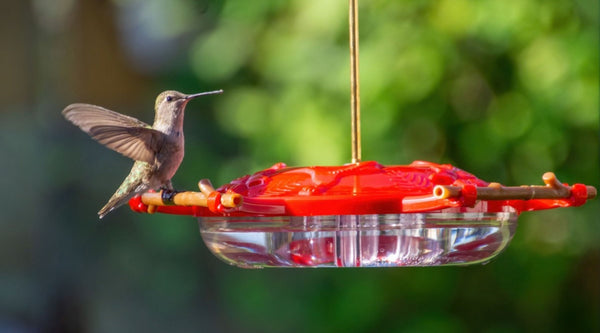
Saucer-style feeders, like our AspenPerch® feeder, hold nectar in a shallow basin below the ports, so there's no sealed air pocket to cause problems; bottle-style, gravity-fed feeders tend to leak more, especially in hot weather, since the air trapped above the nectar expands with heat and pushes nectar out through the ports.
Keeping your feeder filled is also important because hummingbirds need a dependable, fresh source they can count on every visit, not a gamble.
Shop the feeder
AspenPerch® Hummingbird Feeder, 8 oz

Leak-proof by design, with a patented Polyperch® comfort perch built in — so your hummingbirds can rest and feed at the same time instead of hovering through the whole meal. You get to see their tongue in action versus their back!
Shop the AspenPerch® Feeder →Keep Feeders Clean with Fresh Nectar
Clean your feeder every time you change the nectar, using warm water and a bottle brush — no soap residue, no bleach or harsh commercial cleansers. A little vinegar and water solution works great for breaking down sticky buildup or the beginnings of mold. See our full guide to cleaning a hummingbird feeder for the complete how-to.
Skip the Red Dye
Your feeder's color does the attracting; dyed nectar offers no benefit and isn't necessary.
Use a Real Nectar Recipe
Use a 4:1 plain sugar-water ratio to make your hummingbird nectar and read our full recipe guide to get your batch right. You can also use our nectar mixing calculator for any unit of choice to get the full breakdown on sugar to water ratio. Or skip the math with the ready-to-use option below.

Just getting your first feeder going? Nectarade® Ready to Use Liquid comes pre-mixed and formulated with added electrolytes and calcium to support hummingbirds through the demands of nesting season and migration — no dyes, no preservatives, nothing to commit to before you know how much traffic you'll get.
Shop the Ready to Use Nectar →Only Fill Enough to Change Often
An 8 oz feeder rarely needs to be topped all the way off — overfilling just means more nectar sitting around long enough to spoil, especially in Georgia's long, humid summers. A better approach is to fill only enough that your hummingbirds empty your feeder every couple of days.
Wondering how long nectar actually lasts? Our full guide on how long hummingbird nectar lasts covers exactly what spoilage looks like and why the timeline shifts with heat.
How Often to Change Nectar in Georgia
Sugar water ferments faster the hotter it gets — meaning you need to change your nectar according to how hot it is. When temps rise above 90°F that means changing your nectar every 1–2 days, where cooler temps below 70°F can be changed every 5–6 days. Use the table below as a general rule of thumb.
If the nectar ever looks cloudy before that window is up, change it early — cloudiness means it's already started to ferment. In winter, take steps to keep nectar from freezing overnight so it's ready for any second-season visitors.
Keeping Feeders Pest-Free Without Insecticide
Hummingbirds don't live on nectar alone — small insects make up a big part of their protein diet, especially for feeding chicks. That means insect spray is off the table around your feeding station; it removes a food source hummingbirds depend on and can be harmful to them directly. Here's how to handle the two most common pest problems without it.
Ants
Ants are drawn to any spilled or leaking nectar, and once a trail forms, they'll march straight up the feeder pole or hanging hook to reach the source. A vinegar-water spray works well as a deterrent — mist it around (not directly on) the feeder ports, and wipe down the hook or pole where ants tend to travel. A leak-proof feeder design also does real work here: with nothing dripping down in the first place, there's less to draw them in to begin with. Georgia's long, humid summers keep ants active well into fall, so this is worth staying on top of longer than in a drier climate.
Dealing with a real ant problem? See our full guide to keeping ants out of a hummingbird feeder for more fixes.
Bees and Wasps
Bees and wasps are trickier than ants, since they're after the same nectar hummingbirds are drinking, not just what's spilled. A vinegar-water spray around the ports can help, but the more reliable fix is a feeder design that keeps them out entirely rather than just discouraging them.
Bees and wasps still crashing the party? See our full guide to keeping bees away from a hummingbird feeder for the complete picture.

Still crashing the party? HummGuard® Nectar Tips slide onto the AspenPerch's feeding ports — a flexible membrane lets hummingbird beaks through and closes tight against anything bigger.
Shop HummGuard® Tips →Plant a Georgia Native Hummingbird Garden
Feeders are a wonderful supplement, but nothing beats real, native nectar. Native plants evolved right alongside Georgia's hummingbirds, so they bloom on the right schedule and produce exactly the nectar these birds are looking for.
Best Native Nectar Plants for Georgia
| Plant | Why It Works |
|---|---|
| Coral honeysuckle | The earliest bloomer of the group, timed to returning migrants. Named the Georgia Native Plant Society's Plant of the Year in 2019. |
| Red buckeye | An excellent early-season bloomer, ready right as the first Ruby-throateds arrive |
| Cardinal flower | Brilliant red spikes in late summer, right when hummingbirds need fuel most for migration |
|
Wild bergamot (Monarda fistulosa) |
A reliable midsummer favorite that also draws butterflies. This is the bee balm native across the whole state — scarlet beebalm (M. didyma) is also native, but naturally only to a handful of far-north Georgia counties. |
|
Plumleaf azalea (Rhododendron prunifolium) |
A Georgia specialty that blooms in July and August, filling the gap when little else is flowering |
| Eastern red columbine, fire pink, jewelweed, Indian pink | Additional natives commonly recommended across Georgia gardens, filling the gaps between the headliners |
Pop's tip: If you only have room to plant a few things, Georgia native-plant guides repeatedly point to the same trio: coral honeysuckle, red buckeye, and either bee balm or cardinal flower. Between them, you get coverage from the first spring arrivals through the last fall stragglers. And in winter, sap wells drilled by yellow-bellied sapsuckers become an important food source for the hummingbirds that stay.
If You're Near the Border
Hummingbirds don't check a map before deciding where to feed, so if you're near a state line, your best guide might be a blend of both.
Near Florida: Georgia's winter hummingbird season connects directly into Florida's mild winters — many of the same Rufous individuals likely move between the two. See our Florida hummingbird guide for more.
Near Alabama: Shared Gulf-to-Piedmont climate gradient and nearly identical native plant list. See our Alabama hummingbird guide for more.
Near Tennessee: Both states share the Southeast humidity problem that causes Palmer Penstemon to underperform. See our Tennessee hummingbird guide for more.
Near North Carolina: Northern Georgia's mountains share Blue Ridge species and timing with western North Carolina. See our North Carolina hummingbird guide for more.
Near South Carolina: Nearly identical coastal plain climate and native plant performance. See our South Carolina hummingbird guide for more.
To make this easy, our Perfect Little Sanctuary® Wildflower Seed Blend is designed to bring nectar-rich color into your yard with minimal fuss.
When to Plant the Perfect Little Sanctuary® Blend in Georgia

Fall is the best planting window across Georgia — aim for October through November. This timing is based on the germination needs of the blend's own 12 varieties: 9 of the 12 either need or benefit from a cold, moist stratification period before they'll germinate well, including Purple Coneflower, Black-Eyed Susan, and Lance-Leaved Coreopsis, and Georgia's cooler winter months provide exactly that. An early spring planting (March) is a solid backup window if you miss fall.

Ready to plant? Perfect Little Sanctuary® Wildflower Seed Blend packs all 12 varieties into one packet — no separate shopping trips before Georgia's fall planting window.
Shop the Seed →Top Performers in Georgia
The Perfect Little Sanctuary® blend contains 12 varieties, and several are Georgia natives that handle the state's heat and humidity well:
- Purple Coneflower (Echinacea purpurea) — a Georgia native and a long summer-to-fall bloomer
- Black-Eyed Susan (Rudbeckia hirta) — Georgia native, reliable through heat and humidity
- Lance-Leaved Coreopsis (Coreopsis lanceolata) — native and drought tolerant once established, though botanists note its original range is obscure because it spreads so readily from cultivation
- Perennial Lupine (Lupinus perennis) — native to Georgia, though naturally uncommon here and largely restricted to sandhills and dry open woods. An unusual early-season bloomer, and worth knowing that commercially sold seed is often northern stock rather than Georgia genotypes.
- White Yarrow (Achillea millefolium) — extremely low-maintenance once established, but we wouldn't call it a Georgia native. Botanists now treat the native eastern yarrow as a separate species, Achillea gracilis, while commercially sold A. millefolium seed is almost always European stock. Both handle Georgia's conditions perfectly well.
- Painted Daisy (Chrysanthemum carinatum) — not a North American native, but a dependable, heat-tolerant annual bloomer that rounds out the bloom season
Pop's tip: You don't need to do anything special to favor the strong performers — just sow the blend as directed. The rest of the mix still adds seasonal color, but these varieties are the ones that will do the heaviest lifting in a Georgia yard.
Give Them a Place to Rest
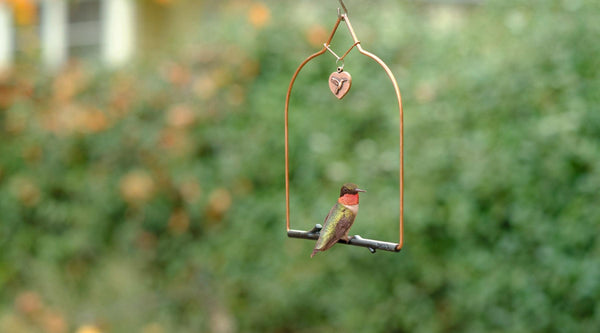
Hummingbirds spend a surprising amount of their day perched, not flying — watching their territory, digesting, and simply resting between feedings. It matters even more once a wintering Rufous or Black-chinned starts defending a coastal or south Georgia feeder through the cold months — more perches spread further apart genuinely means fewer standoffs. A Pop's Original Hummingbird Swing hung near your feeder gives them exactly that spot, and it turns your feeding station into a front-row seat for watching them up close. Hang it about 1 foot from your feeder, at the same height (Pop's rule of thumb), and don't be surprised if a hummingbird claims it as their own personal lookout post. Our guide to where to hang your hummingbird swing covers placement in more detail — height, distance, and the sightlines that make one get used.
Shop the Perfect Perch
Original Series Hummingbird Swing, Onyx

A second swing gives a chased-off bird its own perch to fall back to — especially useful once a wintering Rufous or Black-chinned shows up and starts guarding the feeder against every other visitor.
Shop the Original Swing →Keep Your Sanctuary Safe from Predators
A feeding station draws more than hummingbirds, and knowing what's actually worth worrying about — and what isn't — makes for a safer yard. Cats and window strikes are the two best-documented threats to hummingbirds around any home. See our full Hummingbird Predators guide for the complete picture.
Georgia's own Wildlife Resources Division has published a firsthand account of a rat snake catching and eating a hummingbird directly off a backyard feeder — the same account is careful to note that snake predation on Ruby-throated hummingbirds is genuinely rare, so there's no need for alarm, just a properly sized baffle on an isolated feeder pole if you'd rather not test it. A newer, more current concern in north Georgia specifically is the invasive Joro spider: its large webs can entangle and kill a hummingbird, even though DNR notes there's no confirmed evidence the spider itself preys on them.
Summary: Key Takeaways for Attracting Hummingbirds in Georgia
Building a hummingbird-friendly yard doesn't take a green thumb or a big budget — just a little consistency and the right setup. Here's everything from this guide in one place:
- Ruby-throated Hummingbirds are Georgia's only breeding species, but twelve species appear on the official Georgia state list — nearly all the rest are cold-season visitors during Georgia's "second hummingbird season."
- Rufous Hummingbird is by far the most common winter visitor. Georgia DNR has documented more than 100 in a single winter.
- Feeder timing depends on region: early March in south Georgia, mid-March in the Piedmont, late March in the mountains — and year-round on the coast.
- Winter hummingbirds are a coast and south Georgia story — around Savannah they're reported every week of the winter; around Atlanta and in the mountains, essentially never.
- Busiest month statewide is September, not spring.
- Any size space works — one feeder is plenty for a balcony; larger yards can support multiple feeders spaced apart, since hummingbirds are territorial.
- Use a leak-proof feeder with a comfort perch, like the AspenPerch®, and fill it only as full as it'll be drunk in a few days.
- Skip red dye in nectar; a plain 4:1 sugar-water ratio or Pop's Nectar (with electrolytes and calcium) both work.
- Change nectar every 1–2 days above 90°F, up to every 5–6 days below 70°F.
- Clean the feeder at every nectar change with warm water and vinegar — no soap or bleach.
- Never use insecticide near feeders; hummingbirds rely on insects for protein. Use vinegar-water spray and HummGuard® nectar tips for pest control instead.
- Add a hummingbird swing near the feeder to give them a place to rest and be observed up close.
- Cats and window strikes are the two best-documented threats to hummingbirds around any home; Georgia's own documented rat snake risk is real but rare, and the invasive Joro spider is a newer entanglement concern in the north of the state.
- Native, nectar-rich plants (coral honeysuckle, red buckeye, cardinal flower, bee balm) do more for hummingbirds long-term than feeders alone.
- Sow wildflower seed in October–November for blooms timed to spring migration; Purple Coneflower, Black-Eyed Susan, Lance-Leaved Coreopsis, and Perennial Lupine are the strongest Georgia performers in Pop's Perfect Little Sanctuary® blend.
Get these basics in place, and the wonder takes care of itself.
This guide covers what's specific to Georgia — the species, the timing, the plants that belong here. For the fundamentals that apply anywhere, including water sources, shelter, and how the pieces work together, read our guide to building the ultimate hummingbird sanctuary.
Frequently Asked Questions
A few of the questions we hear most from fellow hummingbird lovers across Georgia:
When should I put my hummingbird feeder out in Georgia?
It depends where you are. Early March in south Georgia, mid-March in the Piedmont around Atlanta, and late March in the north Georgia mountains. On the coast, don't take it down at all — hummingbirds are reported around Savannah every week of the year.
What are common mistakes when feeding hummingbirds?
The big ones in Georgia specifically: taking a feeder down in fall on a fixed calendar date rather than watching for your last sighting, which can mean missing the state's excellent winter rarities on the coast and in south Georgia; overfilling the feeder so nectar sits around long enough to spoil in Georgia's long, humid summers; and adding red dye, which is unnecessary since the feeder's own color does the attracting.
Do hummingbirds like feeders without perches?
They don't need one — hovering while feeding is their default — but they'll use a perch readily when it's there, resting between sips instead of burning energy the whole meal. That's the reasoning behind the AspenPerch's built-in Polyperch® comfort perch. It matters more than usual once a territorial wintering Rufous or Black-chinned is defending the feeder, since more perch options mean fewer birds forced to hover and wait their turn.
What happens if you don't boil sugar water for hummingbirds?
Nothing dangerous — boiling isn't strictly required. Its real purpose is helping sugar dissolve fully in cooler water and giving nectar a slightly longer shelf life before fermenting, not eliminating some hidden risk. What actually matters more in Georgia is sticking to the change schedule for the temperature — nectar left out through a long Georgia summer will ferment on its own timeline regardless of whether it was boiled going in.
Is it bad to leave my feeder up in fall?
Not at all — it's a myth that a feeder left up will delay migration. Hummingbirds migrate based on daylight and instinct, not food availability, and a full feeder just helps them refuel for the journey ahead. In Georgia it's actively encouraged, since it's the best way to attract the state's winter visitors.
What are the best plants to attract hummingbirds in Georgia?
Coral honeysuckle, red buckeye, and cardinal flower perform well across the entire state, with bee balm and eastern red columbine as strong supporting choices. Native, tubular, red or orange flowers are the general rule of thumb.
Georgia Hummingbird Resources
Audubon Chapters
Georgia is home to numerous local Audubon chapters across the state. Find the one closest to you with Audubon's Find Your Local Audubon tool.
If You Find an Injured or Grounded Hummingbird
Hummingbirds are protected under federal and Georgia state law, so only a licensed wildlife rehabilitator can legally care for one.
- Georgia DNR — Wildlife Rehabilitator List — the official statewide directory (Special Permit Unit: 770-918-6408)
- AWARE Wildlife Center (Lithonia/Stonecrest) — licensed to treat all native Georgia wildlife, including birds
- Wild Nest Bird Rehab (Decatur) — a nonprofit dedicated specifically to rehabilitating Georgia's injured and orphaned birds
Reporting a Winter Hummingbird
If you have a hummingbird at your feeder between November and February, Georgia DNR's Wildlife Conservation Section wants to hear about it. Winter records are how the state's remarkable hummingbird list has been built, and most of them come from backyard feeders rather than from field surveys.
- Georgia DNR — Hummingbirds in Your Backyard, with reporting details for the Wildlife Conservation Section (116 Rum Creek Drive, Forsyth, GA 31029; 478-994-1438)
- Georgia Hummer Study Group — the reporting portal Georgia DNR points winter hummingbird sightings toward
Hummingbird Research & Banding in Georgia
- Panola Mountain Banding Station (Panola Mountain State Park, Stockbridge), run through the Georgia Bird Observatory by master bander Charlie Muise — the longest-running year-round banding station in Georgia, operating roughly every two weeks since 2008. It bands migrants of many species, and its data supports Georgia DNR's native grassland restoration monitoring.
- Georgia Hummer Study Group — the state's dedicated hummingbird study organization, founded to advance banding and public understanding of hummingbirds.
Hummingbird Events & Festivals in Georgia
- Hogansville Hummingbird Festival (Hogansville) — a long-running community festival held the third weekend of October, and the principal fundraiser for the Hogansville Charitable Trust. Held every year.
- Annual Hummingbird Banding at Smith-Gilbert Gardens (Kennesaw) — a long-running public event featuring live hummingbird banding by Julia Elliott, one of only a small number of people in North America holding a federal Master Permit to band hummingbirds. Includes crafts and a scavenger hunt, and is included with garden admission. Held every year, in late August or early September.
Sources
- eBird bar chart data, Cornell Lab of Ornithology — Georgia statewide plus Chatham, Lowndes, Fulton, and Rabun counties, 2016–2025. Source for arrival, departure, and seasonal presence figures.
- Georgia Ornithological Society — 2023 Official State Checklist. Source for the twelve-species state list.
- Georgia Department of Natural Resources — Hummingbirds in Your Backyard. Source for nesting, brood counts, winter species status, and nectar guidance.
- Georgia DNR — Georgia's Second Hummingbird Season.
- Georgia DNR — Out My Backdoor: Hummingbird Predation, by Terry W. Johnson. Source for the rat snake and Joro spider predator notes.
- University of Georgia Cooperative Extension — Ruby-throated Hummingbirds, Georgia Spring Arrival.
- UGA Marine Extension & Georgia Sea Grant — Creating Native Plant Hummingbird Habitat in Georgia. Source for native nectar plant recommendations.
- Georgia Native Plant Society — 2019 Plant of the Year, Coral Honeysuckle.
Why We Built This Guide
Pop's Birding has been helping hummingbird lovers for three generations. One of the questions our customers ask most often is "How do I actually attract more hummingbirds to my yard?" — we built this guide to give a direct, practical answer, not a generic one. Georgia's real story runs against the grain of most feeder advice: only one species nests here, but the state hosts a genuine second hummingbird season each winter that most guides never mention at all, and the coast behaves nothing like the mountains just a few hours inland. Most feeder advice treats a state as having one arrival date and one departure date; that would be wrong for Georgia by weeks depending on where you live, and it would miss the winter story entirely. We wanted a guide that gets the everyday reality right and doesn't flatten out what makes Georgia's hummingbirds genuinely worth watching for, twelve months a year.
How We Built This Guide
The timing figures on this page come from the same eBird checklist data behind our Georgia hummingbird calendar — see that page for the full county-by-county methodology. The care and native-plant guidance is checked against Georgia DNR, University of Georgia Cooperative Extension, and Georgia Native Plant Society sources rather than generic national advice — including scarlet beebalm's naturally limited range to a handful of far-north Georgia counties, and that commercial seed for species like Perennial Lupine and White Yarrow is often non-Georgia stock even where the species itself is native. The predator note is checked directly against Georgia DNR's own documented rat snake predation event and its "genuinely rare" characterization, not a generic national list. This Georgia-specific framing is original to this page, not a rewrite of generic advice with Georgia's name inserted.
Haven't grabbed it yet? Download the free Georgia Quick Reference Guide — one page, print and keep.
Know before they arrive
You don't have to keep this calendar taped to the fridge. Insider Birding Access members get seasonal notes timed to your region — when to have feeders out, what the birds are doing right now, and what's worth doing in your yard this season. We take the guesswork out of the calendar. Joining takes about thirty seconds, and there's 10% off your first order in it.
Join Insider Birding Access →Free to join. 10% off your first order.
Your Georgia Backyard Sanctuary
Every real hummingbird sanctuary comes down to the same staples: mess- and pest-free food, a place to perch, native flowers, and fresh nectar. Here's everything from this guide to get all the bases covered in your own Georgia yard.


Bethany Sloan has served as General Manager of Pop's Birding since 2010, continuing the legacy of her grandfather, William "Pops" Sloan, inventor of the Original Hummingbird Swing. A lifelong hummingbird enthusiast, educator, and independent researcher, she leads the company's educational content, including its 50-State Hummingbird Guide series, Regional Guide, Species Guide and Hummingbird Learning Center. Bethany combines scientific research, regional migration data, and more than 16 years of hands-on experience to create trusted educational resources for bird enthusiasts across North America.