Sep 04, 2026
Hummingbirds in Wyoming: The Complete Guide to All 6 Species
Wyoming's documented hummingbird list runs to six species, per the official Wyoming State Bird List — fewer than Colorado's twelve and Utah's ten, but more than South Dakota, Nebraska, and Minnesota (eight each). Four species breed here, with genuinely different levels of confidence behind each: Broad-tailed and Calliope Hummingbird are both confirmed, common breeders — Wyoming alone hosts an estimated 3% of Calliope's entire global population — while Rufous and Black-chinned carry real, honest caveats about just how regular their breeding presence actually is.
Free download
All 6 species, one page
A one-page reference to every hummingbird documented in Wyoming — four breeders plus two rarer visitors, with each species' status and record history at a glance.
Download the Wyoming species guideOne page · PDF · free to print and share

All 6 documented Wyoming hummingbird species, grouped by tier — statewide eBird data, 2016–2025, cross-checked against the official Wyoming State Bird List (WBRC/WGFD/WYNDD).
The Hummingbirds You're Most Likely to See
Broad-tailed Hummingbird Breeds Here
Wyoming's most widespread breeding hummingbird, confirmed across the state's mountain and foothill habitats. Statewide eBird frequency peaks near 10% in late August, and county-level activity runs even higher — 22% in Albany County, 21% in Lincoln County. The Western Hummingbird Partnership names Wyoming among the species' core breeding states. A record-holder, too: the oldest known wild hummingbird ever documented in the United States was a Broad-tailed female who lived to be 12 years old.

Quick ID: Males have a rose-magenta throat and produce a loud, distinctive metallic wing trill in flight — often heard before seen. Females show green throat spotting rather than solid color, with a pale eyering that helps separate her from similar species.
Rufous Hummingbird Breeds Here
Genuinely confirmed as a Wyoming breeder — nesting has been documented near Yellowstone, Cody, Jackson, and Green River. But Wyoming's own wildlife agency is refreshingly honest about the limits of that confirmation: "it is uncertain if Rufous Hummingbird is a regular breeder" in the state, and "most occurrences in the state likely represent fall migrants." The species mostly bypasses Wyoming heading north each spring, since its northbound route hugs the Pacific Coast — nearly every Wyoming sighting is a bird already migrating south. It's ranked a genuine conservation priority here (Species of Greatest Conservation Need) precisely because of that scarcity, even while carrying the same Breeding tier as the state's two truly common species below.

Quick ID: Males glow with a fiery orange-red throat and a coppery-orange body — one of the most recognizable hummingbirds in North America. Females and immatures are green above with rusty flanks and rufous patches at the base of the tail.

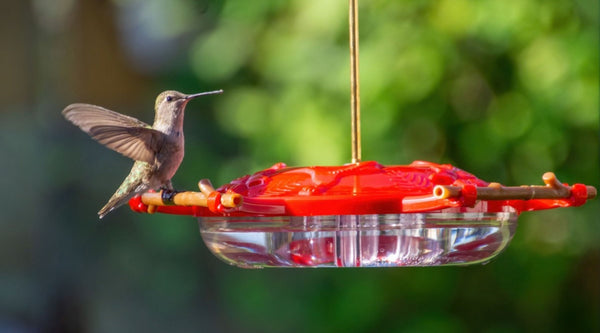
An Extra Feeder for Your Broad-tailed and Rufous
Broad-tailed is Wyoming's most widespread confirmed breeder, and Rufous adds a genuine — if less certain — presence of its own each summer. A second feeder gives both room to feed without crowding the same station.
Shop AspenPerch Feeder →Calliope Hummingbird Breeds Here
A genuinely significant global stronghold. Wyoming's own wildlife agency estimates roughly 3% of the entire world population — about 70,000 birds — breeds in the state's mountain meadows, though the agency itself cautions this figure is likely on the high side given how little observation data it rests on. Breeding is described as "profuse" specifically in Jackson Hole and Story. Statewide frequency peaks near 2.5%, with real county-level peaks reaching 7% in Teton County.

Quick ID: North America's smallest breeding hummingbird, with a hunched posture and short tail. Males have a unique streaked, ray-like magenta throat unlike any other species' solid gorget. Females are tiny even by hummingbird standards, with very little rufous in the tail.
Black-chinned Hummingbird Breeds Here
Present in Wyoming, but worth being precise about: breeding is "suspected," not confirmed. Wyoming's own Species Account documents the bird across 13 of the state's 28 latitude/longitude survey blocks, but calls the evidence "circumstantial," concentrated in a single block near Green River. Only 3 of those 28 blocks carry a confirmed observation ever accepted by the Wyoming Bird Records Committee, and just 5 total observations have been logged statewide since 1991. A real, if genuinely thin, presence — unlike Broad-tailed and Calliope, which are both unambiguously confirmed breeders.

Quick ID: Males show a velvety black throat, only revealing a thin purple band in direct light — otherwise it just looks solid black. Females are plain and pale-throated, best told apart by white-tipped outer tail feathers and a small white spot behind the eye.

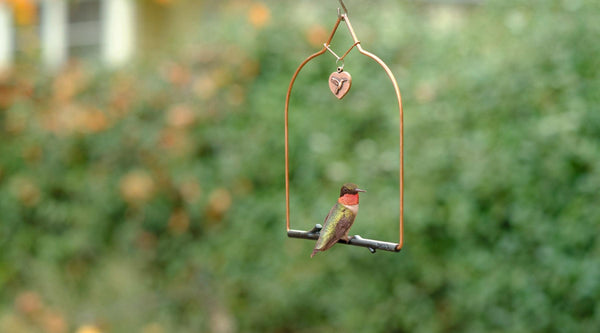
A Little Throne for Your Calliope and Black-chinned
Wyoming hosts an estimated 3% of the entire global Calliope population, and Black-chinned adds a thinner, genuinely suspected presence in the state's warmer corners. A perch nearby gives either species a vantage point to rest and defend its space.
Shop Charm Redwood Swing →If You're Lucky: Wyoming's Documented Rarities
Two more species have accepted Wyoming records, and both are genuinely extreme rarities — a handful of occurrences each, ever.
Anna's Hummingbird Historic / Accidental
Just 3 total known occurrences in Wyoming, ever — 2 accepted by the Wyoming Bird Records Committee plus 1 additional eBird observation. No breeding has ever been reported.

Quick ID: The only North American hummingbird with a fully colored crown as well as throat — males glow rose-pink from head to throat. Females show a central patch of rose-red spotting on an otherwise plain throat, with a stocky, broad-tailed build.
Ruby-throated Hummingbird Historic / Accidental
About as rare as it gets in Wyoming — exactly 2 accepted records ever, the Wyoming Bird Records Committee's scarcest possible tier, one notch below even a standard "Rare" designation. Wyoming sits entirely outside the species' mapped breeding range, which runs only as far west as roughly the 100th meridian.

Quick ID: Males flash a brilliant ruby-red throat in good light, but it reads as solid black most of the time — the forked black tail is the more reliable everyday mark. Females have a plain whitish throat and a more rounded, white-tipped tail.
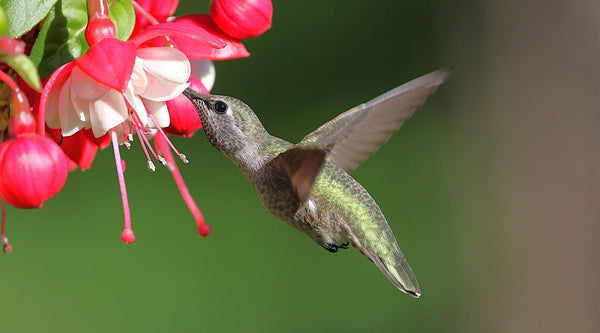
Give Every Visitor a Reason to Stay
Anna's and Ruby-throated have shown up in Wyoming just a handful of times combined, ever. Real nectar sources give the next unexpected visitor — common or exceptionally rare — a reason to stick around long enough to be seen and confirmed.


Wyoming Hummingbirds at a Glance

Statewide peak eBird frequency, 2016–2025. Anna's and Ruby-throated Hummingbird both sit at the ~0.15% eBird rounding floor and aren't plotted here — their real record histories, just 2–3 occurrences ever, are documented in the table and species write-ups above.
| Species | Status | Wyoming Records |
|---|---|---|
| Broad-tailed Hummingbird | Breeding | Confirmed common breeder, statewide dominant species; frequency peaks near 10%. |
| Rufous Hummingbird | Breeding | Confirmed breeding at 4 specific sites, but WGFD itself calls regular breeding "uncertain." |
| Calliope Hummingbird | Breeding | Confirmed common breeder; an estimated 3% of the global population nests in Wyoming. |
| Black-chinned Hummingbird | Breeding | Breeding "suspected," not confirmed; only circumstantial evidence, concentrated near Green River. |
| Anna's Hummingbird | Historic / Accidental | 3 total occurrences ever (2 WBRC-accepted + 1 eBird); no breeding reported. |
| Ruby-throated Hummingbird | Historic / Accidental | 2 accepted records ever — WBRC's scarcest possible tier. |
Frequently Asked Questions
How many hummingbird species have been recorded in Wyoming?
Six, per the official Wyoming State Bird List — four species breed here (Broad-tailed, Rufous, Calliope, and a suspected Black-chinned population), and two (Anna's and Ruby-throated) are documented rarities with just a handful of records each. That's fewer than Colorado's twelve and Utah's ten, but more than South Dakota, Nebraska, and Minnesota (eight each).
Is Wyoming really important for Calliope Hummingbird?
Yes, genuinely — Wyoming's own wildlife agency estimates roughly 3% of the entire global Calliope Hummingbird population breeds in the state's mountain meadows, an estimated 70,000 birds. The agency itself cautions this figure is likely on the high side given limited observation data, but it's still a real, notable share of a species whose entire range is confined to western North America.
Does Rufous Hummingbird breed in Wyoming?
Confirmed breeding has been documented at four specific sites — near Yellowstone, Cody, Jackson, and Green River — but Wyoming's own wildlife agency is honest that it's uncertain whether this is a regular, annual pattern. Most Wyoming sightings likely represent fall migrants passing through, not local nesters, and the species is ranked a genuine conservation priority (Species of Greatest Conservation Need) specifically because of that scarcity.
Does Black-chinned Hummingbird breed in Wyoming?
Probably, but it's honestly not confirmed. Wyoming's own wildlife agency calls it "breeding suspected" rather than confirmed — only circumstantial evidence exists, concentrated in the Green River area, and just 5 total observations have been logged statewide since 1991. It's a real but genuinely thin presence, unlike Broad-tailed and Calliope, which are both confirmed common breeders.
How rare is Ruby-throated Hummingbird in Wyoming?
About as rare as it gets — exactly 2 accepted records ever, the Wyoming Bird Records Committee's scarcest possible category. Wyoming sits entirely outside the species' mapped breeding range, which ends just east of the 100th meridian, so any Wyoming sighting is a genuine, well-outside-range vagrant.
Why We Created This Guide
Pop's Birding has been helping hummingbird lovers for three generations. One of the questions our customers ask most often is "what hummingbirds actually show up in my state" — we built this guide to give a direct, sourced answer, not a generic one. Wyoming's four Breeding-tier species hide a real range of confidence that most general references collapse into one flat "breeds here" label. Broad-tailed and Calliope are unambiguous, common breeders; Rufous carries the state's own honest doubt about whether it's a regular nester at all; and Black-chinned's breeding status is explicitly "suspected," not confirmed. This page keeps those distinctions intact, using the official Wyoming State Bird List's own language.
How We Created This Guide
How we classify each species. eBird checklist data for Wyoming, 2016–2025, pulled statewide plus four counties — Albany, Fremont, Lincoln, and Teton (Jackson Hole) — cross-checked against the official Wyoming State Bird List, a joint product of the Wyoming Bird Records Committee, Wyoming Game and Fish Department, and Wyoming Natural Diversity Database. That source states each species' exact breeding-confirmation status directly, which is what let this page separate Rufous and Black-chinned's real caveats from Broad-tailed and Calliope's unambiguous breeder status, rather than treating all four Breeding-tier species as equally certain.
Sources
- eBird bar chart data, Cornell Lab of Ornithology — Wyoming statewide, 2016–2025.
- Wyoming Bird Records Committee, Wyoming Game and Fish Department — source for every species' status and record history on this page.
Know before they arrive
You don't have to keep this calendar taped to the fridge. Insider Birding Access members get seasonal notes timed to your region — when to have feeders out, what the birds are doing right now, and what's worth doing in your yard this season. We take the guesswork out of the calendar. Joining takes about thirty seconds, and there's 10% off your first order in it.
Join Insider Birding Access →Free to join. 10% off your first order.
Shop Wyoming's Hummingbird Favorites


Bethany Sloan has served as General Manager of Pop's Birding since 2010, continuing the legacy of her grandfather, William "Pops" Sloan, inventor of the Original Hummingbird Swing. A lifelong hummingbird enthusiast, educator, and independent researcher, she leads the company's educational content, including its 50-State Hummingbird Guide series, Regional Guide, Species Guide and Hummingbird Learning Center. Bethany combines scientific research, regional migration data, and more than 16 years of hands-on experience to create trusted educational resources for bird enthusiasts across North America.