Sep 03, 2026
Hummingbirds in Utah: The Complete Guide to All 11 Species
Most states in this series have one true hummingbird breeder and a supporting cast of visitors. Utah doesn't work that way. Drive from the red-rock desert around St. George to the aspen groves above Salt Lake City, and you'll cross the range of two genuinely different nesting hummingbirds — plus, come August, a third species that briefly outnumbers them both in some mountain counties on its way south.
Eleven hummingbird species are on the Utah Bird Records Committee's official state checklist. Two are confirmed breeders. Three more move through in real, measurable numbers every year. The remaining six are review-list rarities, including one so recent — April 2026 — that it's the newest addition to Utah's entire bird list.
Free download
All 11 species, one page
Every Utah hummingbird with its status — from Black-chinned, on nearly half of Salt Lake County checklists at its August peak, down to a species Utah has recorded exactly once, this April — sized 8.5" x 11" for easy reference and printing.
Download the Utah species guideOne page · PDF · free to print and share

All 11 documented Utah hummingbird species, grouped by tier — statewide eBird data, 2016–2025, cross-checked against the Utah Bird Records Committee's official Field Checklist and Review List.
The Hummingbirds You're Most Likely to See
Utah is one of the few states in this series with two genuine breeders rather than one, and they split the state geographically as much as they overlap.
Black-chinned Hummingbird Breeds Here
Utah's most common hummingbird by a wide margin, and the state's own banding data backs that up directly: of 5,806 hummingbirds captured across Utah banding stations, 3,670 — well over half — were Black-chinned, more than the other three banded species combined. It nests at lower elevations throughout the state's foothills and valleys, typically starting in early May. Statewide frequency peaks near 27% of checklists in early August, and Salt Lake County runs even higher, close to 50%. The low desert around St. George and canyon country around Moab both post peaks above 33%, while the high Uinta mountains around Summit County peak earlier, in May, and at a lower ceiling — a real elevation effect, not a data gap.

Quick ID: Adult males show a velvety black chin and upper throat, bordered below by a thin band of iridescent purple visible only in good light — from most angles it just reads black. Look for a small white spot behind the eye and a long, straight black bill. Females have a plain, essentially unmarked pale throat and aren't reliably separable from female Ruby-throated by sight alone, though Ruby-throated is only an accidental visitor here.
Broad-tailed Hummingbird Breeds Here
Utah's other genuine breeder, and a higher-elevation specialist — Cornell and the Western Hummingbird Partnership both place the state squarely in its core breeding range of aspen groves, ponderosa pine, and subalpine conifer forest. Utah's own banding data confirms the pattern directly: birds are caught nesting at sites in Bryce Canyon National Park and on Boulder Mountain, with the breeding season starting in late May, about three to four weeks behind Black-chinned. That elevation preference shows up clearly in the eBird data: Summit County, in the high Uinta Mountains, posts Utah's highest Broad-tailed peak at 27% — actually stronger there than Black-chinned — while the low desert around St. George runs under 10%, the weakest of any tracked county.

Quick ID: Adult males show a rose-magenta throat patch and produce a distinctive loud, metallic trilling whistle with their wings in flight — audible before the bird is even in sight, and a mark no other regular Utah species shares. Females have a green-spotted throat and cheeks, plainer than the male but without the confusable marks of the state's rarer species.

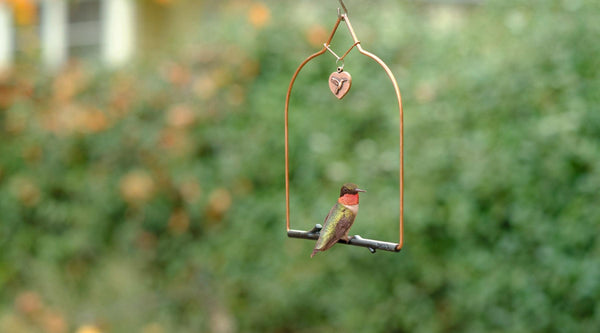
A Little Throne for Utah's Breeders
Black-chinned and Broad-tailed split Utah by elevation, but both hold territory the same way — a redwood perch nearby gives either breeder a vantage point to rest and defend its patch.
Shop Charm Redwood Swing →Passing Through: Utah's Real Migrants
Three more species move through Utah in numbers substantial enough to chart, none of them nesting here in any real way. One of them, in some mountain counties, briefly outnumbers both breeders.
Rufous Hummingbird Migrant/Winter
UBRC codes Rufous a Common Migrant, and the eBird data shows exactly how common: a huge, sharply timed post-breeding pulse that peaks statewide near 15.5% of checklists in early August — comparable to Broad-tailed's own peak, and in some counties bigger than either breeder's. Garfield County, around Bryce Canyon, posts Utah's single highest Rufous number anywhere: nearly 26% of checklists in late August, exceeding that county's own Broad-tailed (20%) and Black-chinned (19%) peaks. This isn't a breeding population — a USFS habitat brochure for the region is explicit that Utah functions as migration-fueling habitat, not nesting range — but for about six weeks in high summer, Rufous is genuinely one of the most-reported hummingbirds in several Utah counties.

Quick ID: Adult males are almost entirely orange-rufous with a glowing orange-red throat — the only largely rufous-backed hummingbird in North America. Females and immatures are green above with cinnamon-washed flanks, a coppery rump, and rufous at the base of the tail feathers, which neither of Utah's breeders ever shows.
Calliope Hummingbird Migrant/Winter
UBRC's own code for Calliope is a dual one — Uncommon Migrant, Rare Summer resident — and on that scale, "uncommon" ranks above "rare," meaning migration is the dominant real pattern here, not breeding. Utah's banding data agrees: only 85 of the 5,806 hummingbirds banded statewide were Calliope, the least common of the four species banded, and they arrive on a fall migration schedule — August and September — not a spring breeding-arrival one. The eBird pattern tracks Rufous's timing closely but at a much smaller scale, peaking statewide near 2.7% of checklists in late August. The Uinta high country (Summit County) again shows the strongest signal, over 5%, consistent with the Western Hummingbird Partnership's note that Calliope's breeding range is "expanding eastward into Idaho, Wyoming, Utah, and Nevada" — real, but still a marginal presence at the eastern edge of that expansion.

Quick ID: North America's smallest hummingbird, and identifiable by that alone in most cases — hunched posture, short bill and tail. Adult males show a gorget of separate magenta rays radiating outward against a white throat, rather than a solid patch, unique among North American hummingbirds. Females are green above with fine dark streaking on a whitish throat.
Costa's Hummingbird Migrant/Winter
Worth being direct about this one: UBRC's own code is "uncommon summer resident, found primarily in Washington County" — a spring-and-summer status, genuinely different from Rufous and Calliope's fall-migration pattern, and not a clean fit for a "Migrant/Winter Visitor" label. We're using that tier because this project's classification system doesn't have a bucket for "locally restricted, uncommon summer resident without confirmed breeding," and it's the closest available fit — not because the season matches. The eBird data reflects UBRC's picture accurately: this is almost entirely a Washington County (St. George) phenomenon, present in some number nearly every week of the year there, building to a real spring peak over 5% of checklists in mid-April, and never fully disappearing even in January. Statewide outside that one corner of the desert, Costa's is close to absent.

Quick ID: Adult males show an iridescent deep purple gorget that flares out along the sides of the neck into elongated points — sometimes called an "overgrown mustache" — with a matching purple crown; it can look solid black without good light. Small and compact with a short tail and a slightly drooping bill. Females are mostly plain whitish below; about half show a small patch of metallic purple throat feathers, and half don't.

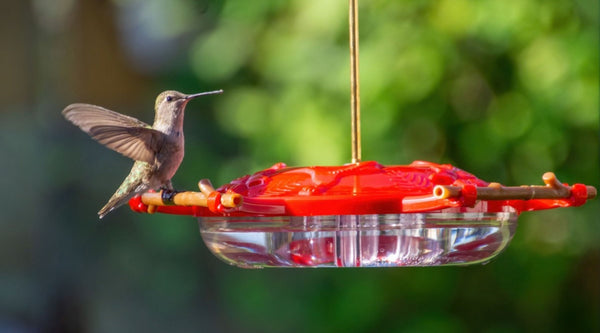
An Extra Feeder for Utah's Migrants
Rufous, Calliope, and Costa's all move through Utah on real, if different, schedules — a second feeder, set apart from the first, means a passing migrant isn't fighting your breeders for the same station.
Shop AspenPerch® Feeder →If You're Lucky: Utah's Documented Rarities
The remaining six species are all UBRC review birds. Two have real, if thin, recurring patterns; four are true one-off or near-one-off records, including the newest addition to Utah's entire state bird list.
Anna's Hummingbird Rare / Casual Visitor
UBRC codes Anna's "Rare, Winter Visitant" — its own definition of Rare is explicit that the species is "found infrequently but annually," a genuine recurring pattern rather than a one-off. Statewide the eBird signal is modest, peaking under 3% of checklists in December. But that statewide number badly undersells what's happening in one specific place: Washington County, around St. George, shows Anna's present in real numbers essentially every week of the year, climbing to a striking 22% of checklists in February — a far bigger, more sustained signal than UBRC's "winter visitant" language alone would suggest, and close to what a USFS regional brochure describes as a year-round presence in that corner of the state. UBRC's official status governs this page's tier, but the St. George pattern in the raw data is real and worth knowing if you live there.

Quick ID: The only North American hummingbird with an iridescent crown as well as throat — adult males glow rose-pink from the top of the head down, unlike anything else on Utah's list. Females carry a small central patch of rose-red spotting on an otherwise pale throat.
Rivoli's Hummingbird Rare / Casual Visitor
Seven accepted Utah records span more than six decades, from a 1962 sighting near Parowan to a female photographed in the Upper Weber River Valley, Summit County, in June 2024. UBRC's own status code is "Accidental," but the record dates themselves — 1962, 1971, 1972, 1974, 2001, 2024 — show real if very infrequent recurrence rather than a single old cluster. The eBird signal is correspondingly thin: a brief blip in Summit County each June, barely above the noise floor, exactly what a genuine but rare vagrant pattern looks like in checklist data.

Quick ID: A notably large hummingbird that often looks all-dark until the light catches it — adult males show a purple crown and an iridescent emerald throat. Both sexes carry a small white spot behind the eye; females are greenish overall with a grayish, speckled throat and no bright gorget.

Make Your Sanctuary Worth a Detour
Anna's and Rivoli's are genuine, if infrequent, Utah visitors — real electrolytes beyond plain sugar water give either one a reason to linger at your feeder.
Shop Nectarlyte® Powder →Allen's Hummingbird Historic / Accidental
Utah's newest bird record, full stop: a male photographed in Highland, Utah County, on April 11, 2026, and accepted unanimously by UBRC on first review — the state's first-ever Allen's. One record, however recent, is still one record, and UBRC's own definition of its "Accidental" code — "not expected and out of normal range" — is exactly that. No eBird signal exists for this species in Utah; the record postdates the 2016–2025 data window this page draws on entirely.

Quick ID: A Rufous look-alike. Adult males show a deep reddish-orange gorget and a coppery eye patch contrasting against a green back — but some male Rufous are green-backed too, so the back alone isn't conclusive. Females and immatures are essentially identical to female Rufous in the field; Utah's one record was confirmed by an experienced observer with photo documentation.
Broad-billed Hummingbird Historic / Accidental
Eleven accepted records span 1978 to 2025, almost all in Washington County — the earliest an October 1978 bird at Springdale, the most recent in March 2025 at Welcome Spring. Two individuals lingered roughly six weeks each in a single season, once in 1978 and once in 2016, but those two events sit nearly four decades apart — isolated vagrant occurrences, not an annual pattern, which is exactly what UBRC's own "Accidental" code reflects. The eBird data matches that read: scattered low-level reports across many different months and years in Washington County, with no single recurring seasonal window any of them cluster into.

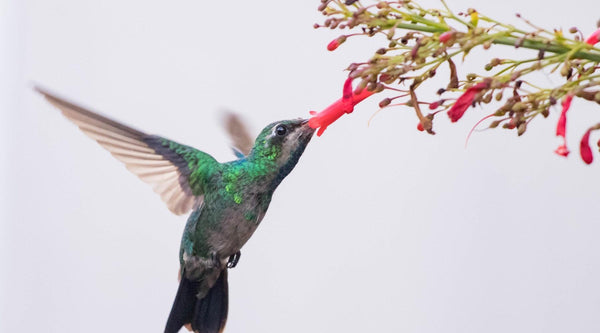
Quick ID: The bright red, black-tipped bill is diagnostic in every plumage — no regular Utah species shows red on the bill. Adult males add a shimmering sapphire-blue throat on a mostly green body; females are duller and grayer below with the same red-based bill.
Ruby-throated Hummingbird Historic / Accidental
The most familiar hummingbird across most of the eastern United States is one of Utah's rarest — exactly three accepted records: Washington County in late August 2005, Washington County again in September 2013, and Ogden (Weber County) in June 2020. UBRC's status code remains "Accidental," full review species, with no annual pattern behind those three widely spaced sightings. The statewide eBird signal amounts to a handful of scattered late-spring and early-summer checklists, right at the rounding floor.

Quick ID: Adult males show a brilliant ruby-red throat that reads black without direct light, an emerald crown and back, and a short forked black tail. Females and immatures are green above and whitish-gray below, with white-tipped outer tail feathers and no rufous anywhere — the one Utah rarity that can't be confused with the state's western species.
Blue-throated Mountain-gem Historic / Accidental
Worth flagging plainly: this species isn't on UBRC's official state checklist at all. It sits on the committee's separate Auxiliary List as Provisional — their own language is that it has "only one record accepted without physical evidence," from August 3–8, 1972, at Springdale, Washington County, and that it "needs [a] second sighting to be on the checklist." More than fifty years later, no second sighting has come. This is Utah's thinnest hummingbird record by any measure, and it's included here because UBRC does still formally track and review it — just not as a confirmed member of the state list.

Quick ID: A large, unmistakable hummingbird if you get a good look — adult males show a brilliant sapphire-blue gorget and a bronzy green crown, with a double white face stripe (a white eyebrow and a short white mustache mark) on both sexes. Females lack the blue throat, showing plain gray underparts instead but the same distinctive facial pattern.

Give Every Visitor a Reason to Stay
Whether it's a common backyard regular or a once-in-a-lifetime rarity like Utah's own Allen's Hummingbird, real nectar sources are what make a yard worth stopping at.
Shop Wildflower Seed →Utah Hummingbirds at a Glance
Unlike most states in this series, Utah doesn't have one species that dominates so completely a chart would be pointless — two real breeders and a major fall migrant are all genuinely competitive with each other, county by county. Here's how the six species with a measurable statewide signal stack up.

Statewide peak weekly frequency, eBird checklist data (Cornell Lab of Ornithology), 2016–2025. Five species aren't plotted because their statewide signal sits at or below the standard eBird rounding floor: Broad-billed, Ruby-throated, and Rivoli's Hummingbirds, plus Allen's Hummingbird and Blue-throated Mountain-gem, both with zero statewide eBird rows in this window. Full details in the Sources section below.
| Species | Status | Utah Records |
|---|---|---|
| Black-chinned Hummingbird | Breeding | Confirmed breeder; statewide peak 27% in August; most common of the 4 species banded statewide |
| Broad-tailed Hummingbird | Breeding | Confirmed breeder, higher elevations; statewide peak 15% in July |
| Rufous Hummingbird | Migrant / Winter Visitor | UBRC code "Common Migrant"; statewide peak 16% in August, higher in some counties than either breeder |
| Anna's Hummingbird | Rare / Casual | UBRC code "Rare, Winter Visitant" (found annually); real year-round pattern in Washington Co. |
| Calliope Hummingbird | Migrant / Winter Visitor | UBRC code "Uncommon Migrant"; statewide peak 2.7% in August |
| Costa's Hummingbird | Migrant / Winter Visitor | UBRC code "Uncommon Summer Resident," Washington Co. only; imperfect tier fit, noted on page |
| Rivoli's Hummingbird | Rare / Casual | 7 accepted records, 1962–2024 |
| Allen's Hummingbird | Historic / Accidental | 1 accepted record — Highland, Apr 2026, Utah's newest state bird |
| Broad-billed Hummingbird | Historic / Accidental | 11 accepted records, 1978–2025, mostly Washington Co. |
| Ruby-throated Hummingbird | Historic / Accidental | 3 accepted records — 2005, 2013, 2020 |
| Blue-throated Mountain-gem | Historic / Accidental | 1 provisional record (1972); not on the official state checklist |
Frequently Asked Questions
How many kinds of hummingbirds have been documented in Utah?
Eleven — ten on the Utah Bird Records Committee's official checklist, plus Blue-throated Mountain-gem, tracked as a Provisional species on the committee's separate Auxiliary List. Black-chinned and Broad-tailed are Utah's two confirmed breeders; Rufous, Calliope, and Costa's are real migrants and visitors; the rest are review-list rarities.
What is the most common hummingbird in Utah?
Black-chinned Hummingbird, both by eBird frequency (a statewide peak near 27%) and by Utah's own banding data, where it made up nearly two-thirds of every hummingbird ever captured at state banding stations.
Does Utah have more than one breeding hummingbird?
Yes — one of the few states in this series that does. Black-chinned nests at lower elevations statewide starting in early May; Broad-tailed nests in higher-elevation aspen and conifer forest starting in late May. Their ranges overlap broadly but each dominates a different part of the state's elevation gradient.
When does Rufous Hummingbird pass through Utah?
A short, intense window in mid-to-late summer. Rufous peaks statewide in the first half of August, and in some mountain counties — Garfield, around Bryce Canyon, especially — briefly outnumbers both of Utah's actual breeders during that stretch.
Are there hummingbirds in Utah in the winter?
In most of the state, no — both breeders and the main migrants clear out by fall. The one real exception is Washington County, around St. George, where Anna's Hummingbird shows a genuine, sustained presence through the winter months, and Costa's is present there in low numbers nearly year-round as well.
Why We Created This Guide
Pop's Birding has been helping hummingbird lovers for three generations. One of the questions our customers ask most often is "what hummingbirds are actually in my state?" — we built this guide to give a direct, sourced answer for Utah specifically, not a generic one. Most identification content treats the Mountain West as interchangeable, one generic set of western hummingbirds. Utah's real story is more specific than that: two breeders that split the state by elevation rather than competing head-on, a fall migrant that can briefly out-report both of them in the high country, and a records committee explicit and public enough about its own review codes that we could check our classification against it species by species.
How We Created This Guide
We started with statewide eBird checklist data from the Cornell Lab of Ornithology, covering 2016 through 2025, then added five counties chosen to show Utah's real geographic and elevation range — from the urban Wasatch Front to the low desert southwest, the high country, and canyon country. Since a decade of checklists can't capture everything, we checked every species against the Utah Bird Records Committee's Field Checklist and Review List to fill in the rest of the picture. Utah is one of the more interesting states in this series to chart, since Black-chinned, Rufous, and Broad-tailed are all genuinely competitive with each other depending on county and season rather than one species running away with it. That extra check against UBRC's records also helped us catch and fix something in our own earlier work — Allen's Hummingbird had been listed as Rare/Casual because its one record was recent, but under our own rules a single record is Historic/Accidental no matter how new it is, so that's been corrected. Every rarity's status here traces back to a specific accepted record with a real date, county, and source, including Allen's Hummingbird, which UBRC accepted on a 9–0 vote just months before this page was built.
Sources
- eBird bar chart data, Cornell Lab of Ornithology — Utah statewide plus Salt Lake, Washington, Garfield, Summit, and Grand counties, 2016–2025.
- Utah Bird Records Committee, Field Checklist of the Birds of Utah (approved through February 2026) — source for all 11 species, their review codes, and abundance definitions.
- Utah Bird Records Committee, Review List and documented sightings records — source for individual accepted-record dates, counties, and finders.
- Western Hummingbird Partnership — source for Broad-tailed and Calliope's regional breeding-range context.
Know before they arrive
You don't have to keep this calendar taped to the fridge. Insider Birding Access members get seasonal notes timed to your region — when to have feeders out, what the birds are doing right now, and what's worth doing in your yard this season. We take the guesswork out of the calendar. Joining takes about thirty seconds, and there's 10% off your first order in it.
Join Insider Birding Access →Free to join. 10% off your first order.
Shop Utah's Hummingbird Favorites


Bethany Sloan has served as General Manager of Pop's Birding since 2010, continuing the legacy of her grandfather, William "Pops" Sloan, inventor of the Original Hummingbird Swing. A lifelong hummingbird enthusiast, educator, and independent researcher, she leads the company's educational content, including its 50-State Hummingbird Guide series, Regional Guide, Species Guide and Hummingbird Learning Center. Bethany combines scientific research, regional migration data, and more than 16 years of hands-on experience to create trusted educational resources for bird enthusiasts across North America.