Aug 02, 2026
Broad-billed Hummingbird: The Sky Island Hummingbird That Hypnotizes Its Mate
Watch a male Broad-billed Hummingbird court a female and you'll see one of the more hypnotic displays in the entire hummingbird world. Cornell Lab's own overview describes it directly: the male "makes a precision flight display likened to a hypnotist's swinging pocket watch." It's a fitting way to describe a bird whose everyday appearance is nearly as striking as its courtship: a glowing red-and-black bill, an emerald body, and a throat that flashes sapphire blue in the right light, found in the US only within a narrow band of mountain canyons along the Arizona and New Mexico border country — the same rugged, isolated ranges birders often call "sky islands" for the way they rise out of the surrounding desert.
Quick Facts
- Scientific name: Cynanthus latirostris Swainson, 1827
- Length: approximately 3.25–4 inches (8–10 cm)
- Lifespan: oldest banded record at least 9 years, 1 month — a male recaptured in Arizona
- Conservation status: Least Concern (IUCN); Partners in Flight rates it 10 out of 20 on the Continental Concern Score, indicating low conservation concern
- Population: approximately 2.2 million global breeding population, with roughly 200,000 breeding in the US
- US range: among the narrowest US footprints of any regularly occurring hummingbird — mainly southeastern Arizona, with smaller numbers in southwestern New Mexico and rare records in southwestern Texas
- Claim to fame: one of the most visually striking hummingbirds in the country, and one associated with a genuinely uncommon courtship behavior — males may gather in small groups called leks to display together, rather than displaying solo
The Origin Story: How the Broad-billed Hummingbird Got Its Name
The Broad-billed Hummingbird was formally described in 1827 by English naturalist William Swainson, based on specimens that English collector William Bullock and his son had gathered during their travels through Mexico. Swainson coined the binomial name Cynanthus latirostris — with latirostris simply Latin for "broad-billed," a straightforward nod to the bill shape that gives the species its common name today. Swainson himself was uncertain about where his specimens actually originated, listing the type locality only as "Table land?" with his own question mark attached, according to Cornell's Birds of the World. The species almost certainly doesn't occur on Mexico's central tableland at all, and in 1939, American ornithologist Robert Moore formally redesignated the type locality to the Valley of Mexico near Mexico City instead.
Swainson also erected the genus Cynanthus itself in 1827, listing four species but without designating which one anchored the group. That designation didn't come until 1907, when American ornithologist Witmer Stone formally named Cynanthus latirostris the type species of the genus. Cynanthus remains a small genus, nearly all of it confined to Mexico — the Broad-billed Hummingbird is the only member that regularly crosses into the United States. The genus has also been the subject of genuinely active, ongoing taxonomic revision: the Turquoise-crowned Hummingbird, found farther south in Mexico, was considered a subspecies of the Broad-billed Hummingbird until 2021, when the eBird/Clements checklist recognized new genetic evidence showing it was actually more closely related to Canivet's Emerald. The American Ornithological Society's own taxonomic committee formalized the split the following year, in its 63rd supplement to the North American checklist — a useful reminder that even well-known hummingbird classifications are still being actively refined by new genetic evidence.
Where the Broad-billed Hummingbird Lives: Mexico's Hummingbird, With a Toehold in the US
Most of the Broad-billed Hummingbird's range lies well south of the border. According to Cornell Lab's All About Birds, this species reaches the mountainous canyons of the southwestern US only during the breeding season, with its US range essentially limited to southeastern Arizona, plus smaller and less consistent numbers in southwestern New Mexico and rare breeding records in southwestern Texas. South of the border, the species breeds across a wide swath of northwestern and central Mexico, including Sonora, where Birds of the World describes it as a common breeding hummingbird — a striking contrast to how narrow and specialized its US presence really is.
Genuine vagrant records exist well outside this core range, too. A 2006 note in the Journal of the Arkansas Academy of Science documented the first confirmed Broad-billed Hummingbird in Arkansas, a bird first found visiting a residential feeder in White Hall, Jefferson County, in late 2005, and the species has since been accepted at additional Arkansas localities — a reminder that even a species this tightly tied to a specific region can still turn up almost anywhere given the right conditions.
How to Identify the Broad-billed Hummingbird: Males vs. Females
Adult Males
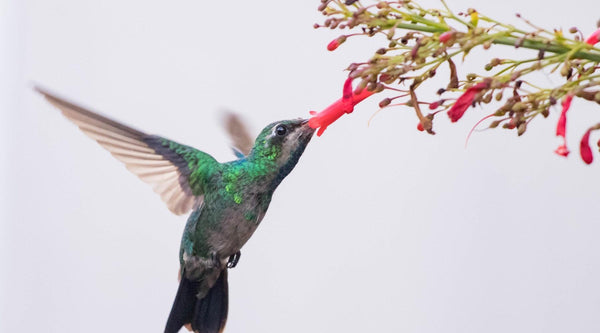
Genuinely one of the most striking hummingbirds in the country: a broad, bright red bill tipped in black, a rich emerald-green body, and a glittering, dark sapphire-blue gorget. The tail is black and forked, with white undertail coverts. Cornell Lab's All About Birds notes that males have fuller tails than females, with rounded corners, versus the squared tail corners typical of females.

Adult Females
Considerably less flashy, but still identifiable by the same distinctive bill shape: a dark bill with a reddish lower mandible, a thin white stripe behind the eye, grayish throat and underparts, and green upperparts. The outer tail feathers show pale tips, according to a USGS Patuxent Wildlife Research Center identification guide.

Immature Birds
Immatures closely resemble adult females. Immature males may already show the beginnings of a developing blue-green gorget well before reaching full adult coloration.
Similar Species
In Arizona specifically, the main identification challenge is the White-eared Hummingbird, which the USGS identification guide notes shows a broader white eye-stripe than the Broad-billed. Farther south in Mexico, things get considerably more complicated: female Broad-billed Hummingbirds can be confused with both sexes of the Dusky Hummingbird — told apart mainly by tail color, blue-black in Broad-billed versus dull olive-green in Dusky, per Birds of the World's identification notes — and with several of the Broad-billed's own close relatives in the genus Cynanthus, including the recently-split Turquoise-crowned Hummingbird, Canivet's Emerald, Golden-crowned Emerald, and Cozumel Emerald, all of which show longer, more deeply forked tails and rarely the blue iridescence typical of male Broad-billeds.
Behavior: Territorial, and Strangely Drawn to Owls
Males are notably territorial, resting on a high perch overlooking a claimed feeding area and chasing off intruders. One genuinely odd documented behavior, straight from Cornell's Cool Facts: Broad-billed Hummingbirds, like several other bird species, are attracted to the calls of small diurnal owls, including Ferruginous and Northern Pygmy-Owls. Rather than fleeing, they often dive at the owl's head, perch nearby, and call — other birds join in, and the whole spectacle is known as "mobbing," a defensive strategy likely meant to drive off a potential predator before it can strike.
Feeding and Diet
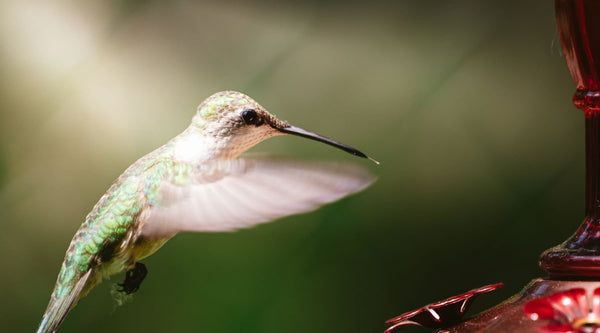
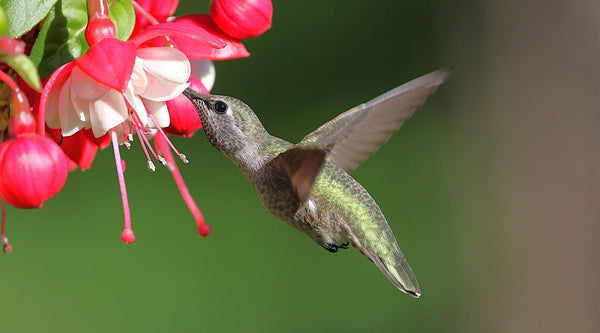
Broad-billed Hummingbirds drink nectar by inserting their bill directly into flowers or feeders, sometimes feeding repeatedly in a small area and sometimes traveling long distances between patches of flowers. Birds of the World notes they're probably opportunistic feeders, selecting whichever flowers offer the highest energy reward when given a choice, rather than specializing narrowly. Small insects round out the diet, caught either by flycatching in mid-air or gleaned directly from plants.
Courtship and Mating
This is one of the most visually memorable courtship displays covered anywhere in this guide series. In the male's display, he hovers about a foot in front of the perched female, then flies back and forth in repeated arcs like a pendulum — the motion Cornell's Cool Facts describes as resembling a hypnotist's swinging pocket watch.
What sets this species apart from most other North American hummingbirds is a genuinely uncommon breeding strategy, though it comes with a caveat worth stating plainly: Cornell's identification page notes that males "may gather in small groups called leks to call and display" — but Cornell's own more detailed scientific account, Birds of the World, is considerably more cautious, stating that little is actually known about the species' social behavior and that the function of its displays remains unclear. Lekking of any kind is genuinely rare among the roughly 15 hummingbird species that breed regularly north of Mexico; most defend individual display territories rather than gathering communally, and the clearest confirmed case of lek behavior in a North American hummingbird is a 1972 study of the Broad-tailed Hummingbird in the Wilson Bulletin. So while the Broad-billed Hummingbird is a genuine candidate for this uncommon behavior, treat it as an intriguing possibility rather than settled fact. As with virtually all hummingbirds, the male's involvement ends after mating regardless — females handle nest-building, incubation, and raising the young entirely alone.
Nesting and Family Life
The female alone selects the nest site and builds the nest, typically low to the ground on a hanging or drooping branch, often somewhere with cover overhead. Unlike many other hummingbird species, Birds of the World notes that Broad-billed Hummingbird nests are only rarely decorated with lichen on the exterior — a genuine point of difference from species like Anna's or Calliope Hummingbirds, which rely heavily on lichen camouflage.
The nest itself is built from bark strips, grasses, and leaves, lined with soft plant down and wrapped in spider silk for elasticity — genuinely tiny even by hummingbird standards. The female typically lays two white eggs, occasionally three, and incubates, feeds, and raises the young entirely without help from the male; the young become independent once they fledge.

Migration
According to Birds of the World, breeding populations across most of Mexico are year-round residents, but the northernmost populations — including those in the United States, Sonora, and Nuevo León — are migratory, moving south each winter into the range of Mexico's resident populations. Northern breeders favor riparian zones of arid canyons, usually below 2,000 meters, which offer enough resources to support nesting for up to five months of the year. In the US specifically, birds typically arrive in spring and most have departed again by fall, though a small but real number of individuals now regularly overwinter near backyard feeding stations rather than continuing south — a pattern Cornell's Project FeederWatch has documented among cold-season hummingbirds in Arizona, Broad-billed included. After the breeding season, Cornell's All About Birds notes that some individuals move to considerably higher elevations to forage — almost 10,000 feet in some cases — before eventually heading south for the winter.
Torpor
The Broad-billed Hummingbird's use of torpor isn't just a family-wide assumption — it's been directly measured. A 2020 study in the Journal of Avian Biology by Anusha Shankar and colleagues recorded torpor in Broad-billed Hummingbirds at Arizona field sites and estimated their minimum tolerable body temperature at around 15°C (59°F), with energy savings during torpor ranging between roughly 65 and 92 percent per hour compared to a normal resting state (the study is also freely readable via its original bioRxiv preprint, if the published version is paywalled). That's a meaningful energy cushion in a landscape where mountain canyon temperatures can swing considerably between a hot afternoon and a cool night, even during the height of summer.
Habitat
Cornell Lab describes the species' preferred US breeding habitat as stream canyons in mountainous areas up to about 6,500 feet in elevation, typically alongside sycamores, cottonwoods, and willows, with birds foraging at considerably higher elevations in summer as monsoon rains bring canyon and meadow flowers into bloom. Beyond wild canyon habitat, the species also does well in residential gardens and is a frequent visitor to backyard hummingbird feeders throughout its range.
Broad-billed Hummingbird by Region: Where and When to Find Them
| Region | Status | Best Time to See Them |
|---|---|---|
| Southeastern Arizona | Core US breeding range; the most reliable place to find this species | Mid-March through October; some overwinter near feeders |
| Southwestern New Mexico | Regular but smaller numbers | Spring through fall |
| Southwestern Texas | Rare breeding records | Spring through fall |
| Sonora, Mexico | Common breeding hummingbird | Year-round |
| Rest of Mexico (through central Mexico) | Primary range; mostly non-migratory resident populations | Year-round |
| Scattered US vagrant records (e.g., Arkansas) | Rare, documented vagrant | Any season |
Build a Broad-billed Hummingbird Sanctuary in Your Own Yard
Because this species' US range is so narrow and canyon-specific, the most effective sanctuary setup leans directly into recreating that shaded, riparian-canyon feel rather than a typical open-sun desert garden.
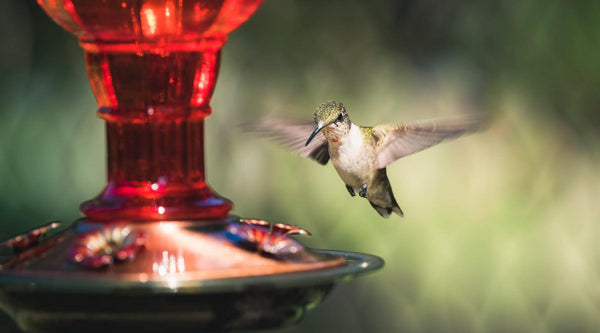
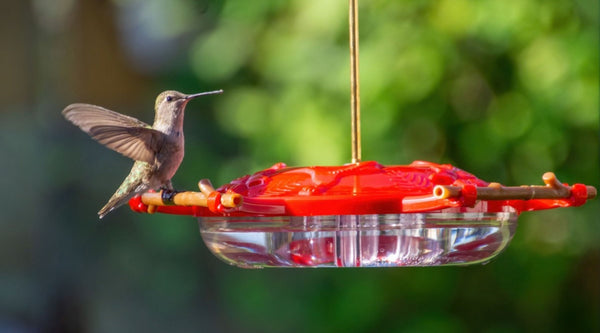
- Use a leak-proof, easy-to-clean feeder like the AspenPerch® Hummingbird Feeder, with a comfort perch so this species can rest between feeding visits.
- Keep nectar fresh from mid-March through October, and consider maintaining it through winter too if you're in southeastern Arizona, since a small but genuine number of individuals now regularly overwinter near backyard feeders. Pop's Nectar, with added electrolytes and calcium, supports the demands of this species' extended breeding season.
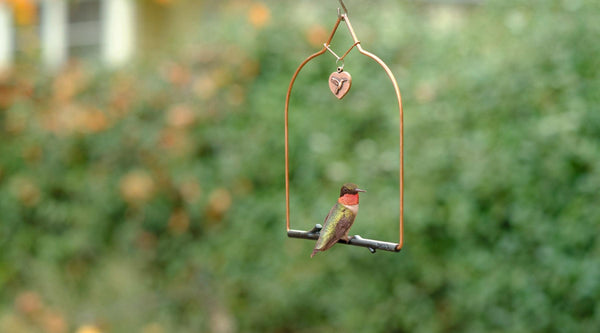
- Add a swing near your feeder — a Pop's Original Hummingbird Swing gives a territorial Broad-billed Hummingbird a consistent high perch to defend its feeding area from, much like the elevated perches this species favors naturally.
- Add shade and shelter where you can. Since this species' natural habitat is shaded stream canyons with overhanging cover, a yard with mature trees or trailing, hanging plants genuinely mimics the conditions this species prefers for both feeding and nesting.
- Skip the insecticide. Since this species catches insects by flycatching and gleaning as a real part of its diet, pesticide use removes food it depends on. Use HummGuard™ nectar tips instead to manage bees and wasps without harming anything else.
For state-specific feeder timing, native plant lists, and wildflower planting guidance, see our companion guides for Arizona, New Mexico, and Texas, or find your own state in our full hummingbird guide by state series.
Frequently Asked Questions
How can you identify a Broad-billed Hummingbird?
Look for a broad, red bill tipped in black on both sexes. Males add a brilliant emerald-green body and a dark sapphire-blue throat, while females are grayer below with a thin white stripe behind the eye and a reddish lower mandible.
What is the Broad-billed Hummingbird's courtship display like?
The male hovers about a foot in front of the female, then flies back and forth in repeated arcs, a motion Cornell Lab compares to a hypnotist's swinging pocket watch. Males may also gather in small groups called leks to call and display together, a genuinely uncommon strategy among North American hummingbirds — though scientists still know relatively little about exactly how or why this species does it.
Where does the Broad-billed Hummingbird live in the United States?
Mostly in the mountain canyons of southeastern Arizona, with regular but smaller numbers in southwestern New Mexico and rare records in southwestern Texas. Most of the species' overall range lies farther south in Mexico, where it's a common breeding hummingbird across Sonora and much of the rest of the country.
Is the Turquoise-crowned Hummingbird the same species as the Broad-billed Hummingbird?
Not anymore. It was considered a subspecies of the Broad-billed Hummingbird until 2021, when genetic research showed it was actually more closely related to Canivet's Emerald, leading taxonomists to formally split it off as its own full species the following year.
Do Broad-billed Hummingbirds migrate?
The US and northernmost Mexican breeding populations do, arriving in spring and departing again by fall, though a small but growing number of individuals now regularly overwinter near backyard feeders instead of continuing south. Populations farther south in Mexico are largely non-migratory.
How long do Broad-billed Hummingbirds live?
The oldest banded Broad-billed Hummingbird on record was a male at least 9 years, 1 month old when recaptured during banding operations in Arizona, according to Cornell.
Why do Broad-billed Hummingbirds respond to owl calls?
Like several other bird species, they're drawn to the calls of small diurnal owls such as Ferruginous and Northern Pygmy-Owls, often diving at the owl and calling loudly — a defensive strategy called mobbing, aimed at driving off a potential predator rather than genuine attraction.
Can Broad-billed Hummingbirds survive cold nights?
Yes — research has directly measured this species entering torpor, dropping its body temperature to around 59°F and cutting its energy use by roughly two-thirds to over 90 percent overnight, an adaptation especially useful given how much its breeding range sits in mountain canyons with big day-to-night temperature swings.
How can I attract Broad-billed Hummingbirds to my yard?
If you're in a mountain canyon in southeastern Arizona or southwestern New Mexico, keep a feeder up from mid-March through October (year-round if you'd like a shot at an overwintering bird), and plant native, tubular red or orange flowers in a shaded, riparian-style setting similar to this species' natural canyon habitat.
At Pop's Birding, we believe every backyard — big or small — has room for a little more wonder. Explore our feeders, nectars, swings, and wildflower seed blends to start building your own hummingbird sanctuary today.

Bethany Sloan has served as General Manager of Pop's Birding since 2010, continuing the legacy of her grandfather, William "Pops" Sloan, inventor of the Original Hummingbird Swing. A lifelong hummingbird enthusiast, educator, and independent researcher, she leads the company's educational content, including its 50-State Hummingbird Guide series, Regional Guide, Species Guide and Hummingbird Learning Center. Bethany combines scientific research, regional migration data, and more than 16 years of hands-on experience to create trusted educational resources for bird enthusiasts across North America.