Aug 02, 2026
Blue-throated Mountain-gem: The Duet-Singing Heavyweight
If the Calliope Hummingbird is the featherweight of North America, the Blue-throated Mountain-gem is its heavyweight counterpart — the largest hummingbird that breeds anywhere in the United States, a bird substantial enough to usually dominate every other hummingbird species at a shared feeder simply by showing up. And yet, despite its size and confidence, its signature sapphire throat is genuinely hard to see, flashing into view only when the light hits it exactly right.
Quick Facts
- Scientific name: Lampornis clemenciae (Lesson, 1830)
- Length: 4–5 inches (11–13 cm)
- Wingspan: 5–6 inches (13–15 cm)
- Weight: 0.2–0.3 oz (6–9 g)
- Lifespan: oldest banded record at least 7 years, 11 months — a male recaptured in Arizona
- Conservation status: Least Concern (IUCN); a global breeding population of roughly 2 million, with fewer than 2,000 in the US, per Partners in Flight
- US range: genuinely narrow — sky-island canyons of southeastern Arizona and the Chisos Mountains of southwestern Texas
- Claim to fame: the largest hummingbird species breeding in the United States, one of the very few hummingbirds anywhere that sings actual duets, and the owner of a nest unlike any other US hummingbird's — camouflaged on the outside with real moss
The Origin Story: A Recent Name Change for Consistency, Not New Science
The Blue-throated Mountain-gem was formally described in 1830 by French naturalist René Primevère Lesson, who gave it the binomial name Lampornis clemenciae. For most of its history in English, the species was known simply as the Blue-throated Hummingbird — a name that stuck for nearly two centuries until mid-2019, when ornithologists officially renamed it. According to Cornell Lab's All About Birds, the change had nothing to do with new genetic findings; it was made purely to bring the species' English name in line with the rest of its genus, Lampornis, the "mountain-gems," which includes seven other species found south of the United States, all already using "mountain-gem" in their common names. Aligning the Blue-throated Hummingbird's name with its relatives simply made the whole genus easier to recognize as a group.
Three subspecies are currently recognized, reflecting the bird's fairly wide range: the nominate L. c. clemenciae, found from the Mexican Plateau north into the US border ranges; L. c. bessophilus, found farther south in Mexico; and L. c. phasmorus, found in the mountains of southeastern Mexico near Oaxaca, at the species' southern range limit.
Where the Blue-throated Mountain-gem Lives: The Largest US Hummingbird, in a Genuinely Small Range
According to the Audubon Field Guide, the Blue-throated Mountain-gem's normal range north of Mexico is limited to canyons in just a few mountain ranges near the border — making it, despite its imposing size, one of the more range-restricted hummingbirds covered in this entire guide series. Cornell Lab's All About Birds confirms the species barely reaches the US at all, found regularly only in southeastern Arizona and southwestern Texas. South of the border, the species ranges through Mexico's Sierra Madre Oriental and central plateau, reaching its southern limit in the mountains near Oaxaca.
According to Tucson Bird Alliance, Cave Creek Canyon in Arizona's Chiricahua Mountains is widely considered the single best spot in the entire country to find this species, with the feeders at the Southwestern Research Station offering close to a guaranteed sighting for visitors; the organization also points to less-reliable but documented spots like the Palisades visitor center on Mount Lemmon and feeder locations in the eastern Huachuca Mountains. In Texas, the Chisos Mountains of Big Bend National Park are the other well-documented US stronghold.
How to Identify the Blue-throated Mountain-gem
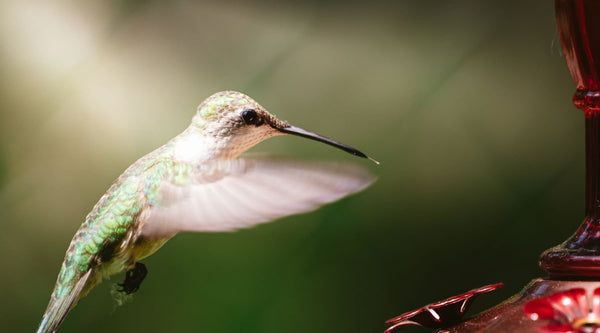
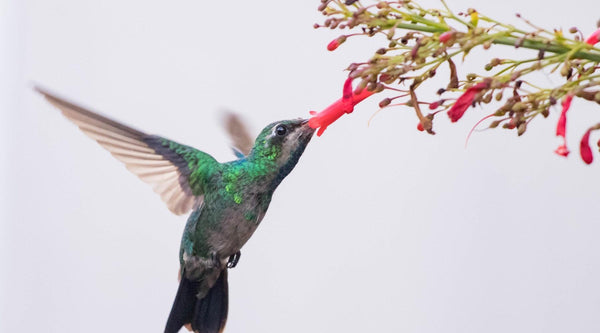
Both sexes look broadly similar — genuinely unusual for a hummingbird, since most species show a dramatic difference between males and females. According to Cornell Lab's All About Birds, males have a brilliant sapphire-colored gorget that glitters only in good, direct light, while both sexes share double white stripes on the face and plain gray underparts. According to the Audubon Field Guide, the flashy white corners of the tail are actually easier to spot in the field than the throat color itself, especially as the bird flies swiftly past or hovers in the shade.

Similar Species
According to eBird, the closest identification challenge is the Amethyst-throated Mountain-gem, a close relative found farther south — the Blue-throated is slightly larger and paler overall, with larger white (rather than gray) tail-feather tips, and females lack the buffy tones shown by female Amethyst-throated. Rivoli's Hummingbird, especially females, is also worth comparing carefully where ranges overlap: Blue-throated is shorter-billed and plainer, less speckled on the underparts, than Rivoli's.
Behavior: Large, Assertive, and Usually in Charge
According to Cornell's Birds of the World, the Blue-throated Mountain-gem's large size and highly aggressive nature usually place it at the top of the hierarchy at feeding stations as well as at natural nectar sources — though "usually" is the key word rather than an absolute rule, and Cornell notes that females are less aggressive than males, even though they too typically drive away other hummingbirds while feeding. Measured territory sizes in Mexico have run from about 0.1 to 0.2 acres. In a genuinely striking display of nerve for a bird this small, Cornell notes the species will mob predatory birds as large as Northern Goshawks, sometimes working cooperatively to do it.
Feeding and Diet
Like other hummingbirds, the Blue-throated Mountain-gem feeds heavily on nectar, but according to Cornell's All About Birds, it relies heavily on insect prey during the dry season, when flowers are scarce or absent — a useful adaptation for a bird living in canyon habitat where bloom availability can vary considerably by season. Documented prey includes small spiders, harvestmen, aphids, flies, true bugs, beetles, and wasps, gleaned from vegetation, spiderwebs, and even sapsucker wells.
Courtship and Mating
This is one of the most genuinely unusual courtship stories in the entire hummingbird family. According to Cornell Lab's All About Birds, both female and male Blue-throated Mountain-gems produce complex songs — sometimes performed together as an actual duet, a trait Cornell notes is unknown in any other hummingbird found in the United States. Males sing two distinct songs: a squeaky "peep song" lasting about a second, and a quiet but complex "whisper song" that can run as long as eight seconds, spanning an unusually wide vocal range for a hummingbird.
Unlike most North American hummingbirds, males do not perform an aerial display at all. Instead, the female gives a distinctive call believed to signal she's ready to mate, followed by a series of short display flights of her own performed in front of the male before copulation — effectively reversing the typical hummingbird courtship script, where the male usually carries the visual display duties alone.
Nesting and Family Life
The Blue-throated Mountain-gem's nest is genuinely distinctive among hummingbirds found in the United States: according to the Audubon Field Guide, the exterior covering of green moss is unique among North American hummingbird nests. Cornell adds a useful caveat, though — nests built in drier areas may carry little or no moss and end up far less camouflaged, and unlike most other hummingbirds, mountain-gems don't decorate their nests with lichen at all. The nest itself is built from plant fibers and spider silk, with placement ranging widely, from near ground level to at least 6 feet up in a tree; nests have also been documented on man-made structures like bridges and buildings, and occasionally tucked into a rock ledge or cave crevice. Nest sites are frequently reused across multiple years, sometimes with an entirely new nest built directly on top of the previous year's structure.
According to Cornell's Birds of the World, the female incubates the two white eggs alone for 17 to 19 days, with the young fledging about 24 to 26 days after hatching; the Audubon Field Guide notes the species may raise up to three broods in a single season.
Migration
Most Blue-throated Mountain-gems in the United States migrate south into Mexico each fall, according to the Audubon Field Guide. That said, Birds of the World notes that artificial feeding has likely helped some northern individuals survive winter in this species' high-elevation habitat, and a small number are now genuine year-round residents at feeding stations in Arizona — well north of the species' historic northernmost limit for permanent, non-migratory residency in northwestern Mexico.
Habitat
According to the Audubon Field Guide, the Blue-throated Mountain-gem is almost always found near flowing water in shady mountain canyons within the US portion of its range, while Cornell notes that migrants and nonbreeding birds use a somewhat wider range of habitats, including pine-fir and pine-oak forest along canyon streams. In the US, the species is typically found between about 4,500 and 11,500 feet in elevation, occasionally as low as 3,200 feet; birds in Mexico range considerably higher, up to nearly 12,800 feet.
Blue-throated Mountain-gem by Region: Where and When to Find Them
| Region | Status | Best Time to See Them |
|---|---|---|
| Southeastern Arizona (Cave Creek Canyon, Chiricahua Mountains) | The most reliable US location | Spring through fall; some now year-round at feeding stations |
| Southeastern Arizona (other sky-island canyons, e.g. Mt. Lemmon, Huachuca Mountains) | Less reliable, but documented | Spring through fall |
| Southwestern Texas (Chisos Mountains, Big Bend National Park) | Regular, well-documented US stronghold | Spring through fall |
| Northwestern Mexico | Historic northernmost limit of year-round, non-migratory residency | Year-round |
| Rest of Mexico, south to Oaxaca (broader range) | Core range | Year-round |
If You're Hoping to Spot (or Attract) a Blue-throated Mountain-gem
Because this species' US range is so narrow, a visit to a known hotspot will almost always beat trying to attract one cold to a home feeder outside its range.
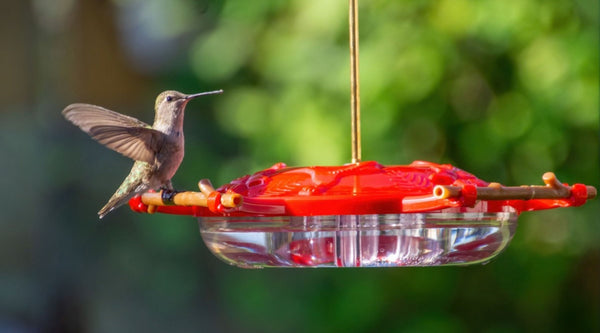
- If your property sits in a shady riparian canyon in southeastern Arizona or the Chisos Mountains of Texas, a leak-proof feeder like the AspenPerch® Hummingbird Feeder filled with fresh Pop's Nectar gives you a genuine chance, especially given how readily this species takes to feeders.
- Expect this species to usually dominate the feeder if it does show up — given its size and temperament, it typically outcompetes other hummingbird species present, though females tend to be somewhat less pushy than males.
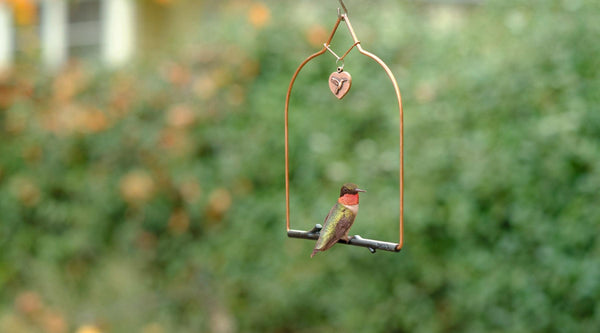
- Add a swing near your feeder — a Pop's Original Hummingbird Swing gives any visiting hummingbird a place to rest and be observed up close.
- Skip the insecticide, since insects can make up a real share of this species' diet, especially when flowers are scarce. Use HummGuard™ nectar tips instead to manage bees and wasps without removing food this bird depends on.
- Consider a visit to Cave Creek Canyon. For most people hoping to see this species, a trip to the Chiricahua Mountains or Big Bend National Park is simply a far more realistic path than attracting one to a home feeder outside its narrow natural range.
For general feeder timing, native plant lists, and wildflower planting guidance for the region, see our companion guides for Arizona and Texas, or find your own state in our full hummingbird guide by state series.
Frequently Asked Questions
Is the Blue-throated Mountain-gem really the largest hummingbird in the United States?
Yes, among species that breed in the country. At 4 to 5 inches long, it's the largest hummingbird that nests north of Mexico, and its size and assertive nature usually let it dominate feeders and flower patches over other hummingbird species it encounters.
Why was the Blue-throated Hummingbird renamed to Blue-throated Mountain-gem?
In mid-2019, ornithologists renamed it specifically so its common name would match the rest of its genus, Lampornis, which includes seven other mountain-gem species found south of the United States. It's purely a naming-consistency change, not a reflection of new taxonomic findings.
What makes the Blue-throated Mountain-gem's nest unusual?
It's typically covered on the outside with moss, a genuinely unique feature among hummingbirds that visit the United States — though nests built in drier areas may have little or no moss and end up much less camouflaged. Nests are also reused across multiple years, with a new nest sometimes built directly on top of the previous year's.
Do Blue-throated Mountain-gems sing?
Unusually for a hummingbird, yes, and both sexes do it. Complex songs are documented in both males and females, sometimes performed together as a duet during courtship — a trait Cornell notes is unknown in any other hummingbird found in the United States.
How long do Blue-throated Mountain-gems live?
The oldest recorded individual was a male at least 7 years, 11 months old when recaptured during banding operations in Arizona.
What's the difference between a Blue-throated Mountain-gem and a Rivoli's Hummingbird?
Both are large hummingbirds found in the same southwestern mountain canyons — Blue-throated is the larger of the two, with Rivoli's a close second. Blue-throated has a shorter bill and plainer, less-speckled underparts, plus larger white tail corners, while Rivoli's males show a distinctive violet crown and green gorget rather than Blue-throated's blue throat. The sexes also look far more alike in Blue-throated than in Rivoli's, where males and females are quite different. When the two share a feeder, Blue-throated typically comes out on top.
Where is the best place to see a Blue-throated Mountain-gem in the US?
Cave Creek Canyon in Arizona's Chiricahua Mountains, particularly around the feeders at the Southwestern Research Station, is considered the most reliable spot in the country. The Chisos Mountains of Big Bend National Park in Texas are another well-known location.
How can I attract a Blue-throated Mountain-gem to my yard?
Realistically, only if you're in a shady riparian canyon in southeastern Arizona or the Chisos Mountains of Texas. A feeder can help within that narrow range, but visiting a known hotspot is a far more reliable way to see this species than attracting one to a home feeder outside its range.
At Pop's Birding, we believe every backyard — big or small — has room for a little more wonder. Explore our feeders, nectars, swings, and wildflower seed blends to start building your own hummingbird sanctuary today.

Bethany Sloan has served as General Manager of Pop's Birding since 2010, continuing the legacy of her grandfather, William "Pops" Sloan, inventor of the Original Hummingbird Swing. A lifelong hummingbird enthusiast, educator, and independent researcher, she leads the company's educational content, including its 50-State Hummingbird Guide series, Regional Guide, Species Guide and Hummingbird Learning Center. Bethany combines scientific research, regional migration data, and more than 16 years of hands-on experience to create trusted educational resources for bird enthusiasts across North America.