Sep 02, 2026
Hummingbirds in Colorado: The Complete Guide to All 12 Species
In July 2002, a female hummingbird with a red, black-tipped bill turned up at a feeder in Clifton, on Colorado's Western Slope. It was the state's first Broad-billed Hummingbird — an Arizona and Mexican species a long way from home — but the detail that made the record remarkable was on its leg. The bird had been banded in Louisiana the previous January. It had wintered on the Gulf Coast, then flown to the Colorado desert for the summer, a route no field guide would draw for it. Colorado's hummingbird list is full of birds like that: a state where the Rocky Mountains funnel migrants through every summer, and where the committee that reviews rare-bird records keeps finding that "rare" comes in several different shapes.
Twelve hummingbird species have been accepted to Colorado's official state list by the Colorado Bird Records Committee. That's more than any of the state's plains neighbors — Kansas, Nebraska, Oklahoma, and Wyoming top out at eleven or fewer — and behind only New Mexico's seventeen among the states that border it. Two species breed here, two pass through every year on their way somewhere else, and eight are rarities the Committee has documented one accession number at a time — from a species with twenty-six accepted records down to one that has, in all likelihood, been seen exactly once.
Free download
All 12 species, one page
Every Colorado hummingbird with its status — from Broad-tailed, the mountain breeder, down to four species with no accepted record in over a decade — sized 8.5" x 11" for easy reference and printing.
Download the Colorado species guideOne page · PDF · free to print and share

All 12 documented Colorado hummingbird species, grouped by tier — statewide eBird data, 2016–2025, cross-checked against the Colorado Bird Records Committee's own accepted-record database.
The Hummingbirds You're Most Likely to See
Broad-tailed Hummingbird Breeds Here
Colorado's hummingbird, by a wide margin. Broad-tailed is reported on 40% of all Colorado checklists at its early-July peak — the largest hummingbird signal in the state by far — and in Summit County, high in the mountains, it reaches 59% in June. The Audubon Field Guide places its breeding range squarely in the Rocky Mountains, mostly in fairly open forest and especially near streams, up to over 10,000 feet; Colorado's montane core is inside that range, not a corridor through it. The Colorado Breeding Bird Atlas confirms it as a common breeder on the northern Front Range and into the mountains. It thins out on the eastern plains — under 1% around Yuma — but from the foothills up, a summer hummingbird in Colorado is this one until proven otherwise.

Quick ID: Adult males show a rose-magenta throat and a green crown, and produce a high metallic wing-trill in flight that no other Colorado hummingbird makes — often the first sign one's nearby. Females and immatures are the harder call: green above with cinnamon-washed flanks, a longer tail that extends well beyond the wingtips, grayer cheeks, and a thin white eye-ring that female Rufous and Calliope lack. Against a migrating female Rufous in August, look for that longer tail and less copper in it.
Black-chinned Hummingbird Breeds Here
The Western Slope's hummingbird. Black-chinned peaks at just under 10% of statewide checklists in mid-May, but that average hides where it actually lives: around Grand Junction it reaches 39% in late August, and around Cortez in Montezuma County 31%, while Denver sees only 8% and the high mountains under 2%. The Colorado Breeding Bird Atlas carries a dedicated species account for it, and the state's own summary of that work puts the split plainly — Broad-tailed breeds on the Front Range and into the mountains, while Black-chinned is more often found on the Western Slope. Where it turns up on the eastern plains, it follows river corridors like the South Platte and Arkansas rather than open country.

Quick ID: Adult males have a velvety black throat edged by a thin violet band that only shows at the right angle — in most light the whole throat reads black. Females and immatures are slender, green above and plain white below, with a longer, slightly drooping bill and a habit of pumping the tail constantly while hovering. Against female Broad-tailed, the other common breeder, look for Black-chinned's cleaner white underparts with no cinnamon on the flanks and no cinnamon in the tail.

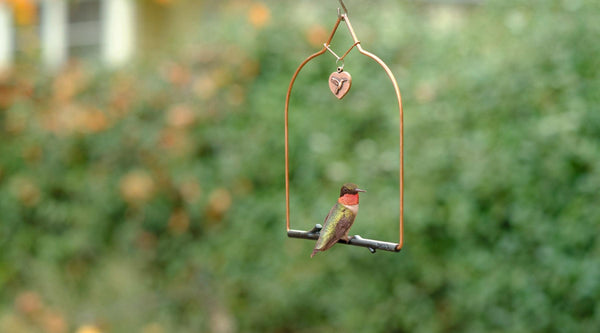
A Little Throne for Your Breeding Season Regulars
Broad-tailed and Black-chinned both hold Colorado territory all summer, one in the high mountains and the other on the Western Slope — a dedicated perch nearby gives either one a proper vantage point to guard while it's here.
Shop Charm Redwood Swing →Passing Through: Colorado's Two Regular Migrants
Once the breeders are on territory, Colorado's hummingbird story picks up a second act. Two western species that nest nowhere near the state use the Rockies as a highway every summer — and the southbound wave in August can outnumber the residents at a mountain feeder.
Rufous Hummingbird Migrant/Winter
Colorado's second-most-reported hummingbird, and it doesn't nest here at all. The Audubon Field Guide describes the species' migration as a loop — north up the Pacific lowlands in spring, then southeast from late June "mostly through the Rocky Mountain region" — and Colorado sits on that southbound leg. The data shows exactly that shape: essentially absent in spring, then a surge to 13.6% of statewide checklists in late August, with 17% around Grand Junction, 19% in Summit County, and 23% around Cortez. It's gone again by October. Audubon describes the Rockies as a migration corridor rather than breeding range, and the Colorado Breeding Bird Atlas agrees: Rufous only passes through.

Quick ID: Adult males are almost entirely orange-rufous with a glowing orange-red throat — the easiest hummingbird in Colorado to call at a glance. Females and immatures are green above with cinnamon-washed flanks, a coppery rump, and rufous in the tail. Against female Broad-tailed, Rufous is slightly smaller with a shorter tail that barely extends past the wings, more copper in the tail, and no white eye-ring. Allen's Hummingbird, the near-identical look-alike, has never been accepted in Colorado — see the note below.
Calliope Hummingbird Migrant/Winter
North America's smallest breeding bird is a genuine regular in Colorado — 4.5% of statewide checklists at its late-August peak, and 5 to 8% around Grand Junction, Cortez, and Summit County — but it breeds elsewhere. The Western Hummingbird Partnership lists Calliope's breeding range as expanding through Idaho, Wyoming, Utah, and Nevada, with Colorado absent from that list, and separately describes Colorado as a migratory stopover site in its own habitat data. The Committee's review list doesn't include it, which under the Committee's convention marks it as a regular, expected migrant.

Quick ID: Tiny even for a hummingbird, with a short tail that sits about level with the wingtips at rest — on Broad-tailed and Rufous the tail extends past the folded wings. Adult males show magenta streaks radiating down a white throat rather than a solid gorget, unlike anything else in Colorado. Females are told from female Rufous by size, that short tail, very little rufous in the tail, and a pale buff wash spread evenly across the breast rather than concentrated on the flanks; from female Broad-tailed by size and a much shorter, thinner bill.

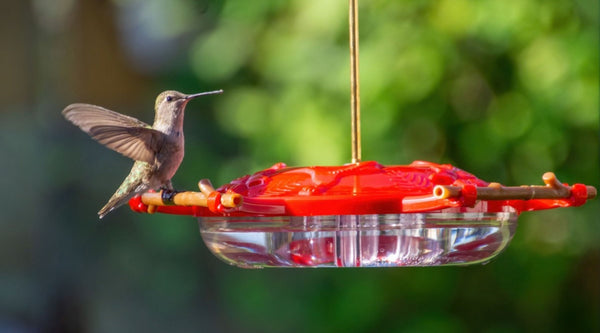
An Extra Feeder for Your Passing Migrants
Rufous and Calliope both pass through on the same southbound wave in August, and that wave can outnumber Colorado's own breeders at a mountain feeder — a second station keeps them from having to compete for what's already there.
Shop AspenPerch® Feeder →Colorado's Recurring Rarities
Eight more species have accepted Colorado records, and the Colorado Bird Records Committee's public database lists every one by accession number, county, and observer — which lets this page say not just "rare" but how rare, and how recently. Four of them show a genuine recurring pattern, with accepted records in the last few years.
Rivoli's Hummingbird Rare / Casual Visitor
Colorado's best-documented rarity, and one of the more surprising: twenty-six accepted records of a large Southwestern hummingbird whose United States range is the sky-island canyons of Arizona and New Mexico. The Committee's 37th report noted a running total of nine as of 2004; it has nearly tripled since. The anchor records tell the story — an adult male at a Collbran feeder in Mesa County in July 2002, the county's second after a 1965 sighting at Colorado National Monument; a female near Chambers Lake in Larimer County that same July; an adult male at a Floyd Hill feeder in Clear Creek County in May 2021; and an El Paso County record in June 2024. Most are late-spring and summer birds in the mountains, and the pattern is still active.

Quick ID: A very large, dark, long-billed hummingbird — roughly double the mass of a Black-chinned, with a bill up to half again as long. Adult males can look all-black until the light catches an emerald throat and violet crown. Females are gray below with a small white mark behind the eye and green central tail feathers; size and bill length alone rule out every regular Colorado species. Against Blue-throated Mountain-gem, the other big dark rarity, Rivoli's has only that small white dot behind the eye where Blue-throated shows two bold white face stripes.
Ruby-throated Hummingbird Rare / Casual Visitor
The East's hummingbird reaches Colorado as a real but reviewed rarity: thirty-seven accepted records in the Committee's database, and every one of them required committee acceptance, because Ruby-throated carries full statewide review status here. The pattern is a fall one — a genuine recurring trickle of migrants on the eastern plains — and Yuma County, on the Kansas line, is the only region where it registers in the eBird data at all, at about 0.6% in May. Anywhere west of the plains, a bird with a red throat is a Broad-tailed until a photograph says otherwise.

Quick ID: Adult males show an all-red iridescent throat, a green crown, a dark cheek patch, and a forked black tail. The Colorado confusion is with Broad-tailed: the male Broad-tailed's throat is rose-magenta rather than red, it shows a thin white eye-ring instead of the dark cheek, and it trills in flight. Females are separated by the tail — cinnamon-colored outer feathers on Broad-tailed, green and black on Ruby-throated.
Anna's Hummingbird Rare / Casual Visitor
Nineteen accepted records, and growing — up from about seven as of the early 2000s. Anna's has been on Colorado's state list since 1974 and remains a review species, so every sighting still needs documentation. The pattern is post-breeding dispersal in fall: an immature male in Douglas County on September 17, 2022, accepted 7–0 and confirmed in the Committee's 84th report, is typical, and the eBird data shows the same thing, with faint October and November signals around Grand Junction and Cortez. Two of the largest raw eBird weeks for this species turned out to be rounding-floor artifacts and were discounted; the records-committee count is the real measure.

Quick ID: The only North American hummingbird with an iridescent crown as well as throat — males glow rose-pink from the top of the head down. Females are plump and short-billed with grayish-green flanks and usually a small red throat spot; against female Broad-tailed, Anna's has grayish rather than cinnamon-washed flanks and no cinnamon in the tail, and against female Black-chinned it's stockier, dingier below, and holds its tail still where Black-chinned pumps it.
Broad-billed Hummingbird Rare / Casual Visitor
Four accepted records, spread over seventeen years and all in Mesa County. The first was the Louisiana-banded female at Clifton in July 2002; the fourth, an immature male at Palisade on October 19, 2019, which the Committee's 82nd report explicitly called "the 4th documented sighting of this species in Colorado." Four records across 2002 to 2019 is a thin pattern, and this page treats it as the most marginal of Colorado's recurring rarities rather than a settled one — but the Grand Junction area's eBird signal, peaking at 1.5% in September, says the Western Slope is where to look.

Quick ID: The bright red, black-tipped bill is diagnostic in every plumage — no regular Colorado species shows red on the bill. Adult males add a shimmering blue throat on a mostly emerald body; females are gray below with a white line curving behind the eye and a bill that's red at the base with a dark tip. The only other red-billed bird on Colorado's list is White-eared, with its bold white ear stripe.

Make Your Sanctuary Worth a Detour
Rivoli's, Ruby-throated, Anna's, and Broad-billed all keep turning up in Colorado in real, documented numbers — real electrolytes and calcium beyond plain sugar water give a recurring visitor a reason to linger instead of just passing through.
Shop Nectarlyte® Powder →If You're Lucky: Colorado's Historic Rarities
The other four have gone silent: two accepted records apiece and nothing in twenty years, a fifteen-record history that stopped in 2011, and a nine-record run that ended in 2014.
Costa's Hummingbird Historic / Accidental
Nine accepted records across seven counties between 2001 and 2014, on both sides of the Divide — Crow Valley Campground in Weld County, Mount Evans, Fort Collins, Clifton and Grand Junction in Mesa County, Lamar, Rye, and Colorado Springs. The Committee's 40th report noted the "second accepted record" in 2005; the 70th, in 2014, the "seventh." That was a clean recurring pattern across thirteen years — but nothing has been accepted in the twelve years since, while the species stays on the Committee's review list, so the silence is real. This page now lists it as historic for the same reason it lists Blue-throated Mountain-gem that way: the calendar, not the count.

Quick ID: Adult males are unmistakable — a violet-purple crown and a gorget that flares out past the sides of the neck like a mustache. Females are small, short-tailed, and whiter-bellied than any regular Colorado species, with a faint pale eyebrow and a slightly droopy bill. Against female Broad-tailed, Costa's shows grayish flanks and a mostly clean throat where Broad-tailed shows peachy flanks and a green-stippled throat; against female Black-chinned, it's smaller, shorter-billed, and paler below.
Blue-throated Mountain-gem Historic / Accidental
The rarity with the most records on this page that isn't tiered as recurring — and the reason is the calendar, not the count. The Committee's database lists fifteen accepted records across eleven counties, from Evergreen in 1970 through Colorado Springs, Grand Lake, Fruita, Durango, Ridgway, Beulah, and Dinosaur National Monument, with the last accepted in 2011. Fifteen years without a record since, while the species stays on the Committee's review list, means the absence is real and not a reporting gap. A genuine cluster, spread across four decades and most of the state, that has simply stopped.

Quick ID: The largest hummingbird that nests in the United States, with two white face stripes — one above the eye and a short one below it — a gray belly, and big white corners on a blackish tail that flash in flight. Adult males add a sapphire throat. Against Rivoli's, look for those two face stripes and the large white tail corners; Rivoli's has a single small white dot behind the eye and a longer bill.
Mexican Violetear Historic / Accidental
Exactly two accepted records, five years apart: Durango, La Plata County, in 1998, and the Conifer area of Jefferson County in 2003. Nothing in the twenty-three years since, and the species remains on the Committee's review list, so the silence is real. A long-distance wanderer from the Mexican highlands that has reached Colorado twice and shown no sign of a pattern.
Quick ID: Unmistakable if you get a look — an all-glittering-green bird, larger than any of Colorado's regular species, with a violet-blue ear patch and a violet-blue band across the chest, a straight black bill, and a blue-green tail crossed by a dark band. Both sexes look alike.
White-eared Hummingbird Historic / Accidental
Two accepted records, both from 2005 and both at Durango — accessions 2005-069 and 2005-077, documented by two separate observer groups. Same town, same year: almost certainly one bird seen twice, which makes this weaker than a two-record pattern, not stronger. Nothing has been accepted in the twenty-one years since, and the species is still on the review list.

Quick ID: A bold white stripe behind the eye against a mostly green body, with a red bill tipped in black. Adult males add a violet-blue crown and throat that make the white ear stripe stand out even more. The red bill puts it alongside Broad-billed on Colorado's list; the white ear stripe separates the two.
The one that isn't here. Allen's Hummingbird — the near-identical twin of Rufous — has accepted records in Kansas, Utah, and New Mexico, but none in Colorado. Since female and immature Allen's are separable from Rufous only by tail-feather measurements in the hand, a green-backed Selasphorus in Colorado should be logged as Rufous, or as "Rufous/Allen's" if you want to be careful. An adult male with a solid green back is the one case worth photographing and submitting.
Colorado Hummingbirds at a Glance
Four of Colorado's twelve species show up often enough on eBird checklists to chart, and the chart tells the state's story in one glance: one dominant breeder, Broad-tailed; one big migrant wave, Rufous; and two more real players behind them.

Statewide eBird checklist data, 2016–2025. Eight documented species are too rare to chart: Anna's and Costa's sit under a quarter of a percent statewide, Broad-billed under a tenth, Rivoli's and Ruby-throated at eBird's rounding floor, and Blue-throated Mountain-gem, Mexican Violetear, and White-eared have no eBird signal in this window at all.
| Species | Status | Colorado Records |
|---|---|---|
| Broad-tailed Hummingbird | Breeding | Statewide peak 40% in early July; 59% in Summit County |
| Black-chinned Hummingbird | Breeding | Statewide peak 9% in May; 39% around Grand Junction in August |
| Rufous Hummingbird | Migrant / Winter Visitor | Southbound migrant only; statewide peak 14% in late August |
| Calliope Hummingbird | Migrant / Winter Visitor | Migrant only; statewide peak 4.5% in late August; not a review species |
| Rivoli's Hummingbird | Rare / Casual | 26 accepted records, 1990s to June 2024 |
| Ruby-throated Hummingbird | Rare / Casual | 37 accepted records; review species; recurring fall migrant on the eastern plains |
| Anna's Hummingbird | Rare / Casual | 19 accepted records; review species; most recent September 2022 |
| Costa's Hummingbird | Historic / Accidental | 9 accepted records, 2001–2014, across 7 counties; none since |
| Broad-billed Hummingbird | Rare / Casual | 4 accepted records, 2002–2019, all Mesa County |
| Blue-throated Mountain-gem | Historic / Accidental | 15 accepted records, 1970–2011, across 11 counties; none since |
| Mexican Violetear | Historic / Accidental | 2 accepted records — Durango 1998, Conifer 2003 |
| White-eared Hummingbird | Historic / Accidental | 2 accepted records, both Durango 2005 — likely one bird |
Frequently Asked Questions
How many kinds of hummingbirds have been documented in Colorado?
Twelve, all accepted by the Colorado Bird Records Committee. Two breed in the state, Broad-tailed and Black-chinned; two pass through every year without nesting, Rufous and Calliope; and the other eight are rarities, ranging from Rivoli's Hummingbird with twenty-six accepted records down to White-eared, which has probably been seen once.
Do Ruby-throated Hummingbirds occur in Colorado?
Yes, but only as a reviewed rarity — thirty-seven accepted Ruby-throated records, mostly fall migrants on the eastern plains, and every one needed committee acceptance. West of the plains, a hummingbird with a red throat is almost certainly a male Broad-tailed: its throat is rose-magenta rather than true red, it has a thin white eye-ring instead of a dark cheek patch, and its wings trill in flight.
How do I tell a female Broad-tailed from a female Rufous in Colorado?
Both are green above with cinnamon-washed flanks and rufous in the tail, and both are at Colorado feeders in August. Broad-tailed is slightly larger with a longer tail that extends well past the folded wings, shows less copper in the tail, has grayer cheeks, and has a thin white eye-ring that Rufous lacks. Rufous is a little smaller, with a shorter tail that barely clears the wingtips, a coppery rump, and more copper in the tail.
Has Allen's Hummingbird ever been seen in Colorado?
Not on the accepted record. Kansas, Utah, and New Mexico all have Allen's records, but Colorado has none, and since female and immature Allen's can only be separated from Rufous by tail-feather measurements in the hand, an unidentified green-backed Selasphorus in Colorado is best logged as Rufous. An adult male with a solid green back — where Rufous usually shows rufous — is the one case worth documenting and submitting.
Which rare hummingbird is Colorado most likely to produce?
Rivoli's Hummingbird, on the numbers — twenty-six accepted records, most in late spring and summer in the mountains, with records as recent as 2021 and 2024. Anna's is the fastest-growing, with nineteen records and a clear fall-dispersal pattern. Either is a large enough signal that a careful photograph of an unfamiliar bird is worth submitting to the Committee.
Why We Created This Guide
Pop's Birding has been helping hummingbird lovers for three generations. One of the questions our customers ask most often is "what hummingbirds are actually in my state?" — we built this guide to give a direct, sourced answer for Colorado specifically, not a generic one. Most identification content treats Colorado as "Broad-tailed plus migrants," and that misses what's distinctive here: a second breeder that dominates the Western Slope, a migrant wave that can outnumber the residents in August, and a rarity list where the records committee's own database lets a reader see the difference between a bird documented twenty-six times and one probably seen once.
How We Created This Guide
We started with statewide eBird bar chart data from the Cornell Lab of Ornithology, covering 2016 through 2025, then added five counties that capture Colorado's different hummingbird landscapes — Denver's Front Range, Mesa's Western Slope, Montezuma's southwest canyons, Summit's high mountains, and Yuma's eastern plains. Since raw checklist numbers alone can make a single well-photographed rarity look like a recurring pattern, we checked every species' week-by-week signal for recurrence across separate years, then checked that against the Colorado Bird Records Committee's live review list and accepted-record database, the Colorado Breeding Bird Atlas, and the Western Hummingbird Partnership's range accounts. That's how we caught two rounding artifacts in Anna's largest raw eBird weeks and set them aside, and how we determined that White-eared's two accepted records — same town, same year — represent one bird rather than a pattern. Only four of the twelve species clear a real threshold above eBird's rounding floor, so those are the only ones charted; the other eight are named instead of plotted, since a bar for a handful of detections in a decade would misrepresent them.
Sources
- eBird bar chart data, Cornell Lab of Ornithology — Colorado statewide plus Denver, Mesa, Montezuma, Summit, and Yuma counties, 2016–2025.
- Colorado Bird Records Committee, Review List and Summary by Species database — Colorado Field Ornithologists. Source for every rare-species record count, date, county, and review status on this page.
- Colorado Bird Records Committee Annual Reports — 37th (2002 Broad-billed and Rivoli's records), 82nd (2019 Broad-billed), 83rd and 84th (2021 Rivoli's, 2022 Anna's).
- Kingery, H. E., ed. (1998). Colorado Breeding Bird Atlas. Colorado Bird Atlas Partnership and Colorado Division of Wildlife. Source for Broad-tailed and Black-chinned breeding status; summarized at Colorado Virtual Library.
- Western Hummingbird Partnership — Calliope Hummingbird breeding range and Colorado stopover status.
- Audubon Field Guide — Broad-tailed and Rufous Hummingbird range and migration accounts.
Know before they arrive
You don't have to keep this calendar taped to the fridge. Insider Birding Access members get seasonal notes timed to your region — when to have feeders out, what the birds are doing right now, and what's worth doing in your yard this season. We take the guesswork out of the calendar. Joining takes about thirty seconds, and there's 10% off your first order in it.
Join Insider Birding Access →Free to join. 10% off your first order.
Shop Colorado's Hummingbird Favorites


Bethany Sloan has served as General Manager of Pop's Birding since 2010, continuing the legacy of her grandfather, William "Pops" Sloan, inventor of the Original Hummingbird Swing. A lifelong hummingbird enthusiast, educator, and independent researcher, she leads the company's educational content, including its 50-State Hummingbird Guide series, Regional Guide, Species Guide and Hummingbird Learning Center. Bethany combines scientific research, regional migration data, and more than 16 years of hands-on experience to create trusted educational resources for bird enthusiasts across North America.