Aug 02, 2026
Rivoli's Hummingbird: The Name That Came Full Circle
Few birds in North America have had a naming history as genuinely tangled as this one. First called Rivoli's Hummingbird in 1829. Renamed Magnificent Hummingbird in the early 1980s. Then, in 2017, officially renamed back to Rivoli's Hummingbird — nearly two centuries after the name was first given, and only after modern genetic research finally sorted out a case of mistaken taxonomic identity that had lingered for decades. Whatever you call it, it's one of the two largest hummingbirds found anywhere in the United States, and a genuine highlight for any birder visiting the mountain canyons of the Arizona and New Mexico borderlands.
Quick Facts
- Scientific name: Eugenes fulgens (Swainson, 1827)
- Length: 4.3–5.5 inches (11–14 cm)
- Weight: 6–10 grams
- Wingspan: approximately 7.1 inches (18 cm)
- Lifespan: oldest banded record at least 11 years, 2 months — a male recaptured in Arizona
- Conservation status: Least Concern (IUCN, assessed together with the closely related Talamanca Hummingbird under the older combined "Magnificent Hummingbird" taxonomy)
- US range: the mountain ranges along the Arizona and New Mexico border with Mexico, representing the northern edge of the breeding range
- Claim to fame: one of the two largest hummingbird species in the United States, and a species whose common name has officially changed twice in the last 200 years
The Origin Story: A Name That's Changed Twice
Rivoli's Hummingbird was formally described in 1827 by English naturalist William Swainson, who gave it the binomial name Trochilus fulgens, based on a specimen from Temascaltepec, Mexico. Just two years later, in 1829, French naturalist René Lesson independently described the same species and named it in honor of François Victor Masséna, the Duke of Rivoli — and remarkably, even after it later became clear that Swainson's earlier description technically had priority, the common name "Rivoli's Hummingbird" stuck anyway and remained in use for well over a century, according to Cornell's Birds of the World. (A nice bit of trivia: Anna's Hummingbird was later named for the Duke's wife, Anna, Duchess of Rivoli.)
That changed in the early 1980s, when the common name was switched to Magnificent Hummingbird instead. The story doesn't end there, though: in 2017, the American Ornithological Society's classification committee officially split what had been treated as a single species into two, based on genetic evidence: the northern population, ranging from the southwestern United States down to northern Nicaragua, and a separate species found in the highlands of Costa Rica and western Panama, newly named the Talamanca Hummingbird (Eugenes spectabilis). As part of that split, the northern species' common name was formally restored to Rivoli's Hummingbird — bringing the name back full circle nearly 190 years after Lesson first gave it. (Worth noting: BirdLife International's Handbook of the Birds of the World still treats the two as one combined "Magnificent Hummingbird" species for conservation-assessment purposes, so you may still encounter that older, broader classification in some references, including the current IUCN status above.)
Where Rivoli's Hummingbird Lives: The Northern Edge of a Mexican and Central American Range
According to Cornell's All About Birds, Rivoli's Hummingbird is found from the southwestern United States all the way to northern Nicaragua, typically occurring at middle to high elevations throughout much of Mexico and Central America — and it's the second-largest hummingbird species in the United States, behind only the Blue-throated Mountain-gem. The mountains and mountain valleys along the Arizona and New Mexico border with Mexico represent the true northern edge of the breeding range — birds move north into this region in early spring specifically to breed, while populations farther south in Mexico and Central America remain full-time residents year-round. The species is also documented in summer in the Chisos Mountains of Big Bend National Park in west Texas, though confirmed breeding there hasn't been established the way it has in Arizona and New Mexico.
Although the core US range is genuinely narrow, individual Rivoli's Hummingbirds are known to wander widely, with documented vagrant records from states well outside the species' typical borderland range, including Colorado, Nevada, Utah, and as far east as Kansas and the Southeast.
How to Identify Rivoli's Hummingbird
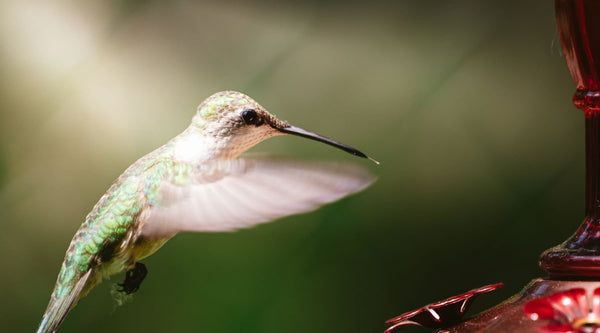
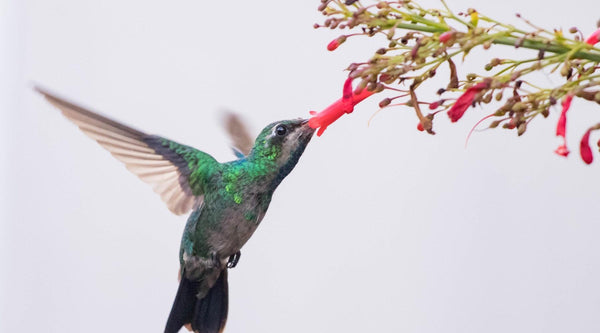
This is a large, dark hummingbird overall, according to Cornell's All About Birds. The male appears almost blackish at first glance, but flashes a glittering green throat and a violet crown when the light hits at the right angle, with a small white spot behind the eye. Females are green above and a dingy grayish below, with a pale white streak behind the eye. The species shows real sexual dimorphism — not just in coloration, but in body mass and bill length as well, according to research published by Donald R. Powers and colleagues in Cornell's Birds of the World: males tend to be heavier, while females tend to have the longer bill.

Similar Species
The most likely confusion species is the Blue-throated Mountain-gem, the only other hummingbird in the US of comparable size. According to Cornell's species-comparison guide, the Blue-throated Mountain-gem has a blue throat and large white tail corners, while Rivoli's shows a green gorget and violet crown and lacks the white tail tips altogether — a genuinely reliable way to separate the two once you know what to look for.
Behavior: Large, But Not Always the Boss
Rivoli's Hummingbird is a large hummingbird of high mountain forests in the Southwest borderlands, and its size does give it an advantage over smaller hummingbirds at flowers and feeders in parts of its range. That said, the real picture is more nuanced than "biggest always wins": Cornell's All About Birds notes the species normally doesn't push other hummingbirds around and tends to travel a regular circuit between flower patches rather than aggressively defending one spot, and Birds of the World specifically notes that in places like southeastern Arizona, Rivoli's Hummingbirds aren't known to be territorial at all. Throughout its range, it's actually subordinate to the even larger Blue-throated Mountain-gem.
Feeding and Diet
Like other hummingbirds, Rivoli's Hummingbird feeds primarily on flower nectar, supplemented by small insects for essential protein — caught either by hawking them out of the air or gleaning them directly from foliage, according to Cornell's All About Birds, which notes some evidence suggests this species is more insectivorous than many other hummingbirds. Its unusually long bill lets it reach nectar in long, tubular flowers that shorter-billed hummingbirds can't access, including thistles, red columbine, beardlip penstemon, and various species of sage. A male will sometimes defend an especially productive nectar source, such as a large flowering agave, against smaller hummingbirds trying to feed there.
Habitat
According to Cornell's All About Birds, Rivoli's Hummingbirds inhabit pine-oak forests in mountainous areas of the Southwest, usually between about 5,000 and 9,000 feet in elevation. Breeding is often closely associated with cool canyons and stream drainages in the mountain ranges of southern Arizona and New Mexico, according to Birds of the World, where nests are commonly built high up in trees overhanging the water below. The Audubon Field Guide adds that across the species' broader range, it also favors shady canyons with sycamore and maple, open hillsides of pine-oak woodland, and coniferous forest at higher elevations.
Migration
According to Birds of the World, Rivoli's Hummingbirds that breed at the northern edge of the range — Arizona and New Mexico specifically — migrate north in early spring to reach their breeding grounds, arriving around March, then move south again for the winter, with a small number lingering at Arizona feeders into the colder months. Populations across most of the species' broader Mexican and Central American range, by contrast, are non-migratory, full-time residents.

Voice
Cornell's All About Birds describes the most commonly heard call as a clipped, high "tsip" note, sometimes given in a rapid, staccato series — a fairly understated vocalization compared to some of the species' more musically inclined relatives.
Rivoli's Hummingbird by Region: Where and When to Find Them
| Region | Status | Best Time to See Them |
|---|---|---|
| Southeastern Arizona (mountain canyons near the Mexico border) | Northern edge of the breeding range; the most reliable place to find this species | Spring through fall; a few overwinter at feeders |
| Southwestern New Mexico | Northern edge of the breeding range | Spring through fall |
| West Texas (Chisos Mountains, Big Bend) | Documented summer presence; breeding unconfirmed | Spring through fall |
| Rest of Mexico & Central America (to northern Nicaragua) | Core range; largely non-migratory, resident populations | Year-round |
| Scattered US vagrant records outside the Southwest (e.g., Colorado, Nevada, Utah, Kansas) | Rare, documented wanderer | Any season |
If You're Hoping to Spot (or Attract) a Rivoli's Hummingbird
Because this species' US range is so tightly tied to specific mountain canyons, a visit to a known hotspot will almost always beat trying to attract one cold to a home feeder outside its range.
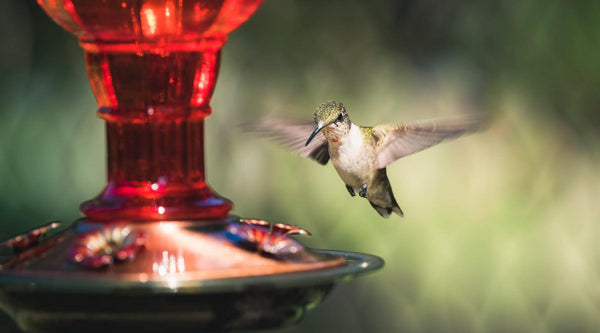
- If your property sits in a cool mountain canyon in southeastern Arizona or southwestern New Mexico, a leak-proof feeder like the AspenPerch® Hummingbird Feeder filled with fresh Pop's Nectar gives you a genuine chance, roughly April through September.
- Expect this species to sometimes dominate the feeder if it does show up, though it's usually more of a regular circuit-feeder than a territorial guard — and it will itself give way to the even larger Blue-throated Mountain-gem.
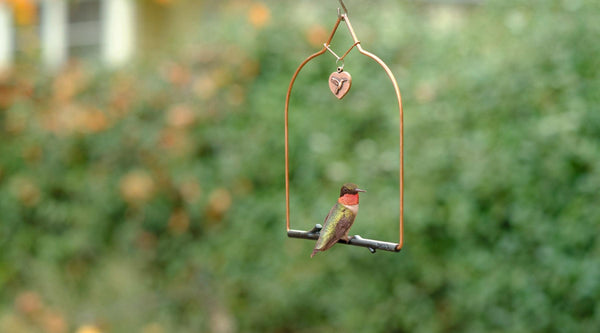
- Add a swing near your feeder — a Pop's Original Hummingbird Swing gives any visiting hummingbird a place to rest and be observed up close.
- Skip the insecticide, since insects are a real part of this species' diet. Use HummGuard™ nectar tips instead to manage bees and wasps without removing food this bird depends on.
- Consider a visit to a known Arizona or New Mexico sky island hotspot — places like Madera Canyon, Ramsey Canyon, and Cave Creek Canyon near Portal are among the most reliable spots in the country to see this species at feeders. For most people, that trip is simply a far more realistic path than attracting one to a home feeder outside its narrow natural range.
For general feeder timing, native plant lists, and wildflower planting guidance for the region, see our companion guides for Arizona, New Mexico, and Texas, or find your own state in our full hummingbird guide by state series.
Frequently Asked Questions
Is it called Rivoli's Hummingbird or Magnificent Hummingbird?
Both names refer to the same bird, and the official name has actually changed twice. It was named Rivoli's Hummingbird in 1829, renamed Magnificent Hummingbird in the early 1980s, and then officially restored to Rivoli's Hummingbird in 2017 when it was recognized as a distinct species from its close relative, the Talamanca Hummingbird.
How big is a Rivoli's Hummingbird?
It's the second-largest hummingbird species in the United States, typically 4.3 to 5.5 inches long, rivaled in size only by the Blue-throated Mountain-gem.
How can you tell a Rivoli's Hummingbird from a Blue-throated Mountain-gem?
Rivoli's Hummingbird shows a glittering green gorget and a violet crown in good light, and lacks the large white tail corners typical of the Blue-throated Mountain-gem, which instead shows a blue (not green) throat.
Where can I see a Rivoli's Hummingbird in the United States?
The mountain canyons of southeastern Arizona and southwestern New Mexico are the most reliable spots — well-known hotspots include Madera Canyon, Ramsey Canyon, and Cave Creek Canyon near Portal, Arizona. The best window is roughly April through September, with the species also documented in summer in the Chisos Mountains of Big Bend National Park, Texas.
How long do Rivoli's Hummingbirds live?
The oldest recorded individual was a male at least 11 years, 2 months old when recaptured during banding operations in Arizona — a notably long lifespan for a hummingbird.
Is Rivoli's Hummingbird aggressive?
Not especially, despite its size. It typically travels a regular circuit between flower patches rather than aggressively guarding one spot, and in some parts of its range — including southeastern Arizona — it isn't known to be territorial at all. It will, however, sometimes defend an especially rich nectar source against smaller hummingbirds.
Is Rivoli's Hummingbird endangered?
No, it's rated Least Concern by the IUCN, though that assessment currently still lumps it together with the closely related Talamanca Hummingbird under the older combined taxonomy.
How can I attract a Rivoli's Hummingbird to my yard?
Realistically, only if you're in a mountain canyon in southeastern Arizona or southwestern New Mexico. A feeder can help within that narrow range, but this large hummingbird's presence is governed far more by elevation and habitat than by garden setup.
At Pop's Birding, we believe every backyard — big or small — has room for a little more wonder. Explore our feeders, nectars, swings, and wildflower seed blends to start building your own hummingbird sanctuary today.

Bethany Sloan has served as General Manager of Pop's Birding since 2010, continuing the legacy of her grandfather, William "Pops" Sloan, inventor of the Original Hummingbird Swing. A lifelong hummingbird enthusiast, educator, and independent researcher, she leads the company's educational content, including its 50-State Hummingbird Guide series, Regional Guide, Species Guide and Hummingbird Learning Center. Bethany combines scientific research, regional migration data, and more than 16 years of hands-on experience to create trusted educational resources for bird enthusiasts across North America.