Sep 04, 2026
Hummingbirds in South Dakota: The Complete Guide to All 8 Species
South Dakota's documented hummingbird list runs to eight species, per the South Dakota Ornithologists' Union (SDOU) — the same as Minnesota and Nebraska, ahead of North Dakota and Wyoming (six each), behind Montana's nine. Ruby-throated Hummingbird is the state's dominant breeder, concentrated in the east. Broad-tailed Hummingbird is a genuine, if only occasional, Black Hills breeder with a real comeback story. And the Black Hills region as a whole holds a surprising amount of diversity — six different species have shown real activity there in a single recent summer.
Free download
All 8 species, one page
A one-page reference to every hummingbird documented in South Dakota — two breeders, a regular migrant, and five documented rarities, with each species' status and record history at a glance.
Download the South Dakota species guideOne page · PDF · free to print and share

All 8 documented South Dakota hummingbird species, grouped by tier — statewide eBird data, 2016–2025, cross-checked against the South Dakota Ornithologists' Union's own State Distributional Checklist.
The Hummingbirds You're Most Likely to See
Ruby-throated Hummingbird Breeds Here
South Dakota's only reliably expected hummingbird across most of the state, found mostly in the eastern half where shelterbelts, riparian corridors, and suburban yards offer the right habitat. Statewide eBird frequency peaks near 8% in early September. SDOU codes it "Regular" (present 8–10 of the last 10 years) statewide — East and River regions both a perfect 10 of 10 years, West 9 of 10 — with breeding confirmations documented most, though not literally every, year.

Quick ID: Males flash a brilliant ruby-red throat in good light, but it reads as solid black most of the time — the forked black tail is the more reliable everyday mark. Females have a plain whitish throat and a more rounded, white-tipped tail.
Broad-tailed Hummingbird Breeds Here
A genuine comeback story confined mostly to the Black Hills. Historic records show it nested there in the late 19th century, but the species then went unconfirmed as a breeder for well over a hundred years — until nesting was documented again in the 2010s, per the South Dakota Game, Fish and Parks Department's Second Atlas of Breeding Birds. SDOU's own checklist codes it "Regular" in the West region (present all 10 of the last 10 years) but only "casual" as a breeder specifically (a confirmed nest in just 3 to 7 of those years) — meaning the species shows up every year, but doesn't nest every one of those years.

Quick ID: Males have a rose-magenta throat and produce a loud, distinctive metallic wing trill in flight — often heard before seen. Females show green throat spotting rather than solid color, with a pale eyering that helps separate her from similar species.

A Little Throne for South Dakota's Breeders
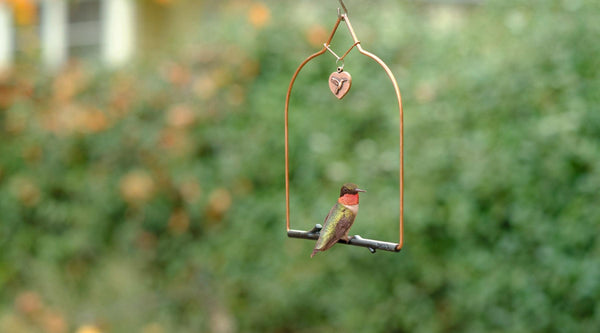
Ruby-throated holds the east and Broad-tailed holds the Black Hills, but both breeders defend territory the same way — a redwood perch nearby gives either one a favorite spot to rest and stand guard.
Shop Charm Redwood Swing →South Dakota's Regular Migrant — And the Black Hills' Real Diversity
Rufous Hummingbird Migrant/Winter
Worth being precise about: Rufous isn't really a rarity in South Dakota, even though it sometimes gets grouped with the state's rare visitors. SDOU codes it "Regular" — present in 9 of the last 10 years in western South Dakota — making it the most frequently recorded species after the state's own two breeders. It just isn't a breeder itself; no nesting confirmations exist anywhere in the state.
The Black Hills region is where South Dakota's real hummingbird diversity concentrates. Meade County alone has shown real activity from six different species in a single recent summer — Rufous (17.65% peak), Broad-tailed (13.79%), Black-chinned (13.24%), Anna's (7.14%), Costa's (7.14%), and Calliope (3.45%) — a level of variety the rest of the state simply doesn't have, driven by the region's proximity to the Rocky Mountain foothills.

Quick ID: Males glow with a fiery orange-red throat and a coppery-orange body — one of the most recognizable hummingbirds in North America. Females and immatures are green above with rusty flanks and rufous patches at the base of the tail.

An Extra Feeder for Your Rufous Visitor
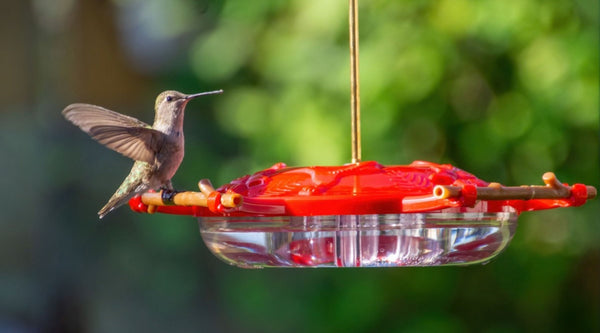
Rufous shows up nearly every year in western South Dakota without ever nesting here — a second feeder, set apart from the first, gives a passing migrant its own station instead of fighting your breeders for one.
Shop AspenPerch® Feeder →South Dakota's Documented Rarities
SDOU's own classification system draws a clean line among the state's remaining five species. Anna's and Calliope are both coded "Casual" — a real, if infrequent, recurring pattern (4 to 6 of the last 10 years). Black-chinned, Costa's, and Rivoli's are all coded "Accidental" — 2 or fewer of the last 10 years, genuinely isolated occurrences.
Anna's Hummingbird Rare / Casual Visitor
Recently upgraded by SDOU from "Accidental" to "Casual" status — a committee-documented change reflecting a genuine, real recurring pattern, not an error in prior tracking. First recorded in South Dakota in a Rapid City sighting in October 2008; regional year-counts now stand at East 1, River 2, West 2 over the last decade.

Quick ID: The only North American hummingbird with a fully colored crown as well as throat — males glow rose-pink from head to throat. Females show a central patch of rose-red spotting on an otherwise plain throat, with a stocky, broad-tailed build.
Calliope Hummingbird Rare / Casual Visitor
SDOU's "Casual" designation here is backed by real, spread-out evidence — genuine activity confirmed across four distinct western counties (Fall River, Meade, Lawrence, and Pennington), consistent with a recurring pattern rather than a single-event vagrant. Regional year-counts: East 0, River 3, West 4.

Quick ID: North America's smallest breeding hummingbird, with a hunched posture and short tail. Males have a unique streaked, ray-like magenta throat unlike any other species' solid gorget. Females are tiny even by hummingbird standards, with very little rufous in the tail.

Make Your Sanctuary Worth a Detour
Anna's and Calliope are genuine, recurring South Dakota visitors, not one-time flukes — real electrolytes beyond plain sugar water give either one a reason to linger at your feeder.
Shop Nectarlyte® Powder →Black-chinned Hummingbird Historic / Accidental
An "Accidental" species per SDOU, confirmed specifically in western South Dakota and the Missouri River corridor — never recorded in the eastern part of the state. Regional year-counts: River 1, West 2, East blank (never recorded).

Quick ID: Males show a velvety black throat, only revealing a thin purple band in direct light — otherwise it just looks solid black. Females are plain and pale-throated, best told apart by white-tipped outer tail feathers and a small white spot behind the eye.
Costa's Hummingbird Historic / Accidental
An "Accidental" species confined entirely to western South Dakota — regional year-count West 2, with no records at all in the East or River regions.

Quick ID: Males show an extravagant violet-purple throat that flares out into long points at the sides, almost like a mustache. Females are compact and plain-faced, best told from other small desert hummingbirds by their short tail and a subtle grayish wash rather than the peachy or rufous tones seen on similar species.
Rivoli's Hummingbird Historic / Accidental
South Dakota's most extreme rarity — a single isolated occurrence, recorded once in the East region (1 of the last 10 years) and never in the West or River regions. The thinnest real eBird signal of any species on this page.

Quick ID: One of the largest hummingbirds likely to show up in South Dakota. Males are dark overall with a glittering green throat and a violet crown visible in good light; females are green above and grayish below, with limited pale tips in the tail corners rather than the bold white outer-tail markings smaller species show.

Give Every Visitor a Reason to Stay
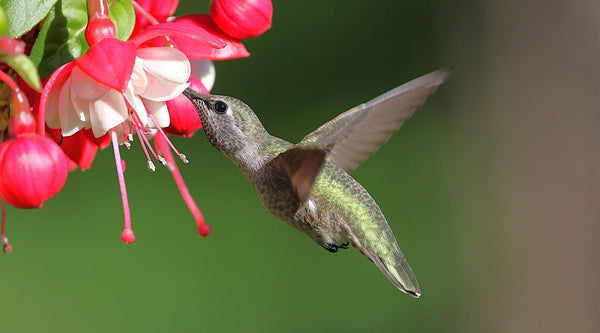
Whether it's a common backyard regular or a once-in-a-decade rarity like South Dakota's own Rivoli's Hummingbird, real nectar sources are what make a yard worth stopping at.
Shop Wildflower Seed →South Dakota Hummingbirds at a Glance
Ruby-throated Hummingbird's statewide lead isn't a close call — its eBird frequency peaks near 8%, roughly ten times the next-highest species. With most of the remaining species clustered under 1% statewide (their real diversity only shows up at the county level, as the Black Hills section above demonstrates), a statewide bar chart would flatten exactly the detail worth seeing, so this section sticks to the table instead.
| Species | Status | South Dakota Records |
|---|---|---|
| Ruby-throated Hummingbird | Breeding | "Regular" statewide (East/River 10 of 10 years); statewide frequency peaks near 8%. |
| Broad-tailed Hummingbird | Breeding | "Regular" in the West (10 of 10 years); breeding confirmed only "casually" (3–7 of 10 years). |
| Rufous Hummingbird | Migrant / Winter Visitor | "Regular" in the West (9 of 10 years); not a breeder, but the most frequent non-breeder. |
| Anna's Hummingbird | Rare / Casual Visitor | Upgraded from "Accidental" to "Casual" by SDOU; first record 2008, Rapid City. |
| Calliope Hummingbird | Rare / Casual Visitor | "Casual" per SDOU; real activity confirmed across 4 distinct western counties. |
| Black-chinned Hummingbird | Historic / Accidental | "Accidental" per SDOU; western SD and the Missouri River corridor only. |
| Costa's Hummingbird | Historic / Accidental | "Accidental" per SDOU; western South Dakota only. |
| Rivoli's Hummingbird | Historic / Accidental | South Dakota's most extreme rarity — a single occurrence, East region only. |
Frequently Asked Questions
How many hummingbird species have been recorded in South Dakota?
Eight, per the South Dakota Ornithologists' Union (SDOU) — two breeders, one regular migrant, two species with a genuine recurring "Casual" pattern, and three single-region rarities. That's the same as Minnesota and Nebraska, more than North Dakota and Wyoming (six each), but fewer than Montana's nine.
Is Rufous Hummingbird rare in South Dakota?
Not really, despite sometimes being lumped in with the state's rarities. SDOU codes it "Regular" — present in 9 of the last 10 years in western South Dakota — it's just not a breeder. It's the most frequently recorded species here after South Dakota's own two breeders.
Does Broad-tailed Hummingbird breed in South Dakota?
Yes, but only in the Black Hills, and only some years. SDOU's own breeding column codes it "casual" — a confirmed nest in 3 to 7 of the last 10 years — meaning the species shows up in western South Dakota every year, but an actual nest isn't documented annually. It's also a genuine comeback story: the Black Hills population went unconfirmed for more than a century after historic 19th-century records, until nesting was re-confirmed in the 2010s.
Which part of South Dakota has the most hummingbird diversity?
The Black Hills, by a wide margin. Meade County alone has shown real activity from six different species in a single recent summer — Rufous, Broad-tailed, Black-chinned, Anna's, Costa's, and Calliope — a level of diversity the rest of the state simply doesn't have.
What's the difference between Anna's/Calliope and South Dakota's other rare hummingbirds?
SDOU's own classification draws the line clearly. Anna's and Calliope are both coded "Casual" — a real, if infrequent, recurring pattern (4 to 6 of the last 10 years). Black-chinned, Costa's, and Rivoli's are all coded "Accidental" — occurring in 2 or fewer of the last 10 years, genuinely isolated occurrences.
Why We Created This Guide
Pop's Birding has been helping hummingbird lovers for three generations. One of the questions our customers ask most often is "what hummingbirds actually show up in my state" — we built this guide to give a direct, sourced answer, not a generic one. South Dakota's own records committee uses an unusually precise system — exact occurrence-frequency codes for every species, region by region — that most general references flatten into a single vague "rare visitor" label. This page keeps that precision intact, including the real distinction between a genuinely regular species like Rufous and the state's true single-occurrence rarities.
How We Created This Guide
We used eBird checklist data for South Dakota, 2016–2025, pulled statewide plus six counties — Minnehaha (Sioux Falls, east), Custer, Fall River, Lawrence, Meade, and Pennington (the Black Hills region, west) — cross-checked against the South Dakota Ornithologists' Union's own live State Distributional Checklist, which codes every species by exact 10-year occurrence frequency (Regular, Casual, or Accidental) and region (East, River, West). That precision is what let this page separate Rufous Hummingbird's genuinely regular, non-breeding status from the state's true rarities, and confirm Anna's and Calliope's real recurring "Casual" patterns against actual multi-county eBird signal rather than a single well-publicized sighting.
Sources
- eBird bar chart data, Cornell Lab of Ornithology — South Dakota statewide, 2016–2025.
- South Dakota Ornithologists' Union — source for every species' status and record history on this page.
Know before they arrive
You don't have to keep this calendar taped to the fridge. Insider Birding Access members get seasonal notes timed to your region — when to have feeders out, what the birds are doing right now, and what's worth doing in your yard this season. We take the guesswork out of the calendar. Joining takes about thirty seconds, and there's 10% off your first order in it.
Join Insider Birding Access →Free to join. 10% off your first order.
Shop South Dakota's Hummingbird Favorites


Bethany Sloan has served as General Manager of Pop's Birding since 2010, continuing the legacy of her grandfather, William "Pops" Sloan, inventor of the Original Hummingbird Swing. A lifelong hummingbird enthusiast, educator, and independent researcher, she leads the company's educational content, including its 50-State Hummingbird Guide series, Regional Guide, Species Guide and Hummingbird Learning Center. Bethany combines scientific research, regional migration data, and more than 16 years of hands-on experience to create trusted educational resources for bird enthusiasts across North America.