Sep 11, 2026
Minnesota Hummingbird Calendar: Month-by-Month Arrival & Departure
Minnesota has one real hummingbird breeder: Ruby-throated Hummingbird, present statewide from May through September. Everything else is a rarity. Rufous Hummingbird is the one rare species with a steady record here — Minnesota's records committee lists it as Casual, recorded in seven of the last ten years, mostly in fall. Anna's Hummingbird is Accidental, with five accepted records in all. Here's how the season actually unfolds.
The short answer: Ruby-throated arrives statewide in early May and is reliably common within two to three weeks. The statewide peak lands in late August, when nearly three in ten checklists include one, and several individual counties run noticeably higher. Most of the state empties out by late September to early October, faster in the north than the south. Everything else — Anna's, Rufous, Calliope, Broad-billed — is a genuine rarity worth a second look and a photo, not a bird to expect.
| Question | Answer |
|---|---|
| When do they arrive? | Early May in the south (Twin Cities, Rochester); mid-May in the north (Duluth, the North Shore) |
| When should feeders go up? | Last week of April statewide — a week or two before the first scouts, wherever you are |
| When do they nest? | June through August, once birds settle in after the spring arrival |
| Busiest month? | Late August into early September — the statewide peak lands in the fourth week of August, and several counties run even higher |
| When do they leave? | Mid-September in the north, early October in the south — most of the state is quiet by the second week of October |
| Any in winter? | No — Minnesota has no regular winter hummingbird presence. A hummingbird seen after October is a genuine rarity worth documenting |
Free download
The whole year on one page
Arrival and departure region by region, when to hang feeders in your part of the state, and what to watch for after the Ruby-throateds have gone — sized 8.5" x 11" for easy reference and printing.
Download the printable calendarOne page · PDF · free to print and share
Minnesota's Hummingbird Season at a Glance
Ruby-throated Hummingbird is the whole statewide story on its own — one clean season, one real breeder, no second species close enough to share the same chart.

How often Ruby-throated turns up on eBird checklists, week by week — statewide, 2016-2025. Source: eBird bar chart data (Cornell Lab of Ornithology), 2016-2025 (pulled Sep 2026).
Of Minnesota's four rare hummingbirds, only one shows a genuine, repeatable seasonal pattern worth charting: Rufous Hummingbird, recorded by the state's records committee in seven of the last ten years, mostly in fall. Anna's, Calliope, and Broad-billed each have only a handful of accepted records (five, two, and one) — charting them on a normal weekly line would visually suggest an annual pattern that isn't real, so we don't.

Source: eBird bar chart data (Cornell Lab of Ornithology), 2016-2025 (pulled Sep 2026). Three more species on Minnesota's official checklist — Mexican Violetear, Rivoli's, and Costa's — have zero eBird signal in this window at all; every one of their accepted records predates 2016.
Regions used below
We track five counties chosen to span Minnesota's real geography: Hennepin County (Minneapolis) and Olmsted County (Rochester), both in the warmer south; and St. Louis County (Duluth), Cook County (Grand Marais), and Lake County (Two Harbors), all in the colder North Shore and Arrowhead region. Statewide figures cover the whole state, including the rest of the Twin Cities metro and every county we don't break out separately.
Regional Arrival and Departure Snapshot
The whole state runs on the same basic pattern — arrive, build, peak, leave — but the far north runs it on a shorter calendar, arriving about a week later and leaving about three weeks earlier than the south.

January – March: The Deep Quiet
Ruby-throated is entirely absent statewide across these three months, in every county we track — genuinely zero, not just low. Minnesota has no regular winter hummingbird presence anywhere, unlike some of the southern and southwestern states in this series. If you see a hummingbird at a feeder in January, February, or March, it is a real rarity and worth documenting, not a late-lingering Ruby-throated.
April: Still Quiet, But Get the Feeder Ready
April stays essentially silent through the first three weeks statewide. The very first hints show up right at the end of the month — Hennepin and Olmsted counties, in the south, tick up to a trace by the fourth week, still well below our arrival threshold, but the earliest signal of what's coming in May. Every other county we track is still flat at zero.

Get a feeder up in the last week of April, not after the first bird shows up.
Minnesota's spring arrival happens fast once it starts, and a feeder still in the garage when the first scout comes through costs you the sighting. This is also the month to check last year's feeder for cracked seals and worn ports. AspenPerch® has a built-in ant moat and a Polyperch® comfort perch, so birds rest between sips instead of hovering through the whole meal.
Shop AspenPerch® →May: The Real Arrival, South First
May is when Minnesota's season actually begins, and it moves from south to north. Hennepin and Olmsted counties see the first steady arrivals in the first week of May, and within another week one in ten checklists or more there includes a hummingbird. St. Louis, Cook, and Lake counties, farther north, follow about a week behind. By the end of the month, birds are reliably common across the state.
June: Nesting Settles In
Statewide, the numbers ease back a little in June as females become secretive around the nest. That's not birds leaving; it's nesting behavior making feeder activity look quieter than it really is. Minnesota's one recent Calliope Hummingbird record, from the summer of 2016, shows up in the eBird data here — far too rare to expect, but worth a photo if you see one.
Why nesting season is the demanding one
There's a wrinkle specific to hummingbirds. Most female birds build up a temporary calcium store in their bones, called medullary bone, and draw on it to make eggshell. Hummingbirds have very little of it, so a laying female has less in reserve. Researchers have seen nesting females eating wood ash and other mineral-rich materials, which they think helps replace the calcium that goes into eggs. In one 1994 study, every bird seen eating ash was a female tending a nest.

It's part of why Pop's Nectar includes calcium and electrolytes rather than sugar alone. Nesting females need extra calcium during egg-laying, and plain sugar water has essentially none. Read more on the research behind it.
Shop Nectarlyte® 8 oz →July: Building Toward the Peak
Ruby-throated holds steady through most of July, with the climb toward August's peak beginning in the last week of the month. Late July is also when Minnesota's only Broad-billed Hummingbird turned up, in 2022 — a genuine once-in-a-decade sighting, not a pattern to watch for.

Keep pests off without pesticides — hummingbirds rely on small insects for protein, so spraying near a feeder can cost them a food source, not just protect one.
AspenPerch®'s built-in ant moat blocks ants with a water barrier, and HummGuard® Nectar Tips keep bees and wasps out without changing anything for the birds.
Shop HummGuard® →August: The Statewide Peak
August holds Minnesota's statewide high point. Sightings build all month, from fewer than one in five checklists in the first week to nearly three in ten by the fourth. Some counties run well past that: in Olmsted (Rochester) and Hennepin (Minneapolis), about one in three checklists includes a hummingbird by the fourth week, and Hennepin keeps climbing into September. Rufous can start turning up now too, though only as scattered single birds.
This is the month to be generous, not economical.
Birds fueling for a long flight south need feeders topped up more often — the large 2lb Nectarlyte® powder or the Nectarade® liquid concentrate keeps you from running out mid-surge.


September: The Real Peak in the South, Then a Fast Decline
Statewide, Ruby-throated numbers are still high in the first week of September before falling off fast — by the last week, only about three checklists in a hundred include one. Hennepin actually posts its own busiest week of the year here, in the first week of September. Duluth and the North Shore counties are already well into their decline by mid-month, having peaked back in August. Whatever county you're in, this is the month to watch feeders closely — the exit, when it comes, comes fast.

One bird chasing everyone else off a feeder is common this time of year.
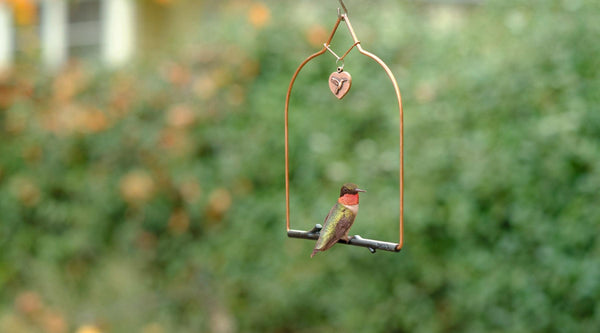
As late migrants compete with lingering residents, a second feeder and a second swing, spaced out of sight of each other, give the next bird its own station instead of a fight over one.
Shop the Charm Swing →October: Mostly Gone, But Watch for Rufous
Ruby-throated is essentially done statewide by October — about one checklist in a hundred in the first week, then almost nothing, and none at all in the far north. This is when Minnesota's Rufous Hummingbirds become most likely, though: reports pick up in late October and continue into November. It's still a rarity, but a real and recurring one.

October is the planting month, not the tidying-up month.
Sow native wildflower seed now and it gets the cold, moist stretch most varieties need before they'll bloom reliably next spring — the same spring your hummingbirds come back to.
Shop the Perfect Little Sanctuary® blend →November: Statewide Quiet, With a Rarity or Two
Statewide, Ruby-throated is done. November is Minnesota's best month for rarities, though. Rufous reports peak in the first half of the month. Anna's Hummingbird, officially Accidental here with five accepted records in all, also shows up in the eBird data in early November, but only one year in the last ten (2023) produced a record — it isn't a bird to expect.
December: The True Quiet
By December, even Minnesota's rarities have mostly gone quiet. A last Rufous or two can linger into the first week before the state settles into complete winter silence. If you see any hummingbird in Minnesota in December, it's worth a photo and a report; nothing is expected here at all.
Regional Arrival and Departure Table
| Region | Ruby-throated Arrives | Ruby-throated Leaves |
|---|---|---|
| Hennepin County (Minneapolis) | Early May | Early October |
| Olmsted County (Rochester) | Early May | Early October |
| St. Louis County (Duluth) | Mid-May | Late September |
| Cook County (Grand Marais) | Mid-May | Mid-September |
| Lake County (Two Harbors) | Mid-May | Mid-September |
"Arrives" and "leaves" mark the first and last of two weeks in a row when hummingbirds show up steadily on a region's checklists.
The Year at a Glance
| Months | Statewide Activity |
|---|---|
| January – March | Genuinely zero statewide; no regular winter presence anywhere in Minnesota |
| April | Still quiet; the first faint signal appears in the south in the final week |
| May | The real arrival, south first, north about a week behind |
| June | Nesting settles in; the state's one recent Calliope record falls here |
| July | Building toward the peak; the state's only Broad-billed record falls here |
| August | The statewide peak; several counties run even higher |
| September | Hennepin's own peak lands here; a fast decline everywhere else |
| October | Ruby-throated mostly gone; Rufous's real fall signal builds |
| November | Statewide silence for Ruby-throated; Rufous at its most likely |
| December | A last trace of Rufous, then true winter quiet |
Frequently Asked Questions
When do hummingbirds come back to Minnesota?
Early May in the south — Hennepin County (Minneapolis) and Olmsted County (Rochester) both cross our arrival threshold in the first week of May. St. Louis (Duluth), Cook (Grand Marais), and Lake (Two Harbors) counties, in the north, follow about a week behind, in the second week of May. Get feeders up by the last week of April statewide, since the arrival happens quickly once it starts.
When do hummingbirds leave Minnesota?
Most of the state by late September to early October, but the north leaves first. Cook and Lake counties, on the North Shore, are nearly empty by the last week of September. St. Louis County (Duluth) follows close behind, essentially done by early October. Hennepin and Olmsted, in the south, hold on longest, still around into the first week of October before dropping off fast.
Are there hummingbirds in Minnesota in winter?
Not as a regular pattern — Minnesota has no reliable winter hummingbird presence at all. Late fall does bring real, documented rarities: Rufous Hummingbird turns up in most years, sometimes lingering into early December, and Anna's Hummingbird has five accepted records. But neither is an expectable winter bird, and a hummingbird seen after October anywhere in the state is worth a photograph.
What types of hummingbirds are in Minnesota?
Eight species have accepted Minnesota records. Ruby-throated is the state's only real breeder, present statewide from May through September. Rufous is genuinely recurring, mostly in fall, classified Casual by the state's records committee (recorded in seven of the last ten years). Anna's, Calliope, and Broad-billed are each Accidental — a handful of total records apiece. The remaining three — Mexican Violetear, Rivoli's, and Costa's — each have just one to three historic records, none since before 2016.
Why We Built This Calendar
Pop's Birding has been helping hummingbird lovers for three generations. One of the questions our customers ask most often is "When do hummingbirds arrive and leave my state?" — we built this calendar to give a direct, sourced answer, not a generic one. Minnesota's answer looks simple on the surface — one breeder, one clean season — but the North Shore runs weeks behind the Twin Cities on both ends, and the state's rare visitors are worth knowing about too. We wanted a calendar that covers both.
How We Built This Calendar
We pulled eBird bar chart data (Cornell Lab of Ornithology) for Minnesota statewide and five counties chosen for real geographic spread — Hennepin and Olmsted in the warmer south, and St. Louis, Cook, and Lake in the colder North Shore and Arrowhead — covering 2016 through 2025. Arrival and departure mark the first and last of two weeks in a row when hummingbirds show up steadily on a region's checklists. Species status follows the Minnesota Ornithologists' Union Records Committee rather than raw eBird volume, which is why Rufous is the only rarity with its own chart. The county comparison is our own analysis, not a rewrite of eBird's bar charts.
Sources
- eBird bar chart data, Cornell Lab of Ornithology — Minnesota statewide and county-level (Hennepin, Olmsted, St. Louis, Cook, Lake), 2016-2025. Source for all month-by-month seasonal figures and the regional arrival/departure pattern.
- Minnesota Ornithologists' Union Records Committee (MOURC), Checklist of Minnesota Birds — current numbered edition through December 31, 2023. Source for all 8 species and their status codes.
- des Lauriers, J. R. (1994). Hummingbirds eating ashes. The Auk, 111(3), 755–756. Documents five nesting female hummingbirds eating wood ash; no males were seen doing so in that study.
- Adam, M. D., & des Lauriers, J. R. (1998). Observations of hummingbirds ingesting mineral-rich compounds. Journal of Field Ornithology, 69, 257–261. Source for hummingbirds' greatly reduced medullary bone and for the mineral-rich materials they eat.
- Werning, S. (2018). Medullary bone is phylogenetically widespread and its skeletal distribution varies by taxon. Journal of Ornithology, 159, 527–543. Source for medullary bone being confirmed in hummingbirds.
Know before they arrive
You don't have to keep this calendar taped to the fridge. Insider Birding Access members get seasonal notes timed to your region — when to have feeders out, what the birds are doing right now, and what's worth doing in your yard this season. We take the guesswork out of the calendar. Joining takes about thirty seconds, and there's 10% off your first order in it.
Join Insider Birding Access →Free to join. 10% off your first order.
Shop Minnesota's Hummingbird Favorites


Bethany Sloan has served as General Manager of Pop's Birding since 2010, continuing the legacy of her grandfather, William "Pops" Sloan, inventor of the Original Hummingbird Swing. A lifelong hummingbird enthusiast, educator, and independent researcher, she leads the company's educational content, including its 50-State Hummingbird Guide series, Regional Guide, Species Guide and Hummingbird Learning Center. Bethany combines scientific research, regional migration data, and more than 16 years of hands-on experience to create trusted educational resources for bird enthusiasts across North America.