Sep 03, 2026
Hummingbirds in Wisconsin: The Complete Guide to All 8 Species
On December 17, 2020, a hummingbird that had no business being in Wisconsin in the middle of winter turned up at a feeder in Green County. Cynthia and Peter Bridge caught it, took it in hand, and confirmed what the coppery tail and orange-red throat already suggested: an Allen's Hummingbird, a California coastal breeder that had somehow found its way more than 2,000 miles from home. It stayed a week, banded and photographed, and became Wisconsin's first accepted record of the species — one of five review-list rarities that, between them, account for exactly seventeen documented sightings in the state's entire history.
Eight hummingbird species are on the Wisconsin Society for Ornithology's official state checklist, maintained by its Records Committee — tying Minnesota for the most in the Upper Midwest, ahead of Illinois's seven and Iowa's five. One breeds here every summer. One is a genuine, if thin, fall visitor the committee no longer even reviews. The other six are accidentals and casuals, and the committee's own record counts — printed right on the checklist — are the clearest measure of how solid each one is.
Free download
All 8 species, one page
Every Wisconsin hummingbird with its status — from Ruby-throated, on nearly a third of statewide checklists at its August peak, down to a species documented exactly once — sized 8.5" x 11" for easy reference and printing.
Download the Wisconsin species guideOne page · PDF · free to print and share

All 8 documented Wisconsin hummingbird species, grouped by tier — statewide eBird data, 2016–2025, cross-checked against the Wisconsin Society for Ornithology's official state checklist and its published rare-bird record dates.
The Hummingbird You're Most Likely to See
Ruby-throated Hummingbird Breeds Here
Wisconsin's only nesting hummingbird, and from mid-May through mid-September, effectively its only hummingbird. Arrival is unusually synchronized for a state that spans nearly five degrees of latitude — Bayfield County on Lake Superior and Milwaukee on the Illinois line both reach reliable activity the same week in mid-May, a pattern most states this size don't share. Statewide frequency climbs through spring, dips slightly in June as nesting settles in, then builds to the year's peak of 30% of checklists in the first week of August. Regionally it runs even higher: 38% around Dane County (Madison) in early September and 28% around Milwaukee in early August. By late September most of the state has emptied out, and by December it's gone entirely — except, as the next entry explains, for one real exception in the south-central part of the state.

Quick ID: Adult males show a brilliant ruby-red throat that reads black without direct light, a bright emerald crown and back, and a short forked black tail. Females and immatures are green above and whitish-gray below, with white-tipped outer tail feathers and no rufous anywhere. From May through September in Wisconsin, a hummingbird is essentially always this one.

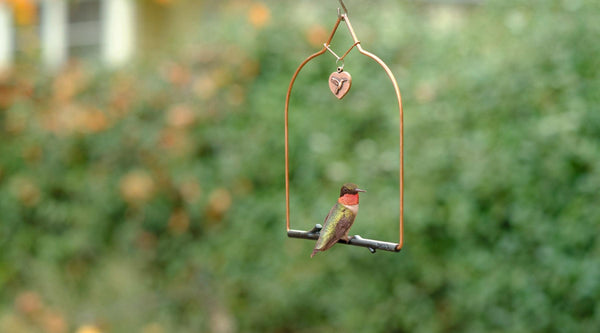
A Little Throne for Your Ruby-throated
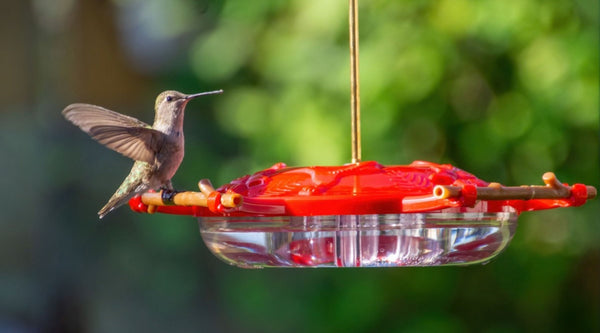
From mid-May through mid-September, Ruby-throated is effectively Wisconsin's only hummingbird, and it holds feeder territory the whole time — a nearby perch gives it a place to rest and watch without giving up ground.
Shop Charm Redwood Swing →Wisconsin Hummingbirds in Winter
Once Ruby-throated clears out of most of the state by mid-September, Wisconsin's hummingbird season isn't quite finished — one western species keeps a real, if narrow, presence going in one corner of the state well into fall.
Rufous Hummingbird Migrant/Winter
Wisconsin's only other regular hummingbird, and a fall bird almost exclusively. The Wisconsin Society for Ornithology's own checklist codes it "rare" with no review flag — the committee stopped individually cataloging Rufous records in 2006 because it had become too regular to track as a rarity, a status confirmed by the checklist's current edition. Statewide the signal is faint, peaking under half a percent of checklists in early October, but that number badly undersells the real story: Dane County alone carries the great majority of it, reaching 2.5% of checklists in the first week of October — a genuine, sustained fall pattern built on roughly a hundred checklists at its peak week, not a single well-visited bird. Two other counties (Portage, Milwaukee) showed candidate late-season signals that turned out to rest on just one and four checklists respectively once checked — too thin to trust, and not part of this pattern. Wisconsin's Rufous doesn't overwinter; it builds through the fall and departs completely by December rather than settling in for the cold months.

Quick ID: Adult males are almost entirely orange-rufous with a glowing orange-red throat — the only largely rufous-backed hummingbird in North America. Most Wisconsin birds aren't adult males, though: females and immatures are green above with cinnamon-washed flanks, a coppery rump, and rufous at the base of the tail feathers, which no Ruby-throated ever shows. The one real look-alike is Allen's, below: outside the hand, female and immature Rufous and Allen's are for practical purposes identical.

An Extra Feeder for Your Rufous
Dane County's Rufous keep a real fall presence going well after Ruby-throated has cleared out — a second feeder in a different spot means a late-season visitor isn't just picking over an emptying yard.
Shop AspenPerch® Feeder →Wisconsin's Recurring Rarity
One more species shows up often enough to track as a genuine pattern rather than a single documented event.
Anna's Hummingbird Rare / Casual Visitor
Twelve accepted records since Wisconsin's first, a bird that spent late August to early December 1990 at a Waukesha County feeder. The most recent came in from Milwaukee County, October 29 to November 28, 2023. The committee's own abundance code is "casual" — by its own published definition, that means at least one record every one to five years, a real recurring pattern but explicitly not an annual one. Most sightings cluster in October and November, and the eBird data backs that up: Milwaukee County shows a real signal peaking at 1.5% of checklists in mid-November, built on roughly thirty checklists at its best week — thin compared to Ruby-throated, but a genuine regional pattern rather than a single bird's worth of reports.

Quick ID: The only North American hummingbird with an iridescent crown as well as throat — adult males glow rose-pink from the top of the head down, unlike anything else on Wisconsin's list. Females are stockier and shorter-billed than a female Rufous, usually showing a small central patch of rose-red spotting on an otherwise pale throat, and tend to hold their tail still while hovering.

Make Your Sanctuary Worth a Detour
Anna's shows up in Wisconsin often enough to be a real, recurring pattern rather than luck — a dozen accepted records over three decades — and real electrolytes and calcium beyond plain sugar water give a wandering Anna's a genuine reason to stick around long enough to be seen and confirmed.
Shop Nectarlyte® Powder →If You're Lucky: Wisconsin's Historic Rarities
Five more species are on the state checklist, each an accidental: one to three records apiece, most of them decades apart, each one a real event in Wisconsin birding history rather than a pattern to expect.
Allen's Hummingbird Historic / Accidental
One accepted record — the Green County bird from the top of this page, banded and photographed December 17–24, 2020, and Wisconsin's first. The eBird data shows exactly this event and nothing else: Green County spikes to nearly 13% of checklists that week, built almost entirely on repeat sightings of the same documented individual rather than a second bird. No further record has been accepted since.

Quick ID: A Rufous look-alike. Adult males show a solid bronze-green back against a coppery tail, eye patch, and deep reddish-orange gorget — but some male Rufous are green-backed too, so the back alone isn't conclusive. Females and immatures are essentially identical to female Rufous in the field; separating them reliably takes a bander's measurement of the outer tail feather width, which is why Wisconsin's one record was confirmed in the hand.
Broad-billed Hummingbird Historic / Accidental
Three accepted records, each roughly a decade apart: an adult photographed in Dodge County in October 2000, a bird in Ozaukee County in November 2011, and one in Winnebago County in October 2022. That spacing — two gaps of eleven years each — is exactly why the species sits at Historic rather than Rare/Casual; the committee's own five-year threshold for "casual" status isn't met by either gap. The 2022 Winnebago bird shows up faintly in the eBird data, a brief mid-October blip built on just a couple of checklists — consistent with a short, well-documented visit rather than a lingering population.

Quick ID: The bright red, black-tipped bill is diagnostic in every plumage — no regular Wisconsin species shows red on the bill. Adult males add a shimmering sapphire-blue throat on a mostly green body; females are duller and grayer below with the same red-based bill.
Buff-bellied Hummingbird Historic / Accidental
One accepted record: an adult photographed at an Ozaukee County feeder on June 17, 2017, by William Grossmeyer and Jeff Rusinow. No second record has been accepted in the years since, and the eBird data for the species amounts to a single statewide checklist the same week that bird was present — as thin a signal as Wisconsin's hummingbird data gets, and consistent with a genuine one-off rather than an undercounted pattern.

Quick ID: A fairly large hummingbird with a warm buff belly, a rufous tail, and a bright red, black-tipped bill visible in every plumage; the throat and breast are iridescent blue-green in good light and read gray-dark in shade. Sexes look similar. The red bill alone rules out every regular Wisconsin species.
Green-breasted Mango Historic / Accidental
One accepted record, and Wisconsin's most tropical hummingbird by a wide margin — a species that normally doesn't range north of Texas. Joan Salzberg photographed and documented the bird at a Rock County (Beloit) feeder from September 18 to November 6, 2007, an unusually long stay for a species this far from home. The bird was eventually captured and taken to Brookfield Zoo. It carries no eBird signal at all, since the record predates the 2016–2025 pull this page draws on, and no second Wisconsin record has been accepted in the nearly two decades since.

Quick ID: A large, robust hummingbird with a stout, slightly decurved black bill. Adult males show a velvety black stripe running from chin to chest, bordered on each side by metallic bluish-green; females carry a similar dark central stripe on white underparts, black at the chin and shading to blue-green toward the breast. Nothing else on Wisconsin's list shows that dark throat stripe.
Mexican Violetear Historic / Accidental
Nine accepted records since 1998, more than any other Wisconsin rarity on this list — and still classified Historic rather than Rare/Casual, because the Wisconsin Society for Ornithology's own committee code for the species is "accidental." Records run from a specimen-backed 1998 bird in La Crosse County through a 2022 sighting in Wood County, with most falling in late summer and early fall. Reading the raw record list alone, several of those gaps run under five years, which would suggest Rare/Casual by this project's usual recurrence test — but the committee's own published classification is the authoritative signal here and takes precedence over that independent reading. Like Green-breasted Mango, the species carries no eBird signal in the 2016–2025 pull; its most recent accepted records fall inside that window but were never picked up by checklist data, consistent with brief, unreported sightings rather than a broader undercount.

Quick ID: Unmistakable if you get a good look — an all-glittering-green bird, larger than any of Wisconsin's regular species, with a violet-blue ear patch and a violet-blue band across the chest, a straight black bill, and a dark-banded tail. Both sexes look alike, though females average slightly duller.

Give Every Visitor a Reason to Stay
Common breeder or once-in-a-lifetime rarity alike, what keeps any hummingbird coming back is real habitat — Perfect Little Sanctuary® Wildflower Seed packs 12 nectar-rich varieties into one packet for lasting native forage, planted before the next Allen's, Mango, or Violetear ever shows up.
Shop Wildflower Seed →Wisconsin Hummingbirds at a Glance
One species accounts for nearly all of Wisconsin's hummingbird activity: Ruby-throated peaks at 30% of statewide checklists, while every other confirmed species tops out under a quarter of a percent at the statewide scale. That gap is too wide for a shared bar chart to show anything useful — it would be one bar and seven slivers — so here's the same information as a table instead. The real regional signals, especially Dane County's extended Rufous season, are charted at true scale on the Wisconsin hummingbird calendar.
| Species | Status | Wisconsin Records |
|---|---|---|
| Ruby-throated Hummingbird | Breeding | Confirmed statewide breeder; statewide peak 30% in early August, 38% around Dane County in September |
| Rufous Hummingbird | Migrant / Winter Visitor | Not a review species since 2006; 2.5% of Dane County checklists in early October, a real fall pattern |
| Anna's Hummingbird | Rare / Casual | 12 accepted records, 1990–2023; committee code "casual" (1 record every 1–5 years) |
| Allen's Hummingbird | Historic / Accidental | 1 accepted record — Green Co., Dec 2020, banded |
| Broad-billed Hummingbird | Historic / Accidental | 3 accepted records, ~11 years apart each — Dodge 2000, Ozaukee 2011, Winnebago 2022 |
| Buff-bellied Hummingbird | Historic / Accidental | 1 accepted record — Ozaukee Co., June 2017 |
| Green-breasted Mango | Historic / Accidental | 1 accepted record — Rock Co., Sep–Nov 2007 |
| Mexican Violetear | Historic / Accidental | 9 accepted records, 1998–2022; committee code "accidental" |
Frequently Asked Questions
How many kinds of hummingbirds have been documented in Wisconsin?
Eight, all on the Wisconsin Society for Ornithology's official state checklist. Ruby-throated is the only one that nests here; Rufous is a real, no-longer-reviewed fall visitor concentrated in Dane County; and the other six range from Anna's, with a dozen records over three decades, down to species documented exactly once.
What is the most common hummingbird in Wisconsin?
Ruby-throated Hummingbird, by an enormous margin. It peaks at 30% of statewide checklists in early August, and no other confirmed species tops a quarter of one percent anywhere in the state. From May through September, a Wisconsin hummingbird is almost certainly this one.
Are there hummingbirds in Wisconsin in the fall after Ruby-throated leaves?
Yes, in one specific place. Rufous Hummingbird keeps a real, documented presence in Dane County into early November, peaking near 2.5% of checklists there in early October — a genuine population signal, not a stray bird. Elsewhere in the state, a hummingbird after mid-September is unusual enough to be worth a photo.
How do I tell a Rufous from an Allen's Hummingbird in Wisconsin?
For an adult male, the back: Rufous is typically solid copper, Allen's shows a solid bronze-green back — but some male Rufous are green-backed too, which erases that shortcut. Females and immatures of the two are essentially identical in the field. Wisconsin's one Allen's record was only confirmed because the bird was banded and measured in the hand; without that, assume any Selasphorus hummingbird here is a Rufous.
Has an Anna's Hummingbird ever stayed in Wisconsin for a whole season?
Not through winter, but close to it. The first Wisconsin record, in 1990, was present at a Waukesha County feeder from late August into early December. That's unusually long for an Anna's this far from its Pacific Coast range, though it's still consistent with the species' "casual" status rather than an annual, expected pattern.
Why We Created This Guide
Pop's Birding has been helping hummingbird lovers for three generations. One of the questions our customers ask most often is "what hummingbirds are actually in my state?" — we built this guide to give a direct, sourced answer for Wisconsin specifically, not a generic one. Most identification content treats the Upper Midwest as a one-species region and stops there, and that misses what's distinctive here: a real, no-longer-reviewed fall visitor concentrated almost entirely in one county, a records committee that publishes its own confidence tiers for every rarity, and a rarity list that includes one of the very few Green-breasted Mango records anywhere north of Texas.
How We Created This Guide
We started with statewide eBird bar chart data from the Cornell Lab of Ornithology, covering 2016 through 2025, then added counties that capture Wisconsin's different geography — Lake Superior's Bayfield, Madison's Dane, the Lake Michigan shore's Milwaukee and Ozaukee, Green and Winnebago for their rarity records, and La Crosse and Portage for the west and central sands. Since raw checklist counts alone can make a single well-reported bird look like a recurring pattern — Green County's banded Allen's Hummingbird produced a statewide spike larger than several genuinely regular visitors — we checked every regional signal's actual checklist count and cross-referenced every species against the Wisconsin Society for Ornithology's Official Checklist of Wisconsin Birds and its published rare-bird record dates. That's how Dane County's real Rufous season, resting on roughly a hundred checklists at its peak week, held up while two other counties' candidate late-season signals, resting on just one and four checklists, didn't. Ruby-throated dominates Wisconsin's checklists so completely that a shared-scale chart would show one bar and seven slivers, so we say that plainly and give every other species its real record history instead — and Green-breasted Mango and Mexican Violetear, which carry no eBird signal at all in this pull, are stated that way rather than papered over, since both species' known records genuinely predate or fall outside what checklist data can show.
Sources
- eBird bar chart data, Cornell Lab of Ornithology — Wisconsin statewide plus Bayfield, Dane, Green, La Crosse, Milwaukee, Ozaukee, Portage, and Winnebago counties, 2016–2025.
- Wisconsin Society for Ornithology, Official Checklist of Wisconsin Birds (updated March 23, 2025) — source for all 8 species, their abundance codes, and review-list status.
- Wisconsin Society for Ornithology, Records Committee — source for individual accepted-record dates, counties, and finders.
Know before they arrive
You don't have to keep this calendar taped to the fridge. Insider Birding Access members get seasonal notes timed to your region — when to have feeders out, what the birds are doing right now, and what's worth doing in your yard this season. We take the guesswork out of the calendar. Joining takes about thirty seconds, and there's 10% off your first order in it.
Join Insider Birding Access →Free to join. 10% off your first order.
Shop Wisconsin's Hummingbird Favorites


Bethany Sloan has served as General Manager of Pop's Birding since 2010, continuing the legacy of her grandfather, William "Pops" Sloan, inventor of the Original Hummingbird Swing. A lifelong hummingbird enthusiast, educator, and independent researcher, she leads the company's educational content, including its 50-State Hummingbird Guide series, Regional Guide, Species Guide and Hummingbird Learning Center. Bethany combines scientific research, regional migration data, and more than 16 years of hands-on experience to create trusted educational resources for bird enthusiasts across North America.