Sep 03, 2026
Hummingbirds in Minnesota: The Complete Guide to All 8 Species
In the fall of 2023, one hummingbird at one Minnesota feeder generated enough excitement to show up clearly in statewide eBird data — a rose-crowned Anna's Hummingbird, thousands of miles from where the species normally lives, drawing a steady stream of visitors through October and November. It was Minnesota's fifth accepted record of the species, and the Minnesota Ornithologists' Union Records Committee still codes Anna's "Accidental" despite that count, because four of the five sightings happened in different years entirely — this one bird's popularity is what made 2023 look busier than it really was.
Eight hummingbird species are on the Minnesota Ornithologists' Union Records Committee's official state checklist. One breeds here every summer. One shows up often enough that the committee's own term for it is "Casual," not "Accidental." The other six are true rarities, most with just one or two accepted records in the state's entire history.
Free download
All 8 species, one page
Every Minnesota hummingbird with its status — from Ruby-throated, on nearly a third of statewide checklists at its August peak, down to species with just a record or two ever — sized 8.5" x 11" for easy reference and printing.
Download the Minnesota species guideOne page · PDF · free to print and share

All 8 documented Minnesota hummingbird species, grouped by tier — statewide eBird data, 2016–2025, cross-checked against the Minnesota Ornithologists' Union Records Committee's official state checklist.
The Hummingbird You're Most Likely to See
Ruby-throated Hummingbird Breeds Here
Minnesota's only nesting hummingbird, and the MOURC checklist codes it as breeding "throughout" the state. Statewide frequency peaks near 29% of checklists in mid-August, and that pattern holds from the southern edge to the Canadian border — Olmsted County (Rochester) tops 35%, Hennepin County (Minneapolis) hits 34%, and even up on the North Shore, Cook County (Grand Marais) and Lake County (Two Harbors) both clear 25%. The northern counties peak about two weeks earlier than the Twin Cities — a shorter season, not a smaller population.

Quick ID: Adult males show a brilliant ruby-red throat that reads black without direct light, an emerald crown and back, and a short forked black tail. Females and immatures are green above and whitish-gray below, with white-tipped outer tail feathers and no rufous anywhere. From May through September in Minnesota, a hummingbird is essentially always this one.

A Little Throne for Your Ruby-throated
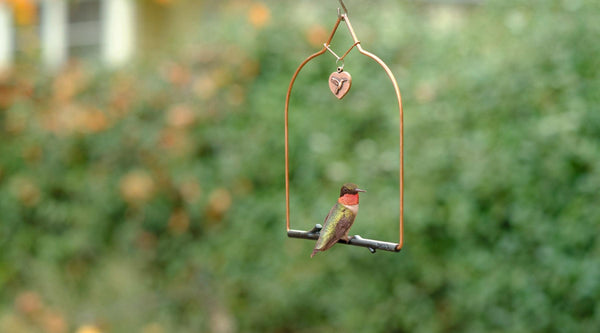
Minnesota's only nesting hummingbird holds this territory alone from May through September — a dedicated perch nearby gives it a proper vantage point to guard the feeder as the shorter northern season runs its course.
Shop Charm Redwood Swing →Minnesota's Recurring Rarity: Rufous Hummingbird
Seven more species are on the state checklist, but only one of them shows a genuine recurring pattern. Rufous is that bird — MOURC's own term for it is "Casual," not "Accidental," the strongest recurring-visitor status any hummingbird on this list carries besides the breeder itself.
Rufous Hummingbird Rare / Casual Visitor
Twenty-three accepted Minnesota records, recorded in seven of the last ten years, most recently 2022 — MOURC codes it "Casual," the strongest recurring-visitor status any hummingbird carries on this state's list besides the breeder itself. The Duluth area (St. Louis County) shows the clearest regional signal: a real, if thin, presence in August that returns in a more sustained way from early November into December, peaking near 0.7% of checklists in mid-November — consistent with genuine repeat occurrence along the North Shore rather than a single well-photographed bird.

Quick ID: Adult males are almost entirely orange-rufous with a glowing orange-red throat — the only largely rufous-backed hummingbird in North America. Females and immatures are green above with cinnamon-washed flanks, a coppery rump, and rufous at the base of the tail feathers, which no Ruby-throated ever shows.

An Extra Feeder for Your Rufous
Rufous is Minnesota's one genuine recurring rarity, with a real pattern building along the North Shore from early November into December — a second feeder set apart gives a late-season visitor its own station instead of competing with whatever Ruby-throateds haven't yet left.
Shop AspenPerch® Feeder →If You're Lucky: Minnesota's Historic Rarities
The other six species on the checklist are true one-offs, most down to a single accepted record and no measurable eBird trace at all.
Anna's Hummingbird Historic / Accidental
Five accepted records — three in fall, one spanning fall into winter, one in winter — but MOURC still codes the species "Accidental," and the count is more scattered than it first looks: the five sightings fall in just one of the last ten years, 2023, and that single season is doing most of the work. The eBird data confirms it directly — a real, building signal through October and November that peaks near 0.4% of statewide checklists in mid-November, matching the well-documented, heavily visited feeder bird from that fall almost exactly. It's a clean single-event footprint, not a spread-out pattern across years or counties.

Quick ID: The only North American hummingbird with an iridescent crown as well as throat — adult males glow rose-pink from the top of the head down, unlike anything else on Minnesota's list. Females carry a small central patch of rose-red spotting on an otherwise pale throat.
Calliope Hummingbird Historic / Accidental
Two accepted records, twenty-two years apart: one in fall-winter 1994, one in summer 2016. That gap is exactly why MOURC's own code remains "Accidental" rather than a recurring-visitor status — two records that far apart don't establish a pattern. The 2016 bird shows up clearly in the eBird data: St. Louis County (Duluth) posts a real June spike that year, peaking near 0.3% of checklists, an isolated event rather than any kind of seasonal window to expect the species in.

Quick ID: North America's smallest hummingbird, and identifiable by that alone in most cases — hunched posture, short bill and tail. Adult males show a gorget of separate magenta rays radiating outward against a white throat, rather than a solid patch, unique among North American hummingbirds. Females are green above with fine dark streaking on a whitish throat.
Broad-billed Hummingbird Historic / Accidental
One accepted record: a summer 2022 sighting in Sherburne County, formally added to MOURC's checklist that July. No second Minnesota record has followed. The species carries almost no eBird trace in the 2016–2025 data — a single statewide checklist the week the bird was present, about as thin as a genuine one-off record gets.

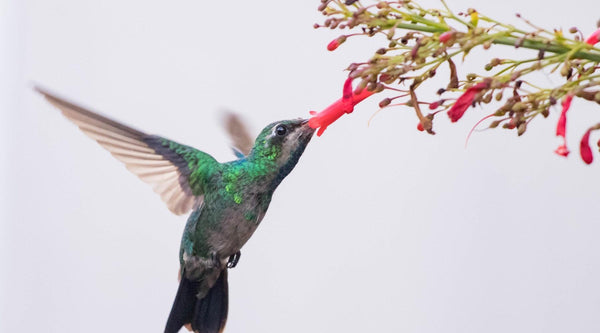
Quick ID: The bright red, black-tipped bill is diagnostic in every plumage — no regular Minnesota species shows red on the bill. Adult males add a shimmering sapphire-blue throat on a mostly green body; females are duller and grayer below with the same red-based bill.
Mexican Violetear Historic / Accidental
Two accepted records, both in summer and only a year apart: 2004 and 2005. Nothing has been accepted since. Both records predate the 2016–2025 eBird data this page draws on, so there's no checklist signal behind either one — an honest gap rather than a pattern to paper over.

Quick ID: An all-glittering-green bird, larger than any of Minnesota's regular species, with a violet-blue ear patch and a violet-blue band across the chest, and a straight black bill. Both sexes look alike, though females average slightly duller.
Rivoli's Hummingbird Historic / Accidental
Three accepted records, all in summer — but every one of them dates to 1994 or earlier, and nothing has been accepted since. Three decades of silence is exactly what turns a three-record species into a genuinely dormant one rather than a recurring pattern, and MOURC's own "Accidental" code reflects that. No eBird signal exists for this species in Minnesota; every known record predates the 2016–2025 data window this page draws on.

Quick ID: A notably large hummingbird that often looks all-dark until the light catches it — adult males show a purple crown and an iridescent emerald throat, with a blackish belly that reads nearly black from most angles. Both sexes carry a small white spot behind the eye; females are greenish overall with a grayish, speckled throat and no bright gorget.
Costa's Hummingbird Historic / Accidental
One accepted record: a fall 2003 sighting, the only time this desert-country species has ever been documented in Minnesota. No second record has followed in the more than two decades since, and like Mexican Violetear and Rivoli's, this one predates the eBird data this page draws on — no checklist signal behind it at all.

Quick ID: Adult males show an iridescent deep purple gorget that flares out along the sides of the neck into elongated points — sometimes called an "overgrown mustache" — with a matching purple crown; it can look solid black without good light. Small and compact with a short tail and a slightly drooping bill. Females are mostly plain whitish below, with about half showing a small patch of metallic purple throat feathers.
Give Every Visitor a Reason to Stay
Minnesota's six documented accidentals prove almost anything can show up when the conditions line up — real nectar sources and a well-stocked feeder give the next one a reason to linger long enough to be seen and confirmed.


Minnesota Hummingbirds at a Glance
One species accounts for nearly all of Minnesota's hummingbird activity: Ruby-throated peaks near 29% of statewide checklists, while every other confirmed species tops out under half a percent at the statewide scale. That gap is too wide for a shared bar chart to show anything useful — it would be one bar and seven slivers — so here's the same information as a table instead.
| Species | Status | Minnesota Records |
|---|---|---|
| Ruby-throated Hummingbird | Breeding | Confirmed statewide breeder; statewide peak 29% in August |
| Rufous Hummingbird | Rare / Casual | 23 records; recorded in 7 of the last 10 years, most recently 2022 |
| Anna's Hummingbird | Historic / Accidental | 5 records, 4 of them in a single year (2023) |
| Calliope Hummingbird | Historic / Accidental | 2 records, 22 years apart — 1994 and 2016 |
| Broad-billed Hummingbird | Historic / Accidental | 1 record — Sherburne Co., 2022 |
| Mexican Violetear | Historic / Accidental | 2 records — 2004 and 2005 |
| Rivoli's Hummingbird | Historic / Accidental | 3 records, none since 1994 |
| Costa's Hummingbird | Historic / Accidental | 1 record — 2003 |
Frequently Asked Questions
How many kinds of hummingbirds have been documented in Minnesota?
Eight, all on the Minnesota Ornithologists' Union Records Committee's official state checklist. Ruby-throated is the only one that nests here; Rufous is the one genuine recurring visitor, with 23 records across the last decade; and the other six are true rarities, most down to a single accepted record.
What is the most common hummingbird in Minnesota?
Ruby-throated Hummingbird, by an enormous margin. It peaks near 29% of statewide checklists in mid-August, and no other confirmed species tops half a percent anywhere in the state. From May through September, a Minnesota hummingbird is almost certainly this one.
Are there hummingbirds in Minnesota in the winter?
Not reliably. Ruby-throateds are gone by fall, and while a few rarities — Rufous and Anna's among them — have turned up into November and even December, a hummingbird at a Minnesota feeder in deep winter would be a genuine rarity worth documenting, not something to expect.
Where in Minnesota is Rufous Hummingbird most likely to show up?
The Duluth area and the North Shore. St. Louis County shows Minnesota's clearest regional pattern for Rufous, with real activity in August and a more sustained presence from early November into December — consistent with the species' 23-record history of showing up in most recent years.
What was Minnesota's most recent new hummingbird species?
Broad-billed Hummingbird, added to the state checklist in July 2022 after a single accepted sighting in Sherburne County. No second Minnesota record has followed since.
Why We Created This Guide
Pop's Birding has been helping hummingbird lovers for three generations. One of the questions our customers ask most often is "what hummingbirds are actually in my state?" — we built this guide to give a direct, sourced answer for Minnesota specifically, not a generic one. Most identification content treats the Upper Midwest as a one-species region and stops there, and that misses what's distinctive here: a Rufous Hummingbird pattern real enough to earn its own "Casual" status from the state's own records committee, and an Anna's Hummingbird record count that looks more impressive at a glance than it actually is once you check which year those five sightings happened in.
How We Created This Guide
We started with statewide eBird checklist data from the Cornell Lab of Ornithology, covering 2016 through 2025, then added five counties that represent Minnesota's real geography — the population centers around Minneapolis and Rochester, and the North Shore counties where several rarity records cluster. Since ten years of checklists can't capture everything, especially older or one-off sightings, we checked every species against the Minnesota Ornithologists' Union Records Committee's official checklist to round out the full record, which is how we confirmed Anna's Hummingbird's most current documented count: five accepted records, including one from 2023. Looking closer at those records also told a clearer story than the raw numbers alone: four of Anna's five records cluster in a single year around one well-visited feeder bird, while Rufous Hummingbird's 23 records are spread across seven of the last ten years — which is why Rufous carries a stronger status than Anna's despite a similar record count in some readings. Ruby-throated dominates Minnesota's checklists so completely that a shared-scale chart would show one bar and seven slivers, so we say that plainly and give every other species its real record history instead.
Sources
- eBird bar chart data, Cornell Lab of Ornithology — Minnesota statewide plus Hennepin, Olmsted, St. Louis, Cook, and Lake counties, 2016–2025.
- Minnesota Ornithologists' Union Records Committee (MOURC), Checklist of Minnesota Birds — current numbered edition through December 31, 2023 — source for all 8 species and their status codes.
- Minnesota Ornithologists' Union Records Committee (MOURC) — source for record review status and documentation standards.
Know before they arrive
You don't have to keep this calendar taped to the fridge. Insider Birding Access members get seasonal notes timed to your region — when to have feeders out, what the birds are doing right now, and what's worth doing in your yard this season. We take the guesswork out of the calendar. Joining takes about thirty seconds, and there's 10% off your first order in it.
Join Insider Birding Access →Free to join. 10% off your first order.
Shop Minnesota's Hummingbird Favorites


Bethany Sloan has served as General Manager of Pop's Birding since 2010, continuing the legacy of her grandfather, William "Pops" Sloan, inventor of the Original Hummingbird Swing. A lifelong hummingbird enthusiast, educator, and independent researcher, she leads the company's educational content, including its 50-State Hummingbird Guide series, Regional Guide, Species Guide and Hummingbird Learning Center. Bethany combines scientific research, regional migration data, and more than 16 years of hands-on experience to create trusted educational resources for bird enthusiasts across North America.