Sep 04, 2026
Hummingbirds in North Dakota: The Complete Guide to All 6 Species
North Dakota's documented hummingbird list runs to six species, per the North Dakota Bird Records Committee (NDBRC) — comparable to neighboring South Dakota and Minnesota (eight each), fewer than Montana's nine. Ruby-throated Hummingbird is the state's only regular breeder, and it's genuinely uncommon here compared to most of the country, since North Dakota sits at the northwestern edge of the species' range. Rufous Hummingbird has a real, documented recurring pattern spanning three decades. The other four species each have exactly one accepted North Dakota record — including two that turned up at the very same location the very same summer.
Free download
All 6 species, one page
A one-page reference to every hummingbird documented in North Dakota — Ruby-throated Hummingbird plus five rarer visitors, with each species' status and record history at a glance.
Download the North Dakota species guideOne page · PDF · free to print and share

All 6 documented North Dakota hummingbird species, grouped by tier — statewide eBird data, 2016–2025, cross-checked against the North Dakota Bird Records Committee's own Review List.
The Hummingbird You're Most Likely to See
Ruby-throated Hummingbird Breeds Here
North Dakota's only regularly occurring hummingbird — the sole species the state's own records committee doesn't require documentation for. It dominates the state's hummingbird activity almost completely, with a statewide eBird peak near 16% in early-to-mid August. North Dakota sits at the northwestern edge of the species' breeding range, so numbers here are genuinely thinner than almost anywhere else in this guide series: Robert Stewart's Breeding Birds of North Dakota (1975) describes it as "fairly common" in the Turtle Mountains, but only "uncommon" near the Pembina Hills and Devils Lake, and "uncommon and local" in the Red River Valley. A summer-only breeder; departs entirely for winter.

Quick ID: Males flash a brilliant ruby-red throat in good light, but it reads as solid black most of the time — the forked black tail is the more reliable everyday mark. Females have a plain whitish throat and a more rounded, white-tipped tail.

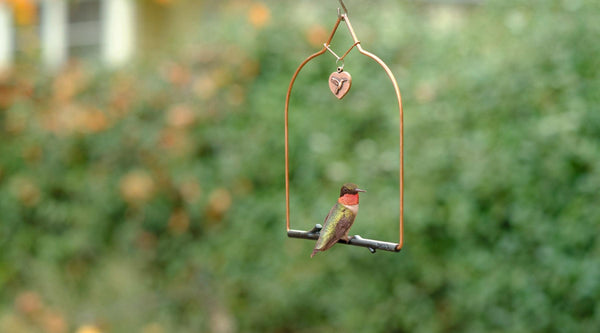
A Little Throne for Your Ruby-throated
Ruby-throated is genuinely uncommon this far north, holding on at the edge of its breeding range — a redwood perch nearby gives your breeder a favorite spot to rest and defend its territory.
Shop Charm Redwood Swing →North Dakota's Most Frequently Recorded Rare Visitor
Rufous Hummingbird Rare / Casual Visitor
The western hummingbird recorded most often in North Dakota, with a real, documented pattern spanning three decades. The first record came in early September 1995 near Bismarck — a bird that continued visiting through October — and recurring fall records have followed since, through a well-documented 2021 sighting at Dickinson. NDBRC doesn't publish graded "casual" or "accidental" tiers the way some other states do; its own operative term is simply "review species," meaning documentation is requested for every North Dakota occurrence, regardless of how often a species has turned up before.
The real underlying eBird signal backs up the recurring pattern: statewide activity shows a genuine, if thin, peak near 0.5% in late August, and Stark County (where Dickinson sits) shows a much stronger local peak of just over 3% in mid-July — which, as it happens, lines up with a genuinely remarkable coincidence explained below.

Quick ID: Males glow with a fiery orange-red throat and a coppery-orange body — one of the most recognizable hummingbirds in North America. Females and immatures are green above with rusty flanks and rufous patches at the base of the tail.

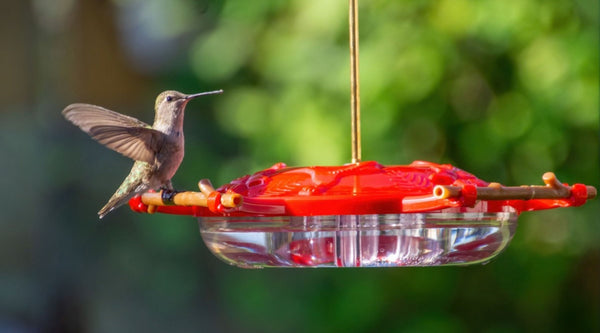
An Extra Feeder for Your Rufous Visitor
Rufous has kept coming back to North Dakota for three decades running — a second feeder, set apart from the first, gives a passing visitor its own station instead of fighting your breeder for one.
Shop AspenPerch® Feeder →If You're Lucky: North Dakota's Single-Record Rarities
Four more species have exactly one accepted North Dakota record each — all documentation-required review species per NDBRC, and all genuinely isolated occurrences with nothing before or since. Two of them, remarkably, showed up at the same small city the same summer.
Anna's Hummingbird Historic / Accidental
North Dakota's first and only Anna's Hummingbird, an adult male first identified in Bismarck on October 2, 2022. It persisted through blizzard and freezing conditions, drawing roughly 20 out-of-town birders within a week, and was independently photographed and confirmed continuing to at least October 22. No second North Dakota record has been found.

Quick ID: The only North American hummingbird with a fully colored crown as well as throat — males glow rose-pink from head to throat. Females show a central patch of rose-red spotting on an otherwise plain throat, with a stocky, broad-tailed build.
Black-chinned Hummingbird Historic / Accidental
North Dakota's only Black-chinned record — found by a Stanley birder at his own property in September–October 2019, where it stayed for three weeks before departing. A single isolated occurrence, with nothing since.

Quick ID: Males show a velvety black throat, only revealing a thin purple band in direct light — otherwise it just looks solid black. Females are plain and pale-throated, best told apart by white-tipped outer tail feathers and a small white spot behind the eye.
Broad-tailed Hummingbird Historic / Accidental
A genuine North Dakota review species, though the exact record count isn't published anywhere online — an honest gap rather than an invented number. The real eBird signal is concentrated in a single narrow peak in Burleigh County in late July, consistent with a documented but infrequent occurrence rather than an established pattern.

Quick ID: Males have a rose-magenta throat and produce a loud, distinctive metallic wing trill in flight — often heard before seen. Females show green throat spotting rather than solid color, with a pale eyering that helps separate her from similar species.
Calliope Hummingbird Historic / Accidental
North Dakota's first-ever Calliope Hummingbird turned up at Bismarck's Tom O'Leary Arboretum in late August 2021. That same summer, at Dickinson, a Rufous Hummingbird was already being watched when a second hummingbird at the same spot was identified, on closer photo review, as a separate Calliope — not a second Rufous. This wasn't a misidentification cleared up later; both species were genuinely present together. The underlying eBird data confirms it directly: Rufous and Calliope both show their strongest Stark County activity in the exact same week, consistent with two distinct rarities sharing one location at once.

Quick ID: North America's smallest breeding hummingbird, with a hunched posture and short tail. Males have a unique streaked, ray-like magenta throat unlike any other species' solid gorget. Females are tiny even by hummingbird standards, with very little rufous in the tail.
Give Every Visitor a Reason to Stay
Whether it's a common Ruby-throated, a recurring Rufous, or one of North Dakota's genuine single-record rarities, real nectar and a reliable feeder are what convince any hummingbird to linger. Nectarlyte® Powder adds electrolytes beyond plain sugar water, and Perfect Little Sanctuary® Wildflower Seed keeps natural nectar sources blooming through North Dakota's short season.


North Dakota Hummingbirds at a Glance
Ruby-throated Hummingbird's dominance here isn't a close call — its statewide eBird frequency peaks near 16%, and every other documented species stays well under 1% at its own peak. With a gap that wide, a bar chart wouldn't show anything the numbers below don't already say plainly, so this section skips straight to the table.
| Species | Status | North Dakota Records |
|---|---|---|
| Ruby-throated Hummingbird | Breeding | North Dakota's only breeder, and its only non-review species; statewide frequency peaks near 16%. |
| Rufous Hummingbird | Rare / Casual Visitor | A real, recurring pattern since 1995; North Dakota's most frequently recorded western vagrant. |
| Anna's Hummingbird | Historic / Accidental | 1 record ever (Bismarck, Oct 2022), persisted through blizzard conditions, nothing since. |
| Black-chinned Hummingbird | Historic / Accidental | 1 record ever (Stanley, Sep–Oct 2019), stayed 3 weeks, nothing since. |
| Broad-tailed Hummingbird | Historic / Accidental | A documented review species; exact record count not published, honestly flagged. |
| Calliope Hummingbird | Historic / Accidental | First state record Aug 2021 (Bismarck), plus a second bird the same summer at Dickinson. |
Frequently Asked Questions
How many hummingbird species have been recorded in North Dakota?
Six, per the North Dakota Bird Records Committee (NDBRC) — Ruby-throated is the only regular breeder, Rufous has a genuine recurring pattern, and four more species (Anna's, Black-chinned, Broad-tailed, Calliope) each have exactly one accepted record. That's comparable to South Dakota and Minnesota (eight each) and fewer than Montana's nine.
Is Rufous Hummingbird common in North Dakota?
Not common, but it's North Dakota's most frequently recorded western vagrant, with a real, documented pattern stretching from a 1995 Bismarck record through a 2021 Dickinson sighting. NDBRC still requires documentation for every occurrence, but this is a genuine recurring pattern, not a single fluke.
What happened in Dickinson, North Dakota in 2021?
Two different rare hummingbird species turned up at the same location the same summer. A Rufous Hummingbird was first identified there, and on closer photo review, a second bird present alongside it turned out to be a Calliope Hummingbird — not a second Rufous. The underlying data backs this up: both species show a matching activity peak the very same week in Stark County, consistent with both genuinely being present together.
How rare are hummingbirds overall in North Dakota?
Genuinely rare by national standards. North Dakota sits at the northwestern edge of Ruby-throated Hummingbird's breeding range, and every other species on the state list is either a documented single occurrence or a scarce, documentation-required visitor.
How can you tell Ruby-throated from Rufous Hummingbird in North Dakota?
Color and timing both help. Ruby-throated males show a red throat and green back; Rufous males are almost entirely orange-red overall, unlike anything else expected in North Dakota. Rufous also tends to show up later in the season, often September or beyond, after most Ruby-throateds have already left.
Why We Created This Guide
Pop's Birding has been helping hummingbird lovers for three generations. One of the questions our customers ask most often is "what hummingbirds actually show up in my state" — we built this guide to give a direct, sourced answer, not a generic one. North Dakota's four single-record rarities hide a genuinely remarkable story most general references would never catch: two of them, Rufous and Calliope, were both present at the same Dickinson location the same week in 2021, confirmed not by assumption but by matching activity data from both species at once. This page tells that story plainly, using NDBRC's own documented findings.
How We Created This Guide
How we classify each species. eBird checklist data for North Dakota, 2016–2025, pulled statewide plus three representative counties — Burleigh (Bismarck), Cass (Fargo), and Stark (Dickinson) — cross-checked against the North Dakota Bird Records Committee's own current Review List. NDBRC doesn't grade rarities into "casual" or "accidental" tiers the way some states do; every reviewed species carries the same "documentation required" designation regardless of how often it has occurred, so a record's actual history — one sighting versus a real recurring pattern spanning decades — is what separates Rufous Hummingbird's tier from the four single-record species here. The Dickinson finding was checked the same way: rather than assuming a photo-review correction meant one bird had been misidentified, the underlying weekly data was checked directly, and it showed Rufous and Calliope both peaking in Stark County the same week — genuine confirmation that two species were present together, not a data artifact.
Sources
- eBird bar chart data, Cornell Lab of Ornithology — North Dakota statewide, 2016–2025.
- North Dakota Bird Records Committee, North Dakota Birding Society — source for every rare-species record and status on this page.
Know before they arrive
You don't have to keep this calendar taped to the fridge. Insider Birding Access members get seasonal notes timed to your region — when to have feeders out, what the birds are doing right now, and what's worth doing in your yard this season. We take the guesswork out of the calendar. Joining takes about thirty seconds, and there's 10% off your first order in it.
Join Insider Birding Access →Free to join. 10% off your first order.
Shop North Dakota's Hummingbird Favorites


Bethany Sloan has served as General Manager of Pop's Birding since 2010, continuing the legacy of her grandfather, William "Pops" Sloan, inventor of the Original Hummingbird Swing. A lifelong hummingbird enthusiast, educator, and independent researcher, she leads the company's educational content, including its 50-State Hummingbird Guide series, Regional Guide, Species Guide and Hummingbird Learning Center. Bethany combines scientific research, regional migration data, and more than 16 years of hands-on experience to create trusted educational resources for bird enthusiasts across North America.