Aug 02, 2026
Buff-bellied Hummingbird: The One That Migrates North
Most Northern Hemisphere birds that migrate at all follow the same basic rule: south for winter, north for the breeding season. The Buff-bellied Hummingbird quietly breaks that rule. According to the U.S. Fish and Wildlife Service, after nesting in the southernmost tip of Texas, this species regularly disperses northeast along the Gulf Coast into Louisiana — and sometimes considerably farther — rather than heading south like nearly everything else. It's one of the more genuinely counterintuitive migration stories in North American birding, and it belongs to a hummingbird most of the country rarely gets the chance to see at all.
Quick Facts
- Scientific name: Amazilia yucatanensis (S. Cabot, 1845)
- Length: 3.9–4.3 inches (10–11 cm)
- Weight: 2.9–4.7 grams
- Lifespan: oldest banded record at least 11 years, 2 months — a male recaptured in Texas
- Conservation status: Least Concern (IUCN) — likely declined historically with habitat loss, but stable today, with documented range expansion in parts of Texas
- Population: approximately 610,000 global breeding population, per Partners in Flight — rated 11 out of 20 on the Continental Concern Score, indicating low conservation concern
- Claim to fame: the only hummingbird that breeds regularly in the southernmost tip of Texas, and one of just three members of the large tropical genus Amazilia found at least somewhat regularly north of Mexico
The Origin Story: How the Buff-bellied Hummingbird Got Its Name
The Buff-bellied Hummingbird was formally described in 1845 by American naturalist Samuel Cabot, based on a specimen from the Yucatán Peninsula — which is exactly where its species name, yucatanensis, comes from. The genus name, Amazilia, has a genuinely unusual origin for a scientific name: according to Cornell's Birds of the World, French naturalist René Lesson drew it from Amazili, a character in Jean-François Marmontel's 1777 romantic novel Les Incas, ou la destruction de l'Empire du Pérou — reflecting a broader 19th-century tradition among hummingbird taxonomists of drawing names from mythology and literature rather than strictly descriptive Latin or Greek terms.
Three subspecies are currently recognized, reflecting the species' fairly wide range across the Yucatán, eastern Mexico, and the U.S. Gulf Coast: the nominate A. y. yucatanensis on the Yucatán Peninsula and into northern Belize and Guatemala; A. y. cerviniventris in eastern and southern Mexico, from central Veracruz south through Puebla and Oaxaca to northern Chiapas; and A. y. chalconota, the only subspecies confirmed in the United States, found in the Lower Rio Grande Valley of southern Texas and into adjacent northeastern Mexico, according to the Texas Breeding Bird Atlas.
Where the Buff-bellied Hummingbird Lives: A Gulf Coast Specialist With a Habit of Wandering North
According to the U.S. Fish & Wildlife Service, the Buff-bellied Hummingbird's core U.S. range is centered on the Gulf Coast, especially the Lower Rio Grande Valley of Texas — and it's the only hummingbird species that breeds there regularly. Outside the U.S., the Texas Breeding Bird Atlas notes the species ranges through the Gulf Coast of Mexico from Tamaulipas to the Yucatán Peninsula, and into Belize and Guatemala.
What genuinely sets this species apart is what happens after breeding season ends. Rather than migrating south the way the overwhelming majority of Northern Hemisphere birds do, Buff-bellied Hummingbirds regularly disperse northeast along the Gulf Coast into Louisiana, and Cornell's Birds of the World notes that some individuals continue on regularly as far as the Florida Panhandle, and irregularly even farther — occasionally reaching other parts of Florida and as far north as North Carolina. The Texas Breeding Bird Atlas notes the species has also been reported in Alabama during fall and winter months, and appears to be genuinely expanding its range within Texas itself.
How to Identify the Buff-bellied Hummingbird: Males vs. Females
Adult Males
A distinctive red bill tipped in black is the fastest field mark, according to Cornell Lab's All About Birds — genuinely useful, since almost no other North American hummingbird combines a red bill with this species' other features. The throat is iridescent metallic green, capable of looking quite dark depending on the angle of light, set against metallic bronze-green upperparts. The tail is rusty chestnut, and the belly is a soft buff color — the feature that gives the species its common name.

Adult Females
Similar overall pattern to the male but with a less iridescent back and throat. The central tail feathers are mostly greenish bronze, while the outer feathers are mostly chestnut, edged and tipped in greenish bronze. Females also tend to show more dusky coloring on the upper bill than males, according to Cornell's detailed species account.

A Note on Sound
Cornell's All About Birds Sounds page describes several distinct calls: a dry "tik," a shrill "shreeeet," a rapid-fire "see-see-see-see-su-su" given during chases after other hummingbirds, and a sharp "tsi-we" or "siik" made during what appear to be display flights. The Audubon Field Guide simply describes the overall impression as shrill squeaks.
Behavior: Territorial and Genuinely Adaptable
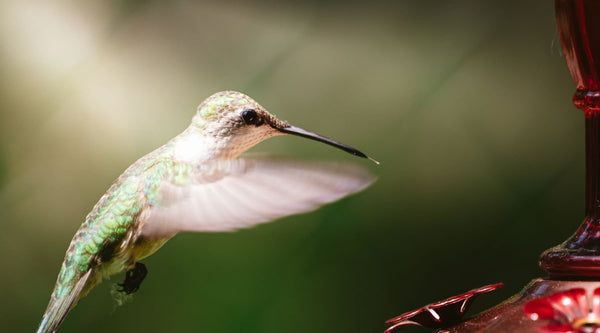
Cornell's Birds of the World describes the Buff-bellied Hummingbird as defending feeders and flowering trees against other hummingbirds — both its own species and others — as well as some insects like butterflies and wasps. At feeders in southern Texas, the species tends to dominate other hummingbirds present, likely because of its comparatively larger size. Unusually among North American hummingbirds, it also readily nectars from a wide variety of flowering plants, shrubs, and trees, including many with non-tubular blossoms — a genuinely more flexible foraging strategy than the tubular-red-flower specialization common in several other species covered in this guide series.
Feeding and Diet
According to the U.S. Fish & Wildlife Service, Buff-bellied Hummingbirds feed on nectar from flowers along with small insects, including flies, beetles, ants, and spiders. The agency specifically identifies Turk's cap, coral bean, and trumpet creeper as plants this species pollinates directly — all three genuinely excellent choices for anyone hoping to support this species with native plantings rather than a feeder alone. The Audubon Field Guide adds red salvia to that list of favorites, and confirms the species readily visits sugar-water feeders as well, feeding either while hovering or perched.
Courtship and Mating
Here's an honest admission worth making plainly: courtship in this species is genuinely poorly understood. The Audubon Field Guide states outright that "breeding behavior is not well known," and Cornell's Birds of the World goes further, calling the Buff-bellied Hummingbird "probably the least-studied hummingbird that occurs regularly in the United States." What little has been observed is limited — Cornell notes that birds have been recorded making a "tsi-we" or "siik" call between dawn and sunrise while performing rapid, erratic flights that may be display flights directed at females, but nothing resembling a fully documented courtship ritual has been described in the scientific literature. As with virtually all hummingbirds, the female alone handles nest-building and raising the young once mating is complete, with no further involvement from the male.
Nesting and Family Life
According to the Audubon Field Guide, the nest site is usually in a large shrub or small deciduous tree — hackberry and Texas ebony are both documented choices, and Cornell adds anacahuita, willow, papaya, pecan, and ash to that list. Cornell's account gives the fullest picture of nest height: sites range from about 3 feet up to roughly 23 feet, though most nests sit around 10 feet above the ground — notably higher than older accounts from Mexico, which tended to cluster closer to 3–10 feet. The nest itself, built by the female, is a cup of plant fibers, stems, bark shreds, and spider silk, lined with soft plant down and camouflaged on the outside with bits of lichen and flower petals.
Clutch size is two white, unmarked eggs. Incubation, handled by the female alone, likely lasts two weeks or longer, though the precise incubation period and time to fledging genuinely haven't been documented with certainty — a reminder that even a well-studied U.S. breeding bird can still have real gaps in its basic life history data. The female feeds chicks by inserting her bill deep into their mouths and regurgitating a mixture of tiny insects and nectar, and may raise up to two broods in a season. In southern Texas specifically, Cornell's Birds of the World notes the nesting season runs mostly from late March through early August, though nesting attempts both earlier and later have been documented.

Migration: Breaking the Rules
This is genuinely the defining fact about the Buff-bellied Hummingbird, and it's worth restating plainly: rather than migrating south after the breeding season the way the overwhelming majority of Northern Hemisphere birds do, this species regularly disperses northeast along the Gulf Coast instead. According to the U.S. Fish & Wildlife Service, birds breeding in southernmost Texas move into Louisiana as a matter of routine, with the broader dispersal pattern extending as far as the Florida Panhandle and, on occasion, considerably farther north along the Atlantic coast. Some individuals do migrate south into Mexico and Central America as well, meaning the species' overall movement pattern is genuinely mixed rather than following one single rule.
Torpor
Like hummingbirds generally, Buff-bellied Hummingbirds can enter torpor — slowing their metabolism and lowering their body temperature — to conserve energy when conditions turn challenging, according to the U.S. Fish & Wildlife Service. Because this species is so little studied overall, exactly how heavily it relies on torpor hasn't been specifically documented the way it has for some better-studied North American hummingbirds.
Habitat
According to the Audubon Field Guide, Buff-bellied Hummingbirds favor woods and thickets, and in Texas specifically are found mostly in semi-open habitat — woodland edges, clearings, brush, and scattered trees, sometimes around citrus groves. The U.S. Fish & Wildlife Service similarly describes the species' habitat as coastal woodlands, thickets, and gardens. Several National Wildlife Refuges in the Lower Rio Grande Valley — including Santa Ana, Laguna Atascosa, and Lower Rio Grande Valley National Wildlife Refuges — protect significant habitat for this species within its limited U.S. breeding range.
Buff-bellied Hummingbird by Region: Where and When to Find Them
| Region | Status | Best Time to See Them |
|---|---|---|
| Lower Rio Grande Valley, Texas | The only regularly breeding hummingbird here | More common in summer, some remain through winter |
| Rest of Texas Gulf Coast | Expanding range, increasingly regular | Year-round in some areas |
| Louisiana | Regular post-breeding dispersal destination | Fall through winter |
| Alabama | Documented visitor | Fall and winter |
| Florida Panhandle | Regular post-breeding dispersal destination | Fall through winter (some reports September–May) |
| Rest of Florida | Irregular but documented visitor | Fall through winter |
| North Carolina & elsewhere on the Atlantic Coast | Rare but documented vagrant | Fall through winter |
| Eastern Mexico, Yucatán Peninsula, Belize, Guatemala | Core range and primary wintering grounds | All year |
Build a Buff-bellied Hummingbird Sanctuary in Your Own Yard
Because this species disperses so widely along the Gulf Coast after breeding, a backyard well outside its core Texas range can still genuinely host one, especially in fall and winter.
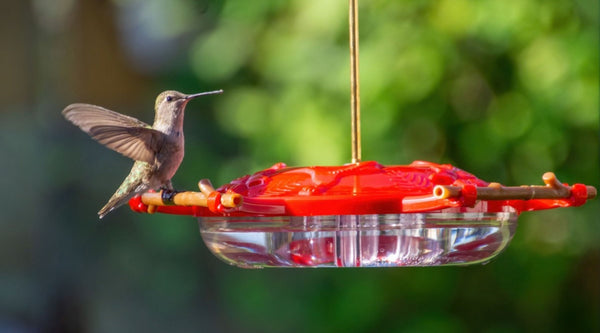
- Use a leak-proof, easy-to-clean feeder like the AspenPerch® Hummingbird Feeder, with a comfort perch so this species can rest between its territorial feeder defense.
- Keep nectar available through fall and winter if you're along the Gulf Coast, since this is exactly when post-breeding Buff-bellied Hummingbirds are most likely to show up outside southern Texas. Pop's Nectar, with added electrolytes and calcium, supports the demands of this species' unusually long lifespan and active breeding season.
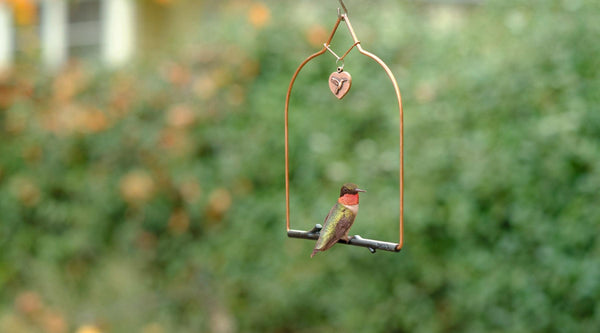
- Add a swing near your feeder — a Pop's Original Hummingbird Swing gives a territorial Buff-bellied Hummingbird a consistent perch to defend its feeding area from.
- Plant real native favorites like Turk's cap, coral bean, and trumpet creeper — all three documented as genuine pollination partners for this species, not just casual nectar stops.
- Skip the insecticide. Since flies, beetles, ants, and spiders are all documented parts of this species' diet, pesticide use removes food it depends on. Use HummGuard™ nectar tips instead to manage bees and wasps without harming anything else.
For state-specific feeder timing, native plant lists, and wildflower planting guidance, see our companion guides for Texas, Louisiana, Florida, and Alabama, or find your own state in our full hummingbird guide by state series.
Frequently Asked Questions
Why does the Buff-bellied Hummingbird migrate north after breeding instead of south?
According to the U.S. Fish and Wildlife Service, most Northern Hemisphere birds don't do this, but Buff-bellied Hummingbirds regularly disperse northeast along the Gulf Coast into Louisiana, and sometimes as far as the Florida Panhandle or North Carolina, after their breeding season ends in southern Texas, rather than migrating south.
Is the Buff-bellied Hummingbird the only hummingbird that breeds in Texas?
It's the only hummingbird species that nests regularly in the southernmost tip of Texas specifically, distinct from the Ruby-throated Hummingbird, which breeds across the rest of the state.
How can you identify a Buff-bellied Hummingbird?
Look for a distinctive red bill tipped in black, a bright metallic green throat and upperparts, a rusty chestnut tail, and a pale buff-colored belly, the feature that gives the species its name.
Is the Buff-bellied Hummingbird aggressive?
Yes, genuinely so. Cornell's Birds of the World describes it as defending feeders and flowering trees against other hummingbirds and even some insects, and notes that at feeders in southern Texas it tends to dominate smaller hummingbird species, likely because of its comparatively larger size.
How is a Buff-bellied Hummingbird different from a Rufous-tailed Hummingbird?
They're closely related — both in the genus Amazilia — and genuinely similar in appearance. The Rufous-tailed Hummingbird tends to show a dingier, grayish belly and more extensive rusty coloring in the tail, which lacks the distinct fork often seen in the Buff-bellied's tail. The two also favor different habitats and their ranges barely overlap, with the Rufous-tailed found largely farther south.
What does a Buff-bellied Hummingbird sound like?
Calls include a dry "tik," a shrill "shreeeet," a rapid-fire chattering given during chases with other hummingbirds, and a sharper "tsi-we" or "siik" made during what appear to be display flights.
How old can a Buff-bellied Hummingbird live?
The oldest recorded individual, a male, was at least 11 years and 2 months old when recaptured during banding operations in Texas, a genuinely long lifespan for a hummingbird.
Is the Buff-bellied Hummingbird endangered?
No, it's rated Least Concern by the IUCN. Numbers likely declined historically with habitat loss, but the current population appears stable to increasing, and the species seems to be expanding its range in parts of Texas.
How can I attract Buff-bellied Hummingbirds to my yard?
If you're in southern Texas or along the Gulf Coast, keep a feeder up (many stay through winter along the coast) and plant native favorites like Turk's cap, coral bean, and trumpet creeper, all documented food sources and pollination partners for this species.
At Pop's Birding, we believe every backyard — big or small — has room for a little more wonder. Explore our feeders, nectars, swings, and wildflower seed blends to start building your own hummingbird sanctuary today.

Bethany Sloan has served as General Manager of Pop's Birding since 2010, continuing the legacy of her grandfather, William "Pops" Sloan, inventor of the Original Hummingbird Swing. A lifelong hummingbird enthusiast, educator, and independent researcher, she leads the company's educational content, including its 50-State Hummingbird Guide series, Regional Guide, Species Guide and Hummingbird Learning Center. Bethany combines scientific research, regional migration data, and more than 16 years of hands-on experience to create trusted educational resources for bird enthusiasts across North America.