Jul 13, 2026
How to Attract Hummingbirds in Alabama: A Backyard Sanctuary Guide
The hummingbird at your feeder in September is not passing time. It is eating for a flight across open water. Ruby-throated Hummingbirds that stage along Alabama's Gulf Coast nearly double their body weight before crossing the Gulf of Mexico — up to 500 miles with nowhere to land, often flown at night. Researchers on the Fort Morgan peninsula who caught and weighed more than 2,700 of them in autumn found birds carrying enough fuel for roughly 1,400 miles of flight, far more than the crossing requires. Alabama isn't just a place hummingbirds pass through. It's where they get ready.
Whether you're gardening along the coast in Mobile and Gulf Shores, in the Black Belt around Montgomery, or up in the Tennessee Valley near Huntsville, this guide will walk you through everything you need to turn your space into an Alabama hummingbird destination: how to size your setup to any space, feeder and nectar care, pest-safe cleaning, and the native plants and wildflower seed varieties that thrive in Alabama's climate.
Free download
Everything above, one page
Species, timing by region, feeder care, and the best native plants for your part of Alabama — free to print and keep by the back door.
Download the Alabama quick reference guideOne page · PDF · free to print and share
Which Hummingbirds You'll See in Alabama

Alabama has 13 documented hummingbird species — more than any bordering state — but only one you can count on seeing: Ruby-throated Hummingbird, the state's only breeder, common statewide from spring through fall. Winter tells a different story along the Gulf Coast specifically, where four species show up regularly enough to count as genuine winter visitors, not just rare stragglers: Rufous Hummingbird, the leading winter visitor, Black-chinned Hummingbird a regular second, and Buff-bellied and Calliope Hummingbird — all four confirmed through two decades of banding research, not just casual sightings. Beyond those five, Alabama's other eight species (Allen's, Anna's, Broad-billed, Broad-tailed, Mexican Violetear, Rivoli's, Costa's, and White-eared) are real but genuinely rare, each with its own documented history.
For full identification help — photos, field marks, and the real story behind each of Alabama's 13 species, including why Black-chinned is so easily mistaken for Ruby-throated — see our complete Hummingbirds in Alabama species guide.
When Do Hummingbirds Arrive and Leave Alabama?
Ruby-throated Hummingbirds reach the Alabama coast about three weeks before they reach the rest of the state — but after that, the whole state runs on nearly the same schedule.
For the full month-by-month breakdown — every region and exactly when each species moves through — see our complete Alabama hummingbird calendar.

Arrival and departure windows by region, based on eBird checklist data (Cornell Lab of Ornithology), 2016–2025. See our Alabama hummingbird calendar for the full month-by-month breakdown.
Arrival Times by Region
| Region | First Arrivals | Reliably Present | Hang Feeders By |
|---|---|---|---|
|
Gulf Coast (Mobile, Gulf Shores) |
Late February | September only — a real late-season peak, not sustained presence through the season | Early February |
|
Birmingham & Central Alabama (Jefferson Co.) |
Mid-March | Late June through early October | Early March |
|
Huntsville & North Alabama (Madison Co.) |
Mid-March | Late April–early May, dips back down through June, then July through early October | Early March |
Windows derived from eBird bar chart data (Cornell Lab of Ornithology), 2016–2025, for Mobile, Jefferson, and Madison counties. "Reliably present" means the species is being reported on a quarter or more of birdwatchers' checklists.
Why three regions, not two? Birmingham and Huntsville see their first birds at almost exactly the same time — both in mid-March — so it would be easy to lump them together as "the rest of Alabama." The data says otherwise once you look past first arrival: Huntsville actually reaches reliable 25%+ presence first, in late April, but then genuinely drops back below that level through most of May and June before climbing again in July. Birmingham does the opposite — it takes until late June to reach reliable presence at all, but once it gets there, it holds steady straight through early October with no dip. Two counties, same starting gun, two different races.
A Note on Winter Hummingbirds
Here's something the data makes unusually clear: winter hummingbirds in Alabama are a Gulf Coast story. Around Mobile, hummingbirds are reported every week of December, January, and February. Around Birmingham and Huntsville, that number is zero — not rare, but absent.
Most of those coastal winter birds aren't Ruby-throated. Two decades of banding by the Hummer/Bird Study Group found Rufous Hummingbirds made up about half of all hummingbirds banded in winter across southern Alabama and northern Florida — 51.6% in the first ten-year study and 49% in the second — with Ruby-throated and Black-chinned making up most of the rest. If you're on the coast, a winter feeder is worth keeping up. You may be hosting a bird that nested in the Pacific Northwest, or as far north as southern Alaska.
Pop's tip: The Gulf Coast isn't just an early-arrival zone — it's also a critical fall refueling stop. Researchers working on the Fort Morgan peninsula banded more than 2,700 Ruby-throated Hummingbirds across five autumns, documenting birds gathering in the coastal scrub from late August through late October to build the fat reserves they need before crossing the Gulf. The eBird data agrees: hummingbird reports around Mobile peak in the third week of September, right when that research found migration cresting.
🗓️ Feeder Timing at a Glance
Put your feeder up: About two weeks before the first arrivals in your area — early February on the Gulf Coast, early March everywhere else. Being the first feeder in the neighborhood pays off for years, because hummingbirds remember where they found food.
Take it down: About two weeks after the last hummingbird you see. That's a better guide than any date we could print, since it accounts for your own yard and this year's weather.
On the coast, consider leaving one up all year. Alabama's Gulf Coast hosts wintering hummingbirds every year — mostly Rufous, not Ruby-throated — and a maintained feeder is how most of them get found.
Attracting Hummingbirds No Matter Your Space
You don't need acres of land to invite wonder into your yard. Hummingbirds are famously adaptable — all they're really looking for is a dependable food source, a safe place to perch, and a little color.

- Small patio or balcony: One feeder hung from a bracket or shepherd's hook, paired with a container of red or orange tubular blooms like scarlet sage, is plenty to get noticed. Hummingbirds are solitary feeders by nature, so a single feeder works great in tight spaces.
- Average backyard: Add a mix of feeders and native blooms along a fence line or garden bed, and give your visitors a swing or two nearby to rest and survey their territory between sips.
- Large yard with trees: Take advantage of the shade. Hummingbirds prefer feeders and plantings tucked out of harsh, direct afternoon sun, with a nearby branch to perch on and watch for rivals. Spread multiple feeders far apart, since hummingbirds are territorial and will happily chase each other off a single feeder.
Keep Feeders Clean with Fresh Nectar
Choose a Leak-Proof Feeder
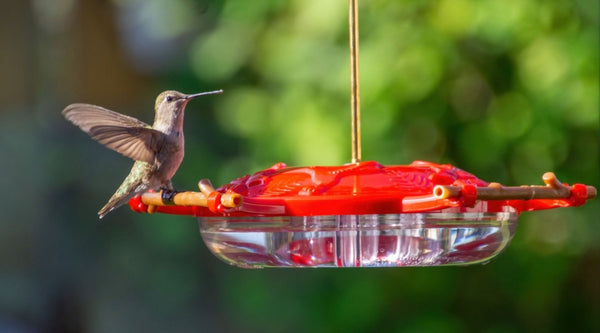
A feeder is only as good as what's in it — and how well it's kept. Pop's AspenPerch® Hummingbird Feeder is leak-proof by design and paired with our patented Polyperch® comfort perch, so your hummingbirds can rest and feed at the same time instead of hovering the whole meal.

Feeding Fundamentals
- Only fill what they'll drink in a few days. An 8 oz feeder rarely needs to be topped all the way off — overfilling just means more nectar sitting around long enough to spoil, especially in Alabama's long, humid summers.
- Skip the red dye. Your feeder's color does the attracting; dyed nectar offers no benefit and isn't necessary.
- Use a real nectar recipe, or save yourself the math with Pop's Nectar, formulated with added electrolytes and calcium to support hummingbirds through the demands of nesting season and migration — no dyes, no preservatives.
How Often to Change Nectar in Alabama
Sugar water ferments faster the hotter and more humid it gets, and Alabama delivers plenty of both for a large part of the year. Use this as your rule of thumb:
| Outdoor Temp | Change Nectar Every |
|---|---|
| Below 70°F | 5–6 days |
| 70–80°F | 3–4 days |
| 80–90°F | 2–3 days |
| Above 90°F | 1–2 days |
If the nectar ever looks cloudy before that window is up, change it early — cloudiness means it's already started to ferment.
Keeping Feeders Clean (and Pests Away) Without Insecticide
Hummingbirds don't live on nectar alone — small insects make up a big part of their protein diet, especially for feeding chicks. That means insect spray is off the table around your feeding station; it removes a food source hummingbirds depend on and can be harmful to them directly.
Instead:
- Clean your feeder every time you change the nectar, using warm water and a bottle brush — no soap residue, no bleach. A little vinegar and water solution works great for breaking down sticky buildup or the beginnings of mold.
- Deter ants and bees with a vinegar-water spray around (not on) the feeder ports, or wipe down the hanging hook where ants tend to march down.
- Use HummGuard™ nectar tips if bees and wasps keep crashing the party. They slide right onto the AspenPerch's feeding ports — the flexible membrane opens easily for a hummingbird's beak but closes tight against anything bigger, keeping your nectar exclusively for the birds it's meant for.
Give Them a Place to Rest
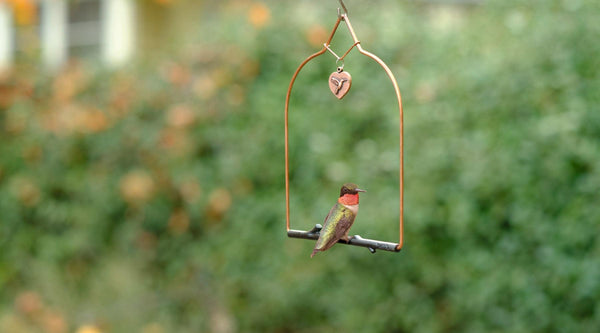
Hummingbirds spend a surprising amount of their day perched, not flying — watching their territory, digesting, and simply resting between feedings. A Pop's Original Hummingbird Swing hung near your feeder gives them exactly that spot, and it turns your feeding station into a front-row seat for watching them up close. Hang it within a foot or two of your feeder, and don't be surprised if a hummingbird claims it as their own personal lookout post.

Plant an Alabama Native Hummingbird Garden
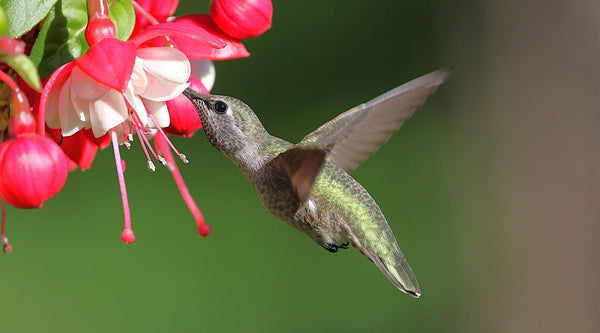
Feeders are a wonderful supplement, but nothing beats real, native nectar. Native plants evolved right alongside Alabama's hummingbirds, so they bloom on the right schedule and produce exactly the nectar these birds are looking for.
Best native nectar plants by Alabama region:
| Region | Best Native Nectar Plants |
|---|---|
| Gulf Coast | Coral honeysuckle, trumpet creeper, crossvine, red buckeye, Indian pink |
| Central Alabama & Black Belt | Wild bergamot, cardinal flower, coral honeysuckle, Indian pink |
| North Alabama & Tennessee Valley | Wild bergamot, lanceleaf coreopsis, jewelweed, crossvine, fire pink, eastern columbine |
Pop's tip: Alabama Audubon specifically calls out red and scarlet buckeye, crossvine, standing cypress, and coral honeysuckle as reliable nectar sources for migrating hummingbirds, in addition to garden favorites like salvia and lantana. Mixing a couple of these natives into your beds gives you real food to back up your feeder.
If You're Near the Border
Hummingbirds don't check a map before deciding where to feed, so if you're near a state line, your best guide might be a blend of both.
Near Tennessee: Both states share the same Southeast humidity problem for Palmer Penstemon — a strong performer out west, it consistently underperforms here. See our Tennessee hummingbird guide for more.
Near Georgia: Georgia's "second hummingbird season" each winter extends right across the state line into Alabama's own Gulf Coast counties. See our Georgia hummingbird guide for more.
Near Florida: Alabama's Gulf Coast shares nearly identical late-February feeder timing and winter Rufous visitors with Florida's Panhandle. See our Florida hummingbird guide for more.
Near Mississippi: Nearly identical Gulf Coast climate and timing, plus overlapping native seed varieties. See our Mississippi hummingbird guide for more.
To make this easy, our Perfect Little Sanctuary® Wildflower Seed Blend is designed to bring nectar-rich color into your yard with minimal fuss.
When to Plant the Perfect Little Sanctuary® Blend in Alabama

Fall is the best planting window across Alabama — aim for October through November. This timing is based on the germination needs of the blend's own 12 varieties: 9 of the 12 either need or benefit from a cold, moist stratification period before they'll germinate well, including Purple Coneflower, Black-Eyed Susan, and Lance-Leaved Coreopsis, and Alabama's cooler winter months provide exactly that. An early spring planting (March–April) works as a backup, though you'll likely see fewer blooms in the first season.
Top Performers in Alabama
The Perfect Little Sanctuary® blend contains 12 varieties, and three of them are Alabama natives that handle the state's heat and humidity well:
- Purple Coneflower (Echinacea purpurea) — an Alabama native and one of the most dependable long-blooming natives in the state, though wild populations are now rare
- Black-Eyed Susan (Rudbeckia hirta) — Alabama native, blooming May through July in full sun or at a woodland edge
- Lance-Leaved Coreopsis (Coreopsis lanceolata) — an Alabama native listed by Alabama Extension as one of the most commonly available native coreopsis, easy to grow and quick to spread
Pop's tip: You don't need to do anything special to favor the strong performers — just sow the blend as directed. The rest of the mix still adds seasonal color, but these varieties are the ones that will do the heaviest lifting in an Alabama yard.
Summary: Key Takeaways for Attracting Hummingbirds in Alabama
Building a hummingbird-friendly yard doesn't take a green thumb or a big budget — just a little consistency and the right setup. Here's everything from this guide in one place:
- Ruby-throated Hummingbird is Alabama's only breeding species, common statewide from spring through fall. A few winter on the Gulf Coast — but most of Alabama's winter hummingbirds are Rufous, not Ruby-throated
- Alabama's Fort Morgan peninsula is home to real hummingbird migration research — more than 2,700 Ruby-throated banded across five autumns, studying how they fuel up for the Gulf crossing
- Feeder timing: up by early February on the Gulf Coast, early March everywhere else — central and north Alabama get birds at nearly the same time
- The Gulf Coast matters twice a year — as an early spring arrival zone and as a critical fall refueling stopover, peaking in September
- Any size space works — one feeder is plenty for a balcony; larger yards can support multiple feeders spaced apart, since hummingbirds are territorial
- Use a leak-proof feeder with a comfort perch, like the AspenPerch®, and fill it only as full as it'll be drunk in a few days
- Skip red dye in nectar; a plain 4:1 sugar-water ratio or Pop's Nectar (with electrolytes and calcium) both work
- Change nectar every 1–2 days above 90°F, up to every 5–6 days below 70°F
- Clean the feeder at every nectar change with warm water and vinegar — no soap or bleach
- Never use insecticide near feeders; hummingbirds rely on insects for protein. Use vinegar-water spray and HummGuard™ nectar tips for pest control instead
- Add a swing near the feeder to give hummingbirds a place to rest and be observed up close
- Native, nectar-rich plants (coral honeysuckle, trumpet creeper, cardinal flower, red buckeye, depending on region) do more for hummingbirds long-term than feeders alone
- Sow wildflower seed in October–November for blooms timed to spring migration; Lance-Leaved Coreopsis, Black-Eyed Susan, and Purple Coneflower are the strongest Alabama performers in Pop's Perfect Little Sanctuary® blend, and all three are Alabama natives
Get these basics in place, and the wonder takes care of itself.
Frequently Asked Questions
When should I put my hummingbird feeder out in Alabama?
Early February on the Gulf Coast, where the first arrivals show up in late February. Everywhere else in the state, early March — birds reach central and north Alabama at nearly the same time, in the second half of March, so there's no need to stagger it.
What are common mistakes when feeding hummingbirds in Alabama?
The biggest one is treating the whole state the same way. On the Gulf Coast, the mistake is taking the feeder down every fall out of habit — Rufous and a few Ruby-throated genuinely winter there, and a feeder that disappears every October is taking away a real food source. Inland, the mistake runs the other way: over-filling a feeder during Alabama's long, humid summer, where nectar can ferment within 1–2 days above 90°F, well before a once-a-week refill schedule would catch it.
Do hummingbirds like feeders without perches?
They'll use either, but a perch matters more than it might seem. Hovering is metabolically expensive, and giving a hummingbird somewhere to land and feed instead of hover the whole time — like the AspenPerch's built-in Polyperch® — means it burns less energy per visit. That matters most during Alabama's September peak, when both Alabama's own late-season young and hummingbirds moving through from farther north are competing for the same feeders before the Gulf crossing.
What happens if you don't boil sugar water for hummingbirds?
Boiling isn't the part that actually matters most — the real variable is how long the nectar sits out afterward. Alabama's own temperature-banded change schedule (every 1–2 days above 90°F, up to every 5–6 days below 70°F) does more to prevent fermentation and mold than boiling the water ever will, especially given how much of the state sits above 90°F for a large part of the season.
Is it bad to leave my feeder up in fall?
Not at all — it's a myth that a feeder left up will delay migration. Hummingbirds migrate based on daylight and instinct, not food availability, and a full feeder just helps them refuel for the journey ahead. On the Gulf Coast especially, leaving your feeder up into late fall can help support both lingering Ruby-throated and visiting Rufous Hummingbirds.
What are the best plants to attract hummingbirds in Alabama?
Coral honeysuckle and trumpet creeper perform well across the entire state, with red buckeye and crossvine especially strong on the Gulf Coast, and wild bergamot a reliable choice in central and north Alabama. Native, tubular, red or orange flowers are the general rule of thumb.
Alabama Hummingbird Resources
Audubon Chapters
Alabama is home to several local Audubon chapters across the state. Find the one closest to you with Audubon's Find Your Local Audubon tool.
If You Find an Injured or Grounded Hummingbird
Hummingbirds are protected under federal and Alabama state law, so only a licensed wildlife rehabilitator can legally care for one.
- Outdoor Alabama — Permitted Wildlife Rehabilitators — the official statewide list, maintained by the Alabama Department of Conservation and Natural Resources (call 334-242-3469 with questions)
- Alabama Wildlife Center (Oak Mountain State Park) — the state's oldest and largest wildlife rehabilitation center dedicated to native birds; call 205-663-7930, ext. 1
Hummingbird Research & Banding in Alabama
Fort Morgan Bird Banding Station (Gulf Shores) — a historic Gulf Coast banding site with genuine hummingbird research roots, continued today by researchers who got their start banding there as kids. A free, public banding week is hosted each spring at the Fort Morgan State Historic Site by Alabama Audubon, described as one of the only public bird banding programs on the Gulf Coast.
Why We Created This Guide
Pop's Birding has been helping hummingbird lovers for three generations. One of the questions our customers ask most often is "How do I actually attract more hummingbirds to my yard?" — we built this guide to give a direct, practical answer, not a generic one. Most feeder advice online treats every state the same way, but Alabama has something most guides never mention at all: a real, peer-reviewed Gulf Coast winter hummingbird research program, and a genuine fall staging ground where birds fuel up for a 500-mile flight across open water. We wanted a guide that actually reflects that, not a generic "put a feeder up in spring" checklist.
How We Created This Guide
Where the timing figures come from. Feeder up/down dates here are the actionable conclusions from our full Alabama hummingbird calendar, which has the complete month-by-month methodology — we don't duplicate that analysis here, just the practical takeaway.
Why the nectar/care schedule is calibrated to Alabama specifically. The change-frequency table is banded by actual outdoor temperature because fermentation speed — not a fixed calendar date — is the real variable, and Alabama's long, humid summers push nectar into the fastest-changing bracket for a large part of the year.
Why the plant lists are regional, not statewide. A plant built for the Gulf Coast's humid, sandy-soil conditions can struggle in the Tennessee Valley's cooler winters, and vice versa. The three-region breakdown here reflects a real climate and soil split within the state, not an arbitrary way of organizing the same statewide list.
Sources
- eBird bar chart data, Cornell Lab of Ornithology — Alabama statewide plus Mobile, Jefferson, and Madison counties.
- Alabama Department of Conservation and Natural Resources — Ruby-throated Hummingbird species account.
- Alabama Cooperative Extension System — Native Flowers for North Alabama Landscaping (ANR-3229).
- Zenzal, T. J., & Moore, F. R. (2016). Stopover biology of Ruby-throated Hummingbirds during autumn migration. The Auk, 133(2), 237–250.
- Bassett, F., & Cubie, D. (2009). Wintering hummingbirds in Alabama and Florida. Journal of Field Ornithology, 80(2), 154–162.
- Bassett, F., & Dietrich, K. (2021). A second decade of overwintering hummingbirds in Florida and Alabama. The Wilson Journal of Ornithology, 133(1), 132–136.
Know before they arrive
You don't have to keep this page bookmarked. Insider Birding Access members get seasonal notes timed to your region — when to have feeders out, what the birds are doing right now, and what's worth doing in your yard this season. Joining takes about thirty seconds, and there's 10% off your first order in it.
Join Insider Birding Access →Free to join. 10% off your first order.

Bethany Sloan has served as General Manager of Pop's Birding since 2010, continuing the legacy of her grandfather, William "Pops" Sloan, inventor of the Original Hummingbird Swing. A lifelong hummingbird enthusiast, educator, and independent researcher, she leads the company's educational content, including its 50-State Hummingbird Guide series, Regional Guide, Species Guide and Hummingbird Learning Center. Bethany combines scientific research, regional migration data, and more than 16 years of hands-on experience to create trusted educational resources for bird enthusiasts across North America.