Jul 25, 2026
Alabama Hummingbird Season: A Month-by-Month Calendar
Alabama has two hummingbird stories running at once, and they're closer to complements than opposites. The Gulf Coast sees two real passage peaks a year — a spring push in April, and an even bigger one in September — with a genuine, if much thinner, wintering population holding on in between. Inland, around Birmingham and Huntsville, there's just one story: a single build that doesn't crest until September.
The short answer: Ruby-throated arrives on the Gulf Coast in late February and inland — around Birmingham and Huntsville — by the third week of March, with both regions building to a September peak that's bigger everywhere in the state than the coast's own April passage peak. Most of Alabama empties out by mid-October, but the Gulf Coast doesn't go quiet: Ruby-throated lingers there into mid-November, and Rufous — a real annual winter visitor — takes over as the coast's main hummingbird from December onward, with Black-chinned, Buff-bellied, and Calliope adding to the mix through winter. Between the two, the coast has a hummingbird in view nearly year-round — inland, the season is shorter, but no less dramatic at its peak.
| Question | Answer |
|---|---|
| When do they arrive? | Late February on the coast; third week of March inland — Birmingham and Huntsville the same week. |
| When should feeders go up? | Early February on the coast; early March inland — ahead of the first arrivals. |
| When do they nest? | March through July, statewide — two to three broods are possible. |
| Busiest month? | September — the statewide peak, including the coast's own biggest week of the entire year. |
| When do they leave? | Inland, mostly gone by mid-October. The coast runs about a month behind, with birds regularly present into mid-November. |
| Any in winter? | Yes — Rufous Hummingbird, a real annual visitor on the Gulf Coast (not just an occasional stray), along with Black-chinned, Buff-bellied, and Calliope. |
Free download
The whole year on one page
Arrival windows for the coast and inland, both Gulf Coast peaks, and when the winter visitors show up — sized 8.5" x 11" for easy reference and printing.
Download the printable calendarOne page · PDF · free to print and share
Here's the whole year, month by month.
Alabama's Hummingbird Season at a Glance
One species nests in Alabama, and it dominates the warm months — Ruby-throated turns up on nearly half of all bird lists at its September peak.

How often birdwatchers report a Ruby-throated on eBird, week by week — statewide, 2016–2025.
Four more species turn up reliably enough to chart, but at a far smaller scale, so they get their own chart. Rufous is the one to watch for, peaking in mid-January long after the breeders have gone — Black-chinned, Buff-bellied, and Calliope Hummingbird are all real, documented winter visitors too, each with its own decade-plus banding record.

How often birdwatchers report each species on eBird, week by week — statewide, 2016–2025.
Regions used below
Coast — Mobile, Gulf Shores, and the Alabama Gulf Coast
Inland — Birmingham, Huntsville, Montgomery, and everywhere else
We checked Birmingham and Huntsville separately, expecting the north to run later. It doesn't — ten years of data put them on the same week. In Alabama the only meaningful divide is coast versus inland.
Here's that same coast-versus-inland pattern mapped out, with the real, computed arrival and departure week for each region.

Real, computed arrival and departure weeks per region — eBird bar chart data, statewide, 2016–2025.
January
Winter visitors on the coast. Nothing inland.
| Coast | Rufous peak for the year in the third week. Calliope and Black-chinned are both real, if thinner, possibilities too — and a few Ruby-throated linger. |
| Inland | Essentially zero. Not rare — absent. |
What to do: On the coast, keep a feeder up and clean. This is the month a wintering Rufous is most likely to be found, and most of them are only discovered because someone kept feeding. Inland, a winter feeder is a long shot.
February
The first arrivals reach the coast.
| Late February | First Ruby-throated arrivals on the Coast — reporting rises clearly above the winter baseline and keeps climbing every week after. Have feeders out by now if you haven't already. |
| Inland | Still nothing. A month and a half still to wait. |
Pop's tip: Put the feeder out before you expect birds, not after. Hummingbirds have exceptional spatial memory and return to reliable food sources year after year — and Alabama Department of Conservation and Natural Resources notes that females often return to the very same place to nest. Being first in the neighborhood pays off for seasons.
March
Arrival month statewide, and nesting begins.
| Week 1 | Hang feeders inland. |
| Week 3 | First arrivals reach Birmingham and Huntsville — the same week for both. |
| Week 4 | Numbers jump sharply everywhere, and the coast and Birmingham are running about even by now — only Huntsville still trails. |
| All month | Nesting season opens. Alabama's own wildlife agency puts egg-laying from March through July. |
What to do: Feeders up statewide. Watch for males chasing each other — territorial behavior is the first real sign the season has started, and the males arrive a week or so ahead of the females.
April
The coast's spring peak — real, but not its biggest of the year.
| Coast | Spring peak, cresting in the third week, when about one in four birdwatchers there reports one. Real and dramatic — but September's peak actually runs higher still. |
| Inland | Numbers climb steadily through the month as birds settle onto breeding territory. |
| Events | Two on the coast, back to back. Coastal Bird Banding at Fort Morgan is a free public banding week and one of the few stations in the country open to the public. Alabama Coastal BirdFest follows immediately after — four days of guided tours across Baldwin and Mobile counties, including hummingbird ecology workshops. |
Why nesting season is the demanding one
An Alabama female lays two eggs, incubates for about 16 days, and the young fly 20 to 22 days after hatching — then she keeps feeding them for days after that. Alabama's warm season is long enough that she may raise two or even three broods, which can mean most of the year spent nesting.
There's a wrinkle specific to hummingbirds. Most female birds build up a temporary calcium store in their bones, called medullary bone, and draw on it to make eggshell. Hummingbirds have very little of it, so a laying female has less in reserve. Researchers have seen nesting females eating wood ash and other mineral-rich materials, which they think helps replace the calcium that goes into eggs. In one 1994 study, every bird seen eating ash was a female tending a nest.

It's part of why Pop's Nectar includes calcium and electrolytes rather than sugar alone. Nesting females need extra calcium during egg-laying, and plain sugar water has essentially none. Read more on the research behind it.
Shop Nectarlyte® 8 oz →What to do: Keep feeders full and clean, and skip the insecticide entirely. Nesting females need small insects and spiders for protein, and spider silk is what holds the nest together — Alabama nests are built from ferns, milkweed, young oak leaves and thistle, bound with spider silk or webbing from tent caterpillar nests.
May
The coast's passage birds move on. Inland doesn't.
| Coast | A sharp drop mid-month — sightings fall to about a seventh of what they were two weeks earlier. Most of those April birds were passing through, not staying — but numbers don't hit zero; a real, smaller population remains all summer. |
| Inland | Steady and busy. Breeding in full swing. |
What to do: If you're on the coast, don't take a sudden quiet spell as the end of the season — it's a real drop, but not an ending. Heat also starts to matter now — above 90°F, change nectar every one to two days, and fill the feeder only as full as your birds will drink in a couple of days.
Keep pests off without pesticides — hummingbirds rely on small insects for protein, so spraying near a feeder can cost them a food source, not just protect one.
AspenPerch®'s built-in ant moat blocks ants with a water barrier, and HummGuard® Nectar Tips keep bees and wasps out without changing anything for the birds.


June
The coast's quietest stretch. Inland, the opposite.
| Coast | Still quiet, continuing straight on from May's drop, though never fully empty. Relatively few hummingbirds nest on the immediate coast. |
| Inland | Busy and getting busier. Second broods are underway. |
What to do: This is the month the coast/inland split is most obvious — a Mobile feeder and a Birmingham feeder are having completely different summers. Keep both going.
July
Inland numbers take off. The coast starts rebuilding.
| Inland | Reports climb steeply as this year's young start flying and joining the adults at feeders. |
| Coast | Climbing steadily now — the real build toward September's bigger peak is underway. |
| All month | Last month of egg-laying. Late nests will still have young in them into August. |
What to do: Add a second feeder if you're seeing chasing. Hummingbirds defend food they can see all of, so two feeders placed out of sight of each other support far more birds than one.
Events: Alabama Audubon's Black Belt Birding Festival runs the first weekend in August, kicking off the evening of the last Friday in July in Greensboro. Guided field trips spread across eight Black Belt counties.
August
Inland approaches its peak. The coast is building toward an even bigger one.
| Inland | About half of birdwatchers are reporting hummingbirds by mid-month — a bit more around Birmingham, a bit less around Huntsville — and still climbing. |
| Coast | Numbers building fast, closing in on April's spring peak by month's end — but the real surge is still to come in September. The Fort Morgan staging season begins in late August. |
| Departures | Adult males start slipping south, often by late August — well ahead of females and young. |
What to do: Keep everything full. Birds on the coast are beginning to build fat for a Gulf crossing, and a reliable feeder in August matters more than one in April.
September
The biggest month of the year, everywhere in Alabama — including the coast's real annual peak.
| Inland | Peak. Around Birmingham, about two of every three birdwatchers report hummingbirds in the first week. |
| Coast | Peak in the third week — the coast's biggest week of the entire year, bigger than April's. Same window in which Fort Morgan researchers found autumn migration cresting — the same banding effort that caught and weighed more than 2,700 Ruby-throated across five autumns, finding birds carrying enough fuel for roughly 1,400 miles of flight, nearly triple the roughly 500-mile Gulf crossing they're building toward. |
What to do: More feeders, filled more often. This is the month to be generous — and on the coast, the birds at your feeder are fuelling for up to 500 miles of open water.
This is the month to be generous, not economical.
Birds fueling for a long flight need feeders topped up more often — the large 2lb Nectarlyte® powder or the Nectarade® liquid concentrate keeps you from running out mid-surge.


October
The season closes fast.
| Inland | From about one in four birdwatchers reporting them in week one to almost nothing by month's end. |
| Coast | Runs about a month behind inland — this isn't a straggler pattern, birds stay active here well into mid-November. |
| Planting | Prime wildflower sowing window opens. |

This is the planting month.
Sow now and native wildflowers get the cold, moist period most varieties need to bloom reliably next spring.
Shop the Perfect Little Sanctuary® blend →Leave your feeder up. It's a myth that doing so delays migration — hummingbirds move on day length and instinct, not food supply. The last birds through are usually that summer's young, making the trip for the first time.
November
Inland closes. The coast switches species.
| Inland | Done. Take feeders down about two weeks after your last sighting. |
| Coast | Rufous become regular by December and hold through the winter, with scattered birds already arriving in November. Calliope Hummingbird's own real window is centered here too. |
What to do: On the coast, this is the moment to decide to keep going. Alabama's Gulf Coast hosts wintering hummingbirds every year — mostly Rufous, not Ruby-throated — and a maintained feeder is how most of them get found.

Seeing one bird chase everyone else off?
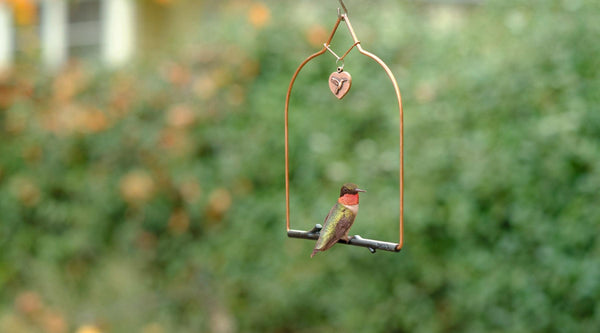
That's usually a resident claiming both the feeder and a nearby swing as its own guarded territory. A second feeder and a second swing, spaced out of sight of each other, gives another bird — the incoming migrant or a displaced resident — its own station to guard instead of fighting over one.
Shop a second swing →December
Winter residents only, and mainly on the coast.
| Coast | Rufous through the month, with Black-chinned and a few Ruby-throated alongside them. Buff-bellied is part of the same real Gulf Coast winter picture, documented by two separate decade-long banding studies, though it gets reported less often than the others. |
| Inland | Nothing. |
What to do: If you're keeping a winter feeder, report what turns up. Winter hummingbirds on the Gulf Coast are of genuine research interest, and females and young often can't be named without a licensed bander measuring them in the hand. Our winter hummingbird feeder care guide covers heated feeders and the two-feeder swap.
The Year at a Glance
| When | What |
|---|---|
| Early February | Feeders up on the Gulf Coast |
| Late February | First coastal arrivals |
| Early March | Feeders up inland |
| Mid-to-late March | First inland arrivals — Birmingham and Huntsville the same week |
| March – July | Nesting season; two to three broods possible |
| April | Coastal spring peak (real, but smaller than September's); Fort Morgan public banding and Coastal BirdFest |
| First weekend in August | Black Belt Birding Festival |
| September | Peak month statewide — including the coast's biggest week of the year |
| October – November | Sow wildflower seed |
| Two weeks after your last sighting | Feeders down inland — on the coast, consider leaving one up all winter |
Frequently Asked Questions
When do hummingbirds come back to Alabama?
The Gulf Coast sees its first Ruby-throated in late February, with numbers climbing hard into an April peak. Inland, Birmingham and Huntsville both get their first arrivals in the third week of March — the same week for both, which surprises people who expect Huntsville to run later.
When do hummingbirds leave Alabama?
Inland it ends fast: from about one in four birdwatchers reporting them in the first week of October to almost nothing by mid-October. The coast runs about a month behind and tapers more gradually, since a small number of birds stay through winter.
Why is the Gulf Coast busy in April but inland isn't?
They're running different patterns. The coast gets a real spring passage peak as birds arrive off the Gulf, cresting in the third week of April — then an even bigger peak in September, as birds stage for the return crossing. Inland, April is just the start of one long build that doesn't crest until September.
Are there hummingbirds in Alabama in winter?
On the Gulf Coast, yes — hummingbirds are reported around Mobile every week of December, January and February, and most of them are Rufous rather than Ruby-throated. Black-chinned and Calliope are both real, documented winter visitors too, each backed by over a decade of banding records. Inland, winter records barely register.
What month has the most hummingbirds in Alabama?
September, statewide — and specifically for the coast, this is its single busiest week of the entire year, ahead of its own April peak. Around Birmingham, about two of every three birdwatchers report one in the first week; the coast peaks in the third week.
How We Built This Calendar
Every arrival, departure and peak date on this page comes from ten years of eBird checklists (2016–2025) for Alabama as a whole and for three counties: Mobile for the Gulf Coast, Jefferson for central Alabama and Madison for the Tennessee Valley. We count a first arrival as the week sightings rise clearly and keep climbing, not a single early bird. One finding worth sharing: a decade-long banding study (Bassett & Cubie 2009) found Rufous, Buff-bellied, Calliope, Black-chinned and Ruby-throated all returning to the same winter sites in later years, but none of the three banded Anna's Hummingbirds came back, which is why Anna's is mentioned here rather than charted.
Sources
- eBird bar chart data, Cornell Lab of Ornithology — Alabama statewide plus Mobile, Jefferson, and Madison counties, 2016–2025. Source for all arrival, departure, peak, and species frequency figures.
- Alabama Department of Conservation and Natural Resources — Ruby-throated Hummingbird species account. Source for nesting dates, clutch size, incubation and fledging periods, brood count, and nest materials.
- des Lauriers, J. R. (1994). Hummingbirds eating ashes. The Auk, 111(3), 755–756. Documents five nesting female hummingbirds eating wood ash; no males were seen doing so in that study.
- Adam, M. D., & des Lauriers, J. R. (1998). Observations of hummingbirds ingesting mineral-rich compounds. Journal of Field Ornithology, 69, 257–261. Source for hummingbirds' greatly reduced medullary bone and for the mineral-rich materials they eat.
- Werning, S. (2018). Medullary bone is phylogenetically widespread and its skeletal distribution varies by taxon. Journal of Ornithology, 159, 527–543. Source for medullary bone being confirmed in hummingbirds.
- Zenzal, T. J., & Moore, F. R. (2016). Stopover biology of Ruby-throated Hummingbirds (Archilochus colubris) during autumn migration. The Auk, 133(2), 237–250. Source for Fort Morgan autumn staging and passage timing.
- Bassett, F., & Cubie, D. (2009). Wintering hummingbirds in Alabama and Florida. Journal of Field Ornithology, 80(2), 154–162. Source for the winter-visitor species list and the year-over-year return-rate findings.
- Bassett, F., & Dietrich, C. (2021). Alabama and Florida wintering hummingbirds: a second decade of banding data, 2008–2018. Wilson Journal of Ornithology, 133(1), 132–136. Independent confirmation of the winter-visitor pattern a decade later.
- Alabama Audubon event calendar — source for festival and public banding dates.
Event dates and formats change from year to year — Coastal BirdFest moved from a fall date to spring in 2026, after more than two decades in the fall. Check organizer websites before making plans.
Know before they arrive
You don't have to keep this calendar taped to the fridge. Insider Birding Access members get seasonal notes timed to your region — when to have feeders out, what the birds are doing right now, and what's worth doing in your yard this season. We take the guesswork out of the calendar. Joining takes about thirty seconds, and there's 10% off your first order in it.
Join Insider Birding Access →Free to join. 10% off your first order.
Shop Alabama's Hummingbird Favorites


Bethany Sloan has served as General Manager of Pop's Birding since 2010, continuing the legacy of her grandfather, William "Pops" Sloan, inventor of the Original Hummingbird Swing. A lifelong hummingbird enthusiast, educator, and independent researcher, she leads the company's educational content, including its 50-State Hummingbird Guide series, Regional Guide, Species Guide and Hummingbird Learning Center. Bethany combines scientific research, regional migration data, and more than 16 years of hands-on experience to create trusted educational resources for bird enthusiasts across North America.