Sep 02, 2026
Hummingbirds in Florida: The Complete Guide to All 12 Species
In late August 1971, a tiny hummingbird with a violet throat and a deeply forked tail showed up in a yard in Lantana, Palm Beach County, and stayed for seven weeks. Slides of it went to two of the era's leading ornithologists, James Bond and Frank Gill, and the record was published in The Auk as the first Bahama Woodstar ever confirmed in the United States. Three years later a second one turned up in Homestead. Then Florida waited forty-three years for the next. That's the shape of Florida's hummingbird list: one bird you can count on nearly everywhere, and a set of visitors — from the West, from the Gulf, from the Bahamas — that reward whoever happens to have a feeder up in the right place.
Twelve hummingbird species are on the Florida Ornithological Society's official state list — one fewer than Alabama and Georgia next door. But Florida has something the others don't: it's the state where Ruby-throated Hummingbird's year-round status is least ambiguous anywhere in its range, with Christmas Bird Counts logging hundreds of birds statewide in a single December. Three western species are regular enough winter visitors that the state's records committee doesn't review them, and the other eight range from a rarity banded every few winters in the Panhandle down to birds confirmed exactly once.
Free download
All 12 species, one page
Every Florida hummingbird with its status — from Ruby-throated, here every week of the year, down to four species with a single record each — sized 8.5" x 11" for easy reference and printing.
Download the Florida species guideOne page · PDF · free to print and share

All 12 documented Florida hummingbird species, grouped by tier — statewide eBird data, 2016–2025, cross-checked against the Florida Ornithological Society Records Committee's official state list and two decades of peer-reviewed winter banding research.
The Hummingbird You're Most Likely to See
Ruby-throated Hummingbird Resident
Florida's only widespread breeder and its only year-round resident — and the second half of that is what sets Florida apart. In most of the East, Ruby-throated is a summer bird. In Florida it's somewhere in the state every week of the year: Birds of the World and All About Birds both map south Florida as year-round range, and Audubon's Christmas Bird Counts bear it out, logging 364 birds statewide on the 122nd count and 349 on the 125th, with over a hundred in the Kendall area alone each time. The catch is that it's never everywhere at once. Around Pensacola it peaks at 44% of checklists in mid-September as birds stage for the Gulf crossing; around Miami it peaks in October and holds through winter; around Gainesville it peaks in July. Statewide the figure is a modest 11%, because south Florida's summer emptiness and the north's winter emptiness cancel each other out.

Quick ID: Adult males show an all-red iridescent throat that can look solid black without direct light, a green crown, and a forked black tail. Females and immatures are green above, plain white below, with white tips on the outer tail feathers. The real Florida look-alike is Black-chinned in winter: on Ruby-throated, the tail extends clearly past the folded wingtips at rest, while Black-chinned's wings reach almost to the tail tip. Anywhere south of the Panhandle, a hummingbird is almost certainly this one.

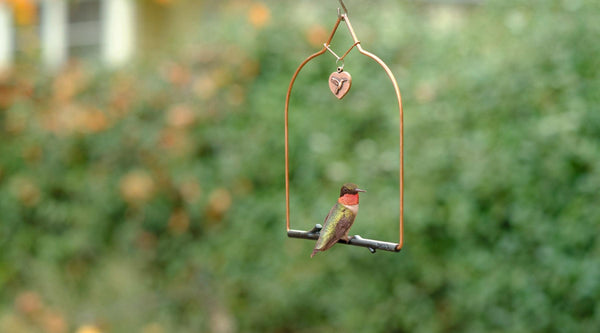
A Little Throne for Your Ruby-throated
Ruby-throated is Florida's only year-round resident, holding territory here in some part of the state every week of the year. Charm Redwood Swing gives your resident bird a real perch to do that from.
Shop Charm Redwood Swing →Florida's Real Winter Hummingbirds
Once Ruby-throated collapses out of the Panhandle in October, the north of the state doesn't go empty — it changes cast. Three western and Gulf species turn up reliably enough that the Florida Ornithological Society Records Committee doesn't ask for documentation when one appears, and two decades of banding research have physically confirmed them in the hand.
Rufous Hummingbird Migrant/Winter
The most common wintering hummingbird in the Panhandle by a wide margin. Bassett and Cubie's decade-long banding study across southern Alabama and northern Florida found Rufous made up 51.6% of the 1,598 hummingbirds they captured between 1998 and 2008; the follow-up study logged 931 Rufous across 2008–2018, 49% of all birds banded. It's not a review species — the Committee lists it as native with no review flag, its own way of saying the species occurs regularly. Around Pensacola it peaks at 2.6% of checklists in February; around Tallahassee and Gainesville, in late January and early February. Statewide it barely registers, because it's a north-Florida winter bird and nothing else.

Quick ID: Adult males are almost entirely orange-rufous with a glowing orange-red throat. Most Florida winter birds aren't adult males, though — females and immatures are green above with cinnamon-washed flanks and rufous at the base of the tail, which separates them from the grayish-flanked female Ruby-throated. They are not reliably separable from female Allen's in the field; the Committee's own reports say the two are told apart only by in-hand measurement.
Black-chinned Hummingbird Migrant/Winter
A regular but scarce winter visitor to the Panhandle and north-central Florida, and the one species on this list most likely to be overlooked — because it looks so much like the bird everyone expects. The Committee's official list carries no review flag for Black-chinned, while every other western hummingbird on Florida's list is flagged, which under the Committee's own convention makes it a regular visitor. North Florida sits inside the banding footprint that has confirmed it in the hand, including a banded Tallahassee bird documented in the Committee's 23rd report. Around Pensacola it peaks in early December, around Tallahassee and Gainesville in February.

Quick ID: Adult males show a throat that looks solid black in most light, with a thin iridescent purple band at the very base visible only in direct sun. Females and immatures are notoriously close to Ruby-throated — the most useful mark is that Black-chinned's folded wingtips reach nearly to the tail tip, while Ruby-throated's tail extends clearly beyond the wings. Black-chinned also pumps its tail almost constantly while hovering. In practice, north-Florida winter Archilochus are often settled only by a licensed bander.
Buff-bellied Hummingbird Migrant/Winter
The Gulf Coast's own hummingbird, and the one Florida winter visitor with a real seasonal peak you can see in the data. Around Pensacola it reaches 4.3% of checklists in late November — the strongest signal of any non-Ruby-throated species anywhere in the state — and it holds a modest winter presence as far south as Miami-Dade. The 2008–2018 banding study captured 49 of them, the fourth-most-banded species in that research, and one Pensacola-area bird was documented returning for seven consecutive winters. The Committee lists it as native with no review flag: a regular, expected visitor, not a stray.

Quick ID: A fairly large hummingbird with a warm buff belly, a rufous tail, and a bright red, black-tipped bill; the throat and upper breast are iridescent green in good light and look gray in shade. Sexes are similar. The red bill alone rules out every regular Florida species — the only other red-billed bird on this list is Broad-billed, which has a blue-green body instead of a buff belly.

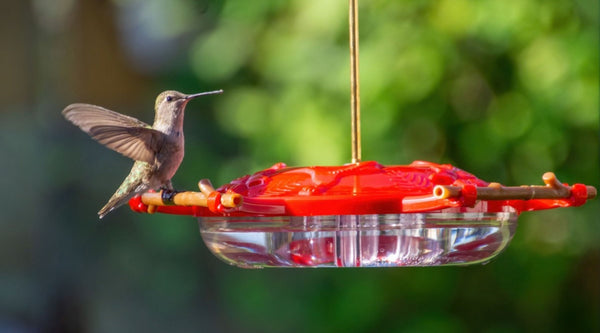
An Extra Feeder for Your Winter Visitors
Rufous, Black-chinned, and Buff-bellied all show up in the Panhandle looking for a station of their own once Ruby-throated thins out for the winter. AspenPerch Feeder gives your regular winter visitors somewhere to land without a fight.
Shop AspenPerch Feeder →Florida's Recurring Panhandle Rarities
Four more species turn up in the Panhandle often enough that the Committee's own report language describes a real, multi-year pattern rather than a one-off. Across ten years of eBird data, Tallahassee has recorded seven hummingbird species and Pensacola and Gainesville six each, and most of that traffic beyond Ruby-throated and the three winter regulars belongs to these four.
Allen's Hummingbird Rare / Casual Visitor
Six Committee-accepted records, and the Committee's own report language says it plainly: "In recent years at least, this species has been regular in the Florida panhandle in winter." The first Florida record came from Cedar Key; the rest cluster around Pensacola and Tallahassee, most of them banded — a hatch-year male in December 2002, adult females in December 2003, February 2004, and December 2004. The 2008–2018 banding study captured 19 more. Every one of those was confirmed in the hand, for a reason the next paragraph explains.

Quick ID: Adult males show a coppery-orange throat and rufous flanks with a solid green back, where most adult male Rufous show rufous on the back. Females and immatures are nearly identical to female Rufous — the Committee itself notes they're separable only by wing length and the width of the outer tail feather, measured in the hand. A female Selasphorus in Florida should be assumed to be Rufous unless a bander says otherwise.
Broad-billed Hummingbird Rare / Casual Visitor
Six accepted records spread across north Florida, from Escambia County east to Duval. The first was an adult male photographed at a Pensacola feeder in September 2004, described in the Committee's 15th report as a red-billed, blue-throated, green-bodied hummingbird with white undertail coverts and a dark, notched tail. By the 23rd report, covering a bird banded at Tallahassee in January 2013, the Committee was noting "five previous records of this species are known in Florida." The 2008–2018 banding study caught six — scarce, but recurring. Gainesville is where the eBird signal is strongest, peaking in mid-December.

Quick ID: The bright red, black-tipped bill is diagnostic in every plumage, and paired with a blue-green body it can't be confused with Buff-bellied's buff belly and rufous tail. Adult males add a shimmering blue throat; females are gray below with a white line curving behind the eye.
Broad-tailed Hummingbird Rare / Casual Visitor
Four accepted records, the fourth an adult male banded at Pensacola in December 2003 with a full red gorget and the attenuated outer primary that separates it in the hand. The Committee's 15th report attached a note that applies to this whole section: "Records of this species and other western hummingbirds increasing in Florida, especially in the panhandle." The 2008–2018 banding study caught 11 — more than the Committee's accepted-record tally, since not every banded bird becomes a submitted record. Around Tallahassee it registers faintly in January.

Quick ID: Adult males show a rose-magenta throat close enough to Ruby-throated's red to cause real confusion, but with a thin white eye-ring instead of Ruby-throated's dark cheek patch, and a high metallic wing-trill in flight. Females show cinnamon-colored outer tail feathers where a female Ruby-throated's are green and black, plus a longer tail that extends well past the wings.
Calliope Hummingbird Rare / Casual Visitor
The most frequently banded of Florida's review-list rarities, and still a review species — the Committee affirmatively re-added it under a newer, stricter standard of twenty accepted records over the previous ten years. Its 15th report enumerates roughly thirteen accepted records, concentrated in the Panhandle and north peninsula in winter, including two banded males at Tallahassee in 2003; the 2008–2018 banding study captured 49 across Florida and Alabama combined. Calliope peaks around Tallahassee in early December and around Gainesville in mid-January.

Quick ID: The smallest hummingbird in the United States, with a short tail that sits about level with the wingtips at rest. Adult males show magenta streaks radiating down a white throat rather than a solid gorget. Females are told from female Rufous by size, the short tail, very little rufous in the tail, and a pale buff wash spread evenly across the breast rather than concentrated on the flanks.

Make Your Sanctuary Worth a Detour
Allen's, Broad-billed, Broad-tailed, and Calliope all show up in the Panhandle with genuine multi-year records behind them. A real nectar recipe with electrolytes and calcium gives a hummingbird that's already come hundreds of miles off course a reason to stick around and get documented.
Shop Nectarlyte® Powder →If You're Lucky: Florida's Historic Rarities
The other four are genuine one-offs, or a cluster that ended decades ago — each with just one or a handful of accepted Florida records and nothing recent enough to call a pattern.
Anna's Hummingbird Historic / Accidental
A review species with very few Florida records — and the banding data shows how few. Across the entire 2008–2018 study, banders caught exactly one Anna's. For a species that is the most abundant hummingbird on the Pacific coast, that single capture in a decade of dedicated winter netting is as clear a signal of accidental status as Florida has.

Quick ID: The only North American hummingbird with an iridescent crown as well as throat — males glow rose-pink from the top of the head down, unlike anything else on Florida's list. Females are plump and short-billed with grayish-green flanks and usually a small red throat spot; against female Black-chinned, Anna's is stockier, dingier below, and holds its tail still where Black-chinned pumps it.
Bahama Woodstar Historic / Accidental
The one Florida rarity that comes from the east instead of the west. Three confirmable records: the Lantana bird of August–October 1971, published in The Auk as the first United States record; a bird at Homestead from April into June 1974, the second; and after a forty-three-year gap, one at Maritime Hammock Sanctuary in Brevard County in May 2017, covered in the Committee's 27th report. A Bahamian endemic, and the pattern — two records in the early 1970s, one in 2017, nothing since — reads as rare storm-assisted or wandering birds, not a population knocking at the door.
Quick ID: A small, long-tailed hummingbird, green above. Adult males show a glittering purple gorget and forehead, a white breast band below it, a rufous belly spangled with green, and a long, deeply forked tail that no other Florida hummingbird shares. Females lack the purple throat and are much harder to call — a small, long-tailed, buffy-bellied hummingbird on Florida's Atlantic coast that doesn't resolve as a female Ruby-throated is worth careful photographs, because the Committee will need them.

Costa's Hummingbird Historic / Accidental
One accepted record, and a thoroughly documented one: an adult male banded, measured, and photographed in the hand by Fred Dietrich in a Tallahassee yard on December 13, 2012, with a confirming photograph the next day. The Committee's 23rd report called it "the first of this species for Florida." The 2008–2018 banding study recorded exactly one Costa's — that bird — and nothing has been confirmed since.

Quick ID: Adult males are unmistakable — a violet-purple crown and a gorget that flares out past the sides of the neck like a mustache. Females are small, short-tailed, and whiter-bellied than any regular Florida species, with a faint pale eyebrow and a slightly droopy bill; about half show a small purple throat patch. Size and that pale belly separate them from female Black-chinned, the species they'd most likely be mistaken for at a north-Florida winter feeder.
White-eared Hummingbird Historic / Accidental
Florida's most thinly documented hummingbird. It's on the Committee's official state list as a review species — added sometime after the 2006 list, which didn't include it — and the 2008–2018 banding study documented exactly one within its study window, the sole Florida occurrence. The Committee's numbered record for it wasn't locatable in the published archive, so this page can confirm the species is accepted and roughly when it occurred, but not the county or the exact date. A real record, honestly limited.

Quick ID: A bold white stripe behind the eye against a mostly green body, with a red bill tipped in black. Adult males add a violet-blue crown and throat that make the white ear stripe stand out even more. The red bill puts it in the same small group as Buff-bellied and Broad-billed; the white ear stripe separates it from both.

Give Every Visitor a Reason to Stay
Whether it's Florida's next Costa's or Anna's, or just a hungry migrant passing through, real nectar sources are what turn a passerby into a repeat visitor. Wildflower Seed gives any hummingbird — common or exceptionally rare — a reason to stay.
Shop Wildflower Seed →Florida Hummingbirds at a Glance
One species accounts for nearly all of Florida's hummingbird activity, and even it looks modest statewide: Ruby-throated peaks at 11% of statewide checklists — 44% around Pensacola — while every other confirmed species tops out under a quarter of a percent at the statewide scale. That gap is too wide for a shared bar chart to show anything useful, so here's the same information as a table instead. The winter visitors' real signal is regional, and the Florida hummingbird calendar charts them at their true, county-level scale.
| Species | Status | Florida Records |
|---|---|---|
| Ruby-throated Hummingbird | Year-Round Resident | Present every week of the year somewhere in the state; 44% of Pensacola checklists in September; 364 on the 122nd Christmas Bird Count |
| Rufous Hummingbird | Migrant / Winter Visitor | Not a review species; about half of all birds banded in two decades of AL/FL winter research |
| Black-chinned Hummingbird | Migrant / Winter Visitor | Not a review species; regular Panhandle and north-central winter visitor, confirmed by banding |
| Buff-bellied Hummingbird | Migrant / Winter Visitor | Not a review species; 49 banded 2008–2018, one returning seven consecutive winters; peaks 4.3% at Pensacola in November |
| Allen's Hummingbird | Rare / Casual | 6 accepted records; "regular in the Florida panhandle in winter" per FOSRC; 19 banded 2008–2018 |
| Broad-billed Hummingbird | Rare / Casual | 6 accepted records, Escambia to Duval, first 2004; 6 banded 2008–2018 |
| Broad-tailed Hummingbird | Rare / Casual | 4 accepted records, Panhandle winters; 11 banded 2008–2018 |
| Calliope Hummingbird | Rare / Casual | About 13 accepted records, still a review species; 49 banded 2008–2018 (FL and AL combined) |
| Anna's Hummingbird | Historic / Accidental | Review species; 1 banded in a decade of winter research |
| Bahama Woodstar | Historic / Accidental | 3 records — Lantana 1971 (first US record), Homestead 1974, Brevard County 2017 |
| Costa's Hummingbird | Historic / Accidental | 1 accepted record — Tallahassee, December 2012, banded |
| White-eared Hummingbird | Historic / Accidental | Review species; 1 documented occurrence, 2008–2018 banding window |
Frequently Asked Questions
How many kinds of hummingbirds have been documented in Florida?
Twelve, all on the Florida Ornithological Society Records Committee's official state list. One, Ruby-throated Hummingbird, is a year-round resident; three western and Gulf species — Rufous, Black-chinned, and Buff-bellied — are regular winter visitors; and the remaining eight range from a rarity banded every few winters in the Panhandle down to birds confirmed exactly once.
What is the most common hummingbird in Florida?
Ruby-throated Hummingbird, everywhere in the state — but how common depends on where and when. It's reported on 44% of Pensacola checklists in mid-September and only 11% statewide, because the Panhandle and south Florida run opposite seasons and average each other out. Outside the Panhandle and north peninsula, it's effectively the only hummingbird you'll see.
Which Florida hummingbird is easiest to identify?
Buff-bellied Hummingbird. A bright red bill tipped in black, a buff belly, and a rufous tail — none of Florida's regular species shows a red bill, so a red-billed hummingbird at a Panhandle feeder in November is almost certainly this one. The only other red-billed species on the state list, Broad-billed and White-eared, are far rarer and have green bodies rather than buff bellies.
How do I tell a Black-chinned from a Ruby-throated Hummingbird in Florida?
In good light, the throat — Ruby-throated's is red, Black-chinned's is black with a thin purple band at the bottom. The problem is that both look solid black in shade, and females and immatures are close to inseparable. The most useful mark is wing length: Black-chinned's folded wingtips reach nearly to the tail tip, while Ruby-throated's tail extends clearly past the wings. Season helps — Black-chinned is a winter bird in the Panhandle, and many north-Florida winter Archilochus are only settled by a licensed bander.
Have western species like Costa's or Anna's ever been recorded in Florida?
Yes, but barely. Costa's has exactly one accepted Florida record, an adult male banded in a Tallahassee yard in December 2012. Anna's is a review species with very few records — across an entire decade of dedicated winter banding in Florida and Alabama, exactly one was caught. Both are genuine accidentals, not something to expect.
Why We Created This Guide
Pop's Birding has been helping hummingbird lovers for three generations. One of the questions our customers ask most often is "what hummingbirds are actually in my state?" — we built this guide to give a direct, sourced answer for Florida specifically, not a generic one. Most identification content treats Florida as a one-species state with a few strays, and that misses what's distinctive here: a year-round resident whose winter presence is measured in the hundreds, three winter visitors confirmed in the hand by two decades of published banding research, and a rarity list that includes the first United States records of a Bahamian species. Which of those you'll see depends almost entirely on whether you're north or south of the Suwannee, and this page is built to make that call.
How We Created This Guide
We started with statewide eBird bar chart data from the Cornell Lab of Ornithology, covering 2016 through 2025, then added six counties that represent Florida's regions — the Panhandle's Escambia, Tallahassee's Leon, the north peninsula's Alachua, central Florida's Orange, Miami-Dade in the south, and the Keys' Monroe. Since checklist data alone can't always tell a real pattern from a single well-publicized bird — Bahama Woodstar's one 2017 individual produced a statewide blip larger than several genuine regular visitors — we checked every species against the Florida Ornithological Society Records Committee's Official State List and its numbered reports in Florida Field Naturalist, plus two peer-reviewed winter-hummingbird banding studies. The banding data turned out to be the clearest signal of all: 931 Rufous Hummingbirds banded against just one Anna's in the same decade of netting is the real difference between a winter visitor and an accidental. Ruby-throated dominates Florida's checklists so completely that a shared-scale chart would show one bar and eleven slivers, so we say that plainly here and give every other species its real record count instead.
Sources
- eBird bar chart data, Cornell Lab of Ornithology — Florida statewide plus Escambia, Leon, Alachua, Orange, Miami-Dade, and Monroe counties, 2016–2025.
- Florida Ornithological Society Records Committee, Official State List (July 2024) — source for all 12 species and their review-list status.
- Bowman, R. (2006). Fifteenth Report of the Florida Ornithological Society Records Committee. Florida Field Naturalist 34(3):69–102. Source for the Allen's, Broad-billed, Broad-tailed, and Calliope record histories.
- Greenlaw, J. S. (2015). Twenty-third Report of the Florida Ornithological Society Records Committee. Florida Field Naturalist 43(1):19–36. Source for the Costa's and 2013 Broad-billed records.
- Kratter, A. W. (2018). Twenty-seventh Report of the Florida Ornithological Society Records Committee. Florida Field Naturalist 46(4):96–117. Source for the 2017 Bahama Woodstar record and Calliope's re-affirmed review status.
- Langridge, H. P. & Sykes, P. W. (1974). Record confirmed of Bahama Woodstar in Florida. The Auk 91(4):849. Source for the first United States record.
- Fisk, E. J. (1974). Second U.S. record of a Bahama Woodstar. American Birds 28(4):855.
- Bassett, F. & Cubie, D. (2009). Wintering hummingbirds in Alabama and Florida. Journal of Field Ornithology 80(2):154–162.
- Bassett, F. & Dietrich, F. (2021). A second decade of overwintering hummingbirds in Florida and Alabama. Wilson Journal of Ornithology 133(1):132–136.
- Audubon Christmas Bird Count, 122nd and 125th counts — Ruby-throated winter totals.
Know before they arrive
You don't have to keep this calendar taped to the fridge. Insider Birding Access members get seasonal notes timed to your region — when to have feeders out, what the birds are doing right now, and what's worth doing in your yard this season. We take the guesswork out of the calendar. Joining takes about thirty seconds, and there's 10% off your first order in it.
Join Insider Birding Access →Free to join. 10% off your first order.
Shop Florida's Hummingbird Favorites


Bethany Sloan has served as General Manager of Pop's Birding since 2010, continuing the legacy of her grandfather, William "Pops" Sloan, inventor of the Original Hummingbird Swing. A lifelong hummingbird enthusiast, educator, and independent researcher, she leads the company's educational content, including its 50-State Hummingbird Guide series, Regional Guide, Species Guide and Hummingbird Learning Center. Bethany combines scientific research, regional migration data, and more than 16 years of hands-on experience to create trusted educational resources for bird enthusiasts across North America.