Jul 14, 2026
How to Attract Hummingbirds in Florida: A Backyard Sanctuary Guide
In January 2010, a bander named Fred Dietrich caught a young female Rufous Hummingbird in a Tallahassee backyard, fitted her with a numbered band, and let her go. Six months later she was caught again — at Chenega Bay, Alaska, 3,530 miles away. It remains the longest hummingbird migration ever documented, and it started in a Florida garden in the middle of winter, at a feeder somebody had decided not to take down.
Whether you're gardening in Pensacola, Gainesville, Orlando, Miami, or the Keys, this guide will walk you through everything you need to turn your space into a Florida hummingbird destination: who's around and when, how to size your setup to any space, feeder and nectar care, pest-safe cleaning, and the native plants and wildflower seed varieties that thrive in Florida's climate.
The short version, if you're in a hurry:
To attract hummingbirds in Florida, keep a leak-proof feeder up year-round filled with fresh, dye-free nectar, change it every one to two days through the long hot season, skip the insecticide so hummingbirds can still hunt insects for protein, and plant native, nectar-rich flowers like firebush, coral honeysuckle, and tropical sage.
But the single most useful thing to know about Florida is this: the north and south halves of the state run opposite seasons. Around Gainesville, hummingbirds peak in July and August and all but vanish in midwinter. Around Miami, they're gone entirely in June and July and at their busiest from October through February. Which advice applies to you depends entirely on where you live.
- Best feeder type: leak-proof design with a comfort perch, like the AspenPerch® Hummingbird Feeder
- Best nectar: plain 4:1 water-to-sugar ratio, no red dye — or Pop's Nectar with added electrolytes and calcium
- North Florida: busiest July through September; feeders up by late February
- South Florida and the Keys: busiest October through February; empty in summer
- Where the rarities are: the Panhandle, overwhelmingly. Tallahassee has recorded seven species; the Keys have recorded one.
- Nectar change frequency: every 1–2 days above 90°F, which covers much of the Florida year
- Pest control: no insecticide — use vinegar-water spray and HummGuard® nectar tips instead
- Top native plants: firebush, coral honeysuckle, tropical sage, red buckeye, coralbean
- Five to avoid: lantana, Mexican petunia, flame vine, Japanese honeysuckle and non-native firebush are all sold as hummingbird plants and all cause problems in Florida
Free download
Take Florida with you
Everything on this page on one page you can print and keep by the back door — species, timing by region, feeder care, and the best native plants for your part of Florida.
Download the Florida cheat sheetOne page · PDF · free to print and share
Which Hummingbirds You'll See in Florida

Twelve hummingbird species appear on the Florida Ornithological Society's official state list, but only one nests here in any numbers, and the rest are concentrated overwhelmingly in the north — Tallahassee has recorded seven species, Key West just one. Ruby-throated Hummingbird is the state's only widespread breeder, and unlike most states it's present somewhere in Florida every week of the year — it just moves, breeding in the Panhandle and north peninsula in summer and wintering in the south. Rufous Hummingbird is the most frequently captured wintering species in two decades of Gulf Coast banding studies, at roughly half of all birds caught, mostly at Panhandle feeders from late autumn through winter. Black-chinned Hummingbird is the third most frequently captured wintering species — rare but regular, and almost exclusively a Panhandle bird. Buff-bellied Hummingbird, the largest hummingbird most Florida gardeners will ever see, arrives in the western Panhandle each October and peaks in late November. Beyond those four, eight more species round out the state list — Anna's, Allen's, Broad-billed, Broad-tailed, Calliope, Costa's, White-eared, and the Caribbean-origin Bahama Woodstar, whose first-ever U.S. record came from Lantana, Florida, in 1971. A shot at any of these means being north of the Suwannee with a feeder up in December.
For full identification help — photos, field marks, and how to tell Rufous and Allen's apart — see our complete Hummingbirds in Florida species guide.
When Do Hummingbirds Arrive and Leave Florida?
Florida runs two hummingbird seasons, not one, and they're on opposite schedules. Around Gainesville and the rest of North Florida, hummingbirds peak in July and August and go quiet from December through February. Around Miami and the south, it's the reverse — nothing at all from May through August, then numbers climb through fall to a winter peak. The split traces back to two different migration routes: the western Panhandle is a staging ground for a nonstop Gulf of Mexico crossing, peaking earliest in mid-September, while the peninsula runs a separate, later route south toward Cuba. Wherever you are, hummingbirds are somewhere in Florida every week of the year — just not always in your part of it.
Hummingbirds by Region
| Region | Busiest | Quietest | Species |
|---|---|---|---|
|
Western Panhandle (Pensacola) |
September — the biggest peak in the state | November–February | 6 |
|
Central Panhandle (Tallahassee) |
September | Winter, but never empty | 7 — the most in Florida |
|
North Peninsula (Gainesville, Jacksonville) |
July–August — the breeding stronghold | December–February | 6 |
|
Central (Orlando, Tampa) |
October | Late spring | 2 |
|
South Florida (Miami, Naples) |
October–February | May–August — genuinely none | 3 |
|
The Keys (Key West, Marathon) |
April — a spring stopover | June–August — none | 1 |
Derived from eBird bar chart data (Cornell Lab of Ornithology), 2016–2025, for Escambia, Leon, Alachua, Orange, Miami-Dade and Monroe counties, cross-checked against University of Florida IFAS Extension and Florida Fish and Wildlife Conservation Commission guidance.
Want the full picture? Our Florida hummingbird season calendar breaks the year down month by month and region by region.
When to Put Your Feeder Up (and Take It Down)
🗓️ Feeder Timing at a Glance
Panhandle and north peninsula: feeders up by late February for the first spring arrivals. Leave one up through winter if you want a shot at a Rufous or Buff-bellied — this is the only part of Florida where that's realistic.
Central Florida: year-round. Numbers are modest but never nothing.
South Florida and the Keys: the season that matters runs October through April. Leave the feeder up anyway — it costs nothing, and the alternative is missing the start of it.
And to settle a persistent myth: leaving a feeder up does not delay migration. Hummingbirds move on day length and hormonal cycles, not food supply. A late feeder simply helps the stragglers.
Attracting Hummingbirds No Matter Your Space
You don't need acres of land to invite wonder into your yard. Hummingbirds are famously adaptable — all they're really looking for is a dependable food source, a safe place to perch, and a little color.

Small Patio or Balcony
One feeder hung from a bracket or shepherd's hook, paired with a container of red or orange tubular blooms like tropical sage, is plenty to get noticed. Hummingbirds are solitary feeders by nature, so a single feeder works great in tight spaces. We put together a guide to which hummingbird products work best on a small patio or balcony if space is tight.
Average Backyard
Add a mix of feeders and native blooms along a fence line or garden bed, and give your visitors a swing or two nearby to rest and survey their territory between sips.
Large Yard with Trees
Take advantage of the shade, and aim for layers — groundcover, shrubs, and canopy. A layered yard gives hummingbirds nectar at different heights, nesting cover, and the perches they spend a large share of the day using. Spread multiple feeders far apart, since hummingbirds are territorial and will happily chase each other off a single feeder.
Choose a Leak-Proof Feeder
A feeder is only as good as what's in it — and how well it's kept. A leaky feeder does more than waste nectar: it can attract ants, bees, and other pests, turning your sanctuary into a mess that can deter hummingbirds.
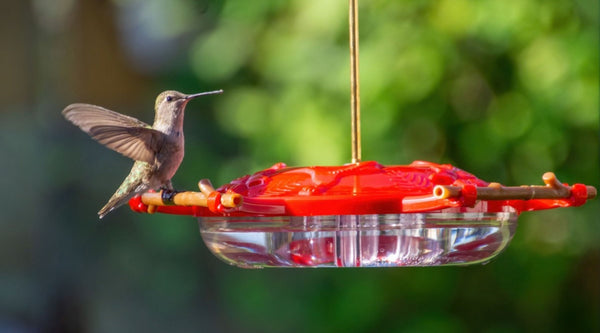
Pop's AspenPerch® feeder is leak-proof by design and paired with our patented Polyperch® comfort perch, so your hummingbirds can rest and feed at the same time instead of hovering the whole meal.
Shop the feeder
AspenPerch® Hummingbird Feeder, 8 oz

Leak-proof by design, with a patented Polyperch® comfort perch built in — so your hummingbirds can rest and feed at the same time instead of hovering through the whole meal. You get to see their tongue in action versus their back!
Shop the AspenPerch® Feeder →Keep Feeders Clean with Fresh Nectar
Clean your feeder every time you change the nectar, using hot water and a bottle brush — no soap residue, no bleach. Diluted white vinegar works well for breaking down sticky buildup or the beginnings of mold, and if you see black mold, scrub it out thoroughly rather than just rinsing. Our practical guide to cleaning hummingbird feeders walks through the whole routine.
Skip the Red Dye
Your feeder's color does the attracting. University of Florida IFAS Extension also warns against honey and sugar substitutes, which can be harmful.
Use a Real Nectar Recipe
Use a 4:1 plain sugar-water ratio to make your hummingbird nectar, or save yourself the math with Pop's Nectar, formulated with added electrolytes and calcium to support hummingbirds through the demands of nesting season and migration — no dyes, no preservatives.
Only Fill Enough to Change Often
An 8 oz feeder rarely needs to be topped all the way off — overfilling just means more nectar sitting around long enough to spoil, especially in Florida's intense, prolonged heat.

Just getting your first feeder going? Nectarade® Ready to Use Liquid comes pre-mixed and ready to pour — no measuring, no mixing — a low-commitment way to get started before Florida's own long, hot season tells you whether you need more.
Shop the Ready to Use Nectar →How Often to Change Nectar in Florida
Florida regularly sees temperatures above 90°F for much of the year, so nectar spoils fast for long stretches:
| Outdoor Temp | Change Nectar Every |
|---|---|
| Below 70°F | 5–6 days |
| 70–80°F | 3–4 days |
| 80–90°F | 2–3 days |
| Above 90°F | 1–2 days |
Above 90°F, nectar can spoil within a day, so plan on changing it daily through peak summer. A smaller feeder placed in shade slows the process down. Our full guide to how often to change hummingbird nectar covers the reasoning in more depth.
Keeping Feeders Pest-Free Without Insecticide
Hummingbirds don't live on nectar alone — small insects make up a big part of their protein diet, especially for feeding chicks. That means insect spray is off the table around your feeding station; it removes a food source hummingbirds depend on and can be harmful to them directly.
Ants
Deter ants with a vinegar-water spray around (not on) the feeder ports, or wipe down the hanging hook where ants tend to march down. For the full set of options, see our guide to keeping ants away from hummingbird feeders.
Bees and Wasps
Bees and wasps are trickier than ants, since they're after the same nectar hummingbirds are drinking, not just what's spilled. A vinegar-water spray around the ports can help, but the more reliable fix is a feeder design that keeps them out entirely.

Still crashing the party? HummGuard® Nectar Tips slide right onto the AspenPerch's feeding ports — the flexible membrane opens easily for a hummingbird's beak but closes tight against anything bigger, keeping your nectar exclusively for the birds it's meant for.
Shop HummGuard® Tips →Plant a Florida Native Hummingbird Garden
Feeders are a wonderful supplement, but nothing beats real, native nectar. Native plants evolved right alongside Florida's hummingbirds, so they bloom on the right schedule and produce exactly the nectar these birds are looking for.
Best Native Nectar Plants for Florida
| Plant | Why It Works |
|---|---|
|
Firebush (Hamelia patens var. patens) |
Red-orange tubular flowers from late spring until frost, and almost year-round in frost-free areas. Buy the native variety specifically — see the warning below. |
|
Coral honeysuckle (Lonicera sempervirens) |
A native vine with long-blooming tubular flowers, and UF/IFAS's own recommended replacement for invasive Japanese honeysuckle |
|
Tropical sage (Salvia coccinea) |
Blooms almost any time of year in the warmer parts of the state, and reseeds itself |
|
Coralbean and red buckeye (Erythrina herbacea, Aesculus pavia) |
Early-season bloomers timed to the first spring arrivals in north Florida |
|
Cardinal flower and standing cypress (Lobelia cardinalis, Ipomopsis rubra) |
Cardinal flower for moist spots in north and central Florida; standing cypress for drier, sandier sites |
|
Blue porterweed and buttonsage (Stachytarpheta jamaicensis, Lantana involucrata) |
Tough south Florida and coastal natives — and buttonsage is the native lantana worth planting |
Pop's tip: Ruby-throated Hummingbirds are especially drawn to red or orange blossoms held at least two feet above the ground — worth keeping in mind when deciding where to place taller plants like firebush or coral honeysuckle versus low groundcovers.
Five Widely Recommended Plants to Avoid in Florida
These all come up constantly in hummingbird and pollinator planting advice, and several of them genuinely do attract hummingbirds. That's precisely the problem — they get recommended for exactly that reason. All five are flagged by the University of Florida IFAS Assessment or the Florida Exotic Pest Plant Council.
Common lantana (Lantana camara) is the big one. UF/IFAS lists it as a Category 1 invasive, partly because it hybridises with Florida's own native lantana and threatens it genetically. You can tell them apart by the leaf base: the native has a tapered base, the invasive a squared-off one. If you want lantana, plant the native Lantana depressa or L. involucrata, or one of the sterile UF-bred cultivars such as 'Bloomify Red'.
Mexican petunia (Ruellia simplex) is another Category 1 invasive, and UF/IFAS is blunt that it displaces natives and alters wetland plant communities. Sterile cultivars exist; the wild type does not belong in a Florida garden.
Flame vine (Pyrostegia venusta) is sold precisely because its orange tubular flowers attract hummingbirds. UF/IFAS rates it a high invasion risk and notes it smothers other vegetation as it climbs.
Japanese honeysuckle (Lonicera japonica) is prohibited in Florida. UF/IFAS's own recommended replacement is coral honeysuckle — a native, equally good for hummingbirds, and already in the table above.
Non-native firebush. Native firebush is excellent. But the widely sold "African", "dwarf" or "compact" firebush is a different variety, Hamelia patens var. glabra, which hybridises with the native. Ask for var. patens by name.
If You're Near the Border
Hummingbirds don't check a map before deciding where to feed, so if you're near a state line, your best guide might be a blend of both.
Near Georgia: Georgia's "second hummingbird season" winter phenomenon extends directly into Florida's Panhandle and north Florida. See our Georgia hummingbird guide for more.
Near Alabama: The western Panhandle shares Alabama's Gulf Coast staging pattern almost exactly — same September peak, same trans-Gulf crossing, and the winter banding research that underpins both guides was carried out across the two states together. See our Alabama hummingbird guide for more.
To make this easy, our Perfect Little Sanctuary® Wildflower Seed Blend is designed to bring nectar-rich color into your yard with minimal fuss.
When to Plant the Perfect Little Sanctuary® Blend in Florida

Fall through early winter is the best planting window in North and Central Florida — aim for October through November, taking advantage of the state's cooler, drier season and avoiding peak hurricane season. This timing is based on the germination needs of the blend's own 12 varieties, though it comes with a real caveat for Florida: 9 of the 12 either need or benefit from a cold, moist stratification period, and much of Florida rarely gets the sustained cold that triggers it. Expect more uneven germination here than in states with real winters, and treat Florida's own native plants as the more dependable long-term investment.

Ready to plant? Perfect Little Sanctuary® Wildflower Seed Blend packs all 12 varieties into one packet — sown right in Florida's own fall-through-early-winter window, with no separate shopping trips.
Shop the Seed →Top Performers in Florida
- Lance-Leaved Coreopsis (Coreopsis lanceolata) — native, and one of the more reliable performers even without a hard winter
- Black-Eyed Susan (Rudbeckia hirta) — native, with a Florida-adapted variety that handles the state's conditions well
- Purple Coneflower (Echinacea purpurea) — native to the Panhandle, and noticeably more reliable in North Florida than further south
- Perennial Lupine (Lupinus perennis) — native, though its natural Florida range only reaches the northern part of the state
- Indian Blanket (Gaillardia pulchella) — not originally a Florida native, but long naturalized along the state's sandy coasts and highly heat and drought tolerant
- White Yarrow (Achillea millefolium) — broadly naturalized rather than native, and better suited to North Florida than the deep subtropical south
Pop's tip: Sow the blend as directed and it will do its job. But Florida's own natives — firebush, coral honeysuckle, tropical sage — are better adapted and will outperform it over time.
Give Them a Place to Rest
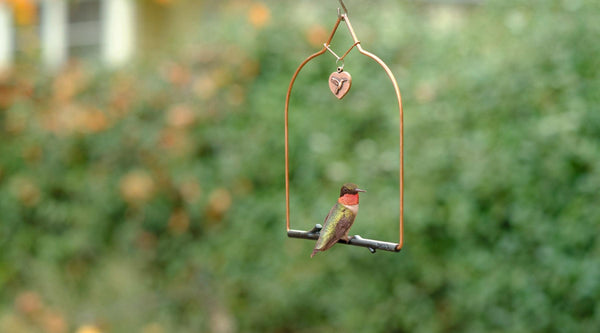
Hummingbirds spend a surprising amount of their day perched, not flying — watching their territory, digesting, and simply resting between feedings. A Pop's Original Hummingbird Swing hung near your feeder gives them exactly that spot, and it turns your feeding station into a front-row seat for watching them up close. Hang it about 1 foot from your feeder, at the same height (Pop's rule of thumb), and don't be surprised if a hummingbird claims it as their own personal lookout post. Our guide to where to hang your hummingbird swing covers placement in more detail.
Shop the Perfect Perch
Original Series Hummingbird Swing, Onyx

Wherever you are in Florida, a swing near your feeder gives an arriving Rufous or Buff-bellied Hummingbird its own spot to perch and defend — calmer territory disputes, and a better view of the bird for you.
Shop the Original Swing →Keep Your Sanctuary Safe from Predators
A feeding station draws more than hummingbirds, and knowing what's actually worth worrying about — and what isn't — makes for a safer yard. Cats and window strikes are the two best-documented threats to hummingbirds around any home. See our full Hummingbird Predators guide for the complete picture.
A less common threat worth knowing about in Florida specifically: peer-reviewed research documents praying mantises capturing hummingbirds at feeders in a small number of well-documented U.S. cases, Ruby-throated included — genuinely rare, but real wherever mantises are established, which in Florida includes the large, non-native Chinese mantis found across much of the state. See our full guide to praying mantises and hummingbirds for what to actually watch for and when.
Summary: Key Takeaways for Attracting Hummingbirds in Florida
Building a hummingbird-friendly yard doesn't take a green thumb or a big budget — just a little consistency and the right setup. Here's everything from this guide in one place:
- North and South Florida run opposite seasons. Gainesville peaks in July and August; Miami is empty then and busiest from October through February.
- Hummingbirds are somewhere in Florida every week of the year — but not everywhere at once.
- Twelve species are on the official Florida list, but they are concentrated in the north. Tallahassee has recorded seven; the Florida Keys have recorded one.
- The western Panhandle is a Gulf staging ground with the state's biggest September peak; the peninsula is a separate, later route toward Cuba.
- Ruby-throated is the only widespread breeder, nesting mainly in the Panhandle and north peninsula from April onward.
- Rufous, Black-chinned and Buff-bellied are the regular winter visitors — and almost exclusively Panhandle birds.
- Feeder timing: late February in the north; year-round everywhere, since it costs nothing and the southern season starts in autumn.
- Any size space works — one feeder is plenty for a balcony; larger yards can support multiple feeders spaced apart.
- Skip red dye and never use honey; a plain 4:1 sugar-water ratio or Pop's Nectar both work.
- Change nectar daily above 90°F, and clean with hot water and diluted vinegar — no soap or bleach.
- Never use insecticide near feeders; hummingbirds rely on insects for protein. Use vinegar-water spray and HummGuard® nectar tips for pest control instead.
- Add a swing near the feeder to give hummingbirds a place to rest and be observed up close.
- Plant native firebush, coral honeysuckle and tropical sage. Avoid common lantana, Mexican petunia, flame vine, Japanese honeysuckle and non-native firebush — all five are sold as pollinator plants and all are flagged by UF/IFAS.
- Sow wildflower seed in October–November in North and Central Florida.
- Cats and window strikes are the two best-documented predator threats; Florida's own established Chinese mantis population is a smaller, less common risk worth an occasional glance.
Get these basics in place, and the wonder takes care of itself.
This guide covers what's specific to Florida — the species, the timing, the plants that belong here. For the fundamentals that apply anywhere, including water sources, shelter, and how the pieces work together, read our guide to building the ultimate hummingbird sanctuary.
Frequently Asked Questions
A few of the questions we hear most from fellow hummingbird lovers across Florida:
When should I put my hummingbird feeder out in Florida?
In the Panhandle and north peninsula, by late February for the first spring arrivals. In central and south Florida, the honest answer is to leave one up all year — it costs almost nothing, and the southern season begins in autumn when most people have stopped paying attention.
Why is my Florida feeder empty all summer?
If you live south of Orlando, that's normal. Ruby-throated Hummingbirds are essentially absent from South Florida and the Keys from May through August. They return in September, peak in October, and stay through the winter. In North Florida the pattern is reversed — summer is the busy season there.
Is it bad to leave my feeder up in fall or winter?
Not at all — it's a myth that a feeder left up will delay migration. Hummingbirds migrate on day length and hormonal cycles, not food availability. In the Panhandle and north peninsula specifically, keeping a feeder up into winter is your best shot at Rufous or Buff-bellied Hummingbirds, both regular cold-season visitors there.
Do hummingbirds stay in Florida year-round?
Somewhere in Florida, yes — but not in one place. The birds move from the north of the state in summer to the south in winter, so any given garden has an off-season even though the state as a whole doesn't.
What is the rarest hummingbird recorded in Florida?
The Bahama Woodstar, a Caribbean species. The first United States record came from Lantana, Florida, in 1971, and of the handful of records since, all but one have been Florida birds.
What plants should I avoid planting for hummingbirds in Florida?
Common lantana, Mexican petunia, flame vine, Japanese honeysuckle, and the non-native "African" firebush. All five are sold widely, several are marketed specifically as hummingbird plants, and all are flagged as invasive or prohibited by University of Florida IFAS. Native alternatives — coral honeysuckle, native firebush, buttonsage — do the same job without the harm.
Florida Hummingbird Resources
Audubon Chapters
Florida is home to numerous local Audubon chapters across the state. Find the one closest to you with Audubon's Find Your Local Audubon tool.
If You Find an Injured or Grounded Hummingbird
Hummingbirds are protected under federal and Florida state law, so only a licensed wildlife rehabilitator can legally care for one.
- FWC — Licensed Wildlife Rehabilitators List — the official statewide directory by county (Wildlife Alert Hotline: 1-888-404-3922)
- Florida Wildlife Rehabilitators Association — an interactive map of licensed rehabilitators statewide
- CROW (Clinic for the Rehabilitation of Wildlife) (Sanibel Island) — a well-established wildlife hospital treating sick and injured native species
Hummingbird Research & Banding in Florida
- Hummingbird Research, Inc., led by master banders Fred Bassett and Fred Dietrich, has run long-term published research on hummingbirds wintering in Florida and southern Alabama since the late 1990s. Across two decades of banding they have documented eleven species wintering in the region — most of which field guides don't show as occurring in the Southeast at all.
- The Rufous Hummingbird in this guide's opening was banded by Fred Dietrich in Tallahassee in January 2010 and recaptured at Chenega Bay, Alaska, six months later — 3,530 miles away, and still the longest hummingbird migration ever documented.
- Fred Bassett or Fred Dietrich speak most Januaries at Native Nurseries in Tallahassee about the current winter banding season.
Sources
- eBird bar chart data, Cornell Lab of Ornithology — Florida statewide plus Escambia, Leon, Alachua, Orange, Miami-Dade and Monroe counties, 2016–2025.
- Florida Ornithological Society Records Committee — Official State List.
- University of Florida IFAS Extension — Hummingbirds of Florida (WEC21/UW059).
- UF/IFAS Gardening Solutions — Invasive Vines of Florida. Source for Japanese honeysuckle and flame vine.
- UF/IFAS — Lantana camara and sterile cultivars. Source for the Category 1 listing and hybridization with native lantana.
- Bassett, F., & Cubie, D. (2009). Wintering hummingbirds in Alabama and Florida. Journal of Field Ornithology, 80(2), 154–162.
- Bassett, F., & Dietrich, F. (2021). A second decade of overwintering hummingbirds in Florida and Alabama. The Wilson Journal of Ornithology, 133(1), 132–136. doi:10.1676/20-00063
- Langridge, H. P., & Sykes, P. W. (1974). Bahama Woodstar in Florida. The Auk, 91(4), 849.
Haven't grabbed it yet? Download the free Florida Quick Reference Guide — one page, print and keep.
Why We Built This Guide
Pop's Birding has been helping hummingbird lovers for three generations. One of the questions our customers ask most often is "How do I actually attract more hummingbirds to my yard?" — we built this guide to give a direct, practical answer, not a generic one. Most feeder advice online is the same handful of tips repeated regardless of where you live, but a single statewide season is genuinely wrong for Florida — the north peaks in summer while the south is empty, and the south peaks in winter while the north goes quiet, and generic advice that assumes one season misses both halves of that story. We wanted a guide that actually accounts for Florida's own bimodal climate and real hummingbird behavior, not one that happens to mention Florida in the title.
How We Built This Guide
Regional timing is built from eBird bar chart data across six counties chosen specifically to capture Florida's split personality — Escambia and Leon for the Panhandle's staging-ground peak, Alachua for the north peninsula's breeding stronghold, Orange for the central transition zone, and Miami-Dade and Monroe for the reversed southern season — cross-checked against University of Florida IFAS Extension and Florida Fish and Wildlife Conservation Commission guidance. The five plants-to-avoid were checked against UF/IFAS's own invasive species assessments rather than assumed from general pollinator-garden advice, since several of them are marketed specifically as hummingbird plants. The predators section checked whether mantis predation is a real, applicable risk here rather than assuming it — it is, given Florida's own established Chinese mantis population. Border-state cross-links (Georgia, Alabama) were each built from that neighboring state's own timing and native-plant records, not assumed to match Florida's at the line — all of it Pop's Birding's own research, tied to Florida's real climate and behavior, not generic gardening advice with a state name inserted.
Know before they arrive
You don't have to keep this calendar taped to the fridge. Insider Birding Access members get seasonal notes timed to your region — when to have feeders out, what the birds are doing right now, and what's worth doing in your yard this season. We take the guesswork out of the calendar. Joining takes about thirty seconds, and there's 10% off your first order in it.
Join Insider Birding Access →Free to join. 10% off your first order.
Your Florida Backyard Sanctuary
Every real hummingbird sanctuary comes down to the same staples: mess- and pest-free food, a place to perch, native flowers, and fresh nectar. Here's everything from this guide to get all the bases covered in your own Florida yard.


Bethany Sloan has served as General Manager of Pop's Birding since 2010, continuing the legacy of her grandfather, William "Pops" Sloan, inventor of the Original Hummingbird Swing. A lifelong hummingbird enthusiast, educator, and independent researcher, she leads the company's educational content, including its 50-State Hummingbird Guide series, Regional Guide, Species Guide and Hummingbird Learning Center. Bethany combines scientific research, regional migration data, and more than 16 years of hands-on experience to create trusted educational resources for bird enthusiasts across North America.