Jul 26, 2026
California Hummingbird Season: A Month-by-Month Calendar
Timing derived from eBird data, 2016–2025 (sourced July 2026)
Most of the country puts hummingbird feeders away in October and gets them back out in April. California doesn't work like that. Here, the birds never really leave — and the busiest stretch of the nesting year happens while the rest of the country is watching snow fall.
The short answer: keep your feeder up all year almost everywhere in California — Anna's nest here from December through June, and resident Allen's never leave Southern California. Migratory Allen's return to the north coast in February, Rufous pass through from February to May, and the only real off-season is the high Sierra and eastern California, roughly April through September.
California's Hummingbird Season at a Glance

How often each species turns up on eBird checklists, week by week — statewide, 2016–2025.
The state's other four regular species run at a much smaller scale, so they get their own chart. All four peak in April, within three weeks of each other.

How often each species turns up on eBird checklists, week by week — statewide, 2016–2025.
| Question | Answer |
|---|---|
| When should I put my feeder up? | Year-round in almost all of California. In the high Sierra, put it out in April. |
| When do hummingbirds leave California? | Rufous finish their spring passage by late May. Black-chinned, Calliope and migratory Allen's wind down by October. Anna's and Southern California's resident Allen's never leave. |
| When do hummingbirds return? | Migratory Allen's return to the north coast in February. Rufous begin arriving in February and peak in early April. Black-chinned arrive March–April. |
| When do hummingbirds nest in California? | Anna's nest from December through June — the earliest nesting season of any US hummingbird. |
| What month has the most hummingbirds? | Late September, when Anna's reach their statewide yearly high, boosted by the summer's fledglings. |
| Do hummingbirds stay all winter? | Yes — Anna's are present every month of the year, and in Southern California, so are resident Allen's. |
Free download
Take California with you
One page covering all six California regions — plus the exact month Anna's start nesting in your part of the state.
Download the California cheat sheetOne page · PDF · free to print and share
Here's the whole year, month by month.
Regions used below
North Coast (Humboldt) — Eureka, Arcata, Mendocino
Bay Area (Alameda) — San Francisco, Oakland, San Jose
Central Valley (Sacramento) — Sacramento, Fresno, Bakersfield
South Coast (San Diego) — Los Angeles, Orange County, San Diego
Deserts (Riverside) — Palm Springs, Anza-Borrego, the Mojave
Sierra & Eastern California (Mono) — Tahoe, Mammoth, Bishop
January
The nesting month nobody expects.
| Statewide | Anna's are nesting. Eggs, incubation, and hungry chicks — in January. |
| South Coast | Resident Allen's are here too, and starting their own season. |
| Deserts | Costa's are settling in and chuparosa is flowering. |
| Sierra & East | Quiet. This is the one part of California with a real off-season. |
Why nesting season is the demanding one
It looks like terrible timing until you look at what's flowering. California's rains come in winter, and the native plants that respond to them — manzanita most of all — bloom from December onward. Anna's have timed their breeding to that food supply rather than to the calendar, so a feeder you keep up in January is feeding a bird that's raising young.
There's a wrinkle specific to hummingbirds. Most female birds build up a temporary calcium store in their bones, called medullary bone, and draw on it to make eggshell. Hummingbirds have very little of it, so a laying female has less in reserve. Researchers have seen nesting females eating wood ash and other mineral-rich materials, which they think helps replace the calcium that goes into eggs. In one 1994 study, every bird seen eating ash was a female tending a nest.

It's part of why Pop's Nectar includes calcium and electrolytes rather than sugar alone. Nesting females need extra calcium during egg-laying, and plain sugar water has essentially none. Read more on the research behind it.
Shop Nectarlyte® 8 oz →What to do: Keep the feeder clean and full. If you're planting anything this year, plant a manzanita.
February
The coast wakes up.
| North Coast | The first migratory Allen's arrive, after four months away. |
| Statewide | The first Rufous appear, moving north up the coast from Mexico. |
| Anna's | Still nesting, and will be for months yet. |
March
Migration builds, and the desert has its moment.
| Deserts | Costa's breeding season peaks. Ocotillo is in flower and the desert is briefly one of the best hummingbird places in the state. |
| Statewide | Rufous numbers climb week on week as the coastal migration gathers. |
| Central Valley | The first Black-chinned appear in riparian corridors late in the month. |
What to do: If you've been meaning to visit Anza-Borrego or Joshua Tree, this is the window. Desert hummingbirds and desert wildflowers peak together.
April
The busiest month almost everywhere.
| Statewide | Rufous peak in the first week — the northbound wave at full strength. |
| Central Valley | Black-chinned arrive in force and settle in for the summer. |
| Sierra & East | The mountain season opens. Calliope, Rufous and Broad-tailed start arriving. Feeders out now. |
| Coast | Allen's building toward their May high. |
May
Allen's peak, and the desert empties.
| Coast | Allen's reach their statewide high in the third week. |
| Rufous | Gone almost as fast as they came. By month's end the spring passage is over. |
| Deserts | Costa's begin drifting west toward the coast as the heat builds. |
What to do: Heat becomes the main issue now. Above 90°F, change nectar daily and move the feeder into shade — in the Central Valley and deserts that's the rule for the next four months.
Keep pests off without pesticides — hummingbirds rely on small insects for protein, so spraying near a feeder can cost them a food source, not just protect one.
AspenPerch®'s built-in ant moat blocks ants with a water barrier, and HummGuard® Nectar Tips keep bees and wasps out without changing anything for the birds — worth having ready as Central Valley and desert heat pushes both feeder traffic and insect activity higher over the next few months.


June
Settled, and quieter than you'd think.
| Statewide | The migrants have moved through. What's left is the resident and breeding population. |
| Sierra & East | Calliope on territory in mountain meadows; Broad-tailed in the White Mountains. |
| Anna's | Finishing up a nesting season that started six months ago. |
July
The Rufous turn around.
| Sierra & East | Rufous reappear, heading south through the mountains rather than back down the coast. |
| Statewide | This summer's young are flying and turning up at feeders. |
| Deserts | Costa's at their quietest. Most have left for cooler ground. |
What to do: If one bird is guarding your feeder, you're seeing exactly this kind of territorial behavior play out — and with Rufous newly back in the mix heading south through the mountains, it's a good month to fix it.

Seeing one bird chase everyone else off?
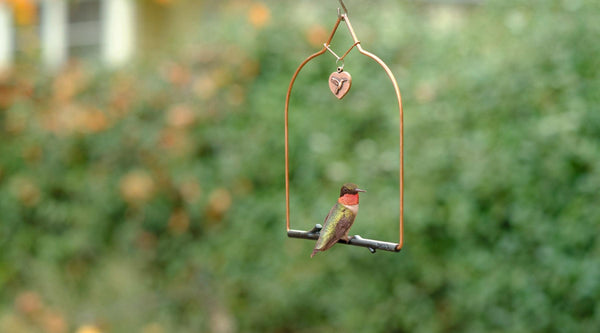
That's usually a resident claiming both the feeder and a nearby swing as its own guarded territory. A second feeder and a second swing, spaced out of sight of each other, gives another bird — Rufous heading south, or a displaced resident — its own station to guard instead of fighting over one.
Shop a second swing →August
The southbound wave, and a festival worth the drive.
| Sierra & East | Rufous at their late-summer high, moving south through the mountains. |
| Events | The Kern River Valley Hummingbird Celebration at the Audubon Kern River Preserve in Weldon — California's flagship hummingbird festival, held in early August. |
| Central Valley | Black-chinned still present and busy with second broods. |
Rufous and Black-chinned are both fueling hard for the push south, and Anna's traffic is climbing too as the summer's fledglings crowd feeders ahead of their own late-September high.
This is the month to be generous, not economical.
Birds fueling for a long flight need feeders topped up more often — the large 2lb Nectarlyte® powder or the Nectarade® liquid concentrate keeps you from running out mid-surge.


September
Anna's reach their yearly high.
| Statewide | Anna's peak for the year in late September, boosted by the summer's young. |
| Migrants | Black-chinned and Rufous both dropping away fast. |
| Late summer plants | California fuchsia is flowering when little else is — the reason to have one. |
October
The migrants finish, and the residents settle.
| Statewide | Black-chinned, Rufous and Calliope are essentially finished for the year. |
| North Coast | Migratory Allen's have gone. They won't be back until February. |
| Planting | Prime wildflower sowing window, just ahead of the winter rains. |
What to do: Leave the feeder up — this is the month people in other states put theirs away, and it's exactly the wrong move here.

This is the planting month.
Sow now and native wildflowers get the cold, moist period most varieties need to bloom reliably next spring.
Shop the Perfect Little Sanctuary® blend →November
The year turns over.
| Statewide | Anna's and resident Allen's, and very little else outside the deserts. |
| South Coast | The earliest Anna's nests can start this month. |
| Sierra & East | Feeders can come down; the season is genuinely over up there. |
December
Back to the beginning.
| Statewide | Anna's nesting season begins. Nest-building, then eggs, in the shortest days of the year. |
| Plants | Manzanita comes into flower, right on cue. |
| Deserts | Costa's returning, and chuparosa starting to bloom. |
What to do: Nothing different — which is the point. In California the feeder just stays up, gets cleaned, and gets refilled, all year round. Our winter hummingbird feeder care guide covers heated feeders and the two-feeder swap.
The Year at a Glance
| When | What |
|---|---|
| December – June | Anna's nesting season; manzanita in bloom |
| February | Migratory Allen's return to the north coast; first Rufous |
| March | Costa's breeding peak in the deserts; ocotillo bloom |
| April | Rufous peak statewide; Black-chinned arrive; Sierra season opens |
| May | Allen's peak on the coast |
| July – August | Rufous head south through the Sierra; Kern River festival |
| Late September | Anna's reach their yearly high |
| October – November | Sow wildflower seed; migrants finish |
| All year | Leave the feeder up — except the high Sierra |
Frequently Asked Questions
A few of the timing questions we hear most from fellow hummingbird lovers across California:
When do hummingbirds arrive in California?
Timing varies by species and region: migratory Allen's return to the north coast in February, Rufous begin arriving in February and peak in early April, and Black-chinned arrive in the Central Valley from March into April. Anna's and Southern California's resident Allen's never leave, so there's no "arrival" for them at all.
When do hummingbirds leave California?
Rufous finish their spring passage by the end of May and reappear briefly moving south through the Sierra in July and August. Black-chinned and Calliope wind down by October. Anna's and resident Allen's in Southern California stay year-round.
Do I need to take my hummingbird feeder down for winter in California?
No, not in most of the state. Anna's are present every month of the year and begin nesting in December, so a feeder taken down in autumn removes food from birds about to breed. The one exception is the high Sierra and eastern California, where feeders can come down once the season ends around September.
When do hummingbirds nest in California?
Anna's nesting season runs from December through June, the earliest of any US hummingbird species, timed to California's winter rains and the bloom of native plants like manzanita.
What time of year are hummingbirds most abundant in California?
Late September, when Anna's reach their statewide yearly high, boosted by the summer's fledged young.
How We Built This Calendar
The month-by-month pattern on this page comes from ten years of eBird bar chart data for California — more than four million submitted checklists — pulled statewide and from six counties chosen to represent the state's range: Humboldt for the north coast, Alameda for the Bay Area, Sacramento for the Central Valley, San Diego for the south coast, Riverside for the deserts, and Mono for the eastern Sierra, covering 2016 through 2025, then cross-checked against California Department of Fish and Wildlife guidance, the California Bird Records Committee, and published research on Anna's and Allen's range expansions. Percentages throughout describe how often a species is reported on submitted checklists, not a count of how many birds there are.
Sources
- eBird bar chart data, Cornell Lab of Ornithology — California statewide plus Humboldt, Alameda, Sacramento, San Diego, Riverside and Mono counties, 2016–2025.
- California Department of Fish and Wildlife — species life-history accounts and breeding seasons.
- California Bird Records Committee — official state checklist.
- Calscape, California Native Plant Society — native plants and bloom seasons.
- Clark, C. J. (2017). eBird records show substantial growth of the Allen's Hummingbird population in urban Southern California. The Condor, 119(1), 122–130.
- Battey, C. J. (2019). Ecological release of the Anna's Hummingbird during a northern range expansion. The American Naturalist, 194(3), 306–315.
- des Lauriers, J. R. (1994). Hummingbirds eating ashes. The Auk, 111(3), 755–756. Documents five nesting female hummingbirds eating wood ash; no males were seen doing so in that study.
- Adam, M. D., & des Lauriers, J. R. (1998). Observations of hummingbirds ingesting mineral-rich compounds. Journal of Field Ornithology, 69, 257–261. Source for hummingbirds' greatly reduced medullary bone and for the mineral-rich materials they eat.
- Werning, S. (2018). Medullary bone is phylogenetically widespread and its skeletal distribution varies by taxon. Journal of Ornithology, 159, 527–543. Source for medullary bone being confirmed in hummingbirds.
Know before they arrive
You don't have to keep this calendar taped to the fridge. Insider Birding Access members get seasonal notes timed to your region — when to have feeders out, what the birds are doing right now, and what's worth doing in your yard this season. We take the guesswork out of the calendar. Joining takes about thirty seconds, and there's 10% off your first order in it.
Join Insider Birding Access →Free to join. 10% off your first order.
Shop California's Hummingbird Favorites


Bethany Sloan has served as General Manager of Pop's Birding since 2010, continuing the legacy of her grandfather, William "Pops" Sloan, inventor of the Original Hummingbird Swing. A lifelong hummingbird enthusiast, educator, and independent researcher, she leads the company's educational content, including its 50-State Hummingbird Guide series, Regional Guide, Species Guide and Hummingbird Learning Center. Bethany combines scientific research, regional migration data, and more than 16 years of hands-on experience to create trusted educational resources for bird enthusiasts across North America.