Aug 10, 2026
Hummingbirds in Arizona: The Complete Guide to All 18 Species
Arizona and Texas trade the top two spots on this project's diversity list — Texas edges it with nineteen species to Arizona's eighteen, but the two states tell genuinely different stories. Instead of one dominant breeder and a scattering of migrants, Arizona has a true year-round resident, nine species with a real nesting season, three migrants and seasonal visitors, and six real rarities — including two documented in Arizona exactly once, decades apart, and never recorded anywhere in the country since.
This guide sorts out which is which: the one species you'll find in any month, the nine that nest here, the three migrants and seasonal visitors worth knowing by name, and the six genuine rarities. For feeder setup, native plants, and pest-safe care, see our how-to-attract guide. For exact timing by region, see the Arizona hummingbird calendar.
Free download
All 18 Arizona Hummingbirds, One Page
Every species on this page, pictured and grouped by tier — Year-Round Resident, Breeding, Migrants & Seasonal Visitors, and the six rarities — on one printable page.
Download all 18 Arizona hummingbirds (PDF)One page · PDF · free to print and share

Species grouped by confirmed breeding evidence and committee record history — statewide eBird data (2016–2025) cross-checked against the Arizona Bird Committee's own checklist and published record reports, not raw sighting counts alone.
Year-Round Resident: Arizona's One True Homebody
Only one Arizona hummingbird holds a genuine year-round population, confirmed as a breeder by the Arizona Bird Committee's own checklist — not just a species with year-round eBird presence.
Anna's Hummingbird Resident
Arizona's single most common hummingbird, and it isn't close — present in every week of the year, statewide, from the low desert to high-elevation Flagstaff, though at much lower numbers there. Arizona State Parks calls it simply "one of the most common species encountered in the state." The Arizona-Sonora Desert Museum notes the first confirmed Arizona nesting was in 1962, and that "since the 1960s the number of fall and winter visitors to Arizona has increased greatly, as has the number of breeding birds" — a real, documented population and range expansion, not just improved detection. In Tucson, birds have been recorded nesting as early as December.
Quick ID: Adult male shows an iridescent rose-red crown and throat together — the only U.S. hummingbird with color on the crown itself. Female and immature are green above with a paler throat, sometimes showing a few red flecks.

Breeding: Nine Species With a Real Nesting Season Here
Nine species carry the Arizona Bird Committee's own "has bred in Arizona" annotation — genuine breeders, not just passing migrants. Four are widespread enough to be everyday backyard birds across much of the state; five are true Sky Island specialties, concentrated in the oak-and-pine canyons of the Huachuca, Chiricahua, and Santa Rita Mountains in the far southeast.
Black-chinned Hummingbird Breeds Here
One of the most adaptable hummingbirds in the country, found from high mountain meadows down into the low desert. The Arizona-Sonora Desert Museum calls it plainly "the summer hummer in southern Arizona," breeding from April through July. Genuinely seasonal — completely absent in winter statewide, then arriving fast every spring and common through September.
Quick ID: Adult male shows a velvety black throat with a thin band of violet-purple that only flashes in direct light. Female and immature are plain whitish below, very similar to female Ruby-throated.

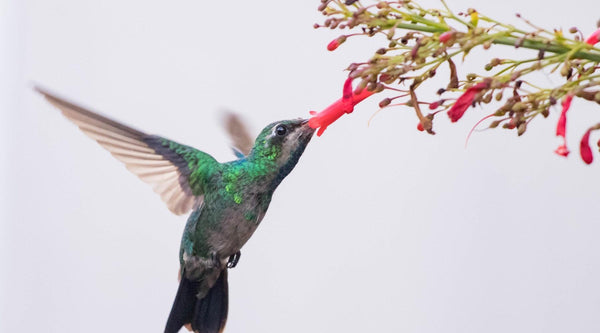
Broad-billed Hummingbird Breeds Here
An Arizona specialty most common in oak-studded canyons of the southeast, and genuinely one of the state's top species overall — but nearly absent from the Phoenix area and essentially unrecorded near Flagstaff. A genuine breeder here, not the year-round resident it's sometimes described as: Tucson Audubon's own regional checklist codes confirm the seasonal breeding pattern rather than a stable twelve-month population.
Quick ID: Adult male is unmistakable, with an orangish-red bill tipped in black and an iridescent blue-green throat and body. Female is duller, grayish below with a more subdued bill color.

Costa's Hummingbird Breeds Here
A true desert specialist, common around Phoenix, Tucson, and the Kofa National Wildlife Refuge. Unlike most other Arizona species, Costa's genuine statewide peak comes in March, not summer or fall — it times its nesting to the desert's earliest bloom, then largely disperses by early summer. Tucson Audubon's own regional checklist codes it common in winter and spring, but only uncommon and local as a summer breeder — a real seasonal breeder, not a stable year-round population.
Quick ID: Adult male has a dramatic, flared iridescent purple crown and throat that extends out past the head like a mustache. Female is green above with a clean whitish throat.

Broad-tailed Hummingbird Breeds Here
Arizona's high-elevation breeder — found in mountain ranges across the state, not just the southeast, typically between 5,000 and 10,500 feet. The Arizona Breeding Bird Atlas found 72% of confirmed nesting in areas containing at least some pinyon or ponderosa pine, consistent with this species' confirmed high-elevation pattern in every other mountain state this project has covered.
Quick ID: Adult male produces a distinctive high-pitched, insect-like trill with its wings in flight — often the first sign one's nearby, before it's even visible — and shows an iridescent rose-magenta throat. Female lacks the trill and the throat color, showing a plain whitish throat with fine dark spotting and warm cinnamon-buff flanks.

Five more species are true Sky Island specialties — real, committee-confirmed breeders, but concentrated almost entirely in the southeastern mountain canyons rather than found statewide.
Rivoli's Hummingbird (formerly Magnificent Hummingbird) Breeds Here
One of the largest hummingbirds in the country, and genuinely common within its limited southeastern range despite its size. Audubon's own field guide describes it as a summer resident that "probably migrat[es] only a short distance south into Mexico for the winter," occasionally lingering at Arizona feeders into the colder months without becoming a true year-round population.
Quick ID: Adult male is dark overall with a glittering green throat and a violet crown visible in good light. Female is green above and grayish below, notably larger than most other Arizona species.

Violet-crowned Hummingbird Breeds Here
Genuinely distinctive and easy to identify even at a distance: a clean white throat and belly, unusual for a hummingbird, paired with a shining violet-blue crown and a red bill with a black tip. Tucson Bird Alliance describes it as "a regular low-density breeder in the state" — historically a summer-only resident, though small numbers have started lingering into winter in recent decades.
Quick ID: Sexes look alike — both show the same white underparts and violet crown, an uncommon trait among North American hummingbirds.

Blue-throated Mountain-gem Breeds Here
Genuinely one of the largest hummingbirds found in the United States, and rarely found below 4,300 feet. Cave Creek Canyon in the Chiricahuas is regularly cited as one of the best sites in the country to find one.
Quick ID: Adult male shows a striking, solid blue throat patch bordered by white facial stripes. Female lacks the blue throat but shares the same bold white eye-stripe and large size, which alone helps separate this species from nearly everything else in the state.

Lucifer Hummingbird Breeds Here
A genuine Chihuahuan Desert specialist, reaching the United States only in extreme southern Arizona, New Mexico, and west Texas — a bird most avid birders travel specifically to see. Best-found sites are Ash Canyon in the Huachucas and the area near Portal, in desert-foothill habitat with agave and ocotillo.
Quick ID: Adult male shows a dramatic, flared magenta-purple gorget and a distinctly curved bill, with a deeply forked tail characteristic of the "sheartail" hummingbird group. Female lacks the gorget but shares the same curved bill.

White-eared Hummingbird Breeds Here
A genuine, if sparse, local breeder — Arizona Field Ornithologists describe it as "a rare summer resident in the mountains of southeastern Arizona," with breeding documented before, regularly at Ash Canyon B&B and Miller Canyon in the Huachuca Mountains.
Quick ID: Named for its most reliable field mark — a bold white stripe behind the eye, visible on both sexes. Adult male adds a striking violet-blue crown and throat, with a red bill tipped in black. Female is duller but keeps the diagnostic white ear stripe and red-based bill.


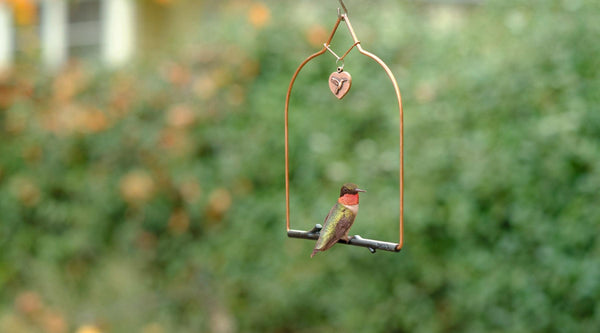
A Little Throne for Your Breeding Season Regulars
Nine species stake out Arizona territory each nesting season, from widespread desert breeders to the Sky Island specialties tucked into southeastern canyons. A stable perch gives a holding bird somewhere to watch from besides your feeder port.
Shop Charm Redwood Swing →Ruby-throated vs. Black-chinned: Where Identification Actually Breaks Down
Adult male Ruby-throated and Black-chinned Hummingbirds are usually easy to tell apart in good light — one shows a red gorget, the other a black one edged in violet-purple. But females and immatures of the two species are close to identical in the field. The one reliable field mark on a perched bird is wing-to-tail proportions — Ruby-throated has a longer tail that extends visibly past the wingtips at rest, while Black-chinned has longer wings that reach the tip of the tail or extend just slightly beyond it. Some birders also watch for tail-pumping: Black-chinned habitually pumps its tail while hovering, Ruby-throated tends to hold its tail still.
Given that Ruby-throated is one of Arizona's genuine rarities (see below), an unusual-looking female hummingbird here is genuinely worth a second look — even though Black-chinned remains the far more likely explanation by a wide margin.

Migrants and Seasonal Visitors
Three species pass through or visit Arizona seasonally without ever nesting here — genuine, repeatable patterns, just not a breeding presence. None of the three is really a winter bird, despite sharing this project's standard tier label with states where "winter visitor" fits better.
Rufous Hummingbird Migrant
Not a breeder here, but a reliable traveler with a genuine double season: a smaller spring passage in March and April, then a much bigger surge from July through October as birds head south from Pacific Northwest breeding grounds. A peer-reviewed USFS study of southeastern Arizona hummingbird migration found Rufous among "the most abundant species" in a massive southbound fall migration, predominantly juveniles.
Quick ID: Adult male is unmistakable — fiery coppery-orange overall with an iridescent orange-red throat — and famously aggressive, chasing off other hummingbirds regardless of size difference. Female and immature are trickier: green-backed above, with rufous-washed flanks and a rusty patch at the base of the tail.

Calliope Hummingbird Migrant
The smallest breeding bird in the United States — though it doesn't breed in Arizona, only passes through. The Arizona Bird Committee's own checklist confirms this: Calliope carries no "has bred here" annotation, unlike Arizona's four confirmed breeders. A genuine bimodal migrant, with a real spring build in April and a fall peak July through September, and essentially nothing in true winter.
Quick ID: Adult male has a truly unique field mark — a gorget of magenta streaks radiating out from the throat like a starburst, a pattern no other North American hummingbird shows. Female and immature are far plainer: green above, peachy-washed underparts, with fine dark stippling on the throat rather than solid color.

Plain-capped Starthroat Migrant
Worth being precise about this one: it's a summer visitor, essentially absent in true winter — Arizona Field Ornithologists describe it as "a casual to rare late spring and summer visitor to Arizona," with records running May through October. The Arizona Bird Committee discontinued formal review of this species at the end of 2013 because it had become regular enough not to need it, and individual birds have returned to the same sites across multiple years — a banded Ash Canyon bird was present in both 2002 and again in 2003.
Quick ID: A genuinely rare, large, and unusually drab hummingbird for the family — the "glistening red throat" is often the only real splash of color, and even that can appear blackish in poor light. Look instead for the reliable marks: a very long, straight black bill, a bold white stripe behind the eye, a broad white "mustache," and a white patch above the rump. Sexes look similar. Unlike most hummingbirds, it spends much of its time flycatching for insects from high, exposed perches rather than working flowers.

Rufous vs. Allen's: A Problem Even Banders Struggle With
This is Arizona's hardest identification call. Adult male Allen's Hummingbird can be told from Rufous by a solid green back with no rufous feathering at all — if a bird shows any solid-rufous feathers on its back, it is not an Allen's. Beyond that one clean field mark, it gets genuinely difficult: females and immatures of the two species are, per Audubon's own field guide, "almost impossible to separate... without close examination." Reliable separation of the two typically requires a bird in hand and a licensed bander measuring specific feather and wing dimensions — not something achievable from a photo alone. If you're hosting an unusually orange hummingbird this fall, the honest answer to "which one is it" is often "we won't know for certain unless someone bands it."

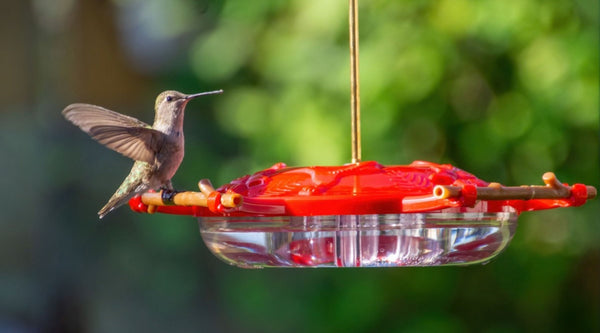
An Extra Feeder for Your Passing Migrants
Rufous is famously aggressive at a feeder, and Arizona's fall surge brings a lot of them through at once alongside Calliope and the summer-only Plain-capped Starthroat. A second station spread across the yard gives each visitor room instead of one dominant bird claiming the whole supply.
Shop AspenPerch Feeder →The Rarities
Six more species round out Arizona's official list of eighteen — all real, Arizona Bird Committee-accepted records, ranging from a genuine recurring pattern down to a single one-time event, in two cases over a century old and never repeated.
Allen's Hummingbird Rare / Casual Visitor
Arizona's official checklist carries no asterisk and no "has bred here" mark for Allen's — a genuine migrant that occurs regularly enough to sit off the review list without ever being a breeder or resident. Uncommon each fall (July) through the mountains of south-central Arizona, and very rare during early spring passage along the Lower Colorado River. A real, recurring pattern, not a single isolated record — see the identification note above for why confirming one is so difficult.
Quick ID: Adult male shows a bronze-green back against a coppery tail and belly. Female and immature are nearly identical to female and immature Rufous — the only usable field mark is the width of the outer tail feathers, and even that typically needs a bird in the hand to confirm.

Berylline Hummingbird Rare / Casual Visitor
The Arizona Bird Committee's own checklist carries a "has bred in Arizona" annotation for Berylline, and the committee removed it from the formal Review List back in 2008 specifically because it had "become more regular in the state" — genuinely rare, but a real, recurring summer visitor rather than a one-off, with confirmed Arizona breeding on record. Tucson Audubon codes it "rare, summer" in its own regional checklist.
Quick ID: An overall coppery-green species best identified by its wings and tail: rich rufous patches on the wings and a rufous-edged tail, visible even when the bird is perched. Both sexes look broadly similar.

Ruby-throated Hummingbird Rare / Casual Visitor
Common practically everywhere else east of the Rockies — it's the only hummingbird that breeds anywhere in the eastern half of the country. In Arizona, that same bird is the genuine outlier: the Arizona Bird Committee has accepted just 8 records total, the first a wintering female in Tucson (Dec 2004–Apr 2005) and the most recent an adult male at Hassayampa River Preserve near Wickenburg in July 2018. A real, if thin, recurring pattern — not a single historic fluke, but still genuinely rare enough that the committee requires documentation for every report.
Quick ID: Adult male shows the familiar red gorget. Female has a plain whitish throat, essentially identical to female Black-chinned. If you're confident you're looking at a Ruby-throated in Arizona, a photo and a report are genuinely worth the effort.

Bumblebee Hummingbird Historic / Accidental
Arizona's oldest hummingbird record, and one of only two collecting events ever documented in the country. Collector Harry Rising took two specimens in the Huachuca Mountains on consecutive days in 1896 — an adult female in Miller Canyon on June 29, and an immature female the next day in a side canyon of Ramsey Canyon, both now housed in museum collections (the adult at the Smithsonian, the immature at UC Berkeley's Museum of Vertebrate Zoology). Neither the species nor any close look-alike has been documented in the United States since. A genuine one-time historic event, not an under-detected pattern.
Quick ID: North America's smallest possible vagrant hummingbird — tiny even by hummingbird standards, with a short bill and a notably short tail for the group. Not expected on any Arizona feeder; if you think you've found one, the identification bar is high given how long it's been since the last confirmed record.

Cinnamon Hummingbird Historic / Accidental
Arizona's most recent one-time record: a single bird at the well-known Paton residence in Patagonia, Santa Cruz County, in July 1992 — the first-ever United States record of the species. Only one other U.S. record exists anywhere, a different individual in New Mexico the following year, an unrelated sighting in a different state. Nothing has been recorded in Arizona since.
Quick ID: A stocky, cinnamon-orange hummingbird overall, with a mostly straight, mostly red bill and a rounded, rufous-orange tail. Sexes look broadly similar. Not expected — the entire U.S. record for this species is two birds, ever.

Give Every Visitor a Reason to Stay
Whether it's a genuine recurring rarity like Allen's and Berylline or the kind of once-in-a-century record Bumblebee and Cinnamon represent, real nectar sources and a boost of electrolytes beyond plain sugar water give any visitor more reason to stick around your yard.


Arizona Hummingbirds at a Glance

Statewide peak weekly frequency, eBird checklist data, 2016–2025. Also documented but too rare to chart reliably: Allen's, Berylline, Bumblebee, Cinnamon, Lucifer, Plain-capped Starthroat, Rivoli's, Violet-crowned, and White-eared Hummingbird.
| Species | Status in Arizona | Best Chance |
|---|---|---|
| Anna's | Year-Round Resident | Any month, statewide — most common species |
| Black-chinned, Broad-billed, Broad-tailed, Costa's |
Breeding — widespread | Spring through fall, statewide or low desert |
| Blue-throated Mountain-gem, Lucifer, Rivoli's, Violet-crowned, White-eared |
Breeding — Sky Island specialty | Spring through fall, southeastern mountain canyons only |
| Rufous, Calliope | Migrant | Spring and/or fall passage; no real winter presence |
| Plain-capped Starthroat | Migrant | May–October only — a summer bird, not a winter one |
| Allen's, Berylline, Ruby-throated |
Rare — real recurring pattern | A real if infrequent possibility, mostly southeast AZ |
| Bumblebee, Cinnamon | Rare — single historic record | Not expected — one-time events, 1896 and 1992 |
Frequently Asked Questions
How many species of hummingbirds are in Arizona?
Eighteen species are on Arizona's official checklist, per the Arizona Bird Committee — the second-most of any U.S. state, just behind Texas's nineteen. One (Anna's) is a true year-round resident, nine have a confirmed nesting season, three are migrants or seasonal visitors, and six are genuine rarities, two of them historic one-time records.
What is the most common hummingbird in Arizona?
Anna's Hummingbird, by a wide margin. It's present in every week of the year, statewide, from the low desert to high-elevation Flagstaff, and Arizona State Parks describes it as simply "one of the most common species encountered in the state."
Is Ruby-throated Hummingbird rare in Arizona?
Yes, genuinely. Ruby-throated is common practically everywhere else east of the Rockies, but in Arizona the Arizona Bird Committee has accepted only 8 records total, most recently in 2018 — a real reversal from its status almost anywhere else in the country.
What is the rarest hummingbird in Arizona?
Bumblebee Hummingbird and Cinnamon Hummingbird are tied for rarest — each documented in Arizona exactly once, in 1896 and 1992 respectively, and never recorded in the country again since either sighting.
How do I tell Ruby-throated and Black-chinned Hummingbirds apart?
Adult males are the easy case: Ruby-throated shows a red gorget, Black-chinned shows a black throat with a thin violet-purple band at the base. Females and young are effectively inseparable in the field — wing-to-tail proportions are the one useful field mark.
How do I tell Rufous and Allen's Hummingbirds apart?
Reliably? Often you can't, without a bander in hand. The one usable field mark is the back: adult male Allen's shows a solid green back with no rufous feathering, while any bird with solid-rufous back feathers is a Rufous, not an Allen's. Beyond that mark, females and immatures of the two species are nearly identical in the field.
For feeder setup, nectar ratios, and native plants that support these species, head back to our how-to-attract-hummingbirds-in-Arizona guide. For region-by-region arrival and departure windows, see the Arizona hummingbird calendar.
Why We Created This Guide
Pop's Birding has been helping hummingbird lovers for three generations. One of the questions our customers ask most often is "what hummingbirds are actually in Arizona?" — we built this guide to give a direct, sourced answer, not a generic one. Arizona has the second-longest official hummingbird list of any U.S. state, but the number alone doesn't tell you which birds you'll actually see versus which ones were once-in-a-century events. Those are genuinely different questions, and Arizona's own committee records give real, different answers for each species — including two, Bumblebee and Cinnamon Hummingbird, documented exactly once each and never seen in the country since.
How We Created This Guide
Every classification on this page starts from the Arizona Bird Committee's own official checklist and published record reports rather than eBird checklist counts alone, because Arizona's eBird weekly data carries a documented scaling problem — even the state's highest-peak species shows an implausible sub-1% frequency versus 20 to 60% for comparable species in neighboring states. That bug had previously led two species, Broad-billed and Costa's Hummingbird, to be misclassified here as Year-Round Residents; both are corrected to Breeding, confirmed instead against Tucson Audubon's own regional checklist codes and published breeding accounts. Because of that scaling issue, only species with real, chartable statewide signal are plotted on the frequency chart, and the Sky Island breeding specialties and six rarities that don't clear that bar are named directly in the chart's caption rather than left off silently — and within the Rare tier, genuine recurring visitors like Allen's and Berylline's are distinguished from true single-event records like Bumblebee's and Cinnamon's by checking each species individually against the Committee's accepted-record history.
Sources
- eBird bar chart data, Cornell Lab of Ornithology — Arizona statewide, 2016–2025.
- Arizona Bird Committee. Source for official species status, breeding annotations, and every rare-species record count on this page.
- Tucson Audubon Society / Tucson Bird Alliance. Source for regional status codes and site detail (Berylline, Broad-billed, Costa's, Blue-throated Mountain-gem).
- Arizona Field Ornithologists, Arizona Birds journal. Source for Plain-capped Starthroat's and White-eared Hummingbird's seasonal status.
- Audubon Field Guide. Source for the female/immature Rufous-Allen's identification difficulty and Rivoli's seasonal pattern.
- Arizona State Parks, Arizona Hummingbirds. Source for Anna's abundance framing.
Know before they arrive
You don't have to keep this calendar taped to the fridge. Insider Birding Access members get seasonal notes timed to your region — when to have feeders out, what the birds are doing right now, and what's worth doing in your yard this season. We take the guesswork out of the calendar. Joining takes about thirty seconds, and there's 10% off your first order in it.
Join Insider Birding Access →Free to join. 10% off your first order.
Shop Arizona's Hummingbird Favorites


Bethany Sloan has served as General Manager of Pop's Birding since 2010, continuing the legacy of her grandfather, William "Pops" Sloan, inventor of the Original Hummingbird Swing. A lifelong hummingbird enthusiast, educator, and independent researcher, she leads the company's educational content, including its 50-State Hummingbird Guide series, Regional Guide, Species Guide and Hummingbird Learning Center. Bethany combines scientific research, regional migration data, and more than 16 years of hands-on experience to create trusted educational resources for bird enthusiasts across North America.